
8×8 vs Vonage
UK business VoIP comparison: pricing signals, feature fit, CRM workflows, analytics, and international calling
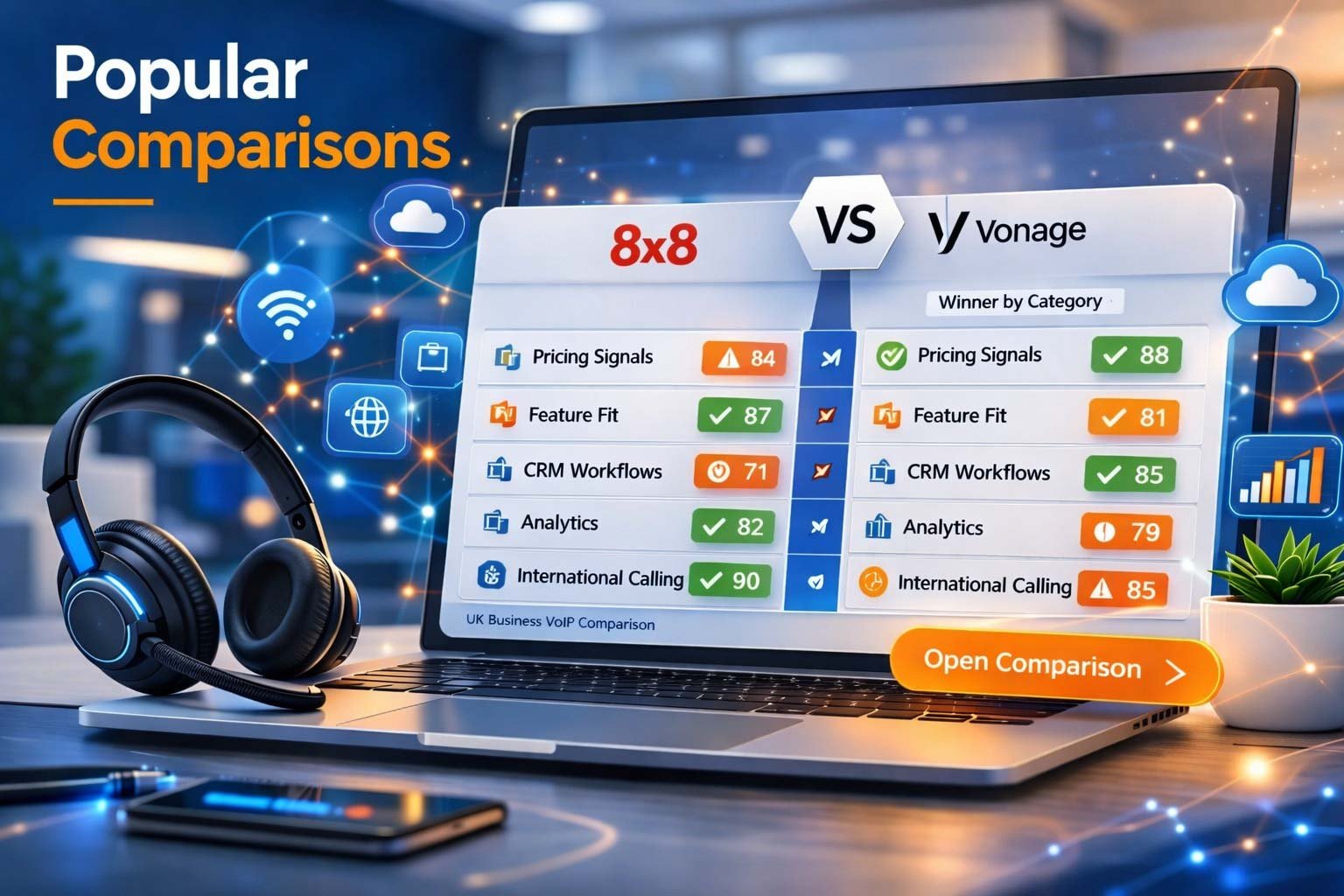
8×8 and Vonage both work well for UK businesses, but they win for different reasons. In this comparison we keep the decision practical: the pricing signals that typically drive totals, the six feature categories that matter most in day-to-day operations, and a dedicated international calling section (because that’s where the difference can be decisive). The result is a clean head-to-head with winners per category, plus clear recommendations by use case.
Quick outcome
Overall: Tie
for many UK businesses. Pick
8×8
if international calling and analytics maturity are core. Pick
Vonage
if CRM workflows and commercial flexibility are the priority.
Quick Winner Summary Table
If you want the shortest answer: this is a tie unless your business has a strong “international calling” requirement (8×8), or a strong “CRM-led workflow” requirement (Vonage). Use the winners table below to map the providers to your real use case.
| Decision category | Winner | Why it wins (UK buyer lens) |
|---|---|---|
| Overall for UK businesses | Tie | Both can cover core VoIP needs (numbers, routing, apps, admin). The better choice depends on your operating model: international footprint, reporting depth, and whether your phone system must “live inside the CRM”. |
| Entry pricing signal | 8×8 | From £6.40 vs Vonage from £12 (entry signals). Real totals depend on licences, calling bundles, add-ons, and what you actually need after go-live (“Day 90 config”). |
| International calling & multi-country posture | 8×8 | Stronger fit when international calling patterns, multi-country teams, or consistent global calling policies are central to your operation. If international spend is material, 8×8 is usually easier to justify. |
| CRM-led workflows (click-to-call, logging, automation) | Vonage | Stronger fit when the phone system must behave like an extension of sales/service operations: call logging, contact matching, and CRM workflow automation as a first-class requirement. |
| Analytics / operational visibility | 8×8 | Stronger fit when reporting and operational insight are core (missed calls, queues, performance visibility, exports). This matters for service-driven UK businesses where visibility prevents churn. |
| Commercial flexibility / packaging choices | Vonage | Stronger fit when you want flexibility in how you package features, licences, add-ons, and how you grow into the platform. Better when you expect your requirements to change quarter-to-quarter. |
Decide the “anchor requirement” first: international footprint (lean 8×8) or CRM-led operations (lean Vonage). Then validate your Day 90 configuration: call flows, reporting needs, licences, and any add-ons that become mandatory after go-live.
8×8 is the safer choice
If your business has recurring international calling, multi-country teams, or a need for consistent global calling policies, 8×8 tends to win because the international posture is easier to operationalise and justify financially.
Vonage is the safer choice
If your phone system is mainly a sales/service tool (logging, automation, CRM-linked workflows), Vonage tends to win because the operational success depends more on CRM outcomes than pure telephony.
Pricing Comparison
Pricing comparisons fail when they stop at “per user per month”. The real total changes with licence mix, calling bundles, add-ons, and how quickly you grow into advanced routing, recording policies, analytics, or CRM integration depth.
Price signal vs total cost of ownership
In your brief, 8×8 starts from £6.40 while Vonage starts from £12. Treat these as entry signals. Your real total is shaped by what you need to run your business safely after go-live: reporting depth, integration behaviour, international minutes, and whether advanced workflows become non-negotiable.
| Cost driver | 8×8 | Vonage | UK buyer guidance |
|---|---|---|---|
| Entry pricing signal | From £6.40 (entry signal) | From £12 (entry signal) | Always price “Day 90 config”, not the starter tier. |
| International spend | Often easier to justify when international calling is frequent. | Can work well; validate how international calling is packaged for your pattern. | Model your typical destinations and volumes, not an “average month”. |
| CRM-driven value | Validate call logging and workflow alignment with your CRM stack. | Often a strong fit when CRM workflow is the main value driver. | Test workflow end-to-end: click-to-call, logging, recording links, contact match. |
| Analytics depth | Typically strong when you need operational reporting and visibility. | Works well; validate reporting depth at your chosen tier. | List the reports you must have (queues, missed calls, service levels, exports). |
| Commercial flexibility | Validate how you add features over time and how it affects totals. | Often stronger flexibility in packaging and evolving requirements. | Confirm what changes cost mid-contract and what requires tier upgrades. |
Ask both providers for an itemised quote: licences, numbers, calling bundles, add-ons, support level, and any implementation services. Then run the same assumptions through the savings calculator to pressure-test which drivers actually move your total.

Model your Day 90 setup
Don’t price the system you buy. Price the system you will actually use after go-live.
Feature-By-Feature Comparison
These six categories cover what UK teams actually feel: call flow control, admin governance, CRM workflow fit, analytics/reporting, collaboration experience, and the flexibility to adapt without rebuilding your setup.
| Category | 8×8 | Vonage | Winner + how to validate |
|---|---|---|---|
| 1) Core calling & routing | Strong core calling, routing, and multi-team operations; validate your exact IVR/queue pattern. | Strong core calling and routing; validate speed of change control and how admins manage day-to-day. |
Tie Run a demo of your real call flow: main number → IVR → queue → overflow → voicemail → out-of-hours. |
| 2) Admin governance | Strong for teams that want controlled administration and consistent policy across users and sites. | Strong; validate role boundaries, auditability, and how changes are applied and tracked. |
Tie Validate: role-based access, change logs, and how quickly you can roll back routing mistakes. |
| 3) CRM workflows | Works well; validate your CRM workflow end-to-end (contact match + call logging accuracy). | Often stronger for CRM-first operations: click-to-call, logging, and sales/service workflow alignment. |
Vonage Validate workflow: click-to-call, auto logging, recording links, disposition notes, and mobile behaviour. |
| 4) Analytics & reporting | Typically stronger for operational visibility: missed calls, queues, service-level insight, exports. | Solid; validate which reports are available at your tier and how exports integrate with ops reporting. |
8×8 Validate the top 10 reports you need, and whether supervisors can act without IT. |
| 5) Collaboration experience | Strong general UC posture; validate adoption by field staff and mobile-heavy teams. | Strong; validate user experience, provisioning, and how quickly users can be managed at scale. |
Tie Pilot with 10–20 users (sales + ops + reception). Measure adoption and admin workload. |
| 6) Flexibility to evolve | Flexible; validate how feature changes affect licensing and your total cost over time. | Often stronger flexibility in packaging and evolving requirements as your workflows change. |
Vonage Validate: what upgrades cost, what can be added mid-term, and what requires a tier shift. |
If you’re choosing based on what most impacts UK operations, the decision hinges on two anchors: international calling + analytics (8×8) versus CRM-led workflow + commercial flexibility (Vonage). Core calling is strong on both, so validate the “edge case” workflows where issues show up in real life.
International Calling Comparison
This is the decisive section for many UK businesses. If you sell, support, or operate internationally, international calling policy and cost control matter. In your brief, 8×8 is the winner for international.
When “international” becomes a core requirement
International spend is rarely “random”. UK businesses usually have predictable calling patterns: a small set of countries, peak times, and teams that call abroad daily. If that’s you, you should evaluate international calling as a first-class requirement: policy control, visibility, and how you manage costs without blocking productivity.
UK decision rule
If international calling is recurring and material, choose the platform that makes it easy to control, report, and explain. The financial win is not only lower minutes—it’s avoiding surprise spend and reducing admin overhead.
| International dimension | 8×8 | Vonage | Winner + validation |
|---|---|---|---|
| Best fit for international-heavy teams | Designed to be strong when international calling is a core requirement. | Can support international calling; validate packaging and reporting for your destinations. | 8×8 Validate your top 10 destinations. |
| International cost governance | Typically strong governance posture for monitoring and controlling international use. | Works well; validate admin controls and reporting depth in your tier. | 8×8 Validate reporting and policy controls. |
| Operational reporting | Often stronger analytics visibility for international patterns. | Solid; validate exports and supervisor visibility. | 8×8 Validate “who called where” reporting. |
| International + CRM workflow blend | Works well; validate CRM call logging under international usage patterns. | Often strong CRM fit; validate how international activity is logged and audited in CRM. | Depends Run real workflows with real contacts. |
Bring a list of your most-called countries, expected monthly minutes, and which teams dial internationally. Then validate: (1) calling bundles, (2) reporting, (3) policy controls, (4) how quickly you can adjust access, and (5) how international calls are logged for sales/service accountability.
International changes everything
If international is core, choose the platform that reduces governance effort while keeping spend predictable.
Best For Each Provider
Use these recommendations to map 8×8 and Vonage to real UK operating models. The best provider is the one that matches your day-to-day decision-making: international governance versus CRM-led productivity.
8×8
8×8 is the best choice when international calling and analytics are core decision drivers. It suits UK businesses that need multi-country calling posture, strong operational visibility, and structured governance so international spend stays predictable.
Validate
Confirm how international calling is packaged for your destinations, the reports you need (queues/missed calls/exports), and whether admin controls match your internal governance requirements.
Vonage
Vonage is the best choice when CRM-led operations and commercial flexibility are the priority. It suits UK businesses that measure telephony value in sales/service workflows: click-to-call, accurate logging, and a platform that can evolve with changing requirements.
Validate
Run real CRM workflows in a pilot: contact match accuracy, call logging behaviour, recording links, and mobile usage. If international calling is important, validate how it’s packaged and reported.
Shortlist properly
If you’re not sure these are your final two, use the quiz to shortlist based on workflow and constraints.
Final Verdict
8×8 vs Vonage is a tie for many UK businesses because both cover core VoIP well. The decision becomes clear when you anchor on international calling posture (8×8) or CRM-led workflow outcomes and flexibility (Vonage).
International posture + analytics-driven operations
Choose 8×8 when international calling and operational visibility are core. If global calling patterns materially impact spend and governance, 8×8 is often the cleaner decision because it supports policy control, reporting, and predictable international operations.
CRM-led workflows + commercial flexibility
Choose Vonage when your phone system must behave like an extension of the CRM: logging accuracy, automation, and sales/service throughput. If your requirements evolve frequently and you want flexibility, Vonage is often the better fit.
Before signing: (1) validate your real call flow (IVR/queues/overflow), (2) test CRM workflow end-to-end with real contacts, (3) list your required reports and exports, (4) model international destinations and minutes, (5) price the Day 90 configuration (licences + add-ons), and (6) confirm how changes are governed in live operations.
FAQs
Quick answers to the questions UK buyers ask most when comparing 8×8 and Vonage.
Validate your shortlist with cost signals
Use the savings calculator to model totals, then use the quiz if you need a fit-based shortlist beyond 8×8 and Vonage.