
BT vs RingCentral
UK business VoIP comparison: cost signals, features, support, integrations, and fit
This BT vs RingCentral comparison is designed for UK businesses that already have a shortlist and want a clean, head-to-head decision. We focus on what changes outcomes in the real world: pricing signals (not just list price), call handling and administration, UK support posture, integrations, and readiness planning for continuity.
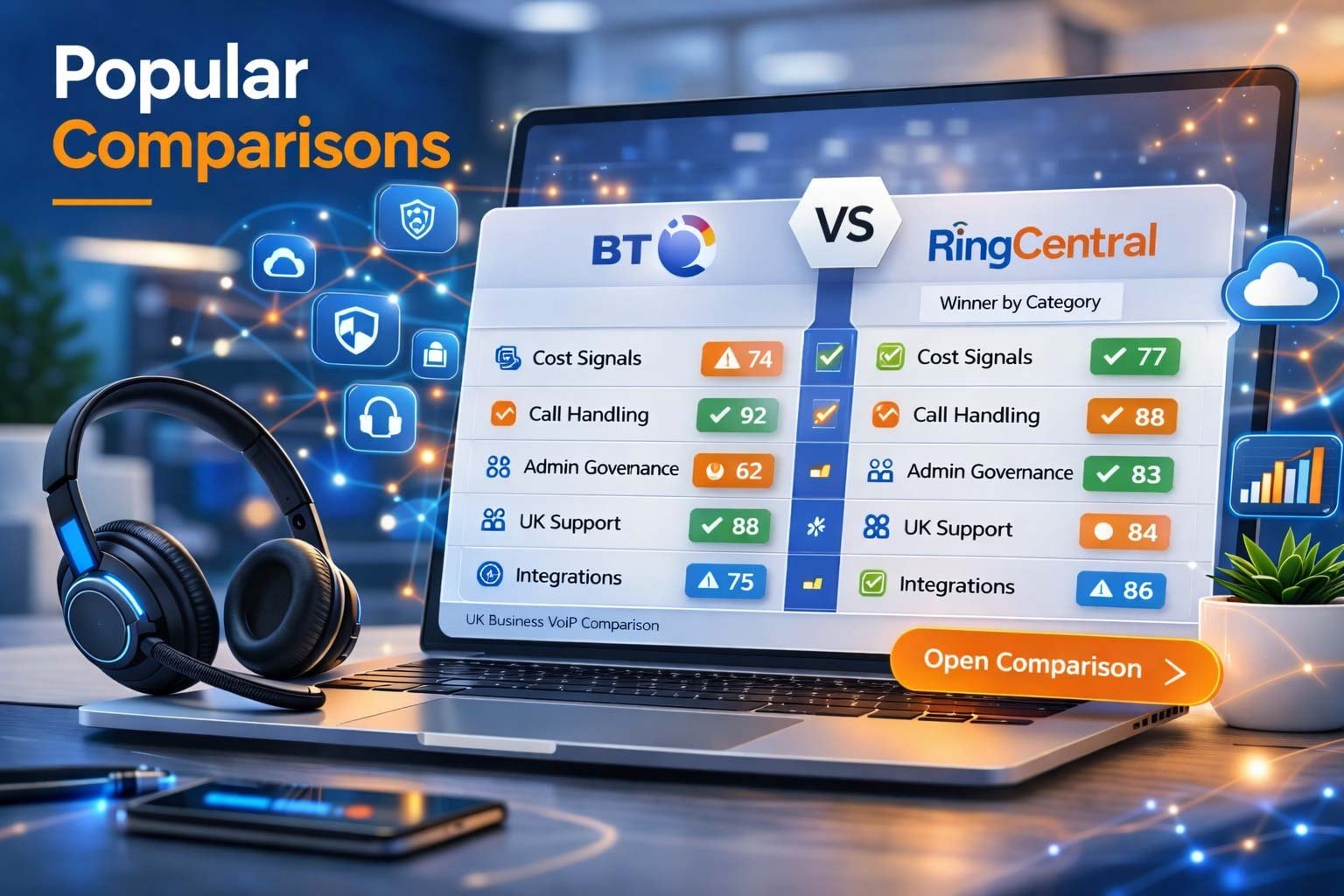
Quick outcome
RingCentral wins for features, price signals, and innovation headroom. BT wins where UK presence, familiarity, and a BT-led operational posture are the priority.
Quick Summary Table
If you want the fastest answer: RingCentral is the stronger default for most UK businesses choosing a modern VoIP platform. BT becomes the better fit when UK presence and a BT-led delivery model is the deciding factor.
| Decision category | Winner | Why it wins (UK buyer lens) |
|---|---|---|
| Overall for most UK businesses | RingCentral | Strong feature depth and administrative headroom, with cost signals that can start lower when you only need core seats. Best when you want a modern VoIP platform that can scale with workflows, integrations, and governance needs. |
| Entry pricing signal | RingCentral | From £12.99 (published entry signal) versus BT from £19.99. These are starting points: totals depend on your licence mix, calling bundles, devices, and any add-ons you need for reporting, recording, or advanced routing. |
| Features coverage and headroom | RingCentral | More “room to grow” without switching platforms: deeper workflows, larger app ecosystem expectations, and broader capability headroom when teams expand or requirements tighten. |
| Innovation and roadmap headroom | RingCentral | Better suited when you want to modernise operations over time (multi-site governance, integrations, analytics maturity, and continuous feature evolution). |
| UK presence and familiarity | BT | Strong fit when UK presence is part of your internal decision rule: procurement preference, supplier consolidation, and expectation of a UK-led operating posture. |
| Best “safe choice” for UK contact routing changes | Depends | If you want maximum admin control and internal self-serve changes, RingCentral is usually easier to run day-to-day. If you want a more supplier-led operational model with UK presence as the anchor, BT can be preferred. |
Decide your operating model first, then price it. If you want internal control, fast changes, and broad feature headroom—lean RingCentral. If your organisation values UK presence and supplier consolidation above feature depth—lean BT. Then validate the real total with the VoIP savings calculator.
Choose the platform that matches how you will run it
If you expect IT/admin teams to own routing, reporting, and policy control internally, pick the platform with the strongest self-serve administration and documentation. If you expect supplier-led delivery and a “known UK supplier” posture, weight UK presence more heavily.
Model the “Day 90” configuration, not the entry tier
Entry prices are useful signals, but most UK businesses outgrow the smallest tier quickly. Price the system as it will be used after go-live: call flows, reporting, recording policies, and integrations.
Pricing Comparison
Pricing changes with contract terms and add-ons. This section focuses on pricing signals—what drives the total for a UK business, and where BT and RingCentral typically diverge in cost behaviour.
Headline pricing vs real operating cost
BT and RingCentral can both look “competitive” on a quote—but they often become expensive for different reasons. The goal is to predict your likely total cost before you sign: licences, numbers, calling bundles, handsets, support level, and anything you need for reporting, recording, or advanced routing.
| Cost driver | BT | RingCentral | What to validate |
|---|---|---|---|
| Entry pricing signal | From £19.99 (starting signal) | From £12.99 (starting signal) | Inclusions at entry level vs exclusions. |
| Licence mix | Validate staff feature needs vs basic seats. | Easier mixed-licence modeling for teams. | Who needs advanced recording/reporting. |
| Numbers + sites | Strong UK presence and simplicity. | Advanced multi-site routing controls. | Porting lead times and location fees. |
| Implementation | Supplier-led delivery model. | Internal control + self-serve onboarding. | Who owns the cutover runbook. |
| Scaling | Validate department add-on costs. | Predictable governance as you grow. | Renewal behavior and add-on creep. |
Ask both providers for an itemised quote that breaks down: licences, numbers, calling plan, and implementation scope. Then run the VoIP savings calculator to avoid “incomplete quote” bias.
Features Head-To-Head
Features only matter when they map to workflows. These six categories are where BT and RingCentral typically diverge for UK business buyers. Each category includes a clear winner, plus what you should validate before committing.
| What to test | BT | RingCentral | Winner |
|---|---|---|---|
| Auto-attendant / IVR | Works well for standard UK business routing; validate complexity and change process. | Strong IVR building and routing control; often easier to iterate without friction. | RingCentral |
| Queues and overflow rules | Suitable for typical queues; validate reporting needs and supervisor controls. | Often stronger queue controls and workflow headroom as teams scale. | RingCentral |
| Change control | Can suit a supplier-led operating model; validate turnaround for changes. | Often better for internal self-serve admin and controlled governance. | RingCentral |
Ask for a live build of your main UK call flow: main number → IVR → sales queue → overflow to mobile → voicemail. Then change business hours, add a holiday schedule, and test how quickly admins can apply and audit changes.
| What to validate | BT | RingCentral | Winner |
|---|---|---|---|
| Role-based administration | Validate how roles map to your internal governance and who owns ongoing changes. | Often stronger when you need clear role boundaries and repeatable admin operations. | RingCentral |
| Multi-site consistency | UK presence can support standardisation; validate the tooling for multi-site structures. | Often easier to replicate policies, extensions, and routing patterns across sites. | RingCentral |
| Operational visibility | Validate reporting depth for supervisors and IT operations. | Typically stronger reporting and admin analytics for ongoing operations. | RingCentral |
Define who can change routing and who can access recordings before you go live. Your “best provider” is the one whose admin model supports safe change control, especially during UK peak hours.
| Requirement pattern | BT | RingCentral | Winner |
|---|---|---|---|
| Standard SME calling + routing | Strong fit for standard UK calling with a supplier-led posture. | Strong fit with more configuration headroom and self-serve admin. | Draw |
| Advanced workflows | Validate whether advanced requirements create add-ons or complexity. | Often better when workflows expand (departments, sites, reporting, and integrations). | RingCentral |
| Future-proofing requirements | Great when UK presence and supplier consolidation is the bigger decision rule. | Great when you expect continued expansion in features, integrations, and analytics maturity. | RingCentral |
If your phone system is expected to evolve into a deeper operational tool (analytics, integrations, governance), RingCentral usually fits better. If your goal is reliable UK business calling within a UK presence frame, BT can be preferred—especially when procurement and supplier consolidation dominate.
| What leaders want | BT | RingCentral | Winner |
|---|---|---|---|
| Baseline reporting | Works well for standard reporting needs; validate export and audit expectations. | Strong baseline reporting; often easier to scale reporting maturity over time. | RingCentral |
| Supervisor visibility | Validate supervisor controls, call queue insight, and how quickly insights can be actioned. | Often stronger supervisor and operational visibility for multi-team operations. | RingCentral |
| Export to BI/ops | Validate how reporting exports fit your internal reporting workflows. | Often stronger for export patterns and operational reporting depth. | RingCentral |
Many UK businesses buy VoIP to reduce missed calls and improve service levels. If reporting is weak, issues become “invisible” until customers complain. Choose the platform whose reporting matches how your team will manage performance week-to-week.
| What UK teams validate | BT | RingCentral | Winner |
|---|---|---|---|
| Admin boundaries | Validate admin roles and how access is controlled in your organisation. | Often stronger governance controls for multi-admin environments. | RingCentral |
| Auditability | Validate what is logged and how quickly you can reconstruct incidents. | Often stronger for audit trails and operational transparency signals. | RingCentral |
| Policy maturity | Can fit procurement-led buying where supplier presence is valued. | Often fits governance-led operations where internal control is the priority. | Depends |
If you record calls, define your retention, access, and export policy before choosing a provider. The “best” platform is the one that matches your governance model without forcing workarounds or uncontrolled access.
| Decision factor | BT | RingCentral | Winner |
|---|---|---|---|
| Modernisation path | Strong fit when UK presence and supplier consolidation is the strategic goal. | Strong fit when you want the platform to evolve into deeper workflows over time. | RingCentral |
| Integration evolution | Validate integration needs and whether they are standardised for your workflow. | Often stronger “innovation headroom” when you expect broader integrations and analytics maturity. | RingCentral |
| Operating model match | Great when the organisation values UK presence and supplier-led delivery. | Great when the organisation values internal control and continuous optimisation. | Depends |
Innovation only helps if you can operationalise it. If your team will not actively improve routing, reporting, and integrations, you may not realise RingCentral’s headroom. If your team values stability and supplier consolidation above optimisation, BT can be a strong strategic choice.
UK Support Comparison
UK buyers should judge support by behaviour under pressure: escalation clarity, incident handling, onboarding scope, and whether support helps safely during live routing issues. BT’s UK presence is often a key decision factor here.
Support outcome: BT wins for UK presence
If your organisation has a strong preference for a UK presence—especially for procurement, supplier consolidation, or comfort with a major UK telco—BT can feel like the safer option. That said, many UK businesses also value fast self-serve changes and clear admin control, where RingCentral can reduce ongoing support dependency.
| Support signal | BT | RingCentral | Winner |
|---|---|---|---|
| UK presence expectation | Often the key buyer preference; validate your account model and escalation routes. | Strong support model; validate escalation and response behaviour for your contract tier. | BT |
| Onboarding clarity | Validate what BT will design/configure vs what you must own internally. | Often strong when internal teams want to own routing and governance. | Depends |
| Incident handling | Validate how incidents are communicated and escalated during UK peak hours. | Validate incident comms and how quickly routing changes can be applied. | Depends |
| Documentation quality | Validate admin documentation and “how-to” depth for day-to-day operations. | Often strong documentation for admin workflows and scaling operations. | RingCentral |
If your business is phone-dependent, don’t optimise only for headline price—optimise for restoration speed and safe change control. Ask for a clear escalation path, and confirm who can change routing during incidents.
Integrations Matrix
Integrations decide whether VoIP becomes a productivity upgrade or a separate tool that staff avoid. In the UK, most buyers prioritise Microsoft 365, CRM, helpdesk workflows, identity controls, and reporting exports.
| Integration need | BT | RingCentral | Winner |
|---|---|---|---|
| Microsoft 365 alignment | Often fits UK business environments; validate the exact workflow you need. | Strong alignment; validate how it maps to your admin and governance model. | Depends |
| CRM call logging | Validate call logging behaviour, recording links, and contact matching. | Often stronger ecosystem expectations; validate your CRM workflow end-to-end. | RingCentral |
| Helpdesk/ticketing workflows | Validate workflow fit and whether supervisors can access the right call context. | Often stronger for app ecosystem breadth and workflow maturity. | RingCentral |
| SSO and identity controls | Validate identity approach in your environment and role mapping. | Often strong for governance-led identity + admin control patterns. | RingCentral |
| Reporting exports | Validate what can be exported and how it maps to ops/QA reporting. | Often stronger export options for operational reporting maturity. | RingCentral |
Don’t validate integrations by screenshots. Validate by workflow: click-to-call, call logging accuracy, recording links, and what happens when licences/roles change. If the connector breaks under normal admin changes, adoption drops and support cost rises.
Best For Each Provider
Use these recommendations to map BT and RingCentral to real UK operating models. This is where most buyers get clarity: which provider fits your day-to-day, your governance style, and your growth path.
BT
BT is a strong choice when UK presence and supplier familiarity are part of your decision rule. It can be the right fit when procurement and supplier consolidation matter as much as features—and when you prefer a more supplier-led delivery posture rather than heavy internal administration.
Validate before signing
Confirm what is included at each tier, how quickly routing changes can be made, and what your escalation route is during UK peak hours. Also validate how integrations and reporting will work for your exact workflow.
RingCentral
RingCentral is the stronger default for most UK businesses that want a modern VoIP platform with feature depth, stronger admin headroom, and better long-term flexibility. It fits teams that want internal control, repeatable governance, and the ability to evolve workflows without switching providers.
Validate before signing
Confirm the licence mix you need, your recording/reporting requirements, and your onboarding plan for porting + routing. Ensure your support tier matches how critical voice is to your operation.

Shortlist first, then decide
If you’re not 100% sure BT and RingCentral are your final two, take the quiz for a fit-based shortlist and return here to make the final call.
Final Verdict
Both providers can work for UK businesses. The correct choice depends on your operating model. If you want the strongest modern platform headroom and value signals, RingCentral is the better default. If UK presence is part of procurement and risk posture, BT can be the better fit.
Features + price signals + innovation headroom
RingCentral is the better default choice for most UK businesses because it offers stronger feature headroom, more robust admin patterns, and pricing signals that can start lower when you only need core seats. It suits teams that want internal control over routing and governance, and organisations that expect their VoIP setup to evolve (integrations, reporting maturity, multi-site scaling).
UK presence as a decision anchor
BT becomes the better fit when UK presence, supplier familiarity, and procurement preferences dominate the decision. If your organisation’s risk model values a major UK telco relationship and a supplier-led operating posture, BT can be the right choice—even if feature depth is not the main driver.
Before signing: (1) confirm number porting lead times and cutover runbook, (2) validate your real call flow in a demo, (3) get itemised pricing (licences, numbers, add-ons, devices, implementation, support tier), (4) confirm recording/reporting requirements, and (5) verify escalation routes during UK peak hours.
FAQs
Quick answers to the questions UK buyers ask most when comparing BT vs RingCentral.
Validate your shortlist with cost signals
Run the savings calculator to model totals, then use the quiz if you need a fit-based shortlist beyond BT and RingCentral.