
Zoom vs RingCentral
UK comparison: video-first platform vs phone-first platform
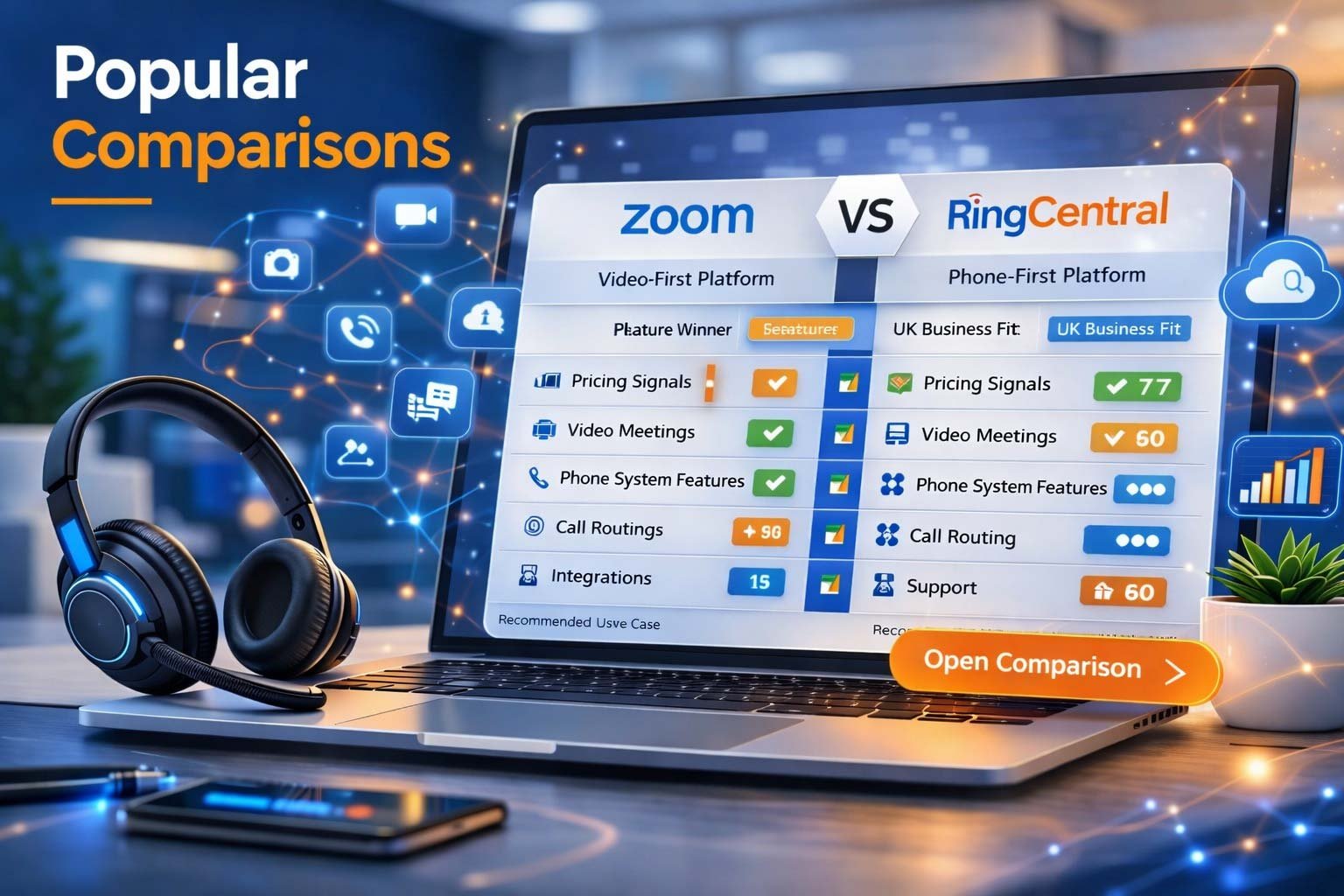
Zoom and RingCentral can both power modern UK business communications, but their “centre of gravity” is different. Zoom is typically chosen when video meetings are the primary workflow and you want a clean, familiar video-first experience. RingCentral is typically chosen when telephony is mission-critical and you need a mature phone system (queues, reception workflows, routing governance) as the core product. This page keeps the decision practical: pricing signals, feature winners, a dedicated video section, a dedicated phone-features section, and clear recommendations by use case.
Quick outcome
Overall winner: RingCentral
for most UK businesses where calling is core.
Video winner: Zoom.
Best for phone-first teams: RingCentral. Choose Zoom when meetings are the primary workflow and calling is secondary.
Quick Winner Summary Table
If you want the shortest answer: Zoom wins for video; RingCentral wins for phone-system depth. For most UK businesses where inbound/outbound calling affects revenue or service KPIs, RingCentral is typically the safer “core comms” choice.
| Decision category | Winner | Why it wins (UK buyer lens) |
|---|---|---|
| Overall for UK businesses | RingCentral | Stronger default when calling is operationally critical: call handling depth, routing governance, and phone-first maturity. If your KPIs include answer rates, queue pressure, and service responsiveness, RingCentral is usually safer. |
| Video meetings | Zoom | Zoom is typically the stronger video-first experience: meeting workflow simplicity, familiar UI, and strong “video as the core workflow” posture. |
| Phone features | RingCentral | RingCentral typically wins on phone-system depth (queues, IVR, reception workflows, routing control) and the operational tooling that phone-heavy teams rely on. |
| Entry pricing signal | Zoom | From £10 vs RingCentral from £12.99 (signals). Real totals depend on the configuration you use after go-live (Day 90), including required phone features, reporting, and any add-ons. |
| Integrations ecosystem | RingCentral | RingCentral often wins when integrations matter to phone operations: CRM workflows, ticketing, analytics exports, and deeper UCaaS platform integration behaviour. |
| Best for phone-first teams | RingCentral | If telephony drives customer outcomes and you run reception/queues, RingCentral is usually the safer choice. If your business is meeting-led (internal collaboration), Zoom may be the better core, with calling treated as secondary. |
Ask: Are we video-first or phone-first? If meetings are the primary workflow, Zoom is usually best. If calling operations are primary (service, sales, reception, queues), RingCentral is usually best.
Zoom is the cleaner core
If your day-to-day is dominated by video meetings and internal collaboration, Zoom usually wins for ease-of-use and familiarity. Calling can still be added, but the primary advantage is meeting-first productivity.
RingCentral is the safer core
If your business depends on reliable inbound/outbound calling, queues, and reception coverage, RingCentral wins due to phone-feature depth and operational tooling.
Pricing Comparison
Price comparisons are only useful when you price what you will *actually run* after go-live. Zoom often wins on the entry price signal. RingCentral often wins on phone-platform depth—so validate which phone features become mandatory for your operation.
Pricing signals vs operational total
In your brief, Zoom starts from £10 while RingCentral starts from £12.99. Treat these as pricing signals. Real totals are shaped by what you need for your operating model: meeting-first (Zoom), or phone-first with advanced call handling and reporting (RingCentral).
| Cost driver | Zoom | RingCentral | UK buyer guidance |
|---|---|---|---|
| Entry pricing signal | From £10 (signal) | From £12.99 (signal) | Do not choose on entry tier alone—price your Day 90 setup. |
| Value centre | Meetings and video-first workflows. | Calling, routing, and phone operations. | Pick based on what drives KPIs: meetings or calling. |
| Advanced call handling | Validate how advanced call flows are delivered if you need queues and reception depth. | Often strong call handling depth; validate which plan tier/add-ons become required. | Phone-first teams should validate queue/reception needs first. |
| Integrations & workflow | Validate your CRM/ticket workflow if calling outcomes must be logged. | Often stronger for phone-led integrations and workflow depth. | Run a pilot with your real CRM and call logging expectations. |
| Admin overhead | Often simpler for meeting-first deployments; validate telephony admin if calling becomes core. | Dedicated phone platform posture; validate admin roles and change control. | Ask: who owns routing changes and how fast can you fix mistakes? |
Build a “Day 90 configuration” list: required call flows, queue KPIs, recording policies, reporting, integrations, and device needs. Then request itemised quotes and compare on the same assumptions.

Model the real total
Use the savings calculator to validate totals under consistent assumptions and avoid choosing on entry pricing alone.
Features Head-To-Head
These categories cover what UK teams actually feel day-to-day: core calling, admin governance, integrations, analytics, video/meetings posture, and phone operations readiness at scale.
| Category | Zoom | RingCentral | Winner + how to validate |
|---|---|---|---|
| 1) Meetings workflow | Video-first experience; typically strong meeting usability and familiarity. | Supports meetings; not usually chosen primarily for video-first posture. | Zoom Validate meeting UX and adoption. |
| 2) Core calling & routing | Works well; validate call flow depth if you run reception/queues heavily. | Phone-first platform; typically stronger routing, queues, IVR, and call handling depth. | RingCentral Validate real call flows and edge cases. |
| 3) Admin governance | Strong for meeting-first deployments; validate telephony governance as complexity grows. | Strong phone-admin posture; validate roles, auditability, and change control. | RingCentral Validate change rollback and admin boundaries. |
| 4) Integrations ecosystem | Integrations exist; validate CRM/ticket workflows if calling must be logged. | Often stronger for phone-led integrations and operational workflow depth. | RingCentral Test CRM logging + ticketing workflows end-to-end. |
| 5) Analytics & reporting | Validate reporting for calling operations if telephony becomes core. | Often stronger phone-system reporting posture for supervisors and queue performance. | RingCentral Validate queue dashboards and exports. |
| 6) Best fit by operating model | Best when meetings are primary and calling is secondary. | Best when calling is primary and meetings are secondary. | Depends Decide: video-first or phone-first. |
Zoom wins when video is your core workflow and you want the cleanest meeting experience. RingCentral wins when telephony is the core workflow and you need phone system depth, routing governance, and supervisor tooling.
Video Comparison
Zoom is the video-first winner in this matchup. This section explains when that matters for UK businesses and how to validate value beyond “meeting quality”.
When video is the primary workflow
If your day-to-day is dominated by internal meetings, client calls, training sessions, and webinars, video becomes the “main comms surface”. In that model, choosing a video-first platform like Zoom can reduce friction and increase adoption quickly. The real advantage is consistency: staff learn one meeting workflow and use it everywhere.
UK adoption tip
The fastest value in UK SMEs often comes from reducing tool sprawl. If Zoom is already culturally embedded, moving away can increase change fatigue. If Zoom adoption is already high, Zoom as a “core” platform may be the practical choice.
| Video dimension | Zoom | RingCentral | Winner + validation |
|---|---|---|---|
| Meeting-first experience | Video-first UX and strong meeting workflow familiarity. | Works well, but typically not the primary reason buyers choose RC. | Zoom Validate with real meeting types. |
| Adoption & training | Often the lowest friction for video-heavy teams. | Adoption can be strong when RC is rolled out as the primary comms platform. | Zoom Measure training and behaviour change. |
| Video as a KPI driver | Best when your productivity is meeting-led. | Better when your productivity is calling/service-led. | Depends Decide what drives KPIs: meetings or calls. |
| Unified comms strategy | Great if you want Zoom as the main comms surface. | Great if you want phone operations as the main comms surface. | Depends Video-first vs phone-first. |
Validate: meeting UX, reliability in your network environment, admin controls for hosts and recordings, webinar/event needs (if relevant), and how meetings relate to your sales/service workflows.
Phone Features Comparison
If you run inbound queues, receptionist cover, or phone KPIs, treat this section as the core. RingCentral is the phone-feature winner in this matchup and is usually the safer choice for phone-first UK operations.
| Phone feature area | Zoom | RingCentral | Winner + how to validate |
|---|---|---|---|
| Reception workflows | Can support reception patterns; validate coverage, exceptions, and busy-period handling. | Typically stronger for reception workflow depth and operational reliability. | RingCentral Test receptionist journey end-to-end. |
| Queues & IVR depth | Validate advanced queue behaviour if you rely on call handling KPIs. | Often stronger depth and flexibility for queues, IVR, routing, and overflow logic. | RingCentral Validate overflow and missed-call protection. |
| Supervisor operations | Validate reporting and supervisor visibility if telephony is core. | Often stronger phone-ops dashboards, reporting, and supervisor tooling. | RingCentral Validate dashboards + exports. |
| Routing governance | Validate admin controls and change speed when telephony becomes complex. | Strong phone-admin posture; validate auditability and role boundaries. | RingCentral Validate change control + rollback. |
| Best fit by operating model | Best when meetings are primary and calling is secondary. | Best when calling is primary and meetings are secondary. | Depends Decide: video-first or phone-first. |
| Business continuity | Continuity depends on your design and governance; validate failover behaviour. | Continuity depends on your design and governance; validate failover behaviour. | Tie Continuity is a design + governance outcome. |
RingCentral is typically the safer choice for UK phone-first operations, especially where inbound calling impacts revenue and service KPIs. Zoom can still work for calling, but the best fit is meeting-first organisations where telephony is secondary.
Test your real call flow
Run a demo with your real IVR wording, queue patterns, overflow rules, and out-of-hours behaviour—then measure admin effort and supervisor visibility.
Best For Each Provider
Use these recommendations to map Zoom and RingCentral to real UK operating models: meeting-first vs phone-first.
Zoom
Zoom is best when video meetings are the primary workflow and you want a familiar, frictionless meeting experience for staff and clients. It’s a strong choice for UK organisations that are meeting-led, training-heavy, or webinar/event-oriented, where “meeting productivity” is the main ROI driver.
Validate
Confirm how your call handling requirements map to Zoom if you need queues/reception depth. If calling becomes mission-critical, pressure-test phone features and supervisor reporting early.
RingCentral
RingCentral is best when telephony is mission-critical and you need a mature phone platform with robust call handling, routing governance, and phone-ops tooling. It suits UK businesses that measure success in answer rates, queue KPIs, and reliable inbound/outbound calling operations.
Validate
Confirm which phone features are required (queues/IVR/reporting/recording), whether any add-ons are needed, and how change control is managed. If video is core, validate how meetings workflow fits for your teams.
Shortlist by workflow
If you’re unsure these are your final two, use the quiz to shortlist based on your call flows, team size, and constraints.
Final Verdict
Zoom vs RingCentral becomes clear once you choose the operating model: meetings-first or phone-first. RingCentral is the safer overall choice for most UK businesses where calling is core. Zoom is the better choice when video is the core workflow.
Meetings are the primary workflow
Choose Zoom when video meetings drive productivity and adoption must be low friction. This is the practical choice for meeting-heavy UK organisations, especially where Zoom is already culturally embedded and calling is secondary.
Calling is mission-critical
Choose RingCentral when telephony is a core operational platform: reception coverage, queues, routing governance, and phone-ops reporting. It is usually the safer choice for phone-first UK businesses that measure success in answer rates and customer responsiveness.
Before deciding: (1) define whether you are meetings-first or phone-first, (2) document your real call flows (IVR/queues/overflow/out-of-hours), (3) list required reports and supervisor needs, (4) validate integrations (CRM/ticketing) if calls must be logged, (5) price the Day 90 configuration (licences + add-ons), and (6) run a pilot with reception, supervisors, and mobile users.
FAQs
Quick answers to the questions UK buyers ask when deciding between Zoom and RingCentral.
Decide: video-first or phone-first
Zoom wins for video. RingCentral wins for phone operations. Use the tools to validate fit and total cost under consistent assumptions.