
Skip to content
CompareVoIPService logo for UK business VoIP comparison platform
  • Home
  • About
  • Contact
  • Best VoIP Providers
  • Resources
Get Started
CompareVoIPService logo for UK business VoIP comparison platform
CompareVoIPService

How We Review VoIP Providers

Data-driven. Independent. Unbiased.

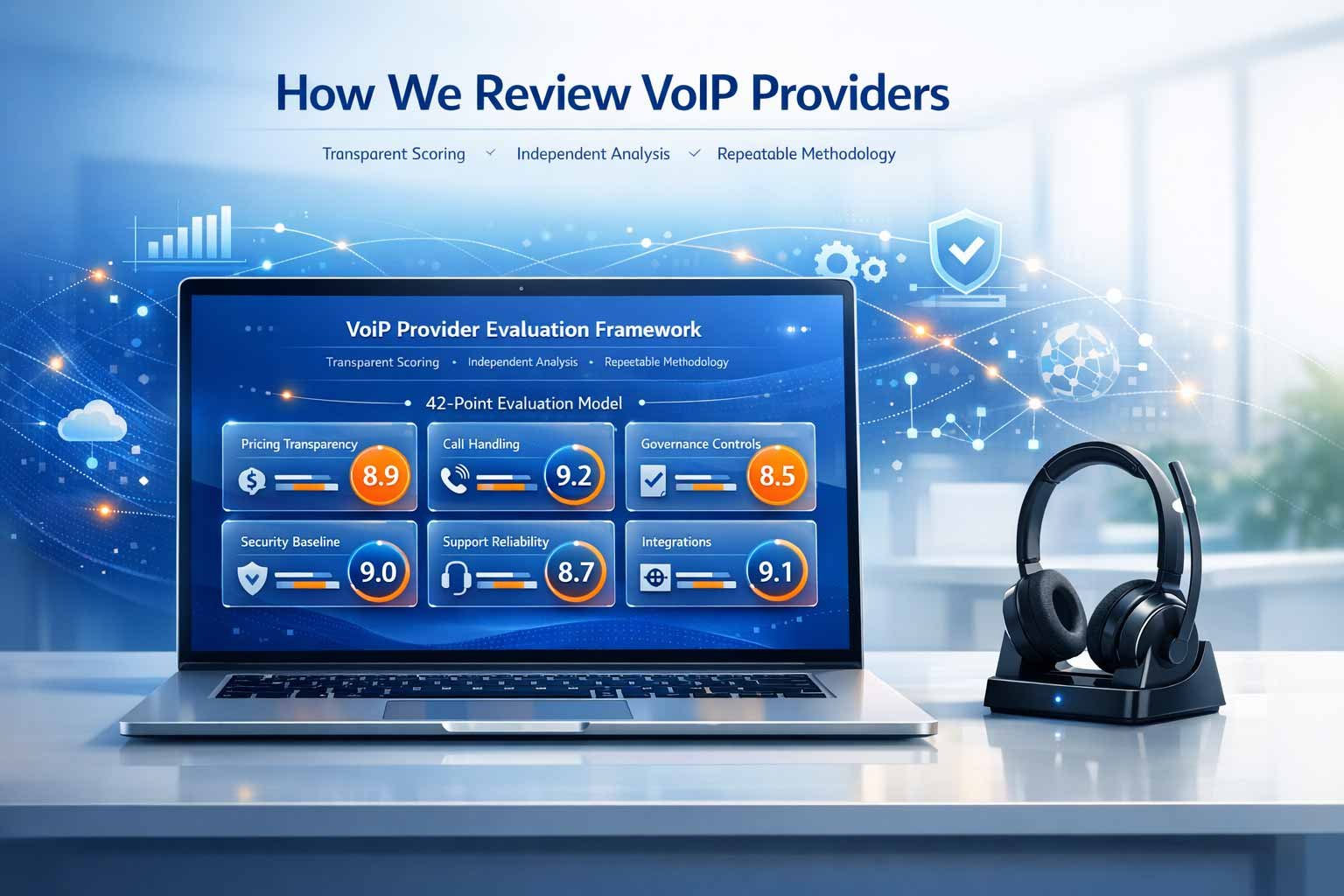
At CompareVoIPService, we’re building a comparison site that UK businesses can trust—without relying on vague “Top 10” lists, hype-led claims, or affiliate-driven placements. Our rankings and reviews follow a repeatable 42-point evaluation framework across seven performance categories to support real-world decisions: pricing clarity, call handling, governance, security, support, integrations, and UK readiness.
Best VoIP providers in the UKVoIP provider reviewsVoIP provider comparisonsVoIP recommendation quizAffiliate disclosure
Infographic showing the 42-point evaluation framework for UK VoIP providers, covering security, support, and pricing clarity.

Transparent Pricing

We ensure clarity in pricing, so you always know what you pay for.

  • Framework overview
  • Transparency By Design
  • Content Intent Firewalls Used Across The Domain
  • Evidence Standards
  • The 42-Point Framework
  • The 42 Checks
  • How Scores Translate Into Rankings
  • Independence Guarantee
  • No Paid Placements
  • Affiliate Neutrality
  • Update And Maintenance Policy
  • Corrections Policy
  • Our Editorial Commitment
  • See The Framework In Action
42

Framework overview

Our rankings and reviews use a repeatable 42-point evaluation framework across seven core performance categories.

Transparency By Design

Most VoIP comparison pages fail buyers in two ways:

  • They rank providers using unclear criteria (or never explain the criteria).
  • They publish overlapping content across pages that repeats the same claims, causing confusion.

We avoid both with two locked rules across the entire domain:

Rule 1: A Single “Ranking Pillar” Per Ranking Intent

When we publish a ranking page (such as “best providers”), that page is the single source for that ranking intent. Reviews, comparisons, guides, tools, and PSTN pages do not replicate ranking tables or “Top 10” lists.

Rule 2: Page-Type Intent Firewalls

Every page type has a defined purpose and boundaries. This keeps the site consistent for readers and prevents self-competition across URLs.

Content Intent Firewalls Used Across The Domain

This is the domain-wide structure we follow. It is locked and enforced during writing and updates.

Page TypePurposeAllowedForbidden
Ranking PagesShortlist and decision support.Scoring rubric, category weights, best-fit scenarios, shortlist tables, decision checklists.Ranking tables, “Top 10” lists, broad provider ordering anywhere else.
Review PagesEvaluate one provider in depth.Strengths, constraints, fit scenarios, pricing signals, support expectations, integrations overview, alternatives (without ranking).Top-provider lists, ranking methodology, “best providers” blocks.
Comparison PagesChoose between two shortlisted providers.Trade-offs, best-fit scenarios, feature/admin/support differences, pricing signals.“Best providers” sections, top-10 tables, broad rankings.
PSTN PagesReadiness and operational planning.Timelines, checklists, migration planning, line-dependency considerations.Provider ranking tables and “best provider” language.
Tools PagesFunctional conversion: calculate or shortlist quickly.Short instructions, assumptions, outputs, and next-step routing.Long guides, provider ranking lists, broad “best” copy.
Guides PagesFoundational learning (no selling, no ranking).Definitions, concepts, pros/cons, “what to check”, safe CTAs to tools/hubs.Ranking lists, “cheap/best” pricing tables, provider ordering.

Evidence Standards

We aim for accuracy and consistency rather than opinion-led content. Every key claim on ranking and review pages should be supported by at least one of the evidence types below.

Evidence Hierarchy

  • Official provider documentation and published service information (packaging, features, admin/security controls, support routes).
  • Public UK infrastructure and regulatory guidance where relevant to readiness planning and continuity.
  • Independent third-party review platforms as supporting context (used carefully; we do not treat star ratings as proof by themselves).
  • Hands-on evaluation notes where feasible (admin UX, configuration flow, general feature behaviour), documented internally.

What We Avoid

  • Unverifiable performance claims presented as facts
  • “Guaranteed savings” claims
  • Ranking based on popularity alone
  • Copying provider marketing statements without context or constraints
  • Publishing the same “best provider” narrative across multiple URLs

The 42-Point Framework

Each provider is assessed across seven categories. For ranking pages, we apply category weights. For review pages, we still evaluate the same categories but present them as structured depth rather than “ordering”.

Scoring Scale

  • 0–3 high risk or unsuitable for most business use cases
  • 4–6 viable, but constraints likely matter
  • 7–8 strong in-category performance for typical UK business needs
  • 9–10 standout performance, mature delivery, clear fit

Category Weights (Used On Ranking Pages)

CategoryWeightWhat it covers
Pricing & Contract Transparency15%Packaging clarity, add-ons, terms, fees, and predictable scaling.
Core & Advanced Features20%Calling toolkit, routing, queues, recording/reporting, multi-site, capability headroom.
Reliability & Call Quality Signals20%SLA clarity, resilience narrative, continuity options, connectivity guidance, status transparency.
UK Customer Support Signals15%Support routes, hours, onboarding model, escalation, documentation, account management.
Software Integrations10%Integration categories, routes, admin effort, UX impact, data flow clarity, stability signals.
Security & Compliance Signals10%Access controls, account protection, auditability, GDPR posture, data handling transparency.
PSTN Switch-Off Readiness10%Porting support, migration guidance, line-dependency awareness, staged migration options.
Best VoIP providers in the UKAffiliate disclosure

The 42 Checks

Below are the 42 checks we use across all providers. These checks are “what we look for” and “what we verify from evidence,” not marketing claims.

  1. Entry pricing clarity: is “from” pricing explained with inclusions and limits?
  2. Add-on visibility: are common add-ons clearly described (numbers, recording, analytics, integrations)?
  3. Minimum terms and renewal: are contract length and renewal mechanics explicit?
  4. Fee disclosure: are setup/activation/porting/hardware delivery fees disclosed upfront?
  5. Scaling cost predictability: does cost remain predictable as users and sites increase?
  6. Commercial constraints: are fair-use, minutes, and policy constraints easy to find?
  1. Core toolkit coverage: auto-attendant, voicemail handling, mobile app/softphone support.
  2. Call routing capability: ring groups, time schedules, routing rules, basic call flows.
  3. Queue and team calling: queue behaviours, agent features, supervisor basics (where relevant).
  4. Recording and reporting basics: recording availability, access controls, and reporting essentials.
  5. Multi-site readiness: multi-site logic, extension management, and operational structure.
  6. Advanced capability headroom: whether the platform can grow with requirements (without overcomplication).
  1. Published SLA clarity: is an SLA stated and is it specific enough to be meaningful?
  2. Resilience narrative: is resilience explained (redundancy, failover approach, continuity routing)?
  3. Operational continuity options: options for divert, failover, and continuity behaviours.
  4. Network dependency clarity: guidance on connectivity requirements and expected call quality dependencies.
  5. Service status transparency: availability of status pages, incident comms, and outage transparency signals.
  6. Deployment suitability: whether the platform suits typical UK business usage patterns without fragile setups.
  1. Support channels: phone, ticketing, chat (where offered) and clarity of access routes.
  2. Support hours clarity: stated hours and after-hours processes.
  3. Onboarding model: responsibilities and what “implementation support” actually includes.
  4. Escalation clarity: whether escalation routes are described and how issues are handled.
  5. Documentation quality: admin docs, how-to guidance, and operational knowledge base depth.
  6. Account management signals: whether account management is available and how it functions.
  1. Integration categories covered: CRM/helpdesk/workspace/reporting categories addressed.
  2. Practical integration routes: whether “how it connects” is clear (native, marketplace, API, partners).
  3. Admin effort: integration setup complexity and maintainability signals.
  4. User experience impact: whether integrations reduce friction or create more admin overhead.
  5. Data flow clarity: what data syncs (calls, logs, recordings metadata, notes) at a high level.
  6. Stability signals: integration documentation maturity and change transparency.
  1. Access control options: role-based permissions and administrative boundaries (where available).
  2. Account protection controls: security settings that protect administrative access.
  3. Auditability signals: logging/reporting signals relevant to governance.
  4. Compliance posture statements: clarity on GDPR alignment and contractual documentation (DPA availability).
  5. Data handling transparency: high-level transparency on data processing and storage approaches.
  6. Security documentation maturity: clarity and availability of security-related documentation.
  1. Porting support clarity: guidance and support expectations for number porting.
  2. Migration planning guidance: availability of planning steps/checklists and implementation support signals.
  3. Line-dependency awareness: whether the provider acknowledges common dependencies and continuity needs.
  4. Business continuity routing: options for fallback routing during transitions.
  5. Deployment options: flexibility for staged migrations and hybrid scenarios.
  6. Operational readiness messaging: clarity on what businesses should prepare and verify.

How Scores Translate Into Rankings

What Rankings Represent

A ranking is a best-fit ordering under the rubric—not a universal truth. A provider can be “excellent” and still be wrong for your needs.

Red Flags That Reduce Scores

  • unclear pricing packaging and heavy add-on reliance
  • weak governance controls for multi-team environments
  • vague support routes and unclear onboarding responsibilities
  • unclear resilience messaging and continuity options
  • insufficient documentation for business administration

What We Never Do

  • sell ranking placement
  • accept payment to change scores
  • hide negative constraints to protect commissions
  • publish rankings inside reviews, comparisons, tools, PSTN content, or guides

Independence Guarantee

0

No Paid Placements

Providers cannot pay to be featured, ranked, or described positively.

=

Affiliate Neutrality

We may earn a commission if you take an action through a link on our site. That relationship does not influence our rubric or ordering.

Affiliate disclosure

Update And Maintenance Policy

Providers change packaging, features, and support models. Our update rules are locked and consistent.

What Triggers An Update

  • pricing/packaging (inclusions, add-ons, minimum terms)
  • core calling capability affecting workflows
  • admin governance controls
  • security baseline signals and documentation
  • support/onboarding model and escalation approach
  • integration approach and availability
  • PSTN migration support clarity and readiness guidance

Review Cycle

  • Ranking pillar + core provider reviews: reviewed on a rolling cycle and updated when material changes occur.
  • All supporting pages: reviewed on a scheduled cadence and updated when required.

(We avoid promising fixed update intervals we cannot uphold; reliability matters more than marketing.)

Corrections Policy

If you spot an error or a page that needs updating, we want to correct it quickly.

Send a correction request with

  • Page URL
  • The specific statement to review
  • Supporting evidence (official provider documentation is ideal)
Contact

How To Use CompareVoIPService

Recommended workflow (to keep decisions clean and consistent):

Shortlist fast

Validate provider-by-provider VoIP provider reviews

Make the final decision head-to-head

Check cost signals quickly

Plan readiness separately

Our Editorial Commitment

This evaluation framework is the “Single Source of Truth” for every review and ranking on CompareVoIPService.co.uk. To ensure total independence, we enforce strict “Intent Firewalls”—this means our rankings are based solely on our 42-point scoring rubric and are never influenced by affiliate relationships or external partnerships. Every page on this site is held to these exact standards to ensure you receive consistent, reliable advice.

See The Framework In Action

Use the ranking pillar to shortlist, then move to reviews and comparisons for depth and final decision checks.

Best VoIP providers in the UKVoIP provider reviewsVoIP provider comparisonsVoIP recommendation quizPSTN switch-off guidance
CompareVoIPService

Compare business VoIP options with clear criteria and transparent routing across rankings, reviews, comparisons, and PSTN readiness content.

Help & Information
  • How we rank providers
  • Affiliate disclosure
  • Privacy Policy
  • Terms
Explore
  • Best VoIP Providers in the UK
  • VoIP Provider Reviews
  • VoIP Provider Comparisons
  • PSTN Switch-off Guidance
Start Here

Get a fast shortlist and cost signals with the core tools.

VoIP Recommendation QuizVoIP Savings Calculator

© 2026 CompareVoIPService. All rights reserved.

All trademarks, logos and brand names are the property of their respective owners and are used for identification and comparison purposes only.
•Business VoIPCompare trusted UK VoIP options
UKUK-focused£Free quote matching•No obligation⚡Fast comparison
•Prefer help first?
•Expert guidance⚡Fast callback•Business advice•Simple next step
30-second form · Free & no obligation
Free
Compare providers
100% free · No obligation · UK suppliers only
Thank you!

Your request has been submitted successfully. We will match you with suitable UK suppliers shortly.

Response time:

Reference:

Priority support · Free & no obligation
Free
Request callback
Request callback

Leave your details and we will call you back to discuss the right business service options.

100% free · No obligation · UK suppliers only
Thank you!

Your request has been submitted successfully. We will match you with suitable UK suppliers shortly.

Response time:

Reference:

  • Home
  • About
  • Contact
  • Best VoIP Providers
  • Resources
Priority support · Free & no obligation
Free
Request a callback
Request a callback

Leave your details and we will call you back to discuss the right business service options.

100% free · No obligation · UK suppliers only
Thank you!

Your request has been submitted successfully. We will match you with suitable UK suppliers shortly.

Response time:

Reference:

30-second form · Free & no obligation
Free
Get a Quote
100% free · No obligation · UK suppliers only
Thank you!

Your request has been submitted successfully. We will match you with suitable UK suppliers shortly.

Response time:

Reference: