
RingCentral Review UK (2026)
Depth review for UK business buyers (pricing, routing, governance, security, support)
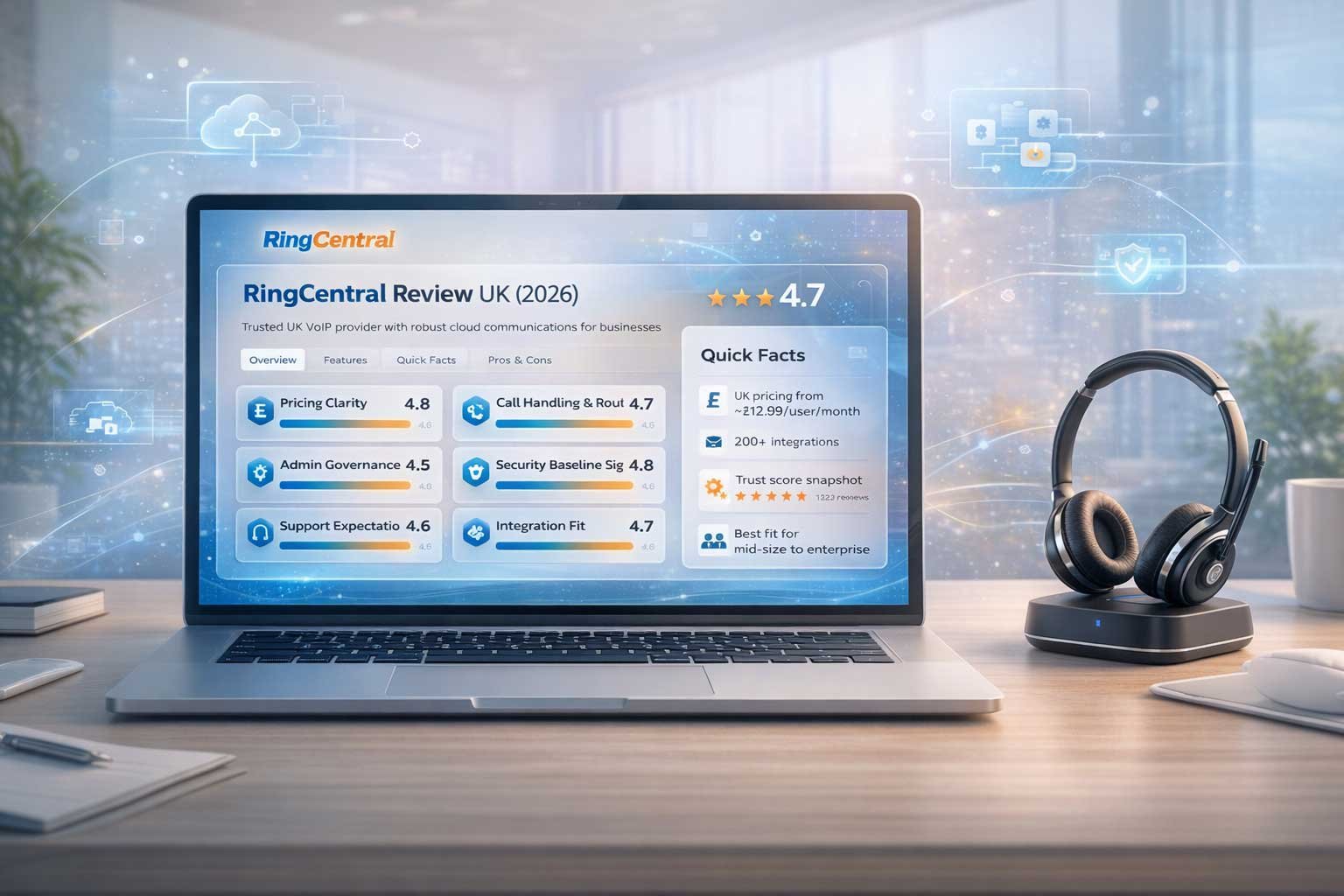
This RingCentral review UK evaluates the platform through a consistent buyer framework: pricing clarity and cost drivers, call handling and routing depth, admin governance, security baseline signals, support expectations, integration fit, and rollout reality. It’s designed for decision-makers who need to know whether RingCentral is the right operational fit—not just whether it has features.
Quick facts: UK pricing from ~£12.99/user/month · 200+ integrations · Trustpilot snapshot 3.5/5 · Best fit for mid-size to enterprise.
Reviews, not rankings
Reviews evaluate one provider in depth. Use rankings to shortlist, and comparisons to decide head-to-head.
Overview
RingCentral is a mature UCaaS platform that combines cloud calling with collaboration tooling and a large integration ecosystem. In the UK, it’s commonly shortlisted by businesses that want predictable call handling, strong administration, and the ability to connect telephony into CRM/helpdesk workflows.
What RingCentral tends to do well
Most buyers choose RingCentral when operational reliability and governance matter as much as features. It is typically strongest in environments with multiple teams, multiple sites, or high inbound call dependency.
Where UK buyers get caught out
The most common problems are not “missing features” but procurement mismatch: buying the wrong tier, underestimating add-ons, and assuming the setup is a one-time project. If you plan to use integrations, recordings, analytics, or contact centre capabilities, validate entitlement and cost early.
Shortlist, then decide
Use comparisons to choose between two providers once RingCentral is on your shortlist.
Pricing table
RingCentral pricing varies by plan tier, billing cadence, and add-ons. For UK buyers, the practical approach is to price the configuration you actually need: users + numbers + calling bundle + required features (recording, analytics, integrations, contact centre).

Entry tier (From ~£12.99/user/month)
Typically used for straightforward cloud calling where you want reliable routing and standard collaboration. Confirm included minutes, number entitlements, and which reporting/recording features are included.
What changes totals
Most budget surprises come from add-ons and scope creep, not from the headline per-user figure.
How to compare price fairly
Compare like-for-like outcomes, not entry-tier brochure pricing.
Queues, IVR, recording, analytics, admin roles, and integrations.
Users + numbers + calling + required add-ons and governance.
Contract length, renewals, onboarding responsibility, and SLAs.
Reception, sales, support, and managers using real call scenarios.
Features (6 sections)
These six areas determine whether RingCentral supports your actual operating model: inbound call handling, daily usability, governance, analytics, integrations, and rollout maintainability.
1) Call handling & routing
RingCentral is typically strong where you need structured inbound call flows across teams, sites, or hours. For UK buyers, this is the core value driver.
Decide on outcomes
Features matter only if they improve response, continuity, and measurable performance.
3) Admin governance
Governance is where platform-grade providers win. If multiple teams need changes, you want controlled delegation, not shared admin accounts.
4) Reporting & analytics
Reporting is only useful if it supports operational decisions. Validate that dashboards can show missed calls, queue performance, and staffing signals.
5) Integrations & automation
The “200+ integrations” headline matters less than whether RingCentral supports your workflow: click-to-dial, call logging, ticket creation, and contact sync.
6) Security baseline (enforceability)
Security value comes from enforceable controls: MFA/SSO, role boundaries, recording access, and predictable governance. Validate what your tier supports.
PSTN readiness (UK buyer check)
A cloud phone system choice is also a migration decision. Confirm porting, call routing continuity, emergency calling setup, and network readiness before go-live.
Validate in a pilot
Test real call flows with reception, sales, and support before committing to contracts.
Pros & cons
A practical view for UK deployments: why RingCentral is shortlisted, and when the same characteristics become drawbacks.
Pros
Cons
Support analysis
Support quality matters most when call quality is impacted, porting is delayed, or call flows need urgent changes. UK buyers should validate support routes, ownership, escalation expectations, and onboarding responsibility.
What to confirm before you sign
RingCentral is commonly sold through different channels and packages. Ensure you have clarity on who does what once you go live.
UK operational checklist
Use these questions during procurement and pilot. They prevent most “support friction” after migration.
Security baseline
For UK businesses, the goal is enforceable governance: controlled access, role boundaries, predictable recording permissions, and repeatable user lifecycle management. Validate what your RingCentral edition supports and ensure your rollout uses disciplined policies.
Controls to validate
Confirm controls at the tier you intend to buy, not at the tier you wish you had.
Practical setup steps
Most security failures come from weak setup and inconsistent ownership.
Keep governance simple
Clear admin roles and documented call flows reduce both risk and day-to-day friction.
Integrations
RingCentral’s integration ecosystem is a key reason it’s shortlisted. The value is workflow improvement: call logging, click-to-dial, ticket creation, contact sync, and reducing manual admin across sales and support.
Where integrations deliver ROI
Integration value shows up in fewer missed follow-ups, faster support handling, and better visibility into call outcomes. Prioritise workflows that remove manual steps.
Integration validation checklist
“Integration supported” does not always mean your exact workflow is supported. Validate before you commit.
Who RingCentral is best for
RingCentral is usually a good fit when you have meaningful inbound call volume, multiple teams, and you want governance and integrations to reduce operational noise. If your needs are simple, you may be paying for headroom you will not use.
Best fit scenarios
Common UK scenarios where RingCentral tends to make sense.
Not ideal scenarios
When a simpler or lower-cost platform can be a better outcome.
Keep the decision clean
Shortlist by fit, then decide head-to-head using comparisons.
Alternatives
Alternatives should be chosen based on a specific reason: lower cost, simpler admin, UK incumbent preference, or a different integration strategy. Use the reviews below to validate fit with the same criteria.
UK buyer routes
Validate UK delivery expectations, support ownership, and procurement fit.
FAQs
UK buyer questions that typically decide whether RingCentral is a clean fit.
Verdict
RingCentral is a strong platform-grade choice for UK organisations that need advanced routing, structured administration, and integrations at scale. It is typically best when inbound calls matter, multiple teams share responsibility, and governance is required to keep operations consistent. If your needs are basic and cost is the primary driver, a simpler provider may be a cleaner outcome.
Choose RingCentral if you need
Consider an alternative if you want
Shortlist cleanly, then decide head-to-head
Use the quiz to shortlist, then use comparisons to choose between two providers using the same decision criteria.