
AI Voice Agent Cost UK (2026): First-Year Calculator


Price the complete AI voice-agent project—not just the minutes.
Separate platform and voice processing from telephone fees, transfers, implementation and support. Calculate first-year cash spend, your peak month and what a verified business outcome really costs.
Fast answer: The cost of an AI voice agent in the UK depends on how it is deployed and which components are bundled. To compare proposals, combine fixed subscription, chargeable minutes, telephone legs, implementation, integration, monitoring, VAT/FX treatment and contract exposure. A first-year estimate and cost per verified result are more useful than an isolated platform-per-minute headline.
Jump to a section
What does an AI voice agent cost in the UK?
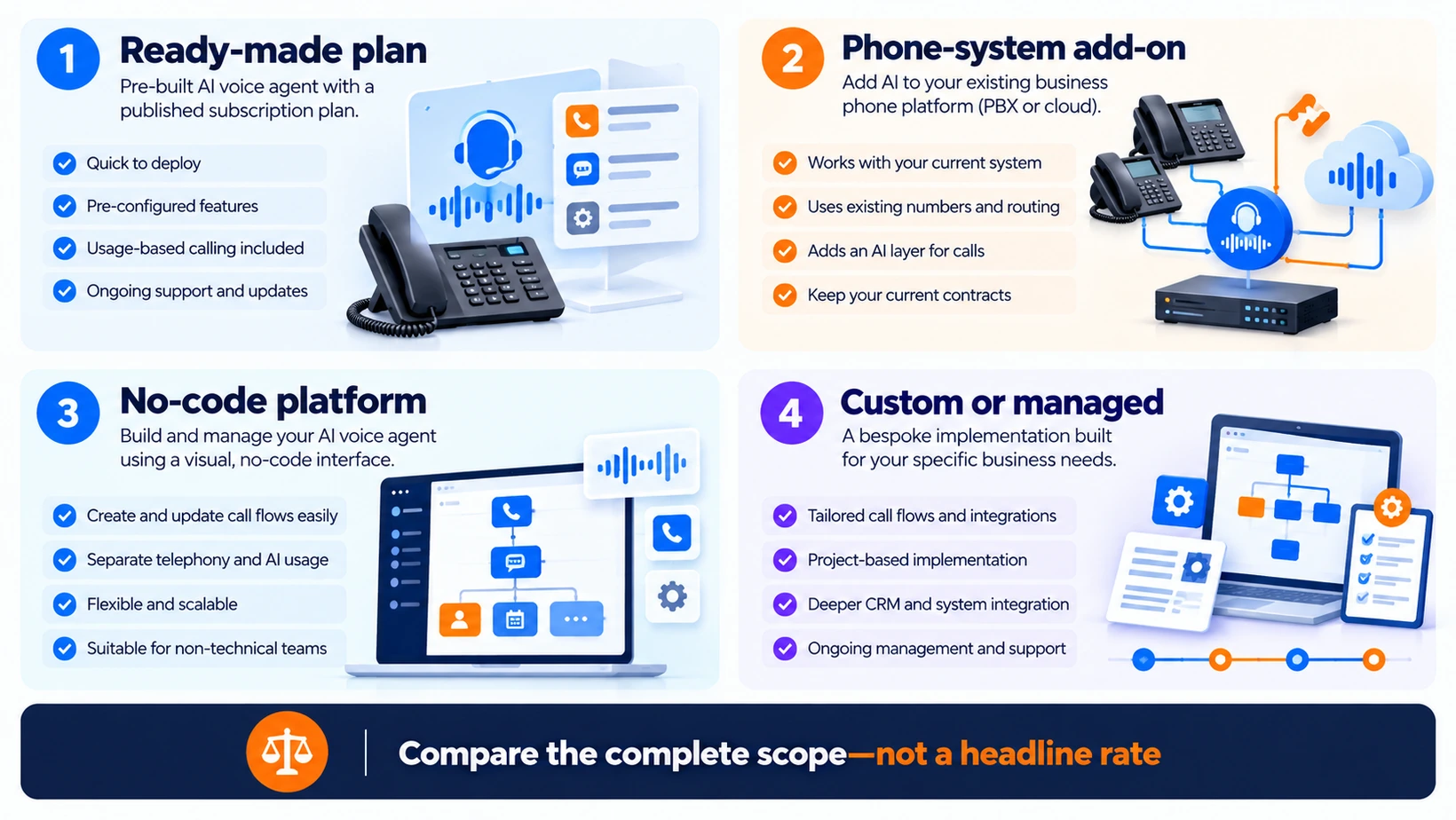
An AI voice agent does not have one universal UK price. A business might buy a managed monthly service, add an AI feature to an existing business phone platform, configure a no-code agent or pay an implementation partner to build a connected application. The headline rate is only comparable after you establish what it includes: conversation engine, speech models, telephone network, fixed licence, human transfer, integrations and support.
Usage-based software
A billable conversation rate, sometimes plus separate speech, language model, carrier, number and infrastructure charges.
Managed service
A recurring package or quotation, potentially with included minutes, implementation, specialist support and an allowance or fair-use condition.
Native AI add-on
An additional feature in an existing phone service, subject to plan eligibility, per-user limits and what the AI can actually do.
Custom integration
A separately scoped implementation plus live calling, hosting, maintenance, monitoring and periodic re-testing.
For published component examples, Vapi currently lists $0.05 per minute for hosting while model components and transport need accounting for; Retell AI advertises a configurable $0.07–$0.31 per-minute range; Bland AI distinguishes its conversation-minute and transfer-minute rates. These are USD product price signals checked on 2 October 2026, not converted UK quotes. The UK budget examples below use hypothetical GBP inputs so no exchange-rate assumption is hidden.
The four buying models are not interchangeable
Before discussing pounds per month, define exactly what the provider will deliver. A service that captures a message cannot be costed as if it can authenticate a caller, write to a CRM and confirm a diary booking. Likewise, a developer API rate is not the cost of a finished staffed business phone operation.
| Buying route | Usually purchased | Costs to request in writing | Budget risk |
|---|---|---|---|
| Ready-made AI answering plan | Published subscription, call or minute allowance | Qualifying plan, overage, number/diversion, feature eligibility and human option | A low entry price excludes the booking or live-transfer outcome needed. |
| Native AI telephony feature | Licences or AI add-on within an existing system | Base phone contract, eligible seats, usage, recordings and reporting | The core telephone licence may be a prerequisite. |
| Self-service/no-code platform | Configuration workspace and usage allocation | Voice stack, transport, integrations, extra capacity and support | The quote omits implementation time and call-routing ownership. |
| Developer-built/managed agent | Build scope and ongoing operation | Implementation, testing, infrastructure, monitoring, change requests and exit | Initial delivery appears affordable but operational ownership is undefined. |
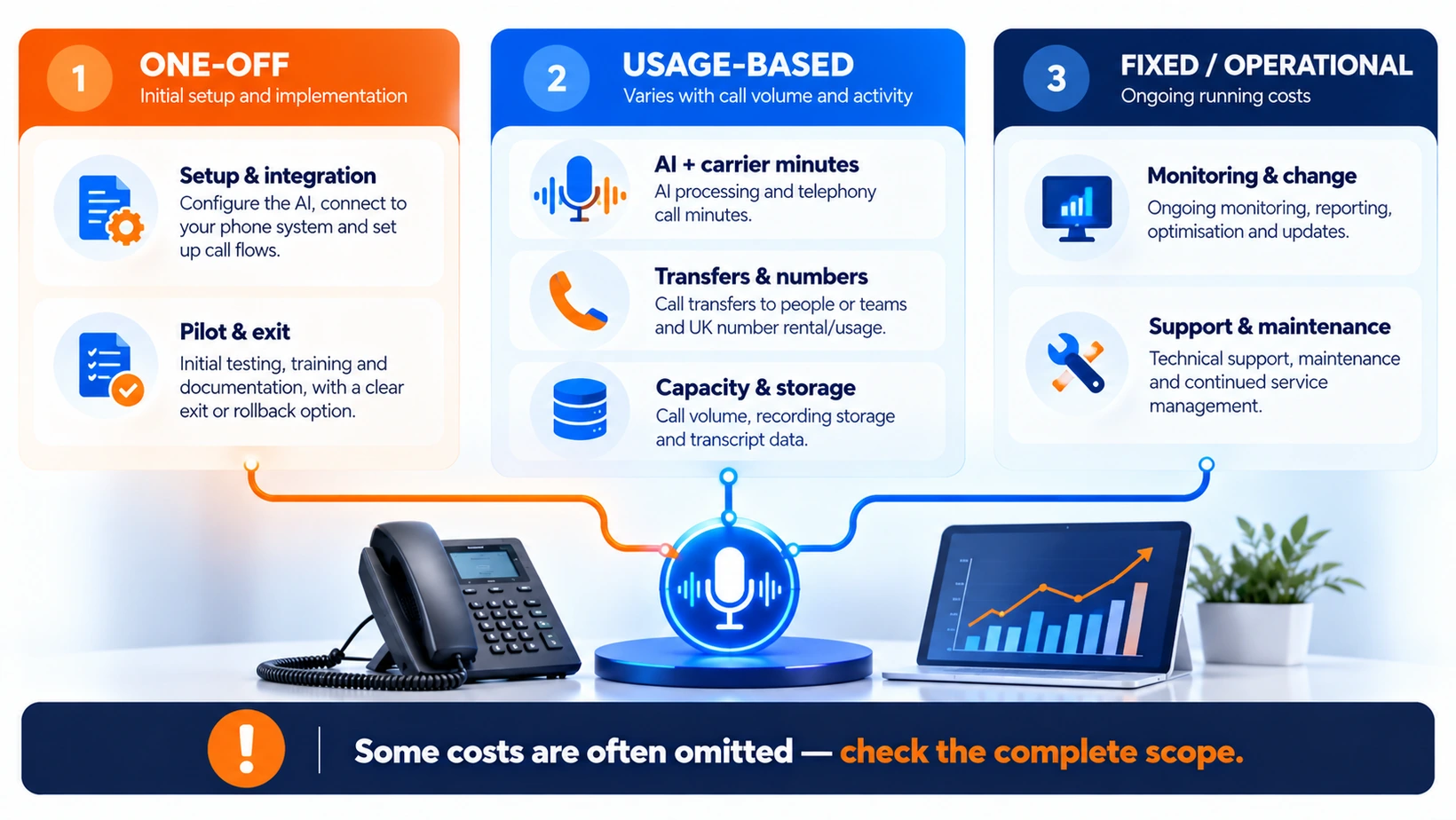
Eleven costs to include before approving a quote
The invoice can come from more than one company. The budget owner should ask every prospective supplier to fill the same ledger and explicitly mark a fee as included, separately billed, not applicable or quote required. A blank cell is not evidence that the charge is zero.
| Cost line | What to clarify | Frequency |
|---|---|---|
| 1. Implementation | Conversation design, prompts, knowledge preparation and business-rule configuration | One-off or scoped change |
| 2. Integration | CRM and calendar connections, authentication, webhook work and failure recovery | One-off plus possible usage |
| 3. Platform licence | Workspace, agent hosting, security or service tier | Monthly / annual |
| 4. AI processing | STT, model inference and TTS; confirm bundled versus pass-through | Billable AI minute / tokens |
| 5. Telephone carrier | Inbound/outbound transport, SIP, diversion and regional route | Call leg / minute |
| 6. Numbers | UK number hosting, porting or number rental when charged | One-off / monthly |
| 7. Transfer leg | AI-to-staff call leg and any overlapping conference time | Minute / transferred call |
| 8. Capacity | Concurrent calls, channel limits and peak-season upgrade | Monthly / commitment |
| 9. Storage/governance | Recording, transcript retention, redaction and audit access | Usage / monthly |
| 10. Quality and maintenance | Failed-call review, prompt updates, regression tests and response ownership | Monthly / retained hours |
| 11. Trial and exit | Pilot minutes, staged rollout, off-boarding and rollback work | One-off / contingency |
An all-in published AI-minute price should not be split into separate STT/LLM/TTS charges again in your spreadsheet. Conversely, do not treat platform-only hosting as inclusive of the underlying models. A vendor should identify the boundary on the written quote.
Why 1,000 caller minutes may not mean 1,000 billed minutes
Start with the billing unit. Suppliers can charge for AI conversation time, speech/model usage, telephone legs, rounded call blocks or fixed allowances. A short failed call may still consume resources. Check whether transfers, silence, voicemail detection, outbound attempts and test calls enter the meter.
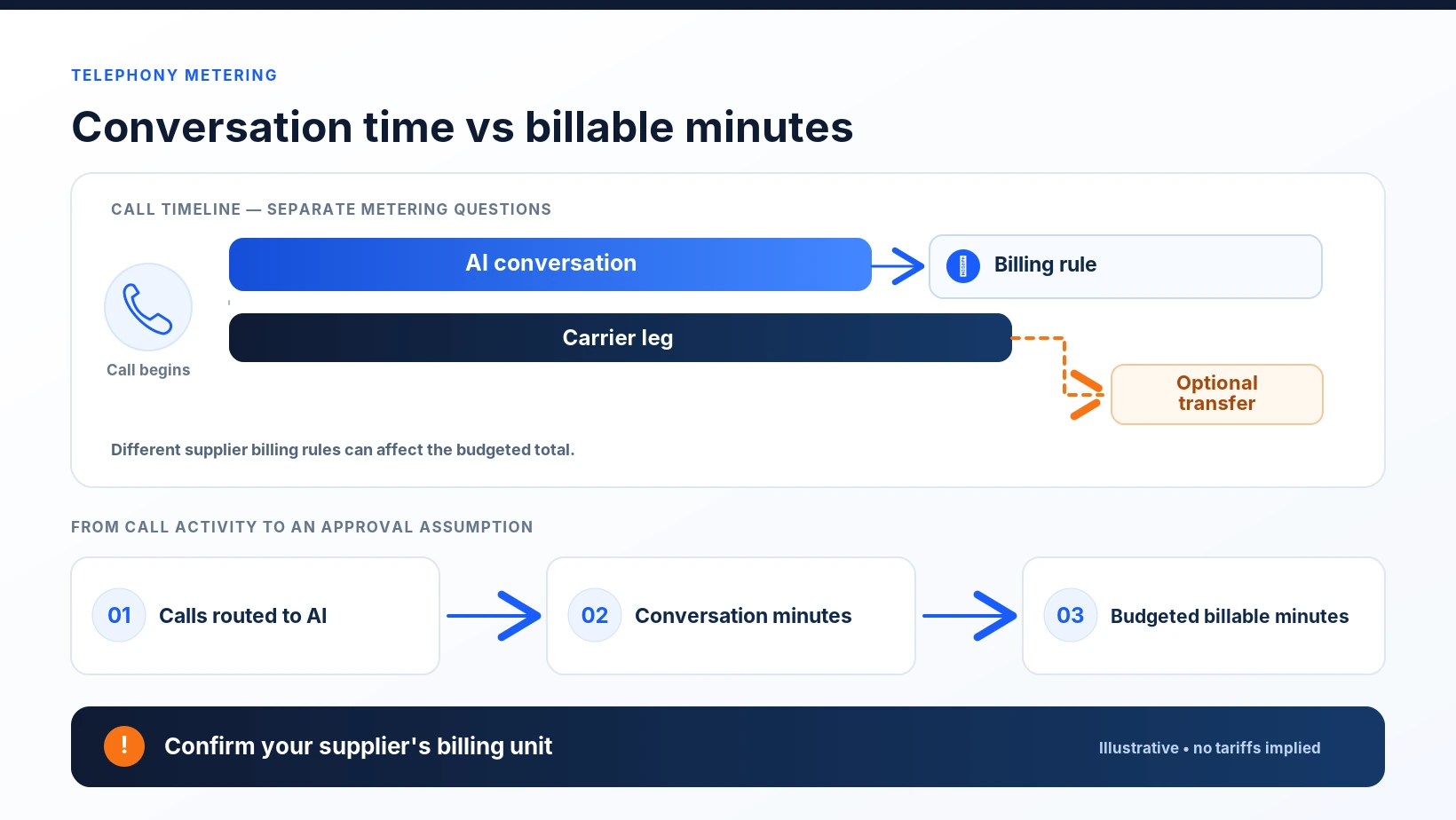
The uplift is a buyer modelling allowance, not a market-wide rounding rule. Replace it once your supplier specifies increments and what happens on short calls. The separate transfer leg should be entered only when the chosen proposal charges it independently; otherwise set that rate to zero to avoid double counting.
Short-call effect
Many 20–40-second conversations can behave differently under per-call rounding than a small number of longer conversations.
Overlapping transfer
Ask whether a conference, warm transfer or the additional staff leg is charged alongside the AI minute.
Busy-month effect
Check concurrency and included-minute thresholds at the busiest hour, not only the average monthly call total.
Testing consumption
Ask whether pre-launch, training and post-change regression calls draw on paid minutes.
Published prices: useful signals, not equivalent UK quotations
These suppliers publish different product boundaries. The point is to show what must be normalised, not to declare the cheapest platform or convert dollars using an unstated exchange rate.
| First-party source | Published signal checked 2 Oct 2026 | What the UK buyer still needs |
|---|---|---|
| Vapi | $0.05/min hosting on usage-only; its example separates transcription, language model, voice and transport. | Choose model/voice route, UK carrier, numbers, support and implementation. |
| Retell AI | Pay-as-you-go voice-agent range $0.07–$0.31/min; configuration and optional features change the rate. | Confirm selected model/TTS, telephony, additional capacity, recording and currency. |
| Bland AI | Start $0.14/conversation min and $0.05/transfer min; Build $299/month plus $0.12/conversation min and $0.04/transfer min. | Confirm volume limits, UK routing, number fees, contract and whether staff transfer overlaps. |
| Synthflow | Current enterprise pricing page invites a tailored scope/demo rather than one universal public rate. | Obtain an itemised quote against the same usage and deployment brief. |
| ElevenAgents | Publishes USD subscription tiers with included call minutes and concurrency allowances. | Confirm UK telephony and overage conditions for the particular plan. |
Recheck these sources on the day you request a written UK quotation. VAT, currency, product version, minimum commitment, concurrency, selected models and included call routing can change the real bill.
First-year total cost: the number finance needs
The live monthly invoice is not the entire purchase. Separate monthly cash outflow, upfront deployment, a realistic reserve and the busiest-month requirement. If a provider requires an annual prepayment or minimum term, show that schedule separately rather than assuming twelve identical monthly payments.
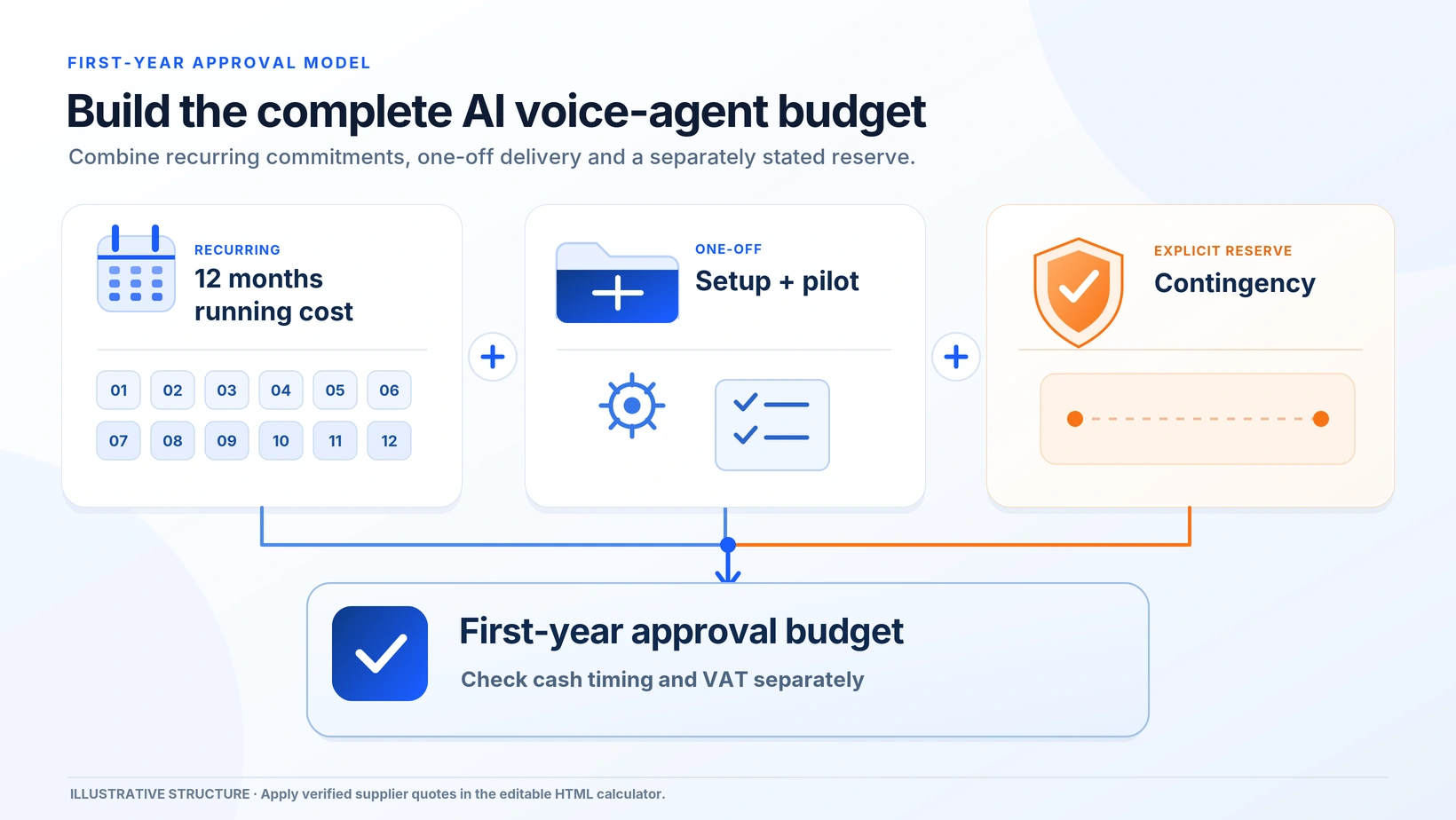
The illustration in this guide uses 400 incoming calls a month, 80% routed to AI, 2.5 minutes per AI-handled call, a 1.10 billing uplift, £0.14 per AI-stack minute, £0.02 carrier minute, a £69 platform fee, £8 number charge and £45 monthly operations. It separately budgets staff-transfer legs, £650 setup and £120 pilot testing. These values are invented input assumptions for demonstrating the arithmetic, not supplier prices or UK market averages.
| Illustrative budget output | Amount | Meaning |
|---|---|---|
| AI-handled calls / billed AI minutes | 320 calls / 880 minutes | 80% of 400 calls; 320 × 2.5 × 1.10. |
| Recurring monthly cash planning cost | £264.96 ex VAT | Includes fixed, AI, transport and modelled transfer leg. |
| First year before reserve | £3,949.52 ex VAT | 12 × monthly cost, plus setup and pilot. |
| First-year reserve (10%) | £394.95 | Buyer-selected provision against the modelled subtotal. |
| Illustrative first-year approval envelope | £4,344.47 ex VAT | Includes the reserve, not a binding supplier invoice. |
| Successful task assumption | 60% of AI-handled calls | Must be measured in a pilot against a defined outcome. |
| Planning cost per successful task | £1.89 ex VAT | £4,344.47 ÷ 2,304 illustrative successful tasks. |
First-Year AI Voice Agent Cost Calculator
Enter the figures from your own traffic and written quote. The initial values reproduce the clearly labelled worked example above. Enter GBP equivalents yourself for USD suppliers after checking the actual invoicing and FX terms.
Averages hide allowances, concurrency and failed-call exposure
A forecast of 400 monthly calls can still hide a Monday-morning burst or seasonal campaign. Check the concurrency in the actual contract, whether queues charge for waiting or failed calls, and whether excess usage automatically renews, pauses, incurs a different rate or forces a package upgrade.
Use the calculator’s peak multiplier to see how usage-linked costs change when traffic rises. It is intentionally not a prediction of availability or a substitute for supplier-specific caps. A capacity upgrade must be entered into the fixed fee if the vendor requires a higher plan.
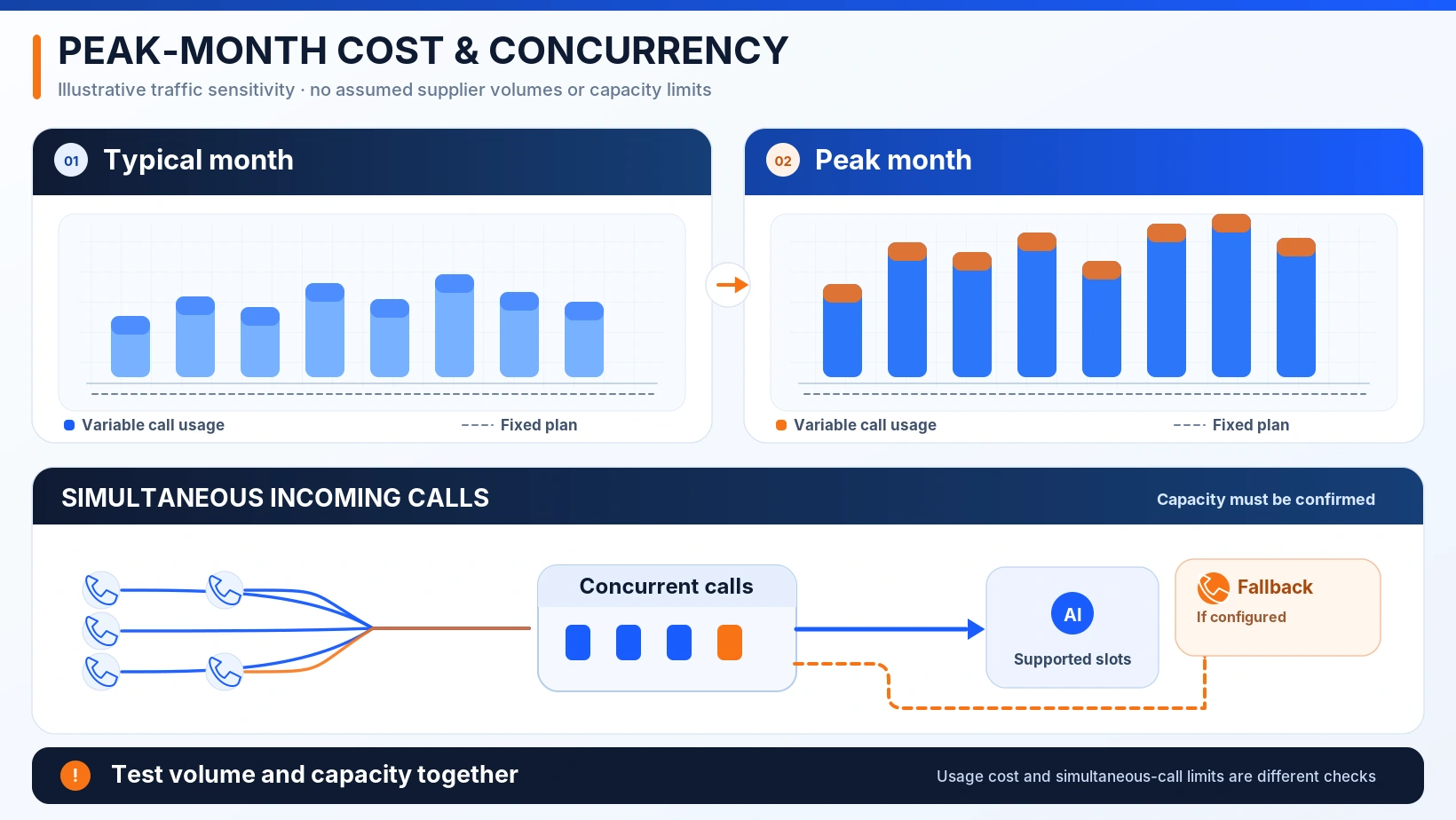
Low-volume month
Check minimum commitments: low usage does not remove setup, contract, support or number fees.
Baseline month
Price ordinary AI-handled minutes plus any parallel telephone legs and business operations.
Peak month
Request written limits and the price of extra lines/minutes, including how failed or transferred calls count.
Service failure
Estimate the manual fallback obligation separately. Poor integration can produce staff rework even when voice minutes remain low.
Cost per verified result—not cost per charming conversation
A voice agent may answer every call but still fail to achieve the business task. A greeting, message captured, valid qualified lead, confirmed calendar booking and a support issue resolved are different outcomes and should not share one success percentage.
| Outcome category | Evidence of completion | Do not count as success |
|---|---|---|
| Message captured | Valid caller details delivered into the agreed inbox or CRM. | The bot saying “I have your message” without a delivery record. |
| Appointment booked | Booking ID and correct diary slot created and available to staff. | A requested slot awaiting manual confirmation. |
| Qualified enquiry | Required answers captured and stored in the correct lead record. | A transcript alone, without valid qualification fields. |
| Customer-service issue resolved | Permitted action completed and reference issued, where appropriate. | A generic reassurance or an unverified API attempt. |
| Human transfer | Call reaches the intended team with the relevant context. | A blind redirect to an unanswered or wrong extension. |
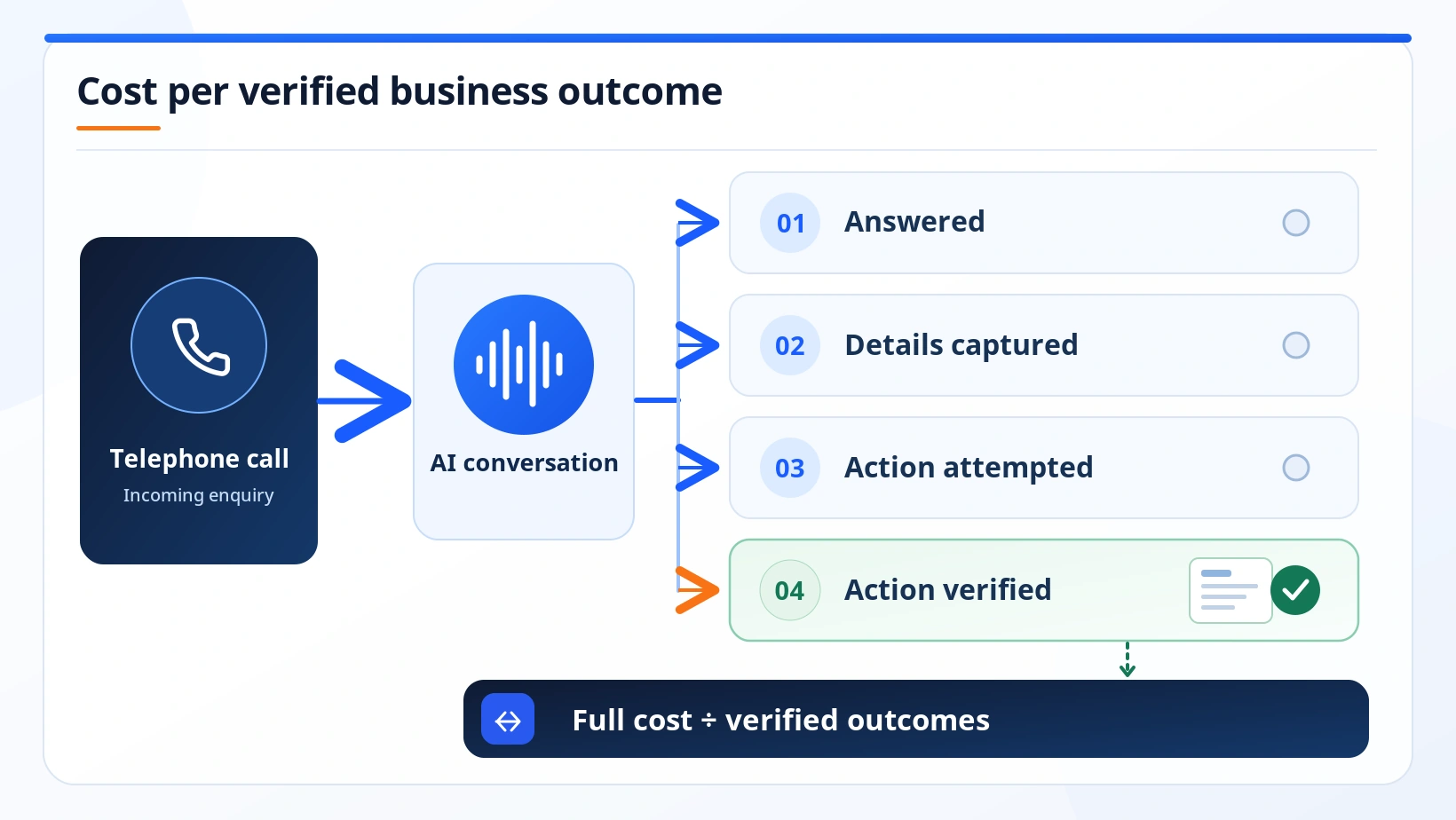
Take a measured pilot period, count independently confirmed results and then calculate annual unit economics. The outcome percentage in the budgeting tool is a user input, not a researched accuracy claim. Only consider a payback case using incremental attributable gross profit or saved operational cost, net of human review and any other relevant spend; do not label every answered call as recovered revenue.
VAT, USD billing and contract exposure
Many platform rate cards are in US dollars, while your finance approval will be in pounds. Take the written commercial terms, use the same FX date and method across quotations, include any card/FX fees, and note who is responsible for the model and carrier bills. Do not copy an approximate USD exchange rate from a competing article into a binding budget.
UK standard VAT is 20% for applicable supplies under GOV.UK guidance, but the correct VAT treatment can depend on the supplier, place of supply and your own business position. The calculator only offers an optional uniform 20% illustration, and defaults to ex VAT. Ask your accountant or supplier to confirm the treatment of each invoice.
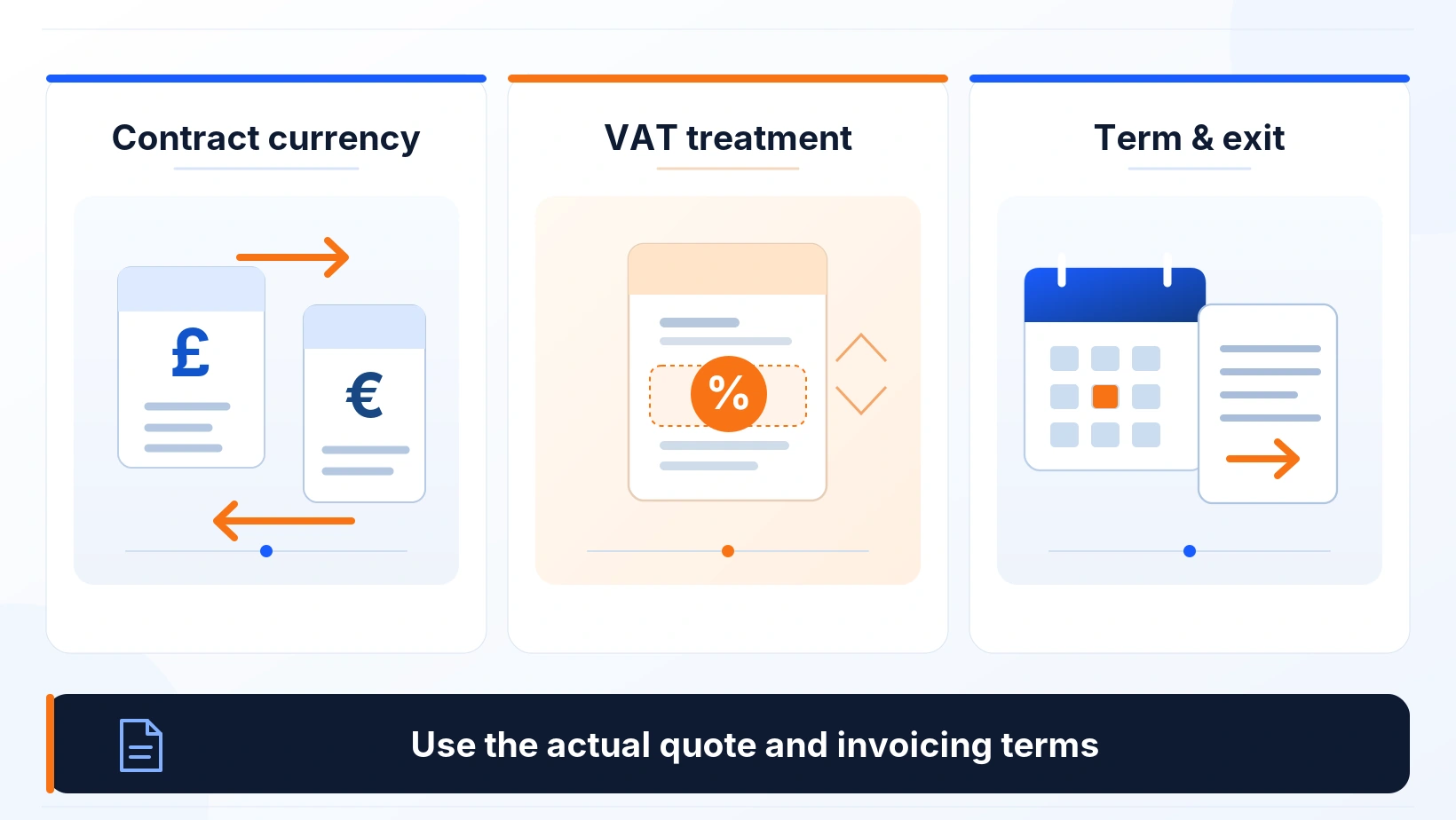
- Specify monthly rolling, annual commitment, prepaid credits and renewal pricing separately.
- Clarify whether unused minute allowances expire and whether trial credits can be applied after deployment.
- Request the charges for extra concurrency, number hosting, transfers, recordings and early termination.
- Ask who owns the telephone number, prompts, knowledge content, call records and integrations at exit.
Give every supplier the same procurement worksheet
A shortlist is useful only if suppliers quote the same job and traffic. Copy the brief below into your request for quotation. Ask vendors to replace “included” with the exact plan or contract clause and “separate” with a charge and billing unit.
Buyer brief: one function, one number, one evidence standard
- Current UK number and telephony environment; whether it must be retained.
- Inbound/outbound scope, monthly call estimates, average/peak traffic and operating hours.
- One specific workflow and evidence of the authorised final action.
- Support for unusual names, interruptions, escalation, security and user notice.
- Per-component charges, rounding, allowance, VAT, currency and FX method.
- Setup, testing, integration changes, support, storage, cancellation and number/record export.
- Live caller transfer, failure diversion and rollback responsibility.
- Pilot sign-off and handover to the business owner.
| Requested quote row | Supplier A | Supplier B | Supplier C |
|---|---|---|---|
| Eligible product and fixed recurring fee | Written figure | Written figure | Written figure |
| AI stack: all-inclusive or pass-through? | Inclusions | Inclusions | Inclusions |
| UK number, carrier and transfer legs | Written figure | Written figure | Written figure |
| Billed minutes, rounding and excess | Terms | Terms | Terms |
| Setup, CRM integration and pilot | Written figure | Written figure | Written figure |
| Support, monitoring and concurrency | Terms / fee | Terms / fee | Terms / fee |
| Contract, VAT, FX and exit costs | Terms / fee | Terms / fee | Terms / fee |
| Verified task and human fallback | Demonstration | Demonstration | Demonstration |
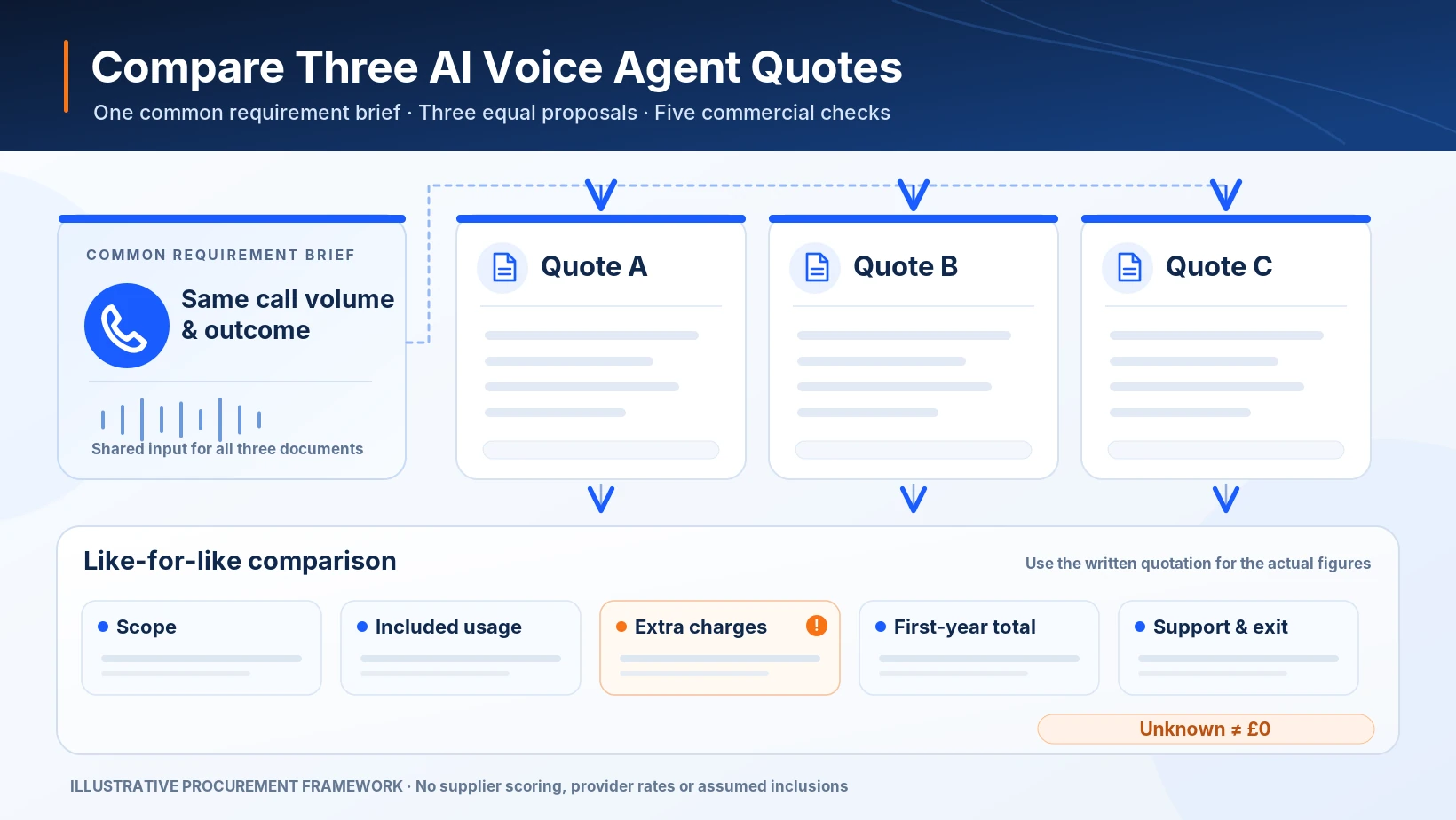
Before agreeing a quote, ask the supplier to recalculate its proposal at your actual baseline and peak call volumes. Keep the written estimate alongside the inputs from the budgeting calculator above.
When a managed offer, an add-on or a build changes the budget
There is no universal point at which a custom build becomes cheaper. A native add-on may have the shortest deployment scope but limited tool permissions; a managed provider may charge more per month but includes operational ownership; self-service infrastructure can shift work and risk onto your team. Compare the full twelve-month obligation and who handles failure.
Already have suitable business telephony
Check native AI eligibility and whether the required workflow, UK number and staff handover can be retained.
Want a defined answering outcome
Request a managed subscription with verified inclusions and an explicit allowance, rather than financing a developer build unnecessarily.
Need controlled CRM or calendar actions
Scope a configurable agent and test identity, data permissions, action acknowledgement and support ownership.
Have an engineering team
Calculate engineering time, hosting, tests, on-call effort and changes alongside the API minutes.
For existing-system operating requirements, identify who owns the number, caller diversion, access to the CRM and the failure route before signing. Our UK AI receptionist comparison provides an additional view of managed answering subscription conditions.
AI voice agent pricing: frequently asked questions
How much does an AI voice agent cost per month in the UK?
There is no single comparable rate. Monthly expenditure depends on the purchased service, included features and minutes, carrier charges, fixed platform fees and operation. Enter the actual quote in the first-year budgeting tool rather than treating another business’s example as an average.
Is a £0.05 per-minute price the total price?
Not necessarily. For example, Vapi distinguishes platform hosting from speech/model components and transport on its public pricing page. Confirm precisely what the published unit includes.
Should I budget for setup even with a no-code product?
Yes, at least assess the time for number setup, business rules, integration credentials, test calls, staff training and rollback planning. Some packages include portions of that work; mark them included only after written confirmation.
How should I estimate the first year?
Calculate twelve months of recurring fixed and usage costs, add one-off configuration and testing, then apply an explicitly stated contingency. Adjust for annual prepaid terms or changing traffic before approving cash flow.
What is the difference between raw conversation time and billed minutes?
The vendor may apply call-level rounding, different chargeable legs, thresholds or add-ons. Request the billing definition and sample call invoice. Use the calculator uplift only as a buyer-controlled sensitivity input until those rules are known.
Do human transfers create additional charges?
They can, depending on platform and carrier route. Check any separate transfer-minute rate, overlapping call legs and whether the AI remains active after transfer.
Can I keep my existing UK business number?
Often an integration, diversion or supported SIP route is possible, subject to your current provider and the selected AI service. The integration guide covers the compatibility checks; retaining a number does not necessarily require porting it.
How do I compare USD pricing with a UK quote?
Set a common conversion date, use the actual contract invoicing currency and include applicable FX charges. Recheck quoted prices, VAT and tax responsibility before signing.
How do I calculate ROI without overstating it?
Use pilot data to measure additional completed tasks or staff capacity actually saved. Apply a defensible incremental gross-profit or avoided-cost figure and subtract all solution and human-review expenditure. Do not assume that each answered call equals a sale.
What if some supplier charges are unknown?
Keep the affected items explicitly marked quote required. An unknown is not zero. Use the model as a planning worksheet and request an itemised written quotation before using the output for final procurement.
Does the cheapest AI platform produce the cheapest project?
Not necessarily. The implementation, phone route, selected models, user support, testing and integration work may cost more than the visible platform fee. Compare like-for-like scope and total first-year cash.
Will the calculator quote a particular supplier?
No. All initial GBP values are stated illustrative assumptions. Replace them with component fees from the specific contract and verify whether the selected service bundles any costs to prevent double counting.
Sources and how these figures were constructed
This guide separates provider-published US-dollar tariff examples from the editable hypothetical GBP worksheet. First-party pages checked on 2 October 2026: Vapi pricing, Retell AI pricing, Bland AI pricing, Synthflow pricing and ElevenAgents pricing. UK VAT reference: GOV.UK VAT rates.
The calculator is arithmetic over buyer-entered fields, not real-time supplier pricing, live FX or a projection of future call success. The baseline is the same twelve-month workflow and outcome definition for every quotation. We have not claimed first-hand installation or production testing of named suppliers. Review each first-party source and the written quote again before purchasing.
For the wider evaluation framework, see how CompareVoIPService reviews business phone providers.
Approve the outcome. Make every cost line visible.
- Use the same call volume and task definition.
- Itemise licences, minutes, network and transfers.
- Include implementation, support and peak periods.
- Require a real demo and written failure route.
Take the budget to suppliers.
Start with the first-year estimate and ask for a scoped proposal against your existing UK phone number, workflow, monthly traffic and success criteria. Compare complete cash cost instead of isolated voice-minute prices.
