
Best Business Phone Systems UK: 10 Compared (2026)

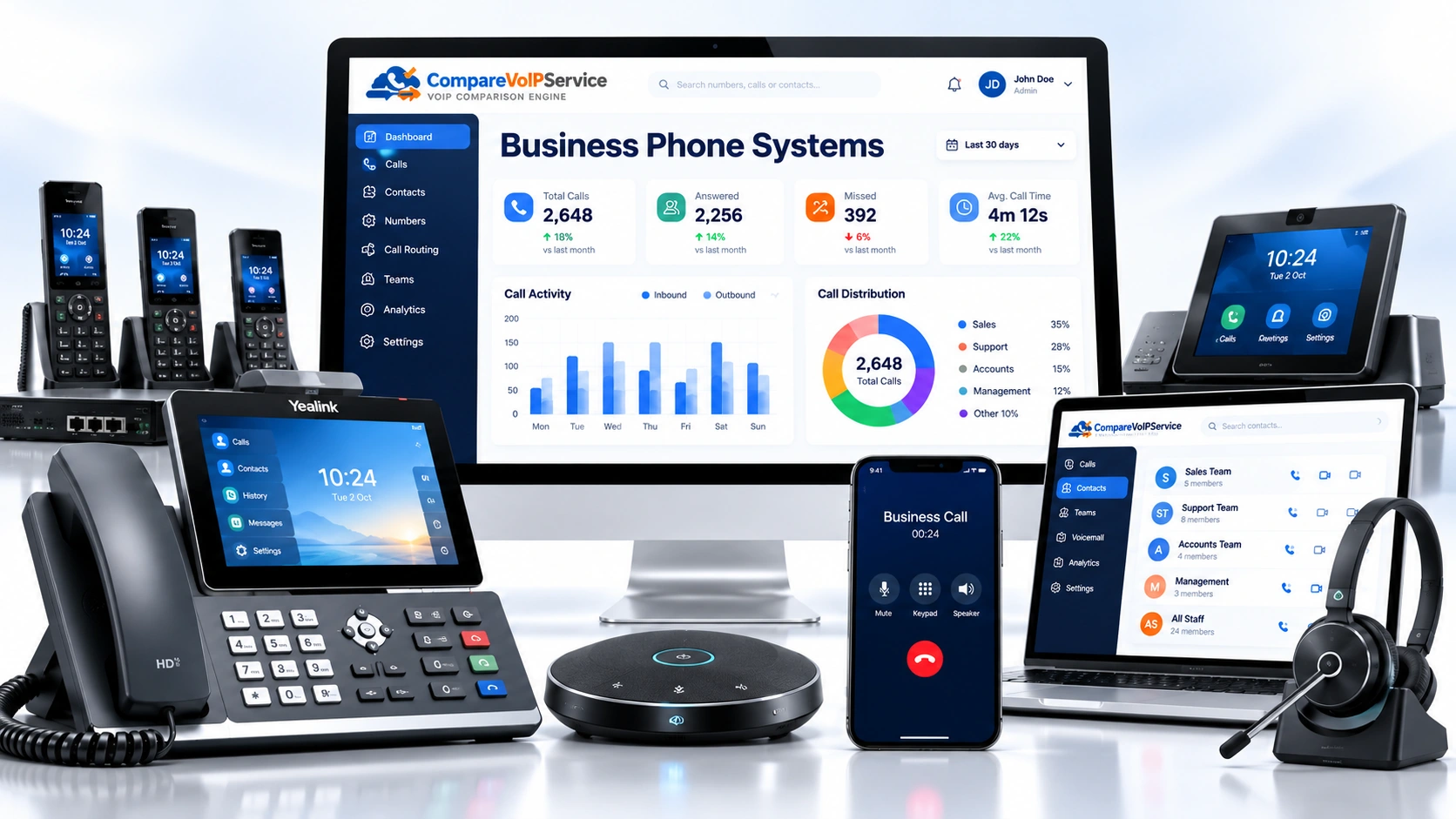
Compare the best business phone systems and VoIP phone systems in the UK for 2026, with a practical focus on pricing clarity, call-flow fit, admin effort, support ownership and switching risk for small businesses, SMEs and growing teams.
Fast answer: Most modern business phone systems are VoIP phone systems that combine business numbers, users, call routing, apps, devices and integrations in one managed environment. For a UK small business or growing SME, the best system is not automatically the cheapest or the most feature-heavy: compare total cost, call-flow fit, number porting, support ownership, administration effort, resilience and room to grow.
The strongest business phone system is not necessarily the platform with the most features or the lowest advertised licence. For a UK SME, the more useful test is whether the system can handle the company’s real call flow at a predictable total cost without creating unnecessary administration or support ambiguity.
That is why this comparison separates provider reputation from system operating fit. We look at what happens after purchase: whether incoming calls reach the right team, where plan upgrades become necessary, how much day-to-day administration is required, how number porting is handled, and who owns the fault when connectivity, hardware or the phone platform fails.
For buyers, the practical takeaway is simple: shortlist on features, but decide on real cost, call-flow fit, switching risk, support ownership and growth headroom.
Jump to a section
Choosing a business phone system is not really about finding the platform with the longest feature list. The important question is whether the system will work properly for the way your business actually handles calls.
For most UK organisations, a modern VoIP phone system combines the company’s business numbers, extensions, users, call routing, voicemail, desktop and mobile apps, devices and integrations. The same underlying technology can support a two-person company, a growing sales team or a multi-site organisation, but the operating requirements are very different.
A five-person company answering enquiries from mobiles has different needs from a 30-person sales team using queues, CRM integration and call recording. A multi-site business has different risks again.
That matters when choosing a small business phone system or a business phone system for a growing SME: the cheapest or most feature-heavy option can still create more administration, switching risk or support complexity than the business actually needs.
For this guide, we compared ten business phone systems available to UK organisations using our UK SME Phone System Reality Test. Instead of concentrating only on headline prices and feature counts, we examine what happens after deployment: how calls are routed, how much administration the system creates, where costs increase, how number porting works and who owns the problem when something goes wrong.
CompareVoIPService’s wider provider research uses a repeatable 42-point framework covering pricing transparency, features, reliability, UK support, integrations, security and PSTN readiness. This guide applies that evidence specifically to business-phone-system operating fit for UK SMEs.
What Is a Business Phone System?
A modern business phone system is the complete calling environment a company uses to manage business numbers, extensions, users, incoming and outgoing calls, voicemail, routing, devices and integrations. In most new UK deployments, the voice layer is delivered using VoIP, so the terms business phone system and VoIP phone system overlap heavily in practice.
VoIP describes the underlying internet-based voice technology. The business phone system is the wider operational solution built around it. That distinction matters because buyers are not only choosing how audio is transported; they are choosing how callers reach teams, how staff make and receive calls, how numbers are controlled, how the system is administered and what happens when something fails.
Business Phone System vs VoIP Phone System
A VoIP phone system carries calls using IP networks rather than relying on a traditional analogue business telephone line. A business phone system can include that VoIP service plus business phone numbers, call routing, queues, voicemail, apps, desk phones, integrations, reporting and administration.
If you need the underlying technology explained first, use our What is VoIP? guide. This page stays focused on comparing complete business phone systems.
Types of Business Phone Systems Covered Here
Provider-hosted systems such as RingCentral, 8×8, Vonage, bOnline and GoTo Connect where the core calling platform is delivered as a cloud service. Our cloud phone systems comparison examines the cloud-specific operating model.
Platforms such as Gamma Horizon where deployment and ongoing support can be strongly shaped by the telecoms partner delivering the service.
Teams Phone uses Microsoft Teams as the user calling environment and requires an appropriate PSTN connectivity model alongside the licence.
Systems such as 3CX can use a different deployment and licensing model, with hosting, SIP trunks and support forming part of the wider architecture.
Best Business Phone Systems at a Glance
These quick picks surface the strongest-fit labels used in the full ranking below. The final choice should still be tested against your actual call flow, integration requirements, support model and total cost.
The 10 Best Business Phone Systems and VoIP Phone Systems in the UK
This table compares the ten systems using the same published order as the detailed reviews below, while surfacing the operating model and main buyer check that can materially affect suitability after purchase.
| Rank | Phone system | Best for | Pricing signal | Operating model | Main buyer check |
|---|---|---|---|---|---|
| 1 | RingCentral RingEX | Growing SMEs needing a mature all-round system | Public UK plans | Cloud business communications / hosted VoIP | Check the exact plan and which capabilities sit above the entry tier. |
| 2 | bOnline | Micro and small UK businesses prioritising simple pricing | From £7/user/month + VAT | Hosted VoIP aimed at smaller businesses | Confirm calling allowances and the features required beyond the starter licence. |
| 3 | Dialpad | AI-first and app-first teams | From £12/user/month | Cloud calling with AI-led user experience | Make sure transcription, summaries and AI features support a real workflow rather than adding unused cost. |
| 4 | 8×8 Work | Multi-site and internationally active organisations | Quote required | Cloud business phone / unified communications | Request an itemised UK quote covering licences, calls, numbers, recording, implementation and support. |
| 5 | GoTo Connect | Businesses needing flexible call-flow control | Quote required | Cloud phone system with configurable routing | Ask the provider to demonstrate your actual inbound call flow before purchase. |
| 6 | Gamma Horizon | UK businesses wanting partner-led deployment | Partner quote | Partner-delivered hosted business phone system | Evaluate the reseller, implementation and support model as carefully as the platform itself. |
| 7 | Microsoft Teams Phone | Businesses already centred on Microsoft Teams | From £7.70/user/month before calling configuration | Teams telephony plus a PSTN calling route | Model Teams Phone, PSTN connectivity, implementation, devices and support as one architecture. |
| 8 | Vonage Business Communications | Flexible mobile and unified communications | From £10/user/month | Cloud communications with tiered integrations | Check whether your required CRM, Teams or advanced features require a higher plan. |
| 9 | BT Cloud Voice | SMEs preferring a large UK telecoms supplier | From £10.52/month on published 60-month licence | Hosted VoIP from a major UK telecoms supplier | Compare total contract value, commitment length and scheduled price changes. |
| 10 | 3CX | IT-led organisations wanting greater deployment control | System-based rather than normal per-user pricing | Software / hosted IP PBX architecture | Include hosting, SIP trunks, support and implementation when comparing total cost. |
Pricing checked: 22 September 2026. VAT, call bundles, contract length, implementation, numbers, hardware and optional features can change the actual cost. Several providers use quotation-led pricing rather than publishing a complete UK tariff.
How We Compare Business Phone Systems for UK SMEs
Most business phone system comparisons concentrate on four things: features, price, pros and cons, and a final rating.
Those factors matter, but they do not expose many of the problems businesses discover after signing a contract.
Our UK SME Phone System Reality Test asks seven additional questions.
1. Real Cost
What will the system actually cost once the required users, numbers, call bundles, recording, integrations, handsets, setup and support are included?
A low entry price does not automatically mean a low-cost business phone system.
2. Call-Flow Fit
Can the system handle the actual journey your callers need?
For example:
Main number → opening greeting → sales or support → queue → overflow → voicemail or alternative team → out-of-hours treatment.
The right VoIP phone system should make that flow manageable rather than forcing the business around the software.
3. Admin Effort
How difficult is it to carry out common changes?
We look at activities such as adding users, changing opening hours, adjusting forwarding rules, retrieving recordings, modifying queues and generating reports.
4. Switching Risk
Moving phone systems can affect business numbers, routing, hardware and service continuity. Our dedicated Number Porting guide covers the continuity and transfer workstream in more depth.
We therefore consider number porting, migration responsibility, temporary routing, broadband dependencies and what happens during the changeover.
5. Support Ownership
If calling stops, who owns the fault?
Depending on the setup, responsibility may sit with the VoIP provider, reseller, broadband supplier, Microsoft partner, network team or internal IT department.
Clear ownership matters when the phones are unavailable.
6. Growth
A system that works perfectly for five users may become expensive or difficult at 30.
We look for the point at which extra queues, recording, analytics, CRM functionality, permissions or additional sites force a significant plan change.
7. Continuity
A business phone system depends on more than the application.
Internet access, power, network configuration and fallback routes all matter. Businesses should consider emergency-calling access and what happens to voice services during broadband or power failures.
1. RingCentral RingEX — Best All-Round Phone System for Growing SMEs
RingCentral is a strong starting point for businesses that expect their communications requirements to become more sophisticated over time.
Its appeal is not simply the number of features. The platform combines business calling with desktop, browser and mobile access, integrations and central administration, making it particularly suitable when different teams need to operate on the same communications platform.
Where RingCentral fits
RingCentral makes most sense for businesses that have moved beyond a single number and a handful of extensions.
A growing organisation may need departmental routing, remote workers, call recording, reporting, integrations and a consistent administration model across multiple locations.
That is the environment where RingCentral becomes more compelling.
Reality Test
Real cost: Check the exact plan rather than relying on the lowest advertised price. Some capabilities and usage allowances differ between tiers.
Call-flow fit: Strong for organisations with structured routing requirements. Use the Business Call Routing guide to map the workflow before comparing platforms.
Admin effort: Centralised administration can reduce fragmentation as the business grows.
Switching risk: Number porting, existing hardware and broadband readiness should be planned before cutover.
Support ownership: Generally clearer when RingCentral provides the core platform directly, although connectivity may remain with another supplier.
Growth: One of the stronger options when a business expects to expand users, integrations or sites.
Continuity: Internet and local-network resilience still need to be considered separately from platform availability.
Growing SMEs that want one phone platform capable of supporting more sophisticated calling requirements later.
Do not buy a higher-tier communications platform simply because the feature list looks impressive. Map the required call flows and integrations first.
2. bOnline — Best for Smaller UK Businesses Wanting Clear Entry Pricing
bOnline deserves particular attention because its UK proposition is designed around small businesses rather than large enterprise communications.
Its current pricing starts at £7 per user per month plus VAT for its Starter plan. The Unlimited Calling plan is £13.95, while its AI-focused plan is currently advertised at £19.95 per user per month plus VAT.
That transparency is useful because small businesses can establish an initial cost without beginning with a sales conversation.
Reality Test
Real cost: Relatively easy to understand at entry level, although the required call allowance and advanced capabilities still need checking.
Call-flow fit: Appropriate for conventional small-business routing and answering requirements.
Admin effort: A comparatively simple proposition for organisations that do not want a complex communications environment.
Switching risk: Confirm number porting arrangements before cancelling an existing service.
Support ownership: Particularly important if broadband comes from another supplier.
Growth: Strongest fit is likely to remain at the smaller end of the SME market.
Continuity: Businesses should still consider broadband failover and how incoming calls are handled during a local connectivity outage.
Startups, professional services firms, trades and smaller offices that need a recognisable business number and proper VoIP phone features without enterprise-level complexity.
The cheapest licence is not automatically the correct licence. Compare outbound calling allowances and required features before choosing on price alone.
3. Dialpad — Best AI-First Business Phone System
Dialpad approaches business calling as an app-led communications environment with AI integrated into day-to-day calls.
Its UK material advertises plans starting from £12 per user per month and includes a UK business number, domestic calling and communications features within the platform.
The distinction is important for businesses that want more than call routing.
Transcription, conversation intelligence and AI-supported workflows can reduce the amount of information lost after customer calls.
Reality Test
Real cost: Public entry pricing makes initial comparison easier, but advanced requirements may require higher tiers.
Call-flow fit: Suitable for businesses combining direct calling with distributed teams.
Admin effort: Strong app-first approach can work well where staff are comfortable managing communications digitally.
Switching risk: Assess number porting and user adoption at the same time.
Support ownership: Connectivity remains a separate operational dependency unless bundled elsewhere.
Growth: Particularly attractive for organisations that expect AI-assisted call handling and analytics to become more important.
Continuity: Mobile access can provide useful flexibility, but an organisation still needs an outage strategy.
Sales teams, recruitment businesses, consultancies and other organisations where a large part of the value sits in the conversation itself.
Do not pay for AI features simply because they are available. Identify whether transcripts, summaries or call intelligence will feed an actual business workflow.
4. 8×8 Work — Best for Multi-Site and International Requirements
8×8 combines cloud PBX capabilities with broader unified communications.
Its UK business-phone platform includes multi-level auto attendant, call recording, visual voicemail, number porting, mobile/browser access and integrations with platforms including Microsoft Teams and CRM systems.
8×8 also supports UK local PSTN numbers, local number porting and emergency calling.
Reality Test
The main commercial limitation for comparison shoppers is that UK platform pricing is increasingly quote-led rather than expressed through a simple public per-user figure.
That does not make the platform expensive or inexpensive; it means buyers should insist on a fully itemised proposal.
Multi-location businesses, internationally active organisations and companies that expect phone and customer communication requirements to become more sophisticated.
Request a like-for-like written quote covering licences, calling destinations, numbers, recording, implementation and support.
5. GoTo Connect — Best for Businesses with More Complex Call Routing
GoTo Connect’s strongest characteristic is its emphasis on configurable business telephony.
Its current Phone System package includes auto attendants, call queues, customisable dial plans, desktop and mobile applications and integrated meetings. UK-facing pricing is sales-led rather than a simple published licence figure.
Why that matters
Some businesses do not have complicated technology requirements, but they do have complicated caller journeys.
Think of a property company routing tenants, landlords, maintenance and new enquiries differently depending on time and location.
That type of problem is more about call-flow design than the number of features on the platform.
Service organisations, multi-department SMEs and businesses where incoming-call routing is operationally important.
Ask the provider to demonstrate your proposed call flow before purchase rather than simply showing the platform’s generic capabilities.
6. Gamma Horizon — Best for Partner-Led UK Deployment
Gamma Horizon is a hosted business-phone platform with a strong presence in the UK channel market.
Gamma describes Horizon as a hosted communications system combining fixed and mobile telephony, hosted PBX functionality, multi-site deployment and collaboration capabilities.
Its operating model differs from app-first providers because the implementation and support experience can depend heavily on the Gamma partner delivering the service.
UK SMEs that prefer implementation, support and ongoing configuration to be delivered through a telecoms partner rather than handled entirely internally.
When comparing Gamma proposals, evaluate the reseller as carefully as the underlying platform. Support quality, onboarding and commercial terms may differ between partners.
7. Microsoft Teams Phone — Best for Microsoft 365-Centred Businesses
Teams Phone can be a logical choice when employees already spend most of their working day inside Microsoft Teams.
Microsoft currently lists Teams Phone Standard at £7.70 per user per month when paid annually, excluding VAT. The licence does not by itself solve the entire PSTN requirement: businesses then need an appropriate calling route such as a Microsoft Calling Plan, Operator Connect or Direct Routing.
Reality Test
Teams Phone demonstrates why headline licence comparisons can be misleading.
The real architecture can include:
- Microsoft 365 or Teams licensing, as applicable
- Teams Phone
- PSTN connectivity
- Implementation
- Certified devices
- Contact-centre requirements
- Support partner
Businesses already standardised on Microsoft 365 and Teams, especially where reducing application switching is important.
Treat Teams Phone as a telephony architecture, not simply another £7.70 phone licence.
8. Vonage Business Communications — Best for Flexible App-Based Communications
Vonage publishes three main UK business communications levels: Express at £10, Core at £15 and Max at £25 per user per month, excluding VAT.
Core adds capabilities including CRM integrations and Microsoft Teams compatibility, while Max adds a more mobile-centric communications model.
Businesses that want conventional business calling combined with mobile and software integration options.
Check which capabilities sit in the required tier. A low entry price matters less if your essential integration or call workflow requires an upgrade.
9. BT Cloud Voice — Best for SMEs Wanting a Major UK Telecoms Supplier
BT Cloud Voice offers a conventional hosted VoIP migration path for UK SMEs.
BT currently publishes Basic at £10.52 per month, Connect at £13.74 and Collaborate at £20.09 on the cited 60-month licence structure, excluding VAT. BT also publishes scheduled annual price increases for these plans.
That makes contract evaluation particularly important.
Businesses that value dealing with an established UK telecoms supplier and want business calling positioned alongside other connectivity services.
Compare total contract value, not just the starting monthly figure. A long commitment and pre-disclosed annual price changes can materially affect the actual cost.
10. 3CX — Best for IT-Led Businesses Wanting More Control
3CX differs significantly from most providers in this guide.
Rather than relying exclusively on the conventional per-user SaaS model, commercial 3CX licensing is built around simultaneous-call requirements and can be hosted by 3CX or deployed through other infrastructure models.
That makes it potentially attractive for organisations that want more control over architecture or economics.
It also creates more design decisions.
Businesses with internal IT capability or a trusted 3CX partner.
3CX should not be compared with normal £X-per-user products by simply dividing the licence cost by headcount. Hosting, SIP trunks, support and implementation form part of the real deployment.
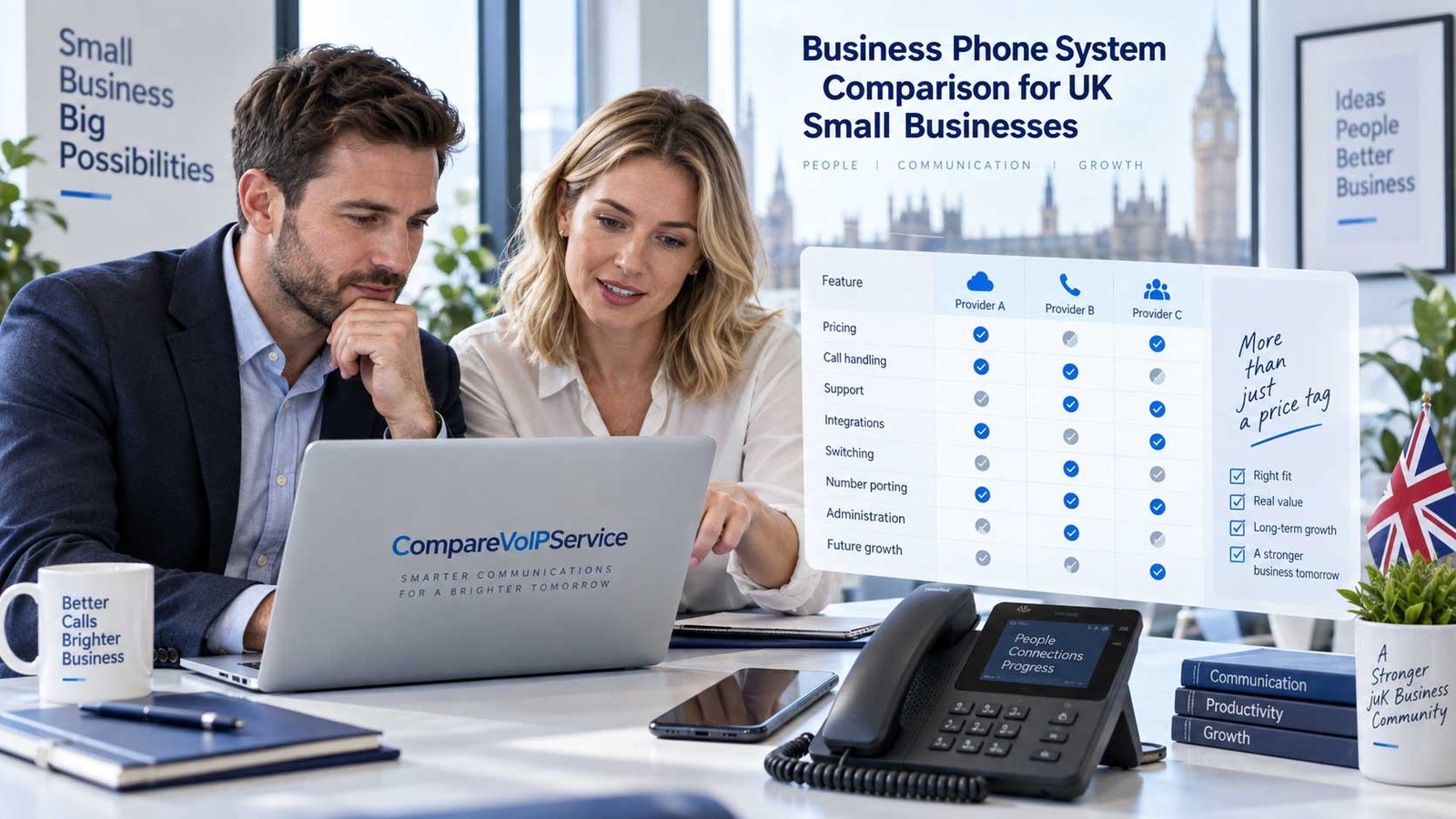
Best Small Business Phone Systems by Company Size
Best Phone System for 1–5 Users
Priorities are usually simplicity, predictable pricing, mobile/desktop calling and reliable handling of the main business number.
Complex contact-centre functionality is rarely necessary.
bOnline and app-led platforms such as Dialpad deserve particular attention here.
Best Phone System for 6–20 Users
This is often the point where phone-system design becomes more important.
Departments, queues, working-hours rules, call recording, CRM integration and administration can start to matter.
RingCentral, GoTo Connect, Gamma Horizon and comparable hosted systems become more relevant.
Best Phone System for 21–50 Users
Governance starts to matter almost as much as calling.
Look at:
- permissions
- reporting
- multi-site administration
- user provisioning
- queue supervision
- recording access
- integration control
- business continuity
A system that was easy for six people may become cumbersome for 40.
Best Phone System for 50+ Users
Do not treat the purchase as simply buying phone licences.
Document telephony architecture, resilience, security, admin roles, contact-centre requirements, integration dependencies and migration governance before choosing a platform.
For organisations operating across several offices, define branch-level control, numbers, routing and continuity using the multi-site business phone systems guide before comparing platforms.
Do Business Phone Systems Need Desk Phones?
No. A modern VoIP phone system for a small business can use IP desk phones, desktop softphones, browser calling, mobile apps, wired or wireless headsets, conference-room devices, or a mixture of these.
The right device model depends on how staff actually work. Reception and high-volume call handlers may still benefit from physical handsets and dedicated headsets, while hybrid and mobile teams may prefer desktop and mobile applications. Microsoft Teams Phone deployments may also use Teams-certified devices where physical endpoints are required.
Buying rule: do not choose a phone system because it supports the largest hardware catalogue. Define which user groups need desk phones, softphones, mobile apps, headsets or shared-room devices first, then confirm the shortlisted platform supports that mix cleanly.
If you are planning the installation stage, use the VoIP Setup Guide for network, equipment, testing and go-live preparation.
What Does a Business Phone System Really Cost?
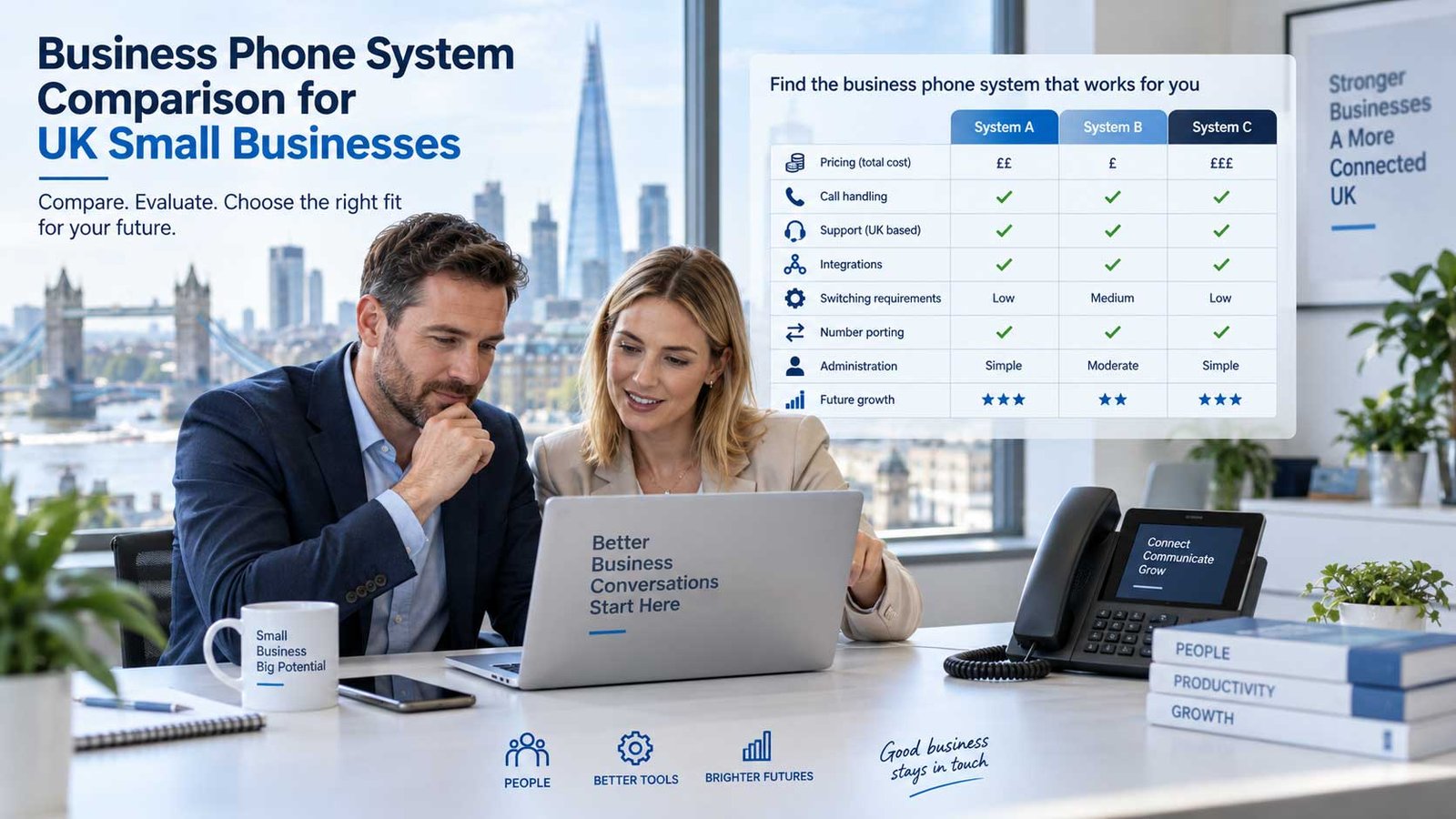
Do not compare quotes solely on:
users × monthly licence price.
A more useful calculation is:
Licences + calling + numbers + setup + porting + hardware + recording + integrations + support + connectivity + contract increases.
That exposes the real commercial difference between providers.
For example, a five-user business may need little more than software licences and number porting.
A 30-user operation may require:
- multiple numbers
- call queues
- recording
- CRM integration
- desk phones or headsets
- analytics
- onboarding
- training
- failover connectivity
The second organisation can therefore have a very different total cost even when the advertised licence price looks similar.
The Feature Cliff: Where Cheap Phone Systems Become Expensive
One of the most useful questions to ask a supplier is:
What requirement would force us onto the next plan?
The answer may be:
- call recording
- advanced analytics
- CRM integration
- multi-level auto attendant
- additional queues
- AI features
- international calling
- supervisor functions
- single sign-on
- advanced security
This is the feature cliff.
Finding it before signing a contract can be more valuable than negotiating another £1 off the entry licence.
Who Owns the Problem When Business Calls Fail?
The answer is not always “the phone provider”.
A cloud phone system can involve several layers:
A well-designed deployment makes ownership clear before there is an outage.
For business-critical locations, ask how inbound calls can be redirected if the site loses connectivity and whether staff can continue from mobile applications or another location. The VoIP call quality and reliability guide explains the network metrics and failure-path evidence to test before deployment.
PSTN Switch-Off: Why 2026 Is an Important Buying Year
Openreach states that traditional UK phone lines will move to digital services by 31 January 2027.
That does not mean every business should rush into the first VoIP contract available.
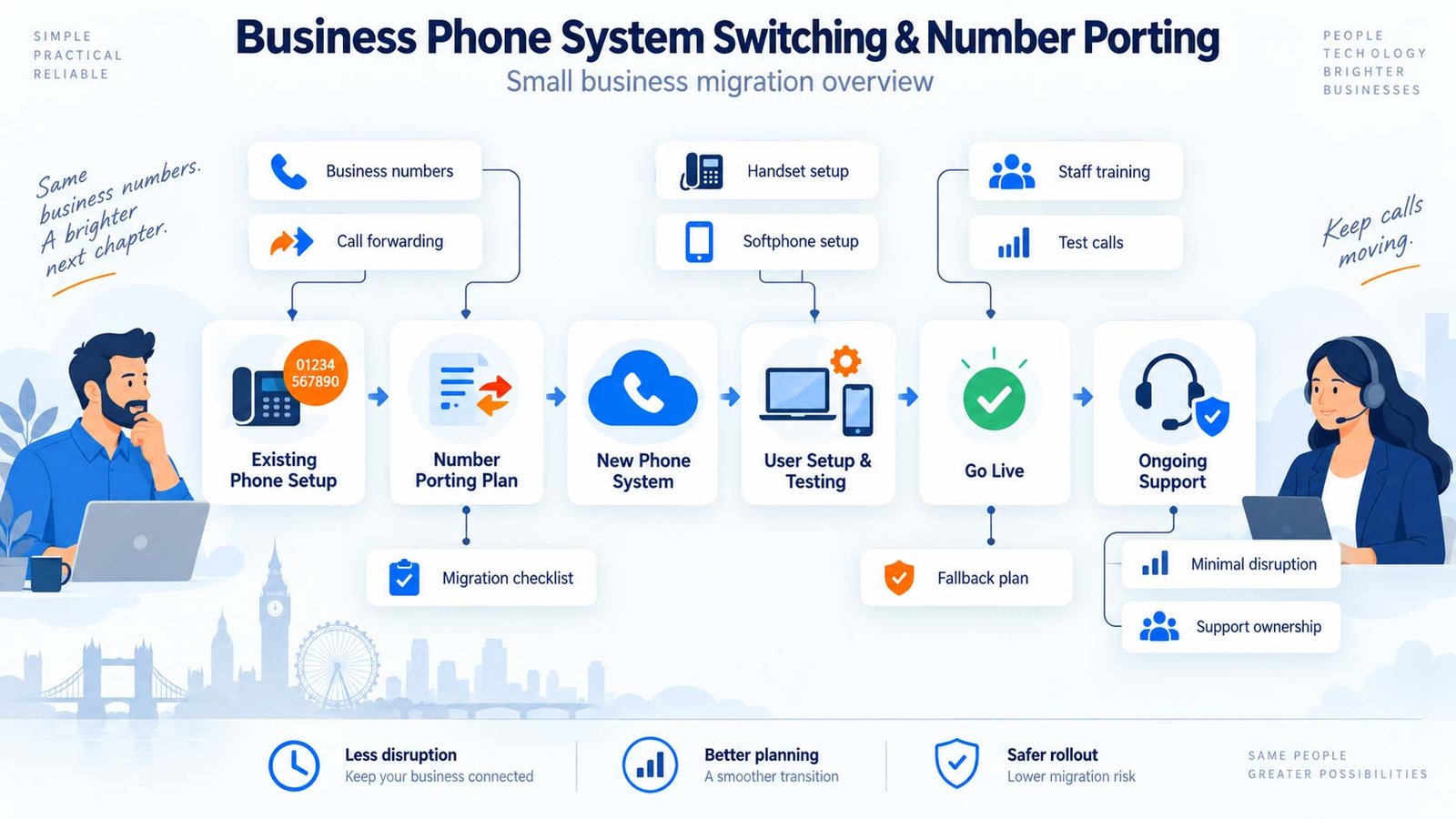
It means businesses still dependent on traditional lines should identify:
- telephone numbers
- existing PBX equipment
- alarms and other line-dependent equipment
- fax or legacy devices
- door-entry systems
- payment terminals
- broadband resilience
- number-porting requirements
Use the dedicated PSTN switch-off guidance for the migration workstream rather than allowing the migration deadline to dictate the wrong long-term phone system.
How to Choose the Right Small Business Phone System
Start with your calls rather than your preferred provider.
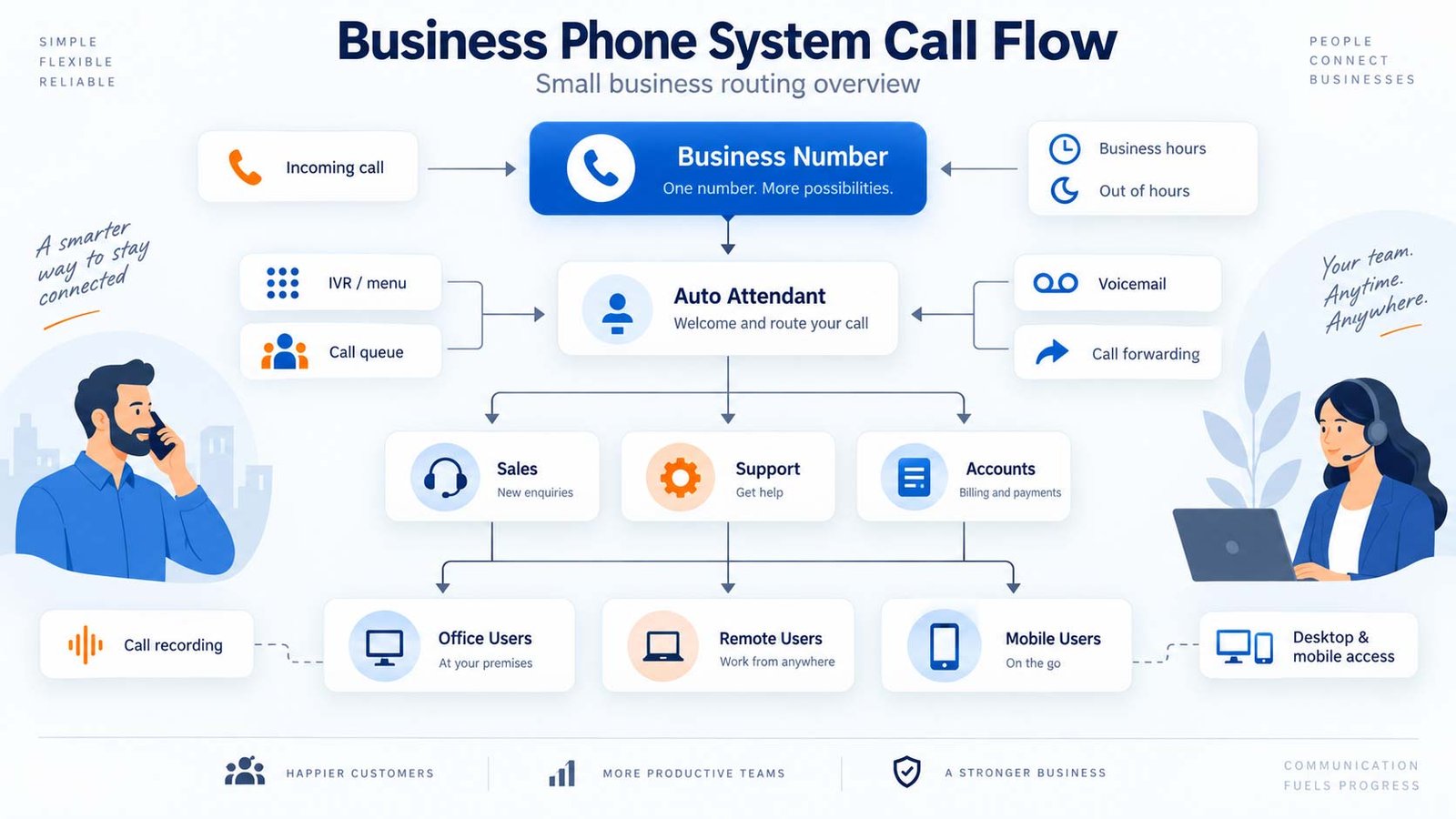
Document one normal working day.
- How many calls arrive?
- Who answers first?
- What happens when they are unavailable?
- Which departments receive calls?
- Do customers wait in queues?
- Which calls need recording?
- Do users need desk phones, mobile applications or both?
- Which customer information should appear when the phone rings?
- Who changes the system when opening hours change?
- What happens if broadband fails?
Once those questions are answered, comparing providers becomes much easier. Define the business number structure, map the call-routing journey, confirm number-porting requirements and document any CRM integration before you ask shortlisted suppliers to demonstrate their platforms.
Final Verdict
There is no single business phone system that is automatically right for every UK SME.
RingCentral RingEX is one of the strongest all-round routes for organisations expecting more sophisticated requirements.
bOnline deserves attention from smaller UK businesses wanting accessible entry pricing.
Dialpad stands out where AI-supported calling and an app-first experience matter.
8×8 becomes more relevant for multi-site and internationally active organisations.
GoTo Connect deserves consideration where sophisticated call-flow design matters.
Gamma Horizon is particularly relevant when a strong UK implementation partner is part of the requirement.
Teams Phone can make sense when Microsoft Teams is already the centre of everyday work.
Vonage, BT Cloud Voice and 3CX each address different operating models that can be the correct fit in the right environment.
The best approach is therefore not to ask:
“Which provider has the highest rating?”
Ask:
“Which system creates the least operational friction for the way our business actually handles calls?”
That is the question this comparison is designed to answer.
Frequently Asked Questions
What is the best phone system for a small business in the UK?
The answer depends on team size, call routing, integrations, support requirements and budget. Small teams may prioritise simplicity and transparent pricing, while larger SMEs usually need stronger queueing, reporting, permissions and integration capabilities.
Is a VoIP phone system the same as a business phone system?
Most new UK business phone systems are built on VoIP, so VoIP phone systems and business phone systems overlap in practice. However, “business phone system” describes the wider operational solution: numbers, users, routing, voicemail, applications, devices, administration and integrations.
What is a VoIP phone system?
A VoIP phone system uses internet protocol networks to carry business voice calls and usually combines that calling service with business numbers, extensions, voicemail, call routing, desktop or mobile apps and administration tools.
Which VoIP phone system is best for a small business?
The best fit depends on team size, required call flow, support expectations, integrations, device preferences and total cost. Smaller teams often value simplicity and transparent pricing, while growing SMEs usually need stronger routing, reporting, permissions and integration control.
What features should a small business phone system include?
Typical requirements include a business number, user extensions, voicemail, working-hours rules, call transfer, mobile or desktop apps and basic administration. Queues, call recording, CRM integration, analytics, AI and advanced security should be added only when the business workflow requires them.
What types of business phone system are available?
Common modern options include hosted or cloud VoIP, partner-managed hosted systems, Microsoft Teams Phone deployments and software or IP PBX platforms such as 3CX. The correct model depends on control, support, integrations, resilience and internal IT capability.
How much does a small business phone system cost?
Public UK entry prices can start below £10 per user per month, but the realistic cost depends on call allowances, numbers, hardware, setup, recording, integrations, support and contract terms. Compare total cost rather than licence price alone.
Can I keep my existing business telephone number?
Business numbers can commonly be ported between providers, subject to technical and contractual requirements. Confirm the porting plan before cancelling the existing service.
Do I need desk phones with VoIP?
No. Many systems support desktop and mobile applications as well as physical IP phones. The correct device mix depends on how employees work.
What happens to VoIP during a power or broadband failure?
VoIP depends on connectivity and powered network equipment. Businesses should plan resilience using measures appropriate to their requirements, such as mobile applications, call diversion, backup connectivity or power protection.
Is Microsoft Teams a business phone system?
Teams becomes a business phone system when Teams Phone and an appropriate PSTN calling method are configured. Teams Phone Standard alone does not represent the entire telephony cost or architecture.
Should I switch before the PSTN deadline?
Businesses using legacy lines should plan migration well before 31 January 2027 so they have time to identify dependencies, port numbers, test routing and resolve problems before legacy services are withdrawn.
Sources & Methodology
This article is a commercial-investigation ranking page. It is designed to answer which business phone systems are most suitable for different UK SME operating scenarios. It does not replace the individual provider reviews, head-to-head comparison pages or the wider Best VoIP Providers UK ranking.
How the ranking was produced
The evidence base starts with the CompareVoIPService review methodology, which uses a repeatable 42-point framework across seven categories: pricing and contract transparency, core and advanced features, reliability and call-quality signals, UK customer support, software integrations, security and compliance signals, and PSTN switch-off readiness.
For this article, that framework is supplemented by the UK SME Phone System Reality Test used on this page:
- Real cost
- Call-flow fit
- Admin effort
- Switching risk
- Support ownership
- Growth headroom
- Continuity
The page therefore evaluates the practical operating fit of each system rather than simply repeating a provider’s marketing feature list.
The published order is determined by the existing weighted 42-point ranking framework. The Reality Test is a page-specific interpretation layer used to explain small-business operating fit; it does not create a separate score or override the domain-wide methodology.
Evidence rules
- Official provider documentation and UK pricing pages are the primary source.
- Published prices are shown only where a current public UK price could be verified. Where pricing is sales-led, the article states quote required rather than estimating a figure.
- Pricing was checked on 22 September 2026. VAT treatment, contract term, call allowances, implementation, numbers, hardware and add-ons can change the real total cost.
- Product capabilities are described from current provider documentation. We do not label a product hands-on tested unless it has actually been independently used and tested by CompareVoIPService.
- Openreach and Ofcom are used for UK migration, continuity and emergency-calling context where relevant.
- Third-party reviews may provide supporting context, but they are not treated as proof of a provider’s technical capability or used as a substitute for primary evidence.
- Providers cannot pay to change the methodology or ranking. See the affiliate disclosure.
- If a material fact changes, the relevant section should be updated and the evidence rechecked. Corrections can be submitted through the contact page.
Primary sources checked
- RingCentral RingEX service information
- bOnline pricing
- Dialpad UK phone calling
- 8×8 UK business phone
- 8×8 United Kingdom service information
- GoTo Connect pricing and plans
- Gamma Horizon hosted phone system
- Microsoft Teams Phone UK
- Vonage Business Communications UK pricing
- BT Cloud Voice
- 3CX pricing and licensing
- Openreach digital phone-line switch-off
- Ofcom guidance on emergency access during power cuts
Compare Business Phone System Quotes Beyond the Headline Price
Compare the total first-year cost of business phone systems, including user licences, business numbers, setup, number porting, handsets, call recording, integrations, support, connectivity and contract terms before choosing a system.
