
VoIP Migration Planner for UK Businesses

Plan a Safer Business Phone Cutover With Clear Evidence

Track business numbers, line-dependent equipment, supplier confirmations, tests and recovery before changing phone services. Create a cutover readiness record and supplier handover pack without signing up.
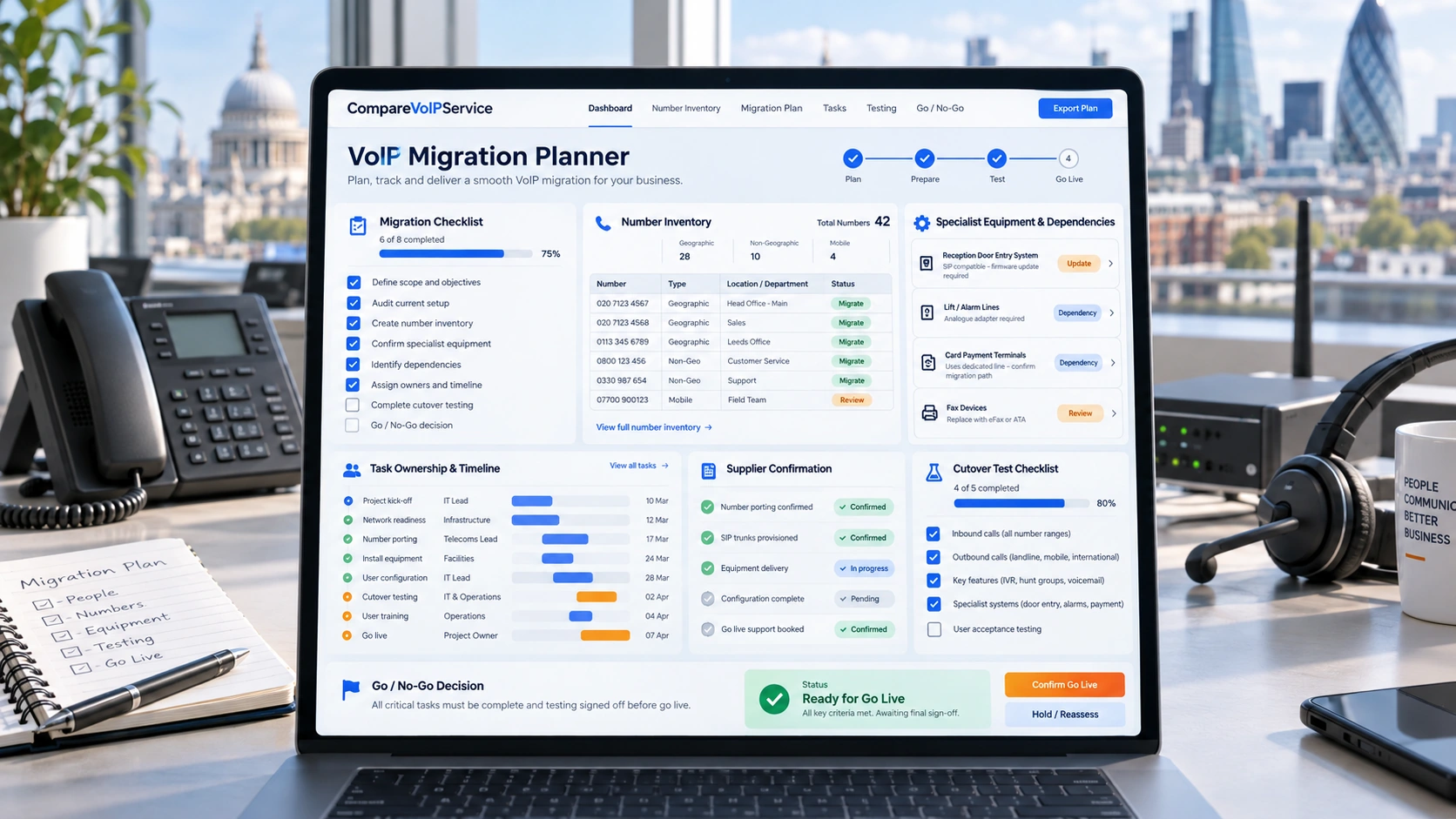
UK VoIP migration planner illustration showing an evidence-led telephone-service cutover

Know What Must Be Ready

Account for every critical number and line-dependent device. Track named owners, supplier evidence and verified customer call routes before the proposed cutover.

Decision rule: An unresolved safety-related dependency or business-critical number should stop the affected cutover.

Prepare a Business-Specific Cutover Plan

Can your business move phone services without overlooking essential lines? A plan is useful only when the numbers, equipment, owner responsibilities, tests and recovery actions are actually recorded.

Use the interactive planner below to identify blockers and produce a handover pack for the relevant business decision-maker and suppliers.

Open Your Migration Planner

What the Planner Delivers

Critical dependency register: business numbers, alarms, lift and telecare systems, network, power and call routes.

Named task owners: status, due date and explicit verification evidence.

Cutover decision: hold or conditional authorisation based on critical blockers, not percentage complete.

Understand Your Migration Readiness Decision

Build a documented inventory, obtain supplier-confirmed commitments and identify unresolved critical blockers before seeking cutover approval.

Business Telephone Migration Readiness Planner

Record what is in scope, who owns each dependency and what has been verified. This is a project record, not a confirmation of a porting appointment or certification of safety-related devices.

1. Project Scope and Change Window

Enter only a date confirmed in writing by the relevant supplier. A proposed date above is never treated as confirmation.

2. Assign Owners and Verify Dependencies

All listed items need review. For critical items, “Verified complete” requires an owner and evidence. “Not applicable” requires an owner and a documented reason; do not use it to bypass safety-related checks.

Migration Tasks

0 of 0 verified
3. Change Approval and Recovery

Privacy: this planner runs in your browser. Data is not sent to CompareVoIPService by this form; leaving or refreshing the page may discard it. Open a downloaded HTML report in your browser to print or save it as PDF. Download your report before leaving. Avoid entering unnecessary personal or security-sensitive details.

';return out} $('cvmig-export').addEventListener('click',()=>{if(latest)download('comparevoipservice-voip-migration-supplier-handover.html',report(latest),'text/html;charset=utf-8')});$('cvmig-print').addEventListener('click',()=>{if(latest)download('comparevoipservice-migration-print-ready-report.html',report(latest),'text/html;charset=utf-8')});renderTasks();togglePort(); })();

Critical Equipment Dependencies

Identify alarms, lifts, payment devices, intercoms, fax and telecare systems that may rely on legacy lines.

Review Specialist Equipment

Provider-Confirmed Number Transfers

A requested date does not prove a port is scheduled. Record the supplier-confirmed appointment and the number inventory.

Review Number-Porting Readiness

What Readiness Does Not Guarantee

No browser tool can certify supplier compliance, successful porting or the safety of third-party devices. A user-recorded authorisation remains conditional on genuine external verification.

Read the Planning Limitations

Build Your Business Telephone Migration Plan

Begin with scope. Identify the locations, numbers, services, people and third parties involved. Then record what depends on the existing telephone connection. Do not assume that every line is used only for voice calls.

Planning areaInformation to establishEvidence to retain
Business sitesEach office, branch, remote team or location using the affected serviceSite list and service owner
Telephone numbersMain numbers, direct dial-in numbers, departmental lines and special destinationsVerified inventory and current provider records
Existing serviceCurrent carrier, PBX, SIP service, analogue line or hybrid arrangementService bills, contract references and technical details
Number portabilityWhich numbers the business needs to retain and who can authorise a moveGaining-provider requirements and written account-holder confirmation
Line-dependent devicesAlarm signalling, payment devices, entry systems, lift communications, fax or monitoring equipment where relevantDevice owner, supplier advice and compatibility test plan
User accessDesk phones, softphones, mobile apps, headsets and shared devicesUser and device inventory
Network and powerRouter, switches, internet circuits, backup connections and power resilienceTechnical readiness evidence and dependency owners
Customer call flowsReception, sales, support, out-of-hours messages and escalation destinationsAgreed routing specification and test calls
Migration ownershipBusiness lead, IT/network owner, existing provider, gaining provider and specialist vendorsNamed responsibility and escalation contacts
Planned cutoverProposed date, required lead times, change window and support coverConfirmed schedule and change approvals

Build my migration plan

Record The Dependency Before Marking A Task Complete

Every important task should have an owner, a status and evidence. “Supplier contacted” is not the same as “supplier confirmed compatibility and agreed the test”. “Port request submitted” is not the same as “porting date confirmed”.

A simple, dependable status set is Not started, In progress, Waiting for third party, Blocked, Verified complete and Not applicable. Keep blocked items visible until resolved; moving them to a completed column does not remove the risk.

Stage 1: Find Everything Using the Existing Connection

The most costly omissions are often services that are not included in a normal extension list. Investigate numbers and analogue circuits that support equipment rather than staff conversations. Ask the people who operate the relevant site or system, not only the telephone administrator.

Potential dependencyWhy it needs a separate checkSuitable next action
Fire or intruder alarm signallingThe communicator may depend on a specific connection or signalling methodObtain advice and test requirements from the alarm or monitoring provider
Lift emergency communicationsEmergency calling and approved communications arrangements may have particular requirementsConfirm the correct solution with the lift maintainer or specialist provider
Telecare or personal alarm equipmentContinuity and safeguarding can be criticalCoordinate with the specialist supplier and follow relevant provider protection procedures
Card payment terminalSome terminals may still use legacy connectivity or have site-specific requirementsCheck the payment provider’s approved connection method
Building entry or intercomDoor or gate equipment may route calls through the current telephone serviceVerify the actual signalling path and replacement compatibility
Fax or other data deviceLegacy protocols may not operate reliably over the proposed configurationEstablish whether the process must be replaced, retained or tested
Broadband or network service linked to a legacy lineService withdrawal or restructuring could affect internet continuityConfirm with the connectivity supplier before cancelling anything
External call diversionCritical calls may depend on legacy routing or published numbersRecord and test the intended route before cutover

Critical principle: do not cancel an existing line because it appears unused on a telephone bill. Confirm the attached service and equipment, including third-party monitoring contracts. Where a device is safety-related, the specialist supplier’s approval and appropriate operational tests are more important than a generic VoIP compatibility claim.

Practical Business Migration Scenarios

Six planning situations that make a critical business dependency more visible than a simple task-completion percentage.

Alarm or Lift Line

01

Specialist equipment may still depend on existing circuit connectivity.

Required evidence
Specialist sign-off
Decision
Hold affected scope

Ask the maintainer for approved replacement and test evidence.

Record This Requirement

Unconfirmed Number Port

02

A porting request was submitted but no appointment was confirmed in writing.

Required evidence
Written confirmation
Decision
Hold number cutover

Do not treat a proposed date as a supplier-committed event.

Record This Requirement

Main Reception Route

03

Staff devices register but the published main number does not reach reception.

Required evidence
Successful test call
Decision
Hold go-live

Repair routing and retest inbound, overflow and out-of-hours calls.

Record This Requirement

Internet or Power Gap

04

A branch cannot demonstrate required call capacity or a continuity route.

Required evidence
Resilience test
Decision
Review / hold

Verify actual network, supported emergency calling and recovery.

Record This Requirement

No Available Incident Lead

05

A cutover is proposed without named supplier or business recovery contacts.

Required evidence
Change cover
Decision
Hold change

Assign an incident owner, escalation path and agreed fallback.

Record This Requirement

Lower-Risk Open Issue

06

A non-critical display preference remains after all customer routes pass.

Required evidence
Accepted exception
Decision
Conditional review

Document the owner, impact, due date and business acceptance.

Record This Requirement

Verify Critical Services Before Cutover

A reliable cutover decision requires provider confirmations, an inventory of all critical lines, specialist sign-offs where needed, representative call tests and an agreed recovery plan.

Confirm Scope and Number Records

Reconcile all main numbers, DDIs and the current supplier records. Make sure the authorised account holder can act.

For critical lines, record proof rather than a general statement that the provider was contacted.

Confirm Specialist Dependencies

Ask relevant alarm, lift, telecare, access or payment suppliers to verify the approved change and required tests.

Never assume an unused-looking number can be cancelled safely.

Cutover Readiness Needs Documented Evidence

A new phone platform may be configured but still be unfit for cutover if critical numbers, specialist equipment, emergency arrangements or recovery have not been confirmed.

Stage 2: Assign Owners and Third-Party Responsibilities

A single migration can involve the business, its IT support provider, connectivity supplier, current telephone operator, replacement operator, alarm specialist and other contractors. Define who is responsible for each activity and who has the authority to stop the change.

ActivityAccountable decision ownerRequired confirmation
Approve business scope and service prioritiesBusiness project leadAgreed inventory and critical call routes
Verify internet and local network readinessIT or network ownerSite-specific tests and documented constraints
Arrange number transfersAuthorised account holder with gaining providerValidated number records and supplier-confirmed transfer process
Validate specialist equipmentRelevant equipment or monitoring supplierCompatibility evidence and successful test criteria
Configure phones and routingNew telephone provider or implementation teamApproved configuration and test results
Confirm user readinessDepartment or service ownersStaff access, training and acceptance checks
Authorise go-liveNamed business change approverNo unresolved critical blockers and accepted evidence
Invoke fallback or rollbackNamed incident leadAgreed trigger conditions and supplier participation

A clear owner is not necessarily the person performing the technical work. Record both where responsibilities are split. Escalation contacts should be available during the change window, not only during normal procurement hours.

Stage 3: Prepare Number Transfers

Telephone number porting is a provider-managed process with its own authorisation, account information and timing requirements. A planned date is not a confirmed porting date. The original range allocation of a telephone number does not establish its current serving provider or guarantee porting eligibility.

Number-Porting Readiness Checks

CheckWhy it matters
Inventory confirmedPrevents an individual DDI or published main number being missed
Account holder authorisedEstablishes who may request or approve a transfer
Current service details reconciledReduces the risk of inconsistent carrier or account records
Destination service testedEnsures the receiving setup is ready before numbers move
Porting arrangements confirmed in writingDistinguishes an agreed event from an informal target date
Fallback and escalation agreedEstablishes how the business responds if a transfer is delayed or disrupted
Customer-facing routing validatedProtects reception, support and important published numbers

For the rules and mechanics of keeping existing UK numbers, use the number porting guide. The planner’s role is to track whether the relevant requirements have been met for your project, not to promise that a transfer will succeed.

Stage 4: Validate Connectivity, Power and Critical Calls

A cloud telephone system relies on multiple components working together. An internet connection, router, power supply or user device can become a single point of failure. Test the arrangements that matter to the business rather than relying only on platform uptime claims.

Readiness areaPractical evidence
Calling capacityPeak concurrent-call requirement compared with site-specific network capacity
Call qualityRepresentative inbound and outbound tests under normal business load
Internal networkRouter, firewall, switching and Wi-Fi behaviour validated for the chosen service
Power resilienceActual availability of powered routers, network equipment and relevant endpoints during interruption
Emergency callingSupplier-confirmed arrangements for calling emergency services and the relevant location information
Critical line-dependent equipmentSpecialist supplier confirmation and recorded functionality tests
Remote workersA practical test of approved devices, connectivity and access controls
Alternate arrangementsDiversion, backup connectivity or other agreed continuity measures tested where feasible

Ofcom’s guidance on digital voice and access to emergency organisations recognises the importance of continuity during power cuts. The correct measures depend on the service and customer circumstances. Do not treat an ordinary backup battery or mobile phone as a universally sufficient emergency solution without confirmation.

UK Digital Landline Transition Context

The UK telephone industry is phasing out the legacy Public Switched Telephone Network, with the programme aiming for migration by January 2027. Government and Ofcom guidance stresses that customers and services with particular vulnerability or line-dependent equipment need appropriate protections. The network programme is a reason to investigate legacy dependencies early; it does not mean every organisation has the same cutover date or that all existing circuits can be disconnected immediately.

Your migration plan should be driven by the actual services affected, contractual arrangements and supplier-confirmed change events. For an explanation of the broader transition, use the PSTN migration guide.

Stage 5: Apply the Cutover Go/No-Go Decision

The most important outcome of the planner is a credible go / hold decision. Completion should be evidence-based, not a percentage that gives trivial tasks the same weight as emergency communications or the main business number.

Essential Conditions Before Go-Live

Decision gateEvidence of readinessEffect if missing
Business-critical numbers accounted forReconciled number list and approved destinationsHold until the number and route are resolved
Number transfer event confirmed where requiredWritten supplier confirmation and contact arrangementsHold if transfer is essential to the planned cutover
Critical equipment assessedSpecialist validation and completed test requirementsHold for unresolved safety-critical dependencies
Core call journeys testedSuccessful inbound, outbound, overflow and out-of-hours testsHold if important callers cannot reach the intended destination
Network and continuity validatedTechnical evidence and agreed fallbackHold or reduce scope if capacity or resilience is inadequate
People and support readyNamed approval, user briefing and incident contactsHold if no responsible team can operate or recover the change
Rollback or continuity decision madeSupplier-agreed procedure and trigger criteriaHold if failure could leave critical services without an acceptable alternative

Not every open issue prevents a migration. A low-impact cosmetic change may be acceptable after go-live. The distinction is whether an unresolved issue affects critical services, safety, availability, legal obligations or the ability to recover from failure.

A Practical Go/No-Go Decision Tree

Is an emergency, alarm or other safety-related dependency unresolved? Do not proceed with the affected cutover until the appropriate specialist has confirmed the arrangements.

Is a business-critical number missing from the confirmed transfer plan? Hold the dependent move and reconcile the inventory with the relevant provider.

Has the new call route failed an acceptance test? Fix and retest it; do not assume it will behave differently after go-live.

Can the change team respond if service is disrupted? If the incident lead, supplier contacts or continuity route are unavailable, reconsider the timing.

Are critical conditions evidenced and accepted? Authorise the defined scope, record the decision and monitor the service during the agreed change window.

Stage 6: Test Customer and Staff Call Journeys

Technical registration alone does not show that the business can handle calls. Use representative scenarios and record the observed outcome.

TestExpected business resultEvidence to capture
Call the main published numberReception or nominated team answers as specifiedDestination, call behaviour and test result
Dial department and individual numbersCalls reach the correct teams or usersNumber tested and actual destination
Put the first team out of serviceThe agreed overflow or fallback worksRouting behaviour and any recovery gap
Call outside business hoursThe correct announcement or destination respondsScheduled-rule evidence
Make an outbound callThe call connects as intended with correct calling identity where supportedCalled destination and relevant display/CLI result
Test remote or mobile usersApproved users can call and receive calls in intended environmentsDevice and connection tested
Exercise agreed continuity arrangementsCritical call handling remains acceptable in the defined scenarioSupplier-supported test and outcome
Confirm specialist devicesEach affected device meets its own acceptance testSpecialist’s approval or recorded test evidence

Keep actual caller personal data out of shared planning documents unless necessary and appropriately controlled. A test record generally needs the service, expected behaviour, result and responsible reviewer—not a collection of customer contact details.

Stage 7: Prepare Recovery and Post-Cutover Review

A rollback is not simply “switch the old phone system back on”. Number transfers, account changes and service cease orders may not be instantly reversible. Agree realistic continuity steps with the providers before the change and document which actions are actually possible.

Recovery Planning Questions

Who can declare an incident? Which customer numbers are affected? How will urgent calls be handled while the issue is investigated? Which supplier can change routing, and under what conditions? How will staff learn of the temporary process? How will the business confirm that normal service has been restored?

After go-live, verify the important customer routes again, record open issues, retain supplier escalation contacts and set an ownership date for closing outstanding tasks. A cutover is complete when the accepted service is working—not merely when the change window has ended.

Number-Porting Readiness

Confirm the gaining provider has validated the number list, current service details, account authorisation and receiving configuration.

Use the UK Number Porting Guide for the provider-led process.

Safety-Related Devices

For alarms, lift emergency systems and telecare, obtain the competent specialist’s confirmation and appropriate test evidence before moving the affected service.

Unresolved safety-critical equipment is a cutover blocker.

BEFORE CUTOVER

Make the Cutover Decision Visible Before the Change Window

Account for every critical business number, obtain specialist approval where needed, confirm provider commitments in writing and protect customer call journeys. When essential evidence is missing, hold the affected change rather than relying on a completion percentage.

Open Your Migration Plan · PSTN Migration Guide

FAQs

Answers about number transfers, line-dependent equipment, business continuity, cutover approval and the limits of a migration readiness assessment.

It is a practical project tool for recording the specific telephone services, dependencies, tasks, owners, tests and decisions needed for a business phone-system change. It focuses on execution and readiness rather than simply explaining what VoIP is.

A guide explains the usual stages and considerations. A planner documents which stages apply to your organisation, who is responsible, what evidence has been obtained and which critical matters remain unresolved.

Do not assume an existing service can be cancelled safely before the transfer is complete and dependencies have been checked. Confirm the sequencing and authorisation requirements with the relevant telephone providers, including any circuits used by other devices or services.

No. The wider industry transition is not a booking confirmation for an individual business. Agree your actual service, equipment and number-transfer timetable with the relevant suppliers.

Review devices that may communicate through existing lines, including alarms, lift emergency systems, telecare, payment terminals, access controls and legacy data or fax equipment where present. Involve specialist maintainers and monitoring providers.

That depends on the provider, local network equipment, powered endpoints, backup arrangements and alternative calling routes. Ask the provider to confirm the emergency-calling and power-resilience measures appropriate to the business and its users.

Treat it as pending. Do not describe a requested or proposed date as confirmed. If the transfer is essential to cutover, that uncertainty should remain visible in the critical readiness decision.

Unresolved safety-related equipment, unaccounted-for critical numbers, failed essential call routes, insufficient continuity arrangements and lack of an authorised incident response are examples of reasons to hold the relevant change until they are resolved.

No. Good planning reduces preventable omissions and creates a response to problems, but it cannot eliminate every supplier, network, equipment or external dependency risk. Use tested routing, supplier commitments and agreed escalation procedures.

An Evidence-Led Migration Record

The project plan is more useful when a leadership team can see unresolved blockers without reading every technical message.

RecordBusiness value
Inventory of sites, numbers and devicesEstablishes what is actually in scope
Named task owners and due datesMakes dependencies and accountability visible
Supplier confirmationsSeparates promises from confirmed external commitments
Test resultsShows which operational journeys have been proven
Critical blocker listPrevents readiness percentages hiding serious gaps
Change window and authorised decisionCaptures what was approved and by whom
Recovery arrangementsRecords the response if essential communications fail
Post-cutover reviewEnsures outstanding issues remain owned after launch

This is not a substitute for a supplier-approved change plan, specialist equipment advice, appropriate safety procedures or required regulatory checks. It is a structured record to make those obligations easier to manage.

Make the Cutover Decision Visible Before the Cutover Day

The most reliable migration plan is the one that shows both completed tasks and the evidence still missing. Account for every critical number and connection, obtain specialist confirmation for dependent equipment, verify the customer journey and give a named decision-maker the authority to hold the change when necessary.

PSTN migration guide · Number porting guide · VoIP Bandwidth Calculator · VoIP setup guide

Sources and Safety Context

This planning approach reflects the separation between technical tasks, supplier confirmation and operational sign-off. UK digital landline transition and customer-protection context is informed by Ofcom and UK government guidance. Specialist equipment and emergency arrangements always require confirmation from the responsible supplier or competent specialist; no generic checklist can certify them remotely.

Safety, service and data limitations: This independent planner records user-entered project details. It cannot certify third-party equipment, emergency calling or the correctness of a porting date. Consult the competent specialist and provider. Do not cancel existing lines before dependencies are confirmed. No personal data is submitted by the browser-side planner; downloaded reports are saved to your device.

Related guidance: PSTN Migration Guide, UK Number Porting Guide and VoIP Setup Guide.