

Choose the right UK business number types, decide which teams need direct numbers, define outbound caller ID and build a number structure that remains manageable as your phone system grows.
Choose geographic, national, Freephone, department and direct numbers only where they serve a clear purpose.
First define the entry points. Then decide how calls move through teams, users and fallback paths.
Document every important number, caller-ID rule, current provider and portability requirement.
On this page
A business phone number is more than a way for customers to reach you. It can shape how local or national your organisation appears, determine whether callers reach a central team or a specific person, affect what number customers see when you call them, and influence how easy it is to move providers later.
For many UK businesses, the difficult part is not getting a number. It is deciding which numbers are actually needed, what each one should represent, and how they should fit together.
A small local company may want one recognisable geographic number. A national organisation may prefer an 03 number. A sales team may need a dedicated entry point, while account managers may benefit from individual DDIs. A multi-site business may want local numbers for each branch even though every call is handled through the same cloud phone platform.
This guide explains the main UK business phone number types and shows how to turn them into a practical number structure before you choose or configure a VoIP provider.
Buying principle: choose the number structure first, then decide how each number should route and which provider can support it.
If you are defining your entire telephone requirement rather than only the number layer, use the complete VoIP Buyer’s Guide to combine numbers with users, call handling, devices, integrations, resilience, support and commercial requirements.
1. Which Business Phone Number Does Your Business Need?
Use a geographic number where regional recognition matters.
Use one national, non-geographic point of contact.
Useful where removing caller cost supports the customer journey.
Give a team or named person a direct public entry point.
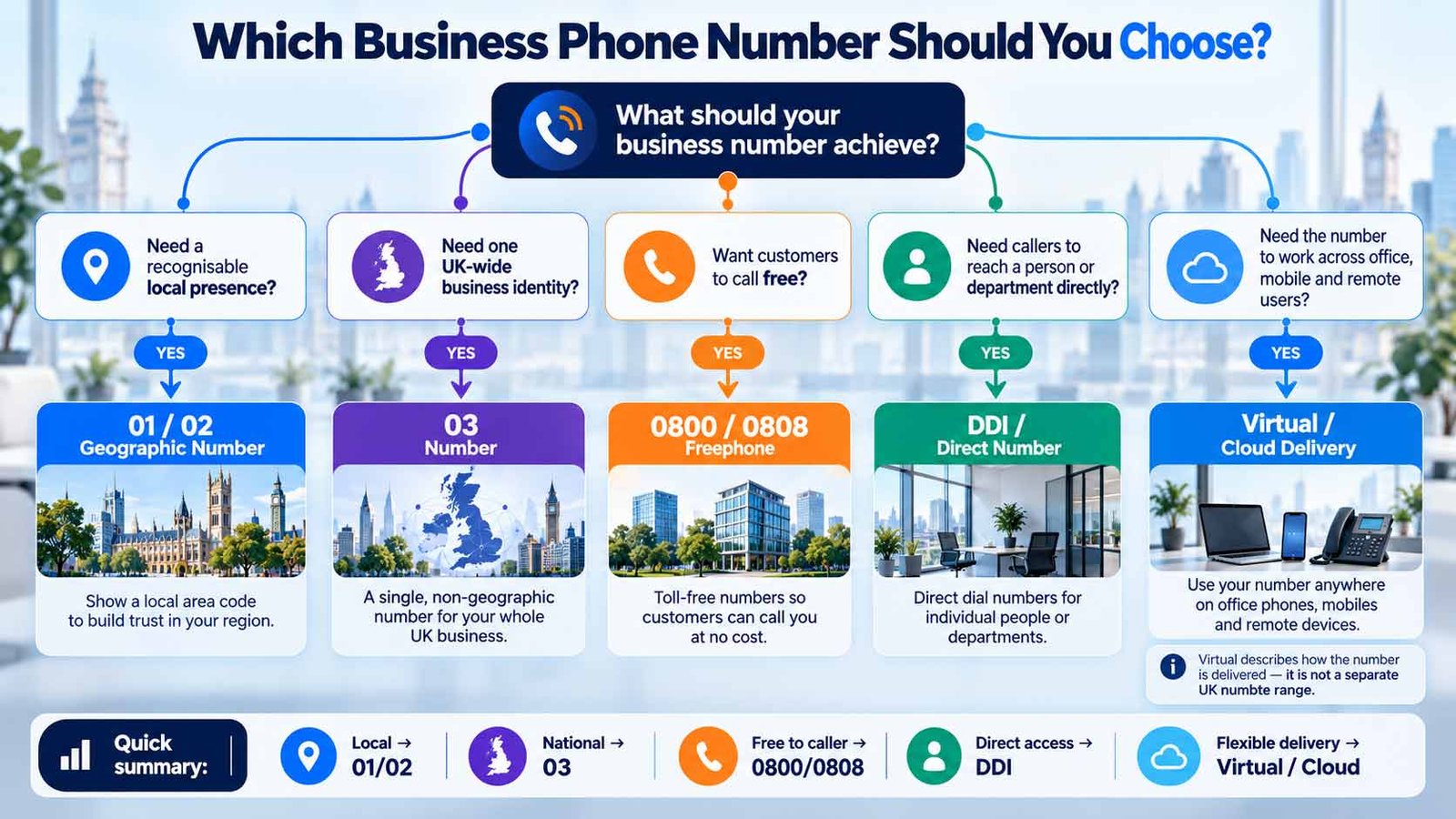
There is no single number type that is right for every UK business.
The best starting point is to ask what the number needs to communicate and what job it needs to perform.
A practical first decision looks like this:
| Requirement | Number approach to consider |
|---|---|
| Customers should recognise a local area | 01 or 02 geographic number |
| The organisation wants one UK-wide identity | 03 number |
| The business wants callers to contact it free of charge | 0800 or 0808 Freephone number |
| The number should work through a cloud or VoIP service rather than one traditional line | Virtual number capability |
| Callers should reach a specific person or team directly | DDI / direct number |
| Different departments need separate public entry points | Department numbers |
| Different branches need local identities | Regional geographic numbers |
| The business wants one consistent outbound identity | Main or department caller ID |
In practice, many organisations use a combination.
A 25-person company might have:
- one main 020 number;
- one Sales DDI;
- one Support DDI;
- individual DDIs for selected account managers;
- a separate campaign number;
- one main number presented on most outbound calls.
The important point is that a phone number and a phone system are not the same thing.
The number is the public entry point or identity. The phone system determines what happens after the call arrives.
For example:
020 1234 5000 → Main business number
and separately:
Main number → Greeting → Sales / Support → Team → Overflow → Voicemail
The second part is call handling. Once the number structure is clear, use the business call routing guide to design what happens after each important number is called.
2. The Main Types of UK Business Phone Numbers
UK telephone numbers are organised into different ranges, and the first digits can tell callers something about the type of number they are dialling.
Ofcom classifies numbers beginning 01 or 02 as geographic numbers. These are associated with specific geographic areas through their area codes. Ofcom also identifies 03 numbers as UK-wide non-geographic numbers and 080 numbers as free-to-caller numbers.
For most business buyers, the main number types to understand are:
- 01 and 02 geographic numbers;
- 03 non-geographic numbers;
- 0800 and 0808 Freephone numbers;
- direct dial or DDI numbers;
- virtual numbers delivered through VoIP or cloud systems.
If you have an existing UK telephone number to review, use our UK Phone Number Checker to check its format, numbering category and original Ofcom allocation where available. This is a preliminary numbering check, not confirmation of the current provider, subscriber, live service or number-porting eligibility.
The right number plan is usually not about choosing one category and ignoring the rest. It is about deciding how these categories should work together.
2.1 01 and 02 Geographic Business Numbers
Numbers beginning 01 or 02 are associated with UK geographic areas.
Examples include:
- 020 for London;
- 0161 for Manchester;
- 0121 for Birmingham;
- 029 for Cardiff;
- 0131 for Edinburgh.
For a business, a geographic number can provide a clear regional identity.
That can be useful when customers expect to deal with a local office, branch or professional service. A local number may also be appropriate where the organisation has an established number that customers already recognise.
Typical uses include:
- local professional services;
- estate agencies;
- trades and property services;
- regional healthcare providers;
- local retail or hospitality;
- branch offices;
- regional sales teams.
A geographic number does not necessarily mean the business is using a traditional analogue line. Modern VoIP and cloud systems can deliver and manage geographic numbers digitally, subject to provider availability and applicable number-use requirements.
The important buyer questions are:
- Which area codes do we genuinely need?
- Is the number intended to represent a real branch, market or customer base?
- Can the provider supply the required number range?
- Can existing geographic numbers be retained?
- Can calls be delivered to remote or central teams?
- Which number should staff present when calling customers back?
Do not create local numbers simply because they are available. Every additional number should have a clear operational, customer or reporting purpose.
2.2 03 Business Numbers
03 numbers are UK-wide non-geographic numbers.
Ofcom introduced 03 numbers so organisations could have a national point of contact without callers facing the higher charging structures associated with some other non-geographic ranges.
Calls to 03 numbers cost no more than calls to 01 and 02 numbers and must count towards inclusive minutes in the same way.
For a business, an 03 number can make sense when:
- one national identity is more useful than a specific local identity;
- the organisation serves customers across the UK;
- several sites need one central published number;
- the business does not want its main number associated with one city;
- a consistent number is needed across marketing, customer service and documentation.
An 03 number can still route into a cloud phone system, contact centre or distributed team. The prefix tells the caller about the number range; it does not determine the internal call-handling design.
A business considering 03 should ask:
- Do customers benefit from seeing one national number?
- Would a geographic number create a stronger local connection?
- Is the number intended for the whole organisation or one service?
- What are the provider’s charges for supplying and receiving calls on the number?
- Can the number be ported if the business changes provider later?
2.3 0800 and 0808 Freephone Numbers
0800 and 0808 are Freephone ranges.
Ofcom’s current consumer guidance identifies 080 numbers as free to call. That makes them useful where the organisation wants to remove the caller’s cost as a barrier to contact.
Common business uses include:
- national sales lines;
- customer-service lines;
- helplines;
- response campaigns;
- high-value enquiries;
- organisations where accessibility of contact is important.
A Freephone number does not automatically make sense for every business.
A small local firm may gain more value from a familiar geographic number. A business whose customers mainly call through inclusive mobile packages may not need Freephone simply because it sounds more established.
The commercial question is not only whether the caller pays. The business should also confirm:
- what the provider charges for receiving Freephone calls;
- whether charges differ by originating network or commercial plan;
- whether the number can be routed to several teams or sites;
- how the number is reported;
- whether it is portable at exit;
- whether a geographic or 03 alternative would be simpler.
2.4 Other Number Ranges
Other UK number ranges exist, including mobile and chargeable non-geographic services, but most ordinary business VoIP number planning revolves around geographic numbers, 03 numbers, Freephone numbers and direct-dial structures.
Do not choose a number range simply because it looks memorable or unusual. The number should fit the caller experience, brand position, commercial model and operating workflow.
3. What Is a Virtual Business Phone Number?
A virtual business phone number is usually a telephone number delivered through a cloud or VoIP service rather than being permanently tied to one traditional physical telephone line.
The important word is virtual.
It describes how the number can be delivered and managed, not necessarily a separate telephone prefix.
A virtual business number could be:
- an 01 number;
- an 02 number;
- an 03 number;
- an 0800 or 0808 number;
- another supported number assigned through a communications provider.
The number can then point to a destination or workflow such as:
- a desk phone;
- a desktop softphone;
- a mobile application;
- one employee;
- several employees;
- a department;
- reception;
- a queue;
- an external destination;
- a cloud call-routing workflow.
This is why the phrase virtual number can be confusing. It does not mean that the phone number itself is somehow temporary or unreal. A normal business telephone number can be delivered virtually through a hosted communications platform.
When a virtual business number is useful
Virtual delivery can be particularly useful for:
Hybrid teams
Calls can reach employees regardless of whether they are working in the office or remotely.
Remote businesses
The organisation can publish a business number without relying on one desk or physical telephone line.
Multi-site businesses
Different numbers can be presented to customers while calls are managed through one central platform.
Regional presence
A business may use different geographic numbers for genuine regional operations while managing them through one system.
Departments
Sales, Support or Accounts can have separate numbers even though users share the same underlying platform.
Campaigns
A dedicated number can help separate campaign enquiries from normal business calls.
What to verify before ordering a virtual number
Ask the provider:
- Which number types can be delivered virtually?
- Can the number be used for inbound and outbound calling?
- Can users present it as caller ID?
- Can it ring more than one person or site?
- Are external forwarding charges involved?
- Is the number included in the licence or charged separately?
- Can the number be ported to another provider later?
- Who controls number changes?
- Does the business receive a clear inventory of all numbers?
If the wider question is whether a cloud-managed phone system fits the organisation, see the cloud phone system guide.
4. What Is a DDI Number?
DDI usually refers to Direct Dial Inward or Direct Dialling In.
In practical business terms, a DDI gives an external caller a telephone number that reaches a specific person, team or function without first requiring the caller to use the organisation’s main number.
For example:
| Purpose | Example number |
|---|---|
| Main company | 020 1234 5000 |
| Sales | 020 1234 5010 |
| Support | 020 1234 5020 |
| Account Manager A | 020 1234 5121 |
| Account Manager B | 020 1234 5122 |
The exact number structure depends on what the provider has allocated and what numbers are available. The example simply shows the principle.
DDI vs extension
A DDI and an internal extension are not the same thing.
An extension is usually an internal identifier used inside the phone system.
A DDI is a public telephone number that can be dialled from outside the organisation.
A person might therefore have:
- extension
221internally; - DDI
020 1234 5221externally.
Not every employee needs both.
When individual DDIs make sense
Individual DDIs can be useful for:
- account managers;
- relationship managers;
- senior staff;
- salespeople;
- customer-success teams;
- employees who need direct external contact.
They can make communication simpler where customers regularly contact one named person.
When a DDI may be unnecessary
If customers should normally enter through a central team, giving every employee a public number may create unnecessary complexity.
For example, Support may work better as:
Support Number → Support Team
rather than publishing separate numbers for every support agent.
That preserves continuity when staff are unavailable, change roles or leave.
The DDI determines the number the caller reaches. The detailed logic after the call arrives belongs to the call-handling design. See the business call routing guide for queues, ring groups, schedules, overflow and fallback.
5. Main Number, Department Number or Individual DDI?
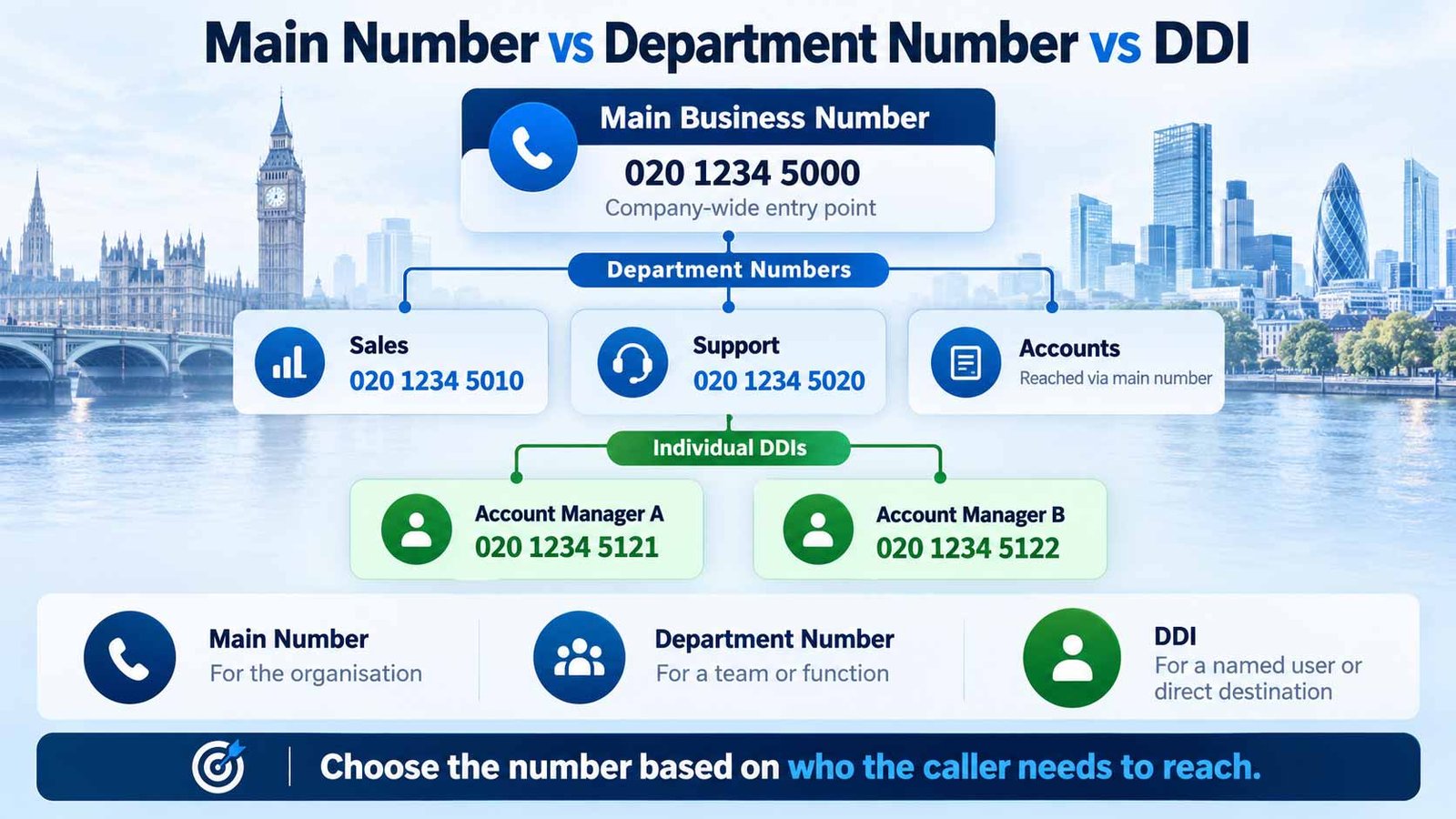
Most businesses need more than a technical definition. They need to decide which type of number should represent each customer journey.
Main business number
The main number is the organisation’s primary public telephone identity.
It commonly appears on:
- the main website;
- Google Business Profile where applicable;
- invoices;
- stationery;
- email signatures;
- customer communications;
- directories;
- signage;
- contracts;
- advertising.
A main number should normally remain stable.
Changing a long-established main number can create avoidable customer, operational and marketing work. If an existing number is still suitable, keeping it may be more valuable than replacing it simply because a new phone system is being introduced.
Department numbers
A department number gives callers a direct entry point to a function such as:
- Sales;
- Support;
- Accounts;
- Bookings;
- Customer Service;
- Renewals.
A separate department number can make sense when:
- the team receives significant direct demand;
- its calls follow a different workflow;
- reporting by entry number is useful;
- the number appears in dedicated campaigns or customer communications;
- bypassing the main reception route improves the caller experience.
Do not create a separate public number for every internal department automatically.
If Accounts receives only a few calls, for example, it may be cleaner for callers to reach Accounts through the main number rather than publishing another permanent number.
Individual DDIs
Individual direct numbers make most sense where the business relationship is person-specific.
Examples include:
- named account management;
- high-value sales relationships;
- specialist advisers;
- executives;
- case-based professional services.
For roles where continuity should be team-based rather than person-based, a team or department number may be better.
A simple decision rule
Ask:
Does the caller need to reach the organisation, a team or a named person?
Then map the answer:
- organisation → main number;
- team → department number;
- named person → DDI.
Once those entry points are defined, decide what happens after each call arrives. Use the business call routing guide to design the call flow behind each number.
6. How Many Business Phone Numbers Do You Actually Need?
More numbers do not automatically create a better phone system.
Every additional number can create:
- another item to administer;
- another cost line;
- another caller-ID decision;
- another reporting dimension;
- another number to document during migration;
- another asset that may need porting later.
A good rule is:
Create a separate business number only when it delivers a meaningful customer, operational, reporting or regional benefit.
Ask five questions before adding a number.
1. Does this audience need a separate entry point?
Sales and Support may genuinely need different numbers. Two small internal teams that receive similar calls may not.
2. Does the call require different handling?
If calls to a number need a unique workflow, a separate number may make operational sense.
3. Do we need separate reporting?
A dedicated campaign number can make it easier to attribute calls to a particular marketing activity.
4. Does the number create a meaningful local or national identity?
A branch may benefit from a local geographic number. Creating local numbers for places where the organisation has no meaningful presence may add complexity without customer value.
5. Will the number still be useful later?
Avoid building a permanent number structure around short-lived organisational arrangements.
Avoid number proliferation
A common mistake is giving every employee a DDI by default simply because the platform supports it.
Instead, categorise user roles:
| Role | Likely number requirement |
|---|---|
| Reception | Main number / internal extension |
| General office user | Extension; DDI only if needed |
| Sales | Team number and/or DDI |
| Account manager | DDI often useful |
| Support agent | Team number; individual DDI may be unnecessary |
| Field worker | Business outbound identity; DDI if customers call directly |
| Shared location | Main/department number rather than individual DDI |
Include number costs in the wider commercial model. The VoIP pricing and hidden costs guide covers the additional items that can sit behind headline licence pricing.
7. Local vs National Business Phone Numbers
A business phone number also communicates identity.
The choice between a geographic 01/02 number and a national 03 number should reflect how customers understand the organisation.
When a local geographic number can work well
A local number may be appropriate when:
- the business operates primarily in one area;
- customers expect a local service;
- the organisation has a physical branch;
- local identity is part of the brand;
- customers already know the number.
Examples could include a regional solicitor, local estate agent, dental practice, trades business or branch-based professional service.
When a national number can work well
A national number may be suitable when:
- customers are spread across the UK;
- the business does not want the main identity tied to one city;
- several offices share one customer-facing service;
- marketing is national rather than regional;
- one consistent published number is easier to manage.
Multi-location organisations can use both
The choice does not have to be exclusive.
A company might publish:
- one national 03 number;
- one London 020 number;
- one Manchester 0161 number;
- one Birmingham 0121 number.
All of those numbers could then be managed through the same cloud phone platform.
The key is to decide what each number represents.
Do not treat a regional number as a substitute for a regional operating model. The number plan should reflect how the business actually serves customers.
8. Inbound Numbers and Outbound Caller ID
The number a customer calls and the number a customer sees when your staff call them are related but separate decisions.
Inbound number
The inbound number determines which public number the customer dials.
Examples:
- main company number;
- Sales number;
- Support number;
- individual DDI;
- local branch number;
- Freephone number.
Outbound caller ID
Outbound caller ID determines which number is presented when an employee makes a call, subject to the provider’s configuration and applicable rules.
For example, an account manager could have an individual DDI for incoming calls but present the main company number on outbound calls.
Another business may prefer Sales staff to present the Sales number so customer callbacks return to the whole Sales team.
Questions to decide
For every user or team, define:
- Which number should they present?
- Should customers call the person back directly?
- Should callbacks return to a team?
- Should remote workers present the business number rather than a personal mobile?
- Should different departments present different numbers?
- Who is allowed to change caller-ID settings?
- What happens when a user leaves?
A simple caller-ID policy might be:
| User type | Outbound number presented |
|---|---|
| Reception | Main company number |
| General staff | Main company number |
| Sales | Sales number |
| Support | Support number |
| Account managers | Individual DDI or main number depending workflow |
| Mobile/remote users | Approved business identity |
Caller-ID configuration should be governed rather than left uncontrolled. For wider account, administrative and access considerations, see the VoIP security guide.
9. How to Design Your Business Number Structure
A useful business number plan should be easy to understand on one page.
Start with five layers:
- main public identity;
- department entry points;
- individual direct numbers;
- regional or campaign numbers;
- outbound caller-ID rules.
Example: 25-user professional-services business
Assume the business has:
- one office;
- hybrid workers;
- Sales;
- Support;
- Accounts;
- several account managers.
A sensible structure might be:
Main company number
Used on the website, stationery and general communications.
Sales number
Published on sales campaigns and direct Sales contact pages.
Support number
Provided to customers who already use the service.
Accounts
Reached through the main number rather than a separately published number.
Account managers
Selected employees receive individual DDIs.
Reception and general administration
Use internal extensions without individual public numbers.
Outbound caller ID
General staff present the main number. Sales presents the Sales number. Account managers present their DDI only where direct callbacks are desirable.
Number architecture example
| Business need | Number design |
|---|---|
| Main brand identity | Main published geographic or national number |
| Sales enquiries | Sales DDI / department number |
| Customer support | Support DDI / department number |
| General administration | Main number route |
| Named account relationships | Selected individual DDIs |
| Hybrid workers | Business caller ID through app/softphone |
| Marketing campaign | Dedicated tracking number where justified |
| Existing customer continuity | Retain important existing numbers |
| Future provider change | Ensure portability is understood |
This number plan defines the entry points. The next step is to design the call flow behind each number, including menus, teams, queues, schedules, overflow and fallback.
10. Business Phone Numbers for Multiple Locations
Local number can route to a branch or central team.
Keep regional identity without separate phone infrastructure.
Manage multiple regional numbers through one platform.
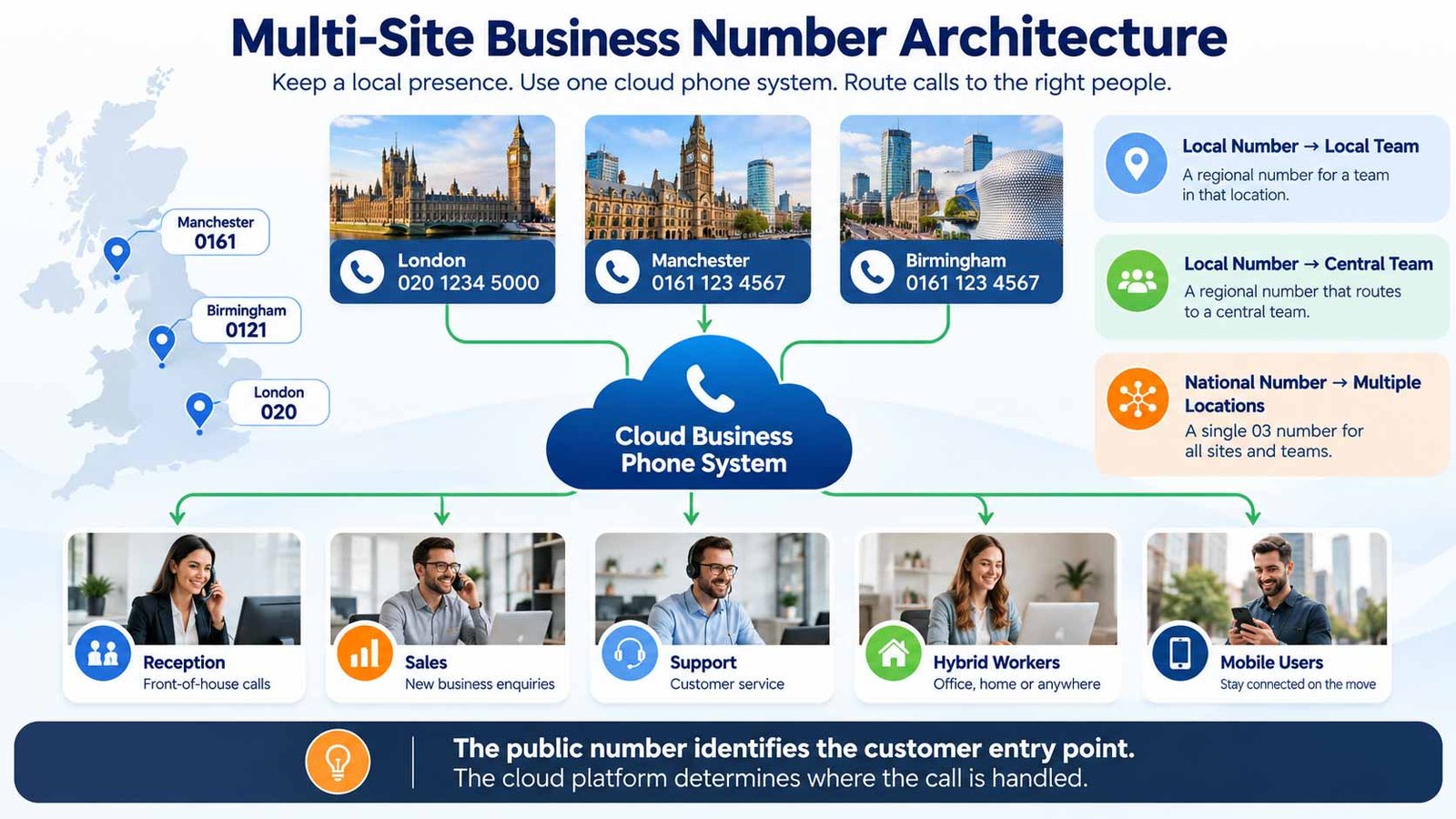
Multi-site businesses need to separate number identity from where the call is physically answered.
A London number does not necessarily need to ring only a telephone sitting in a London office. A modern phone platform can route the call according to the organisation’s operating design.
For example:
020 London number → central Sales team
0161 Manchester number → same central Sales team
0121 Birmingham number → regional service team
The business may therefore use local numbers to maintain genuine branch or regional identities while still centralising administration.
Common multi-site models
Model 1: One national main number
Best suited to organisations that want one consistent point of contact.
National Number → Central Routing → Appropriate Team
Model 2: One local number per branch
Useful where local identity matters.
London Number → London Team
Manchester Number → Manchester Team
Birmingham Number → Birmingham Team
Model 3: Local numbers with central answering
Useful when the organisation wants local customer entry points but operational calls are managed centrally.
Regional Number → Central Reception → Relevant Branch or Team
Model 4: National main number plus local branch numbers
This provides both a consistent corporate number and direct local entry points.
Questions to decide
- Does each site need its own public number?
- Should each site present a local caller ID?
- Is there one central reception function?
- Can calls overflow between sites?
- What happens if one site is unavailable?
- Who administers the numbers centrally?
- Are the numbers included in the same provider account?
A cloud-managed platform can support this type of distributed model. For broader platform considerations, see the cloud phone system guide.
11. Number Ownership, Control and Portability
Phone numbers can become long-term business assets because customers, suppliers and marketing channels learn to use them.
That makes control and portability important procurement questions.
Before committing to a provider, establish:
- which numbers already belong to your current service;
- which provider currently hosts them;
- which account or service they are associated with;
- who is authorised to request changes;
- whether the new provider can accept the numbers;
- whether newly supplied numbers can be ported out later;
- who controls caller-ID configuration;
- how number changes are documented;
- what happens to numbers when the contract ends.
Keep a number inventory
A simple inventory might contain:
| Number | Type | Purpose | Current provider | Published where? | Keep? | Target destination |
|---|---|---|---|---|---|---|
| 020 1234 5000 | Geographic | Main number | Current carrier | Website, stationery | Yes | Main reception |
| 020 1234 5010 | Geographic/DDI | Sales | Current carrier | Sales pages | Yes | Sales team |
| 020 1234 5020 | Geographic/DDI | Support | Current carrier | Customer portal | Yes | Support team |
| 0800 123 456 | Freephone | Campaign | Provider B | Campaign | Review | Sales |
This becomes valuable during migration and again if the business changes provider in the future.
Portability should be checked before signing
Ofcom describes number portability as a regulated facility that allows customers to keep their telephone numbers when changing provider.
For a buyer, the important question is:
If we leave this provider later, can we take the business-critical numbers with us and what will the process require?
The detailed operational process belongs in the dedicated number porting guide.
12. Keep Existing Numbers or Add New Ones?
Moving to VoIP does not automatically mean replacing every existing number.
In many cases, continuity is more valuable than novelty.
Keep an existing number when
- customers already know it;
- it is printed on signage or vehicles;
- it appears across advertising;
- it is associated with the brand;
- customers use it for support;
- changing it creates unnecessary risk;
- it is linked from important directories or business listings.
Add a new number when
- opening a new branch;
- creating a genuinely separate service entry point;
- launching a national contact route;
- introducing Freephone access;
- assigning selected individual DDIs;
- creating a campaign that requires separate call attribution.
Retire a number when
- it no longer has a business purpose;
- it duplicates another number;
- it creates customer confusion;
- it belongs to a closed service;
- nobody owns or monitors the calls;
- maintaining it adds cost without value.
Do not cancel an existing service simply because a new VoIP account has been created.
If a current customer-facing number needs to move, document it first and understand the migration sequence. See how to move an existing business number to a new provider before planning the cutover.
13. Create Your Business Phone Number Requirement
Before comparing providers in detail, create one number requirement that every supplier can answer consistently.
A simple worksheet is enough.
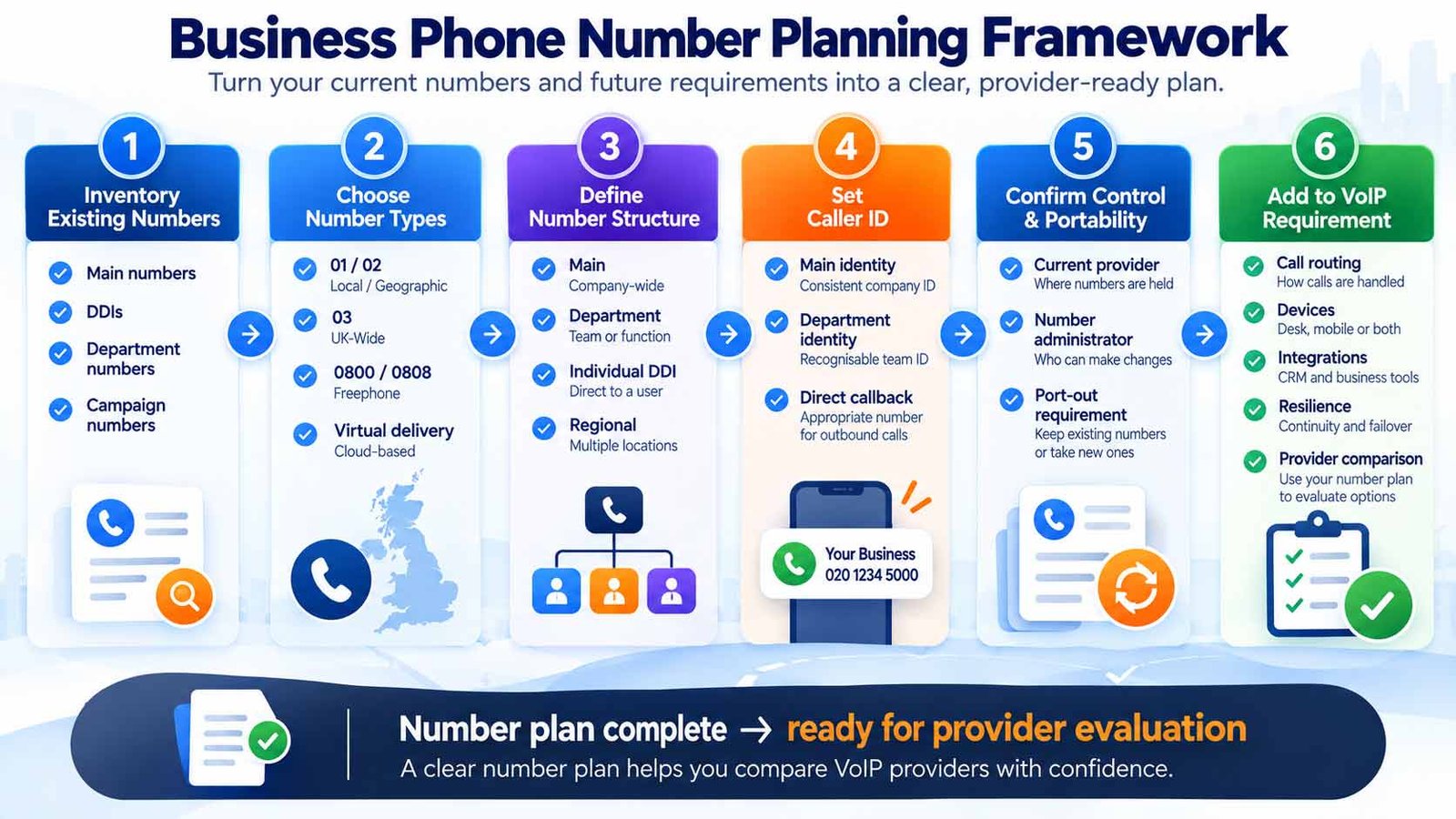
| Requirement | Your answer |
|---|---|
| Current main number | |
| Main number to retain? | |
| Other existing numbers | |
| Numbers to port | |
| New 01/02 numbers required | |
| Required area codes | |
| 03 number required? | |
| 0800/0808 required? | |
| Department numbers | |
| Individual DDIs | |
| Regional/branch numbers | |
| Campaign/tracking numbers | |
| Main outbound caller ID | |
| Department caller-ID rules | |
| Individual caller-ID rules | |
| Mobile/remote user identity | |
| Numbers that can be retired | |
| Number administrator | |
| Reporting by number required? | |
| Port-out requirement | |
| Expected future number growth |
Turn the worksheet into a short specification
For example:
We require one existing London geographic main number to be retained, one Sales DDI, one Support DDI, six individual DDIs for account managers and a new Manchester geographic number for our regional office. General users should present the main number on outbound calls. Sales should present the Sales number. Account managers may present their DDIs. All business-critical numbers must be documented and portable if we change provider later.
That is much more useful than asking a provider:
“What business numbers do you offer?”
It gives every provider the same requirement to respond to.
Once this number plan is complete, add it to your complete VoIP buying requirement alongside users, call handling, devices, integrations, resilience, support, migration and commercial requirements.
After a provider is selected, use the VoIP setup guide to plan configuration, testing and go-live.
14. Questions to Ask a VoIP Provider About Business Numbers
A provider demonstration or quotation should answer specific questions about numbering.
Use the same questions with every shortlisted supplier.
Number availability
- Which UK number ranges can you provide?
- Which geographic area codes are available?
- Can you provide 03 numbers?
- Can you provide 0800 or 0808 numbers?
- Can you supply number blocks or individual DDIs?
Existing numbers
- Can our existing main number be retained?
- Can all of our current DDIs be moved?
- What information is required before you confirm portability?
- Who manages the transfer?
- Are temporary numbers used before the move completes?
Direct numbers and DDIs
- Can individual users have DDIs?
- Can departments have dedicated numbers?
- Can one number terminate on several users or sites?
- Can a DDI be reassigned when an employee changes role?
Outbound caller ID
- Which numbers can users present on outbound calls?
- Can caller ID be set by user, team or department?
- Can remote/mobile users present the business number?
- Who can change caller-ID settings?
Administration
- Can administrators add, remove or reassign numbers?
- Is there a complete number inventory in the admin portal?
- Can number information be exported?
- Are number changes recorded in an audit history?
Commercial terms
- What is the monthly cost for each number type?
- Are there setup or provisioning charges?
- Are Freephone inbound charges separate?
- Are external forwarding charges separate?
- Are DDIs included in the licence or charged individually?
Exit and portability
- Can eligible numbers be ported out if we leave?
- What information will be required?
- What happens to numbers at contract end?
- How long are disconnected numbers retained before they may be released or reallocated, where applicable?
- Who owns the exit process?
Once the number and wider system requirements are documented, the VoIP recommendation quiz can help narrow the market to services worth investigating.
You can then compare the broader Best VoIP providers in the UK shortlist against the number structure and other requirements you have already defined.
15. Business Phone Number Mistakes to Avoid
The most expensive mistakes are often structural rather than technical.
Giving every employee a DDI by default
Direct numbers should follow a real business requirement.
If customers should normally call a team, an individual DDI can reduce continuity when that employee is unavailable.
Creating too many department numbers
Every number creates another entry point to administer and explain.
If two departments can sensibly share the same entry path, a new public number may be unnecessary.
Confusing a virtual number with a number range
“Virtual number” describes how the number is delivered or managed.
It does not mean there is a special “virtual” prefix. A geographic, 03 or Freephone number can potentially be delivered through a virtual or cloud platform.
Treating the number and the route as the same thing
The number answers:
What does the customer dial?
Routing answers:
What happens next?
Keep those decisions separate.
Ignoring outbound identity
A business can design inbound numbers carefully and then forget to decide which number employees present when calling customers.
That creates inconsistent callbacks and can expose personal mobile numbers unnecessarily.
Failing to inventory current numbers
Businesses often discover important numbers during migration that were not included in the original project.
Build the inventory before contract signature.
Cancelling the old service too early
Existing services may be tied to numbers, broadband or other dependencies.
Do not cancel first and investigate later. Follow the number porting guide where numbers need to move.
Using campaign numbers without governance
Tracking numbers can be useful, but somebody should own:
- where they are published;
- how calls are routed;
- how long they are retained;
- what happens when the campaign ends.
Failing to check exit portability
A number may become much more valuable to the business over time.
Confirm the provider’s port-out process before the number becomes deeply embedded in customer communication.
16. Business Phone Number Checklist
Use this checklist before approving the number design.
Business identity
- We have identified the main company number.
- We have decided whether local, national or Freephone identity is appropriate.
- We know which geographic areas genuinely need local numbers.
- We have decided whether an 03 number is required.
- We have decided whether an 0800/0808 number is required.
Existing numbers
- Every important existing business number is documented.
- We know which numbers must be retained.
- We know which numbers can be retired.
- We have identified which numbers require porting.
- We know which existing services are associated with those numbers.
Departments and people
- We have identified departments that genuinely need separate public numbers.
- We have decided which employees need individual DDIs.
- We have avoided giving DDIs to users who do not need direct external contact.
- We know how DDIs should be reassigned when roles change.
Caller ID
- The main outbound caller ID is defined.
- Department caller-ID rules are defined.
- Individual DDI presentation rules are defined.
- Remote and mobile users can present an approved business identity.
- Caller-ID changes are controlled by appropriate administrators.
Multi-site and cloud use
- Branch and regional number requirements are documented.
- We know where each number should terminate.
- We know whether calls need to reach users at different sites.
- We know whether regional numbers need regional caller ID.
Administration and reporting
- The business has a named number administrator.
- We can maintain a complete number inventory.
- We know which numbers need separate reporting.
- Campaign numbers have clear ownership and retirement rules.
Commercial and exit
- Number rental costs are understood.
- Freephone inbound costs are understood where relevant.
- DDI charges are understood.
- Forwarding charges are understood where relevant.
- Port-out requirements have been confirmed.
- Business-critical numbers can be included in the exit plan.
With the number plan complete, the next steps are to design your business call routing, add the result to the VoIP Buyer’s Guide requirements and, where existing numbers need to move, follow the number porting guide.
17. Frequently Asked Questions
What is the best phone number for a UK business?
There is no single best number type for every organisation. A local business may benefit from an 01 or 02 geographic number, while a national business may prefer an 03 number. A Freephone number may be useful where the business wants callers to contact it free of charge. The right choice depends on customer expectations, geographic identity, call purpose and the wider number structure.
Should a business use an 01, 02 or 03 number?
Use 01 or 02 where geographic identity is useful. Consider 03 where the organisation wants a UK-wide non-geographic identity. Ofcom states that calls to 03 numbers cost no more than calls to 01 or 02 numbers and count towards inclusive minutes in the same way.
What is a virtual business phone number?
A virtual business number is generally a telephone number delivered through a VoIP or cloud service rather than being tied permanently to one traditional physical phone line. It can route to users, applications, teams or other destinations.
Is a virtual number the same as a VoIP number?
The terms overlap but are not identical. VoIP describes the technology used to carry voice over IP networks. “Virtual number” usually describes a telephone number that is managed or routed through a digital platform rather than one fixed physical line. A business may use a normal 01, 02, 03 or other supported number through a VoIP platform.
What is a DDI number?
A DDI is a public number that lets an external caller reach a specific person, team or function directly. It differs from an internal extension, which is normally used only within the phone system.
Does every employee need a DDI?
No. DDIs are most useful where customers need direct access to specific employees. Team-based roles may work better through department numbers, queues or shared routing.
Can I get a local number if my team works remotely?
A VoIP or cloud provider may be able to supply geographic numbers and deliver calls to remote or distributed users, subject to number availability and provider requirements. Confirm the area code, permitted use and configuration with the provider.
What is an 03 business number?
03 numbers are UK-wide non-geographic numbers. Ofcom states that calls to 03 numbers cost no more than calls to 01 and 02 geographic numbers and must be included in call allowances on the same basis.
Are 0800 and 0808 numbers free to call?
Ofcom identifies 080 numbers as free to call. The business receiving the call should still check its own provider’s commercial charges for supplying and handling Freephone calls.
Should a small business use an 0800 number?
Not necessarily. Freephone can be useful for national sales, service or response lines, but a local geographic number may provide a stronger identity for a local business. Compare the customer benefit with the cost and administration.
Can a business have several phone numbers?
Yes. A business can use a main number, department numbers, regional numbers, DDIs and campaign numbers where the phone system and provider support them. The better question is whether each additional number has a clear purpose.
Can several numbers ring the same team?
Yes, depending on the phone platform. Several public numbers can potentially feed into the same team or call-handling environment. The detailed behaviour is part of the routing design; see the business call routing guide.
Can I use a different number for Sales and Support?
Yes. Separate Sales and Support numbers can make sense when the teams need distinct public entry points, reporting or workflows. They are not compulsory if the main number can handle both journeys cleanly.
Can staff show the main business number when making calls?
Many business phone systems can be configured so users present an approved main or department number rather than an individual number, subject to provider capabilities and calling-line-identification rules. Define the desired outbound identity as part of the number requirement.
Can I keep my current business number when moving to VoIP?
Eligible existing numbers may be retained through the applicable porting process. Ofcom regulates number portability when customers change provider. Document the number and confirm the migration process before cancelling the existing service. See the number porting guide for the detailed process.
Who owns a business telephone number?
Telephone numbers are part of the UK’s regulated numbering resource rather than conventional property owned outright like a physical asset. From a practical business perspective, you should establish which provider currently hosts the number, who is authorised on the account, how it can be moved and what happens at contract end.
Can I take my number to another VoIP provider?
Number portability rules allow customers to keep eligible numbers when changing provider. The exact process can depend on the service, number and providers involved, so confirm port-out arrangements before signing a new contract.
How many business phone numbers should we have?
Use as many as the organisation needs for clear customer access, regional identity, direct contact or reporting—but no more than necessary. Every number should have a defined purpose and owner.
What is the difference between a phone number and an extension?
A public telephone number can normally be called from outside the organisation. An extension is usually an internal identifier inside the phone system. A user can have an extension without having an individual public DDI.
What should I check before ordering new business numbers?
Confirm the number type, purpose, area code where relevant, inbound destination, outbound caller-ID requirements, recurring cost, administration model, reporting requirement and future portability. Also check whether an existing number could be retained instead of creating a new one.
18. Your Next Step
A good business number plan should tell you:
- which number represents the organisation;
- which teams need their own entry points;
- which people need direct numbers;
- which regional identities matter;
- which existing numbers must be kept;
- which caller ID each user or team should present;
- which numbers need reporting;
- which numbers must remain portable.
Once those decisions are documented, the rest of the phone-system design becomes easier.
A practical sequence is:
Choose the number structure → design call routing → confirm portability → complete the wider VoIP requirement → compare providers → configure and test
Use the VoIP Buyer’s Guide to turn the number plan into a complete provider-ready specification.
Use the business call routing guide to decide what happens after each important number is called.
Use the number porting guide where existing numbers need to move.
Use the VoIP setup guide once the provider and configuration have been selected and you are ready to prepare testing and go-live.
Sources & Research Method
This guide is designed to help UK businesses define their telephone-number requirements before comparing providers. It does not rank providers and does not replace provider-specific confirmation of number availability, charges or portability.
Current UK numbering and portability points were checked against Ofcom information, including:
- Ofcom — Phone numbers and call costs
- Ofcom — What are 03 numbers?
- Ofcom — Number Portability
- Ofcom — Telephone area codes
- Ofcom — Numbering data
Provider number ranges, availability, charges, routing capability and porting arrangements can change. Verify the current position with shortlisted providers before ordering numbers or cancelling an existing telephone service.

Turn your number plan into a complete VoIP requirement
Use your number structure alongside call handling, users, devices, integrations, resilience, support and commercial requirements before you compare providers.