
Top 10 Cloud Phone Systems – Expert Guide for 2026

Compare UK cloud phone systems by administrative control, failure-path resilience, application consistency, integration dependencies and the ability to move numbers, data and users later.
On this page
The best cloud phone system is not simply the platform with the longest feature list. A strong cloud platform gives a business clear control over users, numbers, routing and integrations, provides a defined fallback path when individual components fail, and lets important numbers, data and workflows move without excessive supplier dependency.
CompareVoIPService ranks providers using its weighted 42-point framework. The Cloud Operating Control Test used on this page is an interpretation layer for cloud-platform quality; it does not create a second score or override the core ranking methodology.
Moving a phone system into the cloud is not automatically an operational improvement.
A traditional PBX creates visible infrastructure dependency: hardware, maintenance, local configuration and physical location. Cloud telephony can remove much of that burden, but it can introduce a different type of dependency if routine changes require supplier intervention, users depend on inconsistent applications, fallback routes are unclear, or numbers and data become difficult to move.
For that reason, this comparison treats cloud telephony as an operating model, not simply a list of VoIP features.
The central question is therefore not “does this provider use the cloud?” Almost every serious modern business phone platform does.
The useful question is:
Does this platform remove infrastructure burden while leaving the business with enough control to operate, enough resilience to keep calls moving, and enough portability to change direction later?
That is the lens used throughout this page.
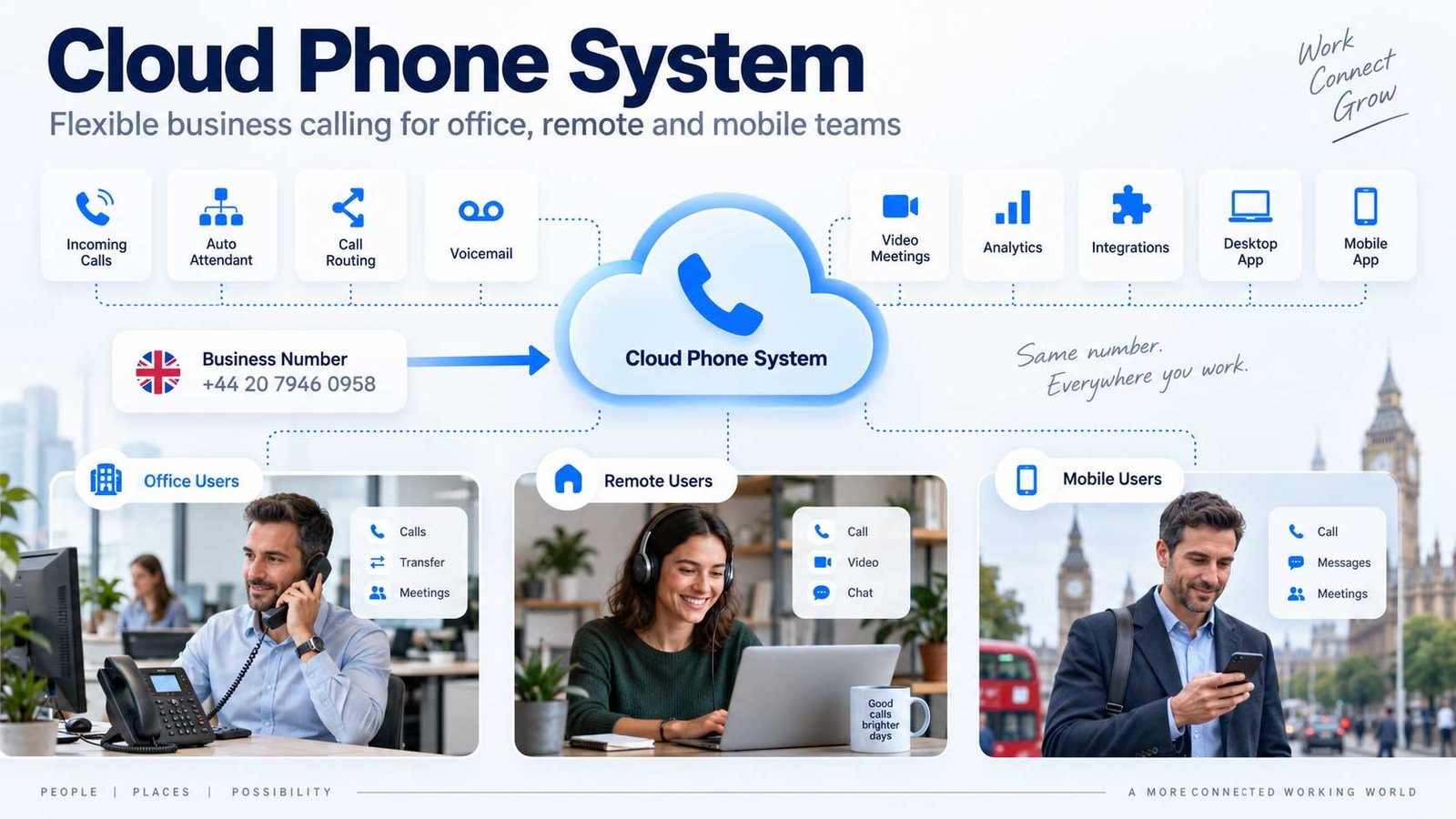
What Makes a Cloud Phone System Good?
A good cloud phone system gives a business central control over users, numbers, routing and devices, works consistently across locations and endpoints, provides a defined continuity path when components fail, and does not unnecessarily trap telephone numbers, data or workflows inside one supplier ecosystem.
In this comparison, cloud phone system means a provider-hosted business telephony platform in which calling, administration and routing are delivered through hosted infrastructure. For a buying decision, the operating quality of that platform matters more than the label used to market it.
Controllable
Administrators should be able to handle routine work such as adding users, changing number assignments, modifying business hours and updating call flows without raising a support request every time.
Observable
A cloud platform should make important configuration and operational information visible. Administrators need to understand who has access, how calls are routed, what devices are registered and where relevant reporting can be found.
Resilient
Cloud hosting removes dependence on an on-site PBX, but it does not remove dependence on connectivity, power, devices, carriers or the provider itself. A strong platform has a credible alternative path when one layer fails.
Portable
Business telephone numbers, relevant data and operational workflows should not become harder to move simply because the platform is cloud-hosted. Portability is part of long-term cloud quality.
Governable
Permissions, recordings, user roles, integrations and administrative access should be controllable enough for the organisation’s risk profile. A cloud service that is easy to use but difficult to govern can create problems as the business grows.
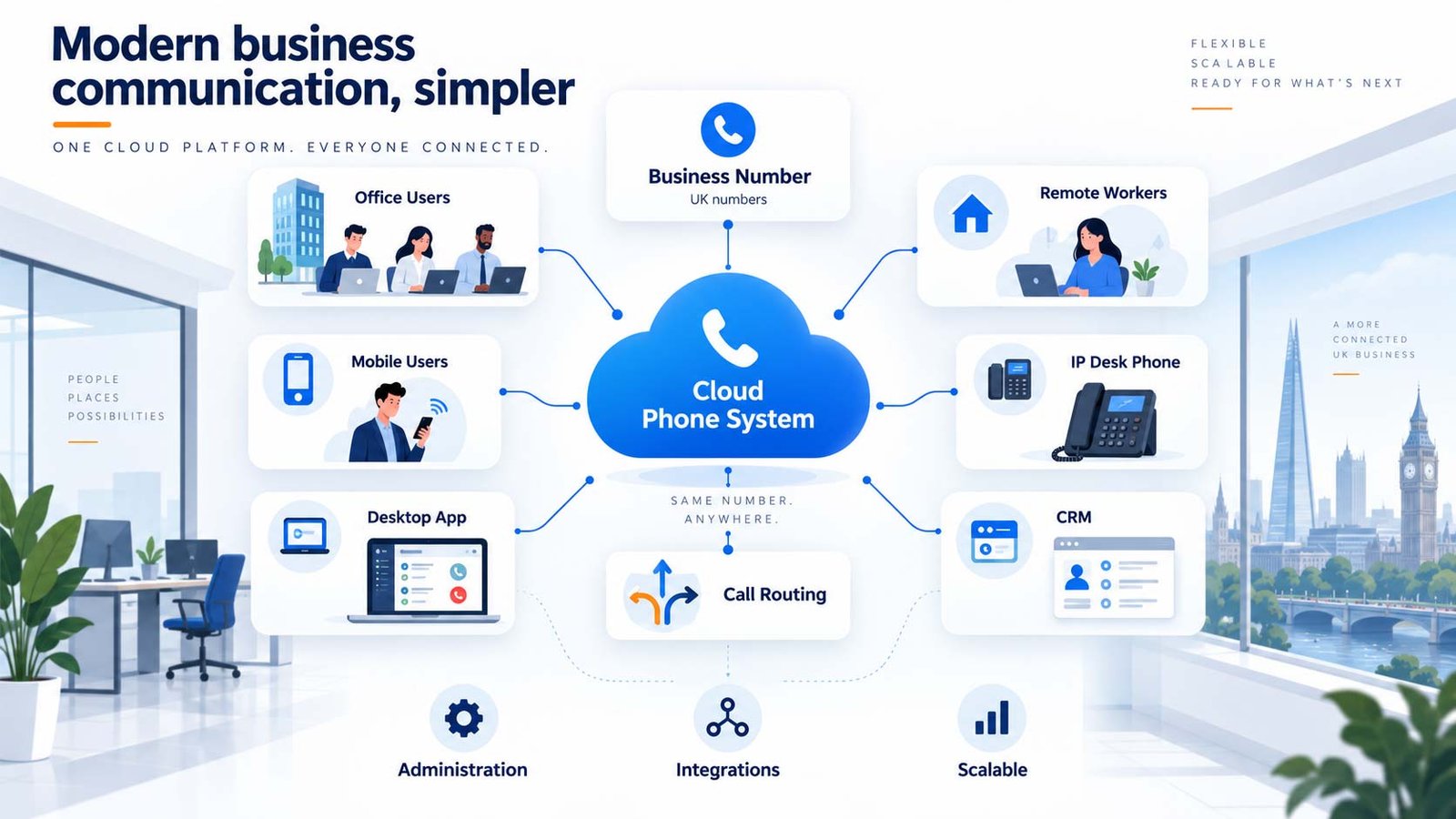
How We Rank Cloud Phone Systems
Provider order on this page is determined by the existing CompareVoIPService weighted 42-point methodology. The Cloud Operating Control Test does not add a second score and does not change provider order independently.
This keeps one consistent ranking model across CompareVoIPService while showing what the evidence means for cloud operations.
The 42-Point Ranking Foundation
The published methodology evaluates providers across seven weighted categories:
| Category | Weight |
|---|---|
| Pricing & Contract Transparency | 15% |
| Core & Advanced Features | 20% |
| Reliability & Call Quality Signals | 20% |
| UK Customer Support Signals | 15% |
| Software Integrations | 10% |
| Security & Compliance Signals | 10% |
| PSTN Switch-Off Readiness | 10% |
The complete framework is explained in the CompareVoIPService review methodology.
For this page, those findings are interpreted through three cloud-specific questions.
Best Cloud Phone Systems UK — Quick Comparison
The table below uses the 42-point ranking order but summarises each platform through the Cloud Operating Control Test.
| Rank | Platform | Control model | Failure-path characteristic | Portability consideration | Best-fit operating model |
|---|---|---|---|---|---|
| 1 | RingCentral RingEX | Mature self-service administration | Strong multi-device and multi-site model | Review ecosystem, recordings and integration dependencies before exit | Growing and multi-site organisations |
| 2 | 8×8 Work | Centralised multi-site administration | Designed around distributed cloud delivery and redundant infrastructure | Document number, data and integration exit requirements | Multi-site and internationally active organisations |
| 3 | Dialpad | App-first administration | Mobile and desktop software reduce dependence on one physical endpoint | Check AI data, recordings and workflow dependencies | App-led and distributed teams |
| 4 | GoTo Connect | Flexible dial-plan and routing control | Multiple routing options can support alternative call paths | Confirm number, recording and integration export requirements | Businesses with changing call-flow needs |
| 5 | Microsoft Teams Phone | Microsoft-admin-centred | Failure path depends partly on chosen PSTN route | PSTN architecture can materially affect portability | Microsoft 365-centred organisations |
| 6 | Vonage Business Communications | Application-led cloud administration | Desktop/mobile working supports endpoint flexibility | Plan around CRM, mobile and number dependencies | Businesses prioritising mobility and integrations |
| 7 | Gamma Horizon | UK partner-delivered management | Continuity depends on both platform design and delivery partner | Partner relationship and commercial model affect portability | Organisations wanting managed UK deployment |
| 8 | BT Cloud Voice | Large-supplier managed model | Cloud routing with BT-managed service structure | Long contract economics deserve close review | Businesses preferring a major UK telecoms supplier |
| 9 | bOnline | Simplified small-business control | App-led working can reduce dependence on office hardware | Check growth limits and contract terms as requirements expand | Smaller UK teams |
| 10 | 3CX Hosted | IT/partner-controlled architecture | Resilience depends heavily on hosting and SIP design choices | Greater architectural freedom comes with greater responsibility | IT-led organisations |
Public product and pricing information was checked on 22 September 2026. Some providers publish clear UK list pricing while others rely on quotations or partner-led commercial models. Pricing can change, so confirm the final configuration directly with the supplier before purchase.
10 Cloud Phone Systems Compared
The same cloud-operating lens is applied to every provider: why it ranks here, what the customer controls, how the failure path behaves, what creates exit friction, and which operating model it best suits.
RingCentral RingEX — Mature All-Round Cloud Control
Why It Ranks Here
RingCentral takes first position because RingEX combines broad cloud-communications capability with a mature administrative model.
RingCentral provides desktop, web and mobile access, multi-site administration, call-management features, reporting and number porting. That matters because cloud control is most useful when users, devices and locations can be managed as one environment rather than as separate telephone systems.
Its current UK support information also documents number-transfer processes, including project-based porting for larger transfers. RingCentral’s numbering policy covers both porting numbers into and out of an account.
Control Model
The platform is suited to organisations that expect administrators to manage users, sites, numbers and calling behaviour centrally. That gives it more headroom than a simple app-and-number service.
Failure-Path Consideration
A user is not tied to one desk phone, which gives the organisation more endpoint flexibility. However, a cloud service still depends on local connectivity, power and the wider telephony path. Buyers should document how inbound calls behave if the main site is unavailable and whether mobile or alternative-site working is part of the continuity plan.
Exit Portability
Number port-out is supported, but numbers are only one part of an exit. Before committing, document how recordings, reports, integrations, devices and administrative configuration would be handled if the organisation later moved platform.
Growing and multi-site organisations that want a mature cloud operating environment rather than a basic hosted line.
Platform breadth can create unnecessary complexity for a very small business that only needs a business number, app and simple routing.
8×8 Work — Strong Multi-Site Cloud Control
Why It Ranks Here
8×8 Work is particularly strong when the cloud requirement extends across several locations.
Its UK business-phone documentation describes cloud PBX features including auto attendant, voicemail, flexible call flows, recording, ring groups, queues, role-based access, user provisioning, multi-site support and mobile administration. 8×8 also promotes a single administrative interface and redundant data-centre architecture.
That combination makes it a strong fit for organisations trying to avoid maintaining separate phone-system logic at each location.
Control Model
8×8 supports centrally managed sites and endpoints. Its multi-site documentation describes standardised rules, site properties and advanced call handling from one platform.
Failure-Path Consideration
Distributed cloud infrastructure can reduce dependence on a local PBX, but the organisation still needs a local continuity plan. Ask how incoming calls behave if a site loses internet access, whether mobile users can continue, and how call routing can be changed during an incident.
Exit Portability
Number porting is supported. For a larger deployment, the more important exit questions concern data, recordings, integration configuration and the work needed to reproduce multi-site routing elsewhere.
Multi-site organisations and businesses that want central administration across several locations.
UK commercial buying is substantially quote-led, so insist on an itemised schedule covering licences, numbers, calling, recording, implementation and support.
Dialpad — App-First and AI-Led Cloud Operations
Why It Ranks Here
Dialpad is one of the clearest examples of an app-first cloud-phone operating model.
Its UK material describes administration through an online dashboard, with users, numbers and lines managed centrally. Dialpad also supports desktop and mobile applications and places AI capabilities such as transcription and summaries inside the communications workflow.
Current UK public material advertises plans from £12 per user per month.
Control Model
The proposition is well suited to organisations that want software rather than a desk phone to be the primary interface. Administrators can manage common settings through the cloud dashboard while users can move between connected devices.
Failure-Path Consideration
An app-first model gives users more endpoint flexibility because calling is not tied to one handset. That does not remove network dependency, so mobile data and alternative connectivity should still be considered in the continuity plan.
Exit Portability
The main portability questions go beyond telephone numbers. Businesses using transcription, summaries and other AI-derived data should understand what can be exported, how long it is retained and which workflows depend on Dialpad-specific outputs.
Distributed and application-led teams that want business calling to work naturally across software endpoints.
Organisations centred on traditional desk-phone workflows should evaluate the user experience with the same care as the AI feature set.
GoTo Connect — Flexible Cloud Call-Flow Control
Why It Ranks Here
GoTo Connect stands out for businesses that need to change how calls move through the organisation.
Its current phone-system offer includes unlimited auto attendants and call queues, customisable dial plans, desktop and mobile applications, meetings and support. That gives the platform a strong position where routing changes are a regular part of operations rather than a one-off installation task.
Control Model
Cloud call-flow control is useful when opening hours change, departments move, queue logic changes or overflow destinations need updating. Those changes should not require an engineer to visit the office.
Failure-Path Consideration
Flexible routing becomes especially valuable during disruption. Buyers should ask which destinations can be used for overflow, whether routing can be changed quickly during an incident and how mobile users continue if a site loses connectivity.
Exit Portability
Because GoTo Connect can combine phone-system and broader communications functions, document which business processes depend on the platform before switching. Number ownership, recording retention and application integrations should be part of the exit inventory.
Businesses with several departments, queues or frequently changing inbound call flows.
UK pricing is quote-led rather than presented as a simple fixed public tariff, so compare the complete configuration rather than the sales headline.
Microsoft Teams Phone — Microsoft-Native Cloud Telephony
Why It Ranks Here
Microsoft Teams Phone approaches cloud telephony from the collaboration platform rather than from the traditional PBX direction.
Teams Phone Standard is currently published at £7.70 per user per month when paid yearly, excluding VAT. A separate eligible Teams licence is required, and external PSTN calling then needs an appropriate route such as Microsoft Calling Plans, Operator Connect, Teams Phone Mobile or Direct Routing.
That architecture is the key to evaluating Teams Phone properly.
Control Model
Administration sits inside the Microsoft environment, but the degree of operational control depends partly on how PSTN connectivity is designed.
Operator Connect lets an approved operator manage PSTN infrastructure while administrators manage users through Teams. Direct Routing gives organisations or their partners more control over the carrier and SBC architecture but also introduces more technical responsibility.
Failure-Path Consideration
With Teams Phone, the failure path cannot be judged only at the Microsoft layer. It may include Microsoft, the chosen operator, an SBC or routing partner, internet connectivity, local networking and endpoints.
The correct question is therefore: which party owns each part of the recovery path?
Exit Portability
Portability depends partly on the selected PSTN model. Organisations should document where numbers are held, which operator contracts exist, whether Direct Routing infrastructure is reusable, and which calling workflows depend on the wider Microsoft environment.
Microsoft 365-centred organisations with the internal capability or partner support to design the telephony architecture properly.
The £7.70 Teams Phone Standard figure is not the full cost of every deployment. PSTN service, Teams licensing and implementation architecture must be included.
Vonage Business Communications — Flexible Application-Led Cloud Calling
Why It Ranks Here
Vonage Business Communications offers a clear UK commercial structure alongside application-led calling.
Current published UK pricing shows Express at £10, Core at £15 and Max at £25 per user per month, excluding VAT. Core adds features including CRM integration and Microsoft Teams compatibility, while Max extends the mobile-oriented proposition.
Control Model
The service suits businesses that want employees to work through desktop and mobile applications instead of relying exclusively on dedicated handsets.
Failure-Path Consideration
Endpoint flexibility can help users continue from another device, but broadband, local networking and the service itself remain part of the path. Confirm what happens to inbound business numbers when a site is offline and which alternative destinations are available.
Exit Portability
The more CRM, mobile and workflow functions a business adopts, the more important it becomes to document what depends on the provider. Plan the exit around numbers, user identities, integrations and retained communication data rather than around licences alone.
Businesses that prioritise mobility and software integration alongside everyday cloud calling.
Compare the tier containing the integrations and control features you actually require rather than using the lowest advertised plan as the whole-cost benchmark.
Gamma Horizon — UK Partner-Managed Cloud Control
Why It Ranks Here
Gamma Horizon represents a different cloud operating model from the direct self-service SaaS platforms.
Gamma describes Horizon as a complete cloud communications system covering fixed and mobile telephony, multi-site deployment and collaboration. It also positions the service around hosted infrastructure, with Gamma responsible for core system hardware and software upgrades.
In practice, many UK organisations buy Horizon through a telecoms partner, so the delivery partner becomes part of the operating model.
Control Model
Horizon provides cloud administration, but buyers need to establish which changes they can perform themselves and which are expected to go through the reseller.
That distinction matters because “managed” can be either an advantage or a constraint depending on the organisation’s internal resources.
Failure-Path Consideration
Continuity depends on both the underlying platform and the way the partner has designed connectivity, routing and support. Ask who changes call routing during an incident and what out-of-hours escalation exists.
Exit Portability
The reseller relationship can affect commercial portability. Before signing, document number ownership, handset terms, support responsibilities, contract ownership and what would be needed to transfer service elsewhere.
UK businesses that want cloud telephony with implementation and ongoing support handled through a telecoms partner.
The quality of onboarding, administration and escalation can depend materially on the partner delivering the service.
BT Cloud Voice — Structured Managed Cloud Migration
Why It Ranks Here
BT Cloud Voice provides a recognisable managed path for organisations moving from conventional UK business telephony to hosted VoIP.
Current published pricing lists the Basic licence at £10.52 a month per 60-month licence, Connect at £13.74, and Collaborate at £20.09, excluding VAT. BT also publishes scheduled annual £1 increases on those licence prices.
That makes the commercial structure unusually visible and therefore important to analyse.
Control Model
BT Cloud Voice includes online administration and call-routing capability, with additional communication features on higher tiers.
Failure-Path Consideration
A managed cloud supplier can simplify support ownership, but buyers should still ask how local connectivity, power loss, handset failure and inbound routing are handled. A single supplier relationship does not remove the underlying technical layers.
Exit Portability
The key consideration is the difference between technical flexibility and contractual flexibility. Cloud software may be flexible while a long commercial term reduces the organisation’s ability to change direction.
Businesses that value a major UK telecoms supplier and a structured managed migration route.
The published 60-month licence structure and scheduled price increases deserve as much attention as the feature list.
bOnline — Simplified Cloud Control for Smaller Teams
Why It Ranks Here
bOnline focuses on making hosted business calling accessible to smaller UK organisations.
Its current public pricing starts at £7 per user per month plus VAT for Starter, £13.95 for Unlimited Calling and £19.95 for its AI for Business Calls tier. Its service includes mobile and desktop apps, business numbers and common VoIP calling features.
Control Model
The proposition is intentionally simpler than many enterprise UCaaS platforms. For a smaller organisation, that can be an advantage if it reduces administration and avoids paying for controls the business will not use.
Failure-Path Consideration
App access can give users an alternative to a desk phone, but the organisation should still decide what happens if its main broadband service fails and whether mobile data or alternative routing is sufficient.
Exit Portability
Smaller businesses should pay particular attention to contract term, number portability and whether growth into more complex routing, integrations or reporting would require a different plan or platform.
Smaller UK teams that need straightforward cloud business calling without enterprise-scale administration.
A simple platform should be judged against future requirements as well as today’s user count.
3CX Hosted — IT-Controlled Cloud Architecture
Why It Ranks Here
3CX is different from most per-user cloud phone systems because it gives organisations more choice over the architecture.
3CX currently prices commercial editions by system and simultaneous calls rather than by a simple per-user monthly licence. It also offers hosted and self-hosted deployment choices.
That can be attractive to technically capable organisations, but greater choice means more design responsibility.
Control Model
3CX can give an IT team or specialist partner more influence over hosting, SIP connectivity and administration than a conventional fully abstracted SaaS phone platform.
Failure-Path Consideration
Resilience depends heavily on the architecture chosen around 3CX. Buyers need to understand hosting, SIP trunks, internet access, backup, failover, support and endpoint design rather than assuming the application itself represents the whole service.
Exit Portability
Architectural choice can improve portability because the organisation may retain more influence over hosting and carrier relationships. The trade-off is that responsibility is spread across more components.
IT-led organisations and businesses working with an experienced 3CX partner.
Greater architectural control creates more responsibility for hosting, SIP, backup, support and continuity.
The Cloud Control Surface: What Should Your Business Actually Control?
Cloud control is the ability to administer the business telephone environment without depending on the provider for every routine change.
A useful way to assess a platform is to map the control surface: the set of things the organisation expects to change, inspect or govern during normal operation.
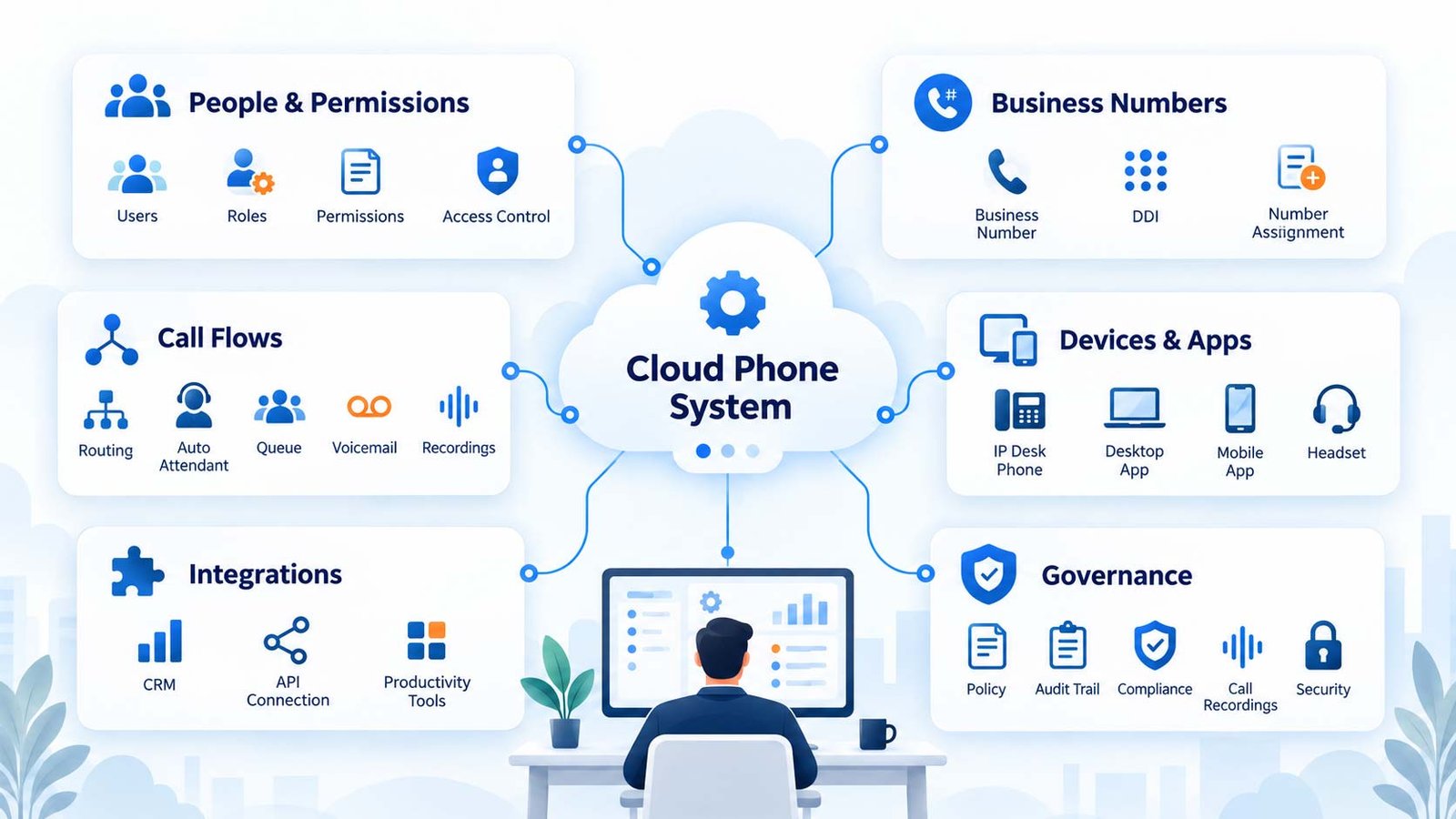
People and Permissions
Administrators should know who can add users, remove users, assign licences and change administrative roles.
A growing organisation may also need delegated administration so one team can manage routine tasks without receiving access to every security or billing setting. For businesses operating several branches, the multi-site business phone systems guide covers central governance alongside branch-level independence.
Numbers and Caller Identity
Telephone numbers are not just configuration objects. They are public business assets.
The control surface should make it clear how numbers are assigned, which outbound identity users present, how department numbers are managed and who is authorised to make changes.
Call Flows
Business hours, auto attendants, queues, ring groups, overflow destinations and voicemail are operational controls.
A platform does not need to expose every possible technical setting, but a business should not need a lengthy support process for ordinary call-flow changes.
Devices and Applications
Cloud telephony may involve:
- IP desk phones;
- desktop applications;
- browsers;
- mobile applications;
- shared-area devices;
- specialist reception or contact-centre endpoints.
Administrators should understand how those endpoints are provisioned and what happens when a user changes device.
Integrations
The existence of an integration is less important than the dependency it creates.
Ask:
- What data moves between the systems?
- Who can authorise the integration?
- What happens if it stops working?
- Is the workflow still usable without it?
- How difficult would it be to reproduce elsewhere?
Governance
As voice becomes software, access control becomes more important.
Administrators should be able to understand who can:
- listen to recordings;
- view call information;
- change routing;
- modify users;
- connect applications;
- change administrative permissions.
For deeper security requirements, use the dedicated VoIP security guide.
The principle is simple:
Cloud convenience without administrative control can replace hardware dependency with supplier dependency.
The Cloud Failure-Path Test
A cloud failure path describes what happens to calls when one component of the communications chain becomes unavailable and which alternative route takes over.
This is more useful than asking only whether a provider advertises a high uptime percentage.
The correct continuity plan asks what happens at each layer. Use the VoIP call quality and reliability guide for the network and failover checks behind that assessment.
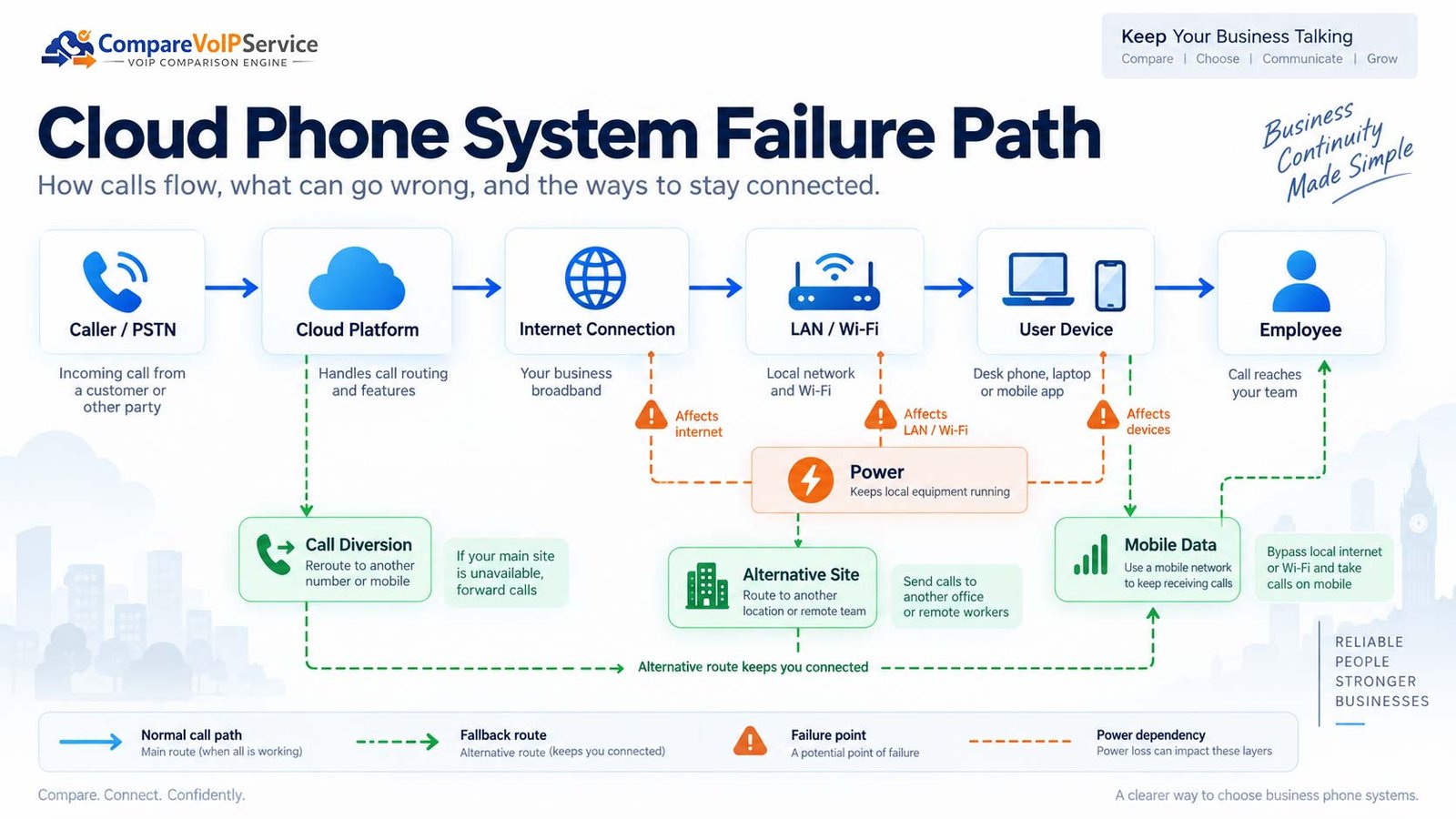
Provider Platform Failure
If the cloud platform itself becomes unavailable, where do inbound calls go?
Questions to ask include:
- Is alternative routing possible?
- Can calls be diverted outside the platform?
- Who is authorised to make emergency routing changes?
- Is status information available during an incident?
A platform SLA is useful evidence, but the business still needs to know what it will actually do during an outage.
PSTN or Carrier Failure
The cloud application may be healthy while a carrier or PSTN route has a problem.
Ask whether the provider uses one carrier path or multiple routes, whether the customer has any choice of operator and who owns escalation when external calling is affected.
This becomes particularly relevant with architectures such as Teams Phone, where the PSTN model may be Microsoft Calling Plans, Operator Connect, Teams Phone Mobile or Direct Routing.
Broadband Failure
A cloud platform cannot make the local office internet connection reliable.
If the primary broadband service fails:
- can calls move to mobile applications using cellular data?
- can inbound numbers divert to another destination?
- can users work from another site?
- is backup connectivity available?
The correct answer depends on how critical voice is to the organisation.
LAN or Wi-Fi Failure
Internet connectivity may still be live while the office LAN, switch, firewall or Wi-Fi environment has failed.
Mobile data can provide an alternative for some users, but reception desks, shared devices and wired handsets may remain unavailable.
The failure plan should identify which users need an alternative path first.
Power Failure
Ofcom’s guidance on voice services delivered over broadband highlights the importance of emergency-call access during power outages. Unlike a traditional exchange-powered telephone line, local broadband equipment normally requires mains power.
For business planning, ask which equipment remains usable when the premises lose power and whether backup power or an alternative calling route is required.
Endpoint Failure
A user should not become unreachable because one laptop or handset fails.
Cloud platforms with good endpoint flexibility can allow a user to continue through another authorised device. That is a practical resilience benefit, but only if authentication, applications and fallback procedures are ready before the incident.
The important conclusion is:
Cloud resilience is end-to-end. Provider uptime is only one layer of the failure path.
The Cloud Exit Test: Can You Leave Without Breaking the Business?
Cloud exit portability measures how easily a business can move its critical communications assets — especially telephone numbers, data, devices and workflows — to another platform without disproportionate operational disruption.
A platform can be easy to buy and difficult to leave.
That is why exit planning belongs in the buying decision.
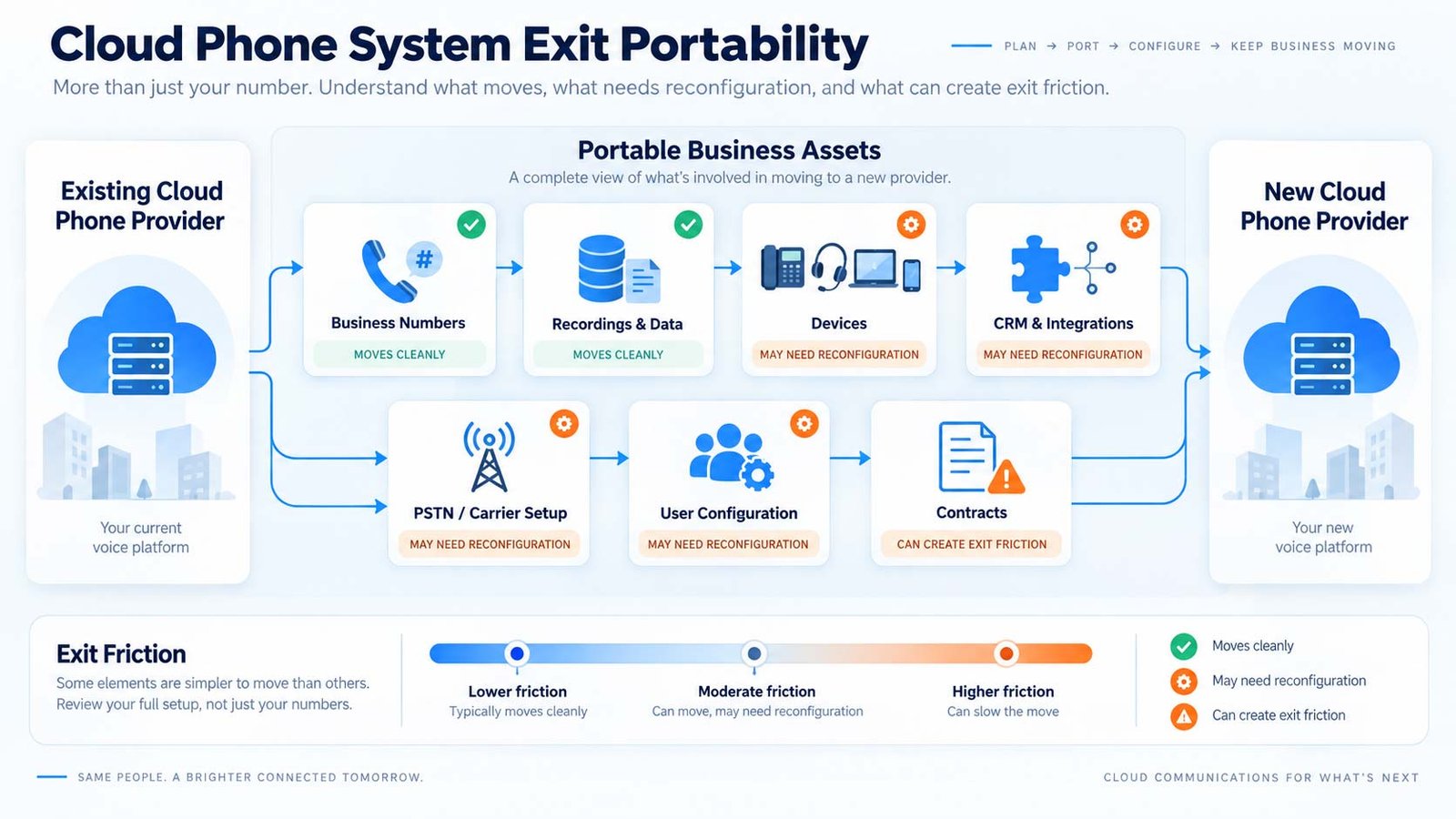
Telephone Number Ownership
Start by establishing which business numbers exist and which legal or commercial entity controls them.
For every important number, confirm:
- whether it can be ported;
- what information is needed for a port;
- whether the losing service must stay active;
- which party controls the port request.
For detailed migration mechanics, use the number porting guide.
Recordings and Data
If call recordings, voicemail, analytics or AI-generated conversation data matter to the business, establish whether they can be exported and in what format.
Do not assume that information visible in a cloud portal can automatically be moved into another system.
Device Portability
Some endpoints can be reprovisioned for another platform; others may be tied to a supplier configuration, firmware model or commercial agreement.
The more physical devices a deployment contains, the more useful it is to understand reuse before signing.
Integration Dependency
A CRM integration can improve productivity while also creating switching work later.
Map which workflows depend on:
- click-to-call;
- automatic activity logging;
- contact synchronisation;
- call recordings;
- transcripts;
- workflow automation;
- reporting.
If the business changes phone system, how much of that workflow must be rebuilt?
PSTN and Operator Dependency
Cloud telephony often has an application layer and a carrier layer.
The two may come from the same supplier, different suppliers, or a partner architecture.
A business should know whether changing the cloud platform also means changing the carrier, SBC, number provider or support partner.
Contract Exit
Check:
- minimum term;
- notice period;
- early termination charges;
- renewal rules;
- hardware commitments;
- price escalation;
- number-porting obligations.
A technically portable cloud system can still be commercially difficult to exit.
Administrative Handover
Documenting the existing configuration reduces migration risk.
At minimum, retain a current record of:
- users;
- numbers;
- call flows;
- business hours;
- queues;
- auto attendants;
- routing destinations;
- devices;
- integrations;
- recording requirements;
- support contacts.
The core principle is:
Exit friction is part of cloud cost.
Cloud Commercial Architecture: Where Does Lock-In Come From?
Headline licence price is only one layer of cloud cost.
The commercial architecture can include:
A provider that appears inexpensive at the licence level can become more expensive once the required operating model is added.
Headline Price vs Operating Cost
The relevant comparison is not:
“Which provider has the lowest advertised user licence?”
It is:
“What does the exact configuration we need cost to operate?”
Examples of costs that can sit outside a base licence include:
- additional call recording;
- advanced analytics;
- CRM integration;
- queue or contact-centre functionality;
- specialist support;
- number rental;
- implementation;
- handset rental or purchase;
- additional storage.
Use the VoIP savings calculator when you need a separate cost-estimation workflow rather than turning this ranking page into a calculator.
Contract Flexibility vs Technical Flexibility
Cloud technology is often described as flexible because users and features can be changed without replacing an on-site PBX.
That does not mean every commercial agreement is flexible.
BT Cloud Voice, for example, currently publishes 60-month licence pricing with scheduled annual increases. Other platforms may use annual agreements, partner terms or quote-specific structures.
Always evaluate:
- technical ability to change;
- contractual ability to change;
- cost of changing.
Those are three different things.
UK Migration Context
The UK transition away from traditional phone lines makes number portability, digital calling and continuity planning relevant to cloud-platform selection.
Openreach states that traditional phone lines will move to digital services by 31 January 2027. Businesses still dependent on legacy services should therefore establish which numbers and voice services need to move and what continuity requirements apply.
Detailed dates, legacy-device considerations and readiness planning are covered in the dedicated PSTN switch-off guidance.
For this cloud comparison, the main lesson is narrower:
Do not choose a replacement platform only because the old service is ending. Choose an operating model the business can control, recover and leave if necessary.
Cloud Control Decision Sequence
The most reliable way to shortlist a cloud phone system is to start with the operating model rather than the provider logo.
Map Control
List the routine changes your business expects to make.
Who needs to:
- add users;
- assign numbers;
- change business hours;
- update queues;
- change routing;
- manage recordings;
- control integrations?
Then decide which actions should be self-service and which you are happy for a provider or partner to manage.
Map Call Paths
Document how a normal inbound call should move.
Include:
- main number;
- auto attendant;
- departments;
- queues;
- overflow;
- voicemail;
- out-of-hours routing;
- remote and mobile users.
This prevents a feature list from distracting from the actual call journey.
Map Applications
Identify which applications depend on telephony.
CRM, helpdesk, Microsoft 365, call recording, analytics and workflow automation can all affect platform choice.
Separate genuinely necessary integrations from features that look useful in a demo but will not become part of daily work.
Map Failure
Walk through each failure layer:
- provider;
- carrier;
- broadband;
- LAN/Wi-Fi;
- power;
- endpoint.
For each one, write down the alternative route and the person responsible for activating it.
Map Exit
Decide what must remain portable:
- telephone numbers;
- recordings;
- data;
- devices;
- integrations;
- workflows.
If leaving later would require rebuilding a critical business process, treat that dependency as part of the buying decision now.
Shortlist Platforms
Only after the operating model is clear should the organisation compare providers.
At that point, the question is no longer “which provider has the most features?”
It becomes:
Which provider gives us the right control surface, the most credible failure path and an acceptable level of exit friction?
Start with the operating model and failure path, not the provider logo.
Final Verdict
There is no single cloud architecture that is ideal for every UK business.
The useful distinction is how much control the organisation wants to retain, how it expects failure to be handled and how easily it needs to move later.
Broad Self-Service Cloud Platforms
RingCentral RingEX, 8×8 Work and GoTo Connect are strong when the organisation wants a mature hosted platform with meaningful administrative control.
RingCentral offers the broadest all-round operating environment in this shortlist, 8×8 is especially relevant to multi-site administration, and GoTo Connect stands out where flexible call-flow design is central.
Application and AI-Led
Dialpad fits organisations that want the cloud phone system to behave primarily like software rather than a replacement desk PBX.
Microsoft-Centred
Microsoft Teams Phone can be the natural option when Teams is already the centre of collaboration, but the PSTN architecture must be treated as part of the system rather than an afterthought.
UK Partner-Managed
Gamma Horizon is particularly relevant where the organisation wants a telecoms partner to take greater responsibility for implementation and support.
Large-Supplier Managed Migration
BT Cloud Voice provides a structured UK supplier route, but its long commercial term makes contract analysis important.
Smaller-Team Simplicity
bOnline is relevant when a smaller business values simple hosted calling and transparent entry pricing more than enterprise-scale administration.
IT-Controlled Architecture
3CX Hosted is strongest where the organisation wants more influence over hosting, SIP and telephony architecture and has the technical capability or partner support to manage that responsibility.
The final decision question should therefore be:
Which platform gives us enough cloud control to operate effectively, a credible failure path when something breaks, and acceptable freedom to leave later?
That question is more useful than choosing a cloud phone system from feature count alone.
Frequently Asked Questions
What should a business control in a cloud phone system?
A business should understand who can manage users, telephone numbers, caller identity, business hours, auto attendants, queues, routing, devices, permissions and integrations. The right level of control depends on the organisation. Some businesses want full self-service administration; others prefer a managed partner. The important point is that the boundary is clear before purchase.
What happens to cloud phone calls if broadband fails?
It depends on the platform and configuration. A business may be able to route inbound calls to mobile applications using cellular data, divert numbers to alternative destinations or move users to another location. The continuity plan should be defined before an outage occurs rather than relying on manual improvisation after connectivity has failed.
Can a cloud phone system fail even when the provider is online?
Yes. The provider can be operating normally while a business experiences problems with its PSTN carrier route, broadband connection, firewall, LAN, Wi-Fi, mains power or endpoint device. That is why cloud resilience should be evaluated across the full failure path rather than through the provider’s platform-uptime figure alone.
Can I move business numbers away from a cloud phone provider?
Business numbers can commonly be ported between compatible providers, subject to number type, carrier procedures, account information and contractual conditions. Keep the existing service active until a port has been coordinated and completed. For the detailed process, use the number porting guide.
What data should be exportable from a cloud phone system?
Requirements vary by platform and business use. Relevant information may include call records, recordings, voicemail, analytics, user information and AI-generated conversation data. Buyers should confirm what can be exported, in which format and for how long it remains available. Do not assume every item visible inside a web portal is portable.
Are cloud phone systems tied to specific handsets?
Not always. Many platforms support desktop, browser and mobile applications as well as compatible IP phones. Hardware portability varies, however. Some devices can be reprovisioned for another platform while others may depend on supplier configuration, firmware or commercial terms. Confirm device compatibility before investing heavily in handsets.
What creates vendor lock-in in cloud telephony?
Lock-in can come from several layers: telephone numbers, proprietary devices, long contracts, recordings, data, application integrations, carrier arrangements and business workflows built around provider-specific functions. A cloud phone system may be technically flexible while still creating significant commercial or operational exit friction.
How should a UK business compare cloud phone system resilience?
Map the entire calling path: provider platform, PSTN/carrier, broadband, local network, power, endpoint and user. For every layer, ask what fails, where calls go next and who owns recovery. That gives a more realistic view of resilience than comparing uptime percentages in isolation.
Is Microsoft Teams Phone a cloud phone system?
Yes. Microsoft describes Teams Phone as a cloud-based calling solution native to Teams. External PSTN calling then requires an appropriate connectivity option such as Microsoft Calling Plans, Operator Connect, Teams Phone Mobile or Direct Routing. The chosen PSTN architecture materially affects administration, support responsibility and portability.
What is the difference between cloud control and managed support?
Cloud control describes what the customer can administer directly, such as users, routing and numbers. Managed support describes what a provider or telecoms partner agrees to operate on the customer’s behalf. A business can deliberately choose less self-service control if the managed-support model is clear, responsive and commercially appropriate.
Sources & Methodology
Provider order is determined by the weighted 42-point CompareVoIPService framework. The Cloud Operating Control Test is used only to interpret that evidence through cloud control, failure-path resilience and exit portability. It does not create a second numerical score.
The full methodology is available at comparevoipservice.co.uk/methodology/.
Evidence Rules
- Primary evidence comes from official provider product, pricing, support and service documentation.
- Public UK pricing is used where it is available and clearly attributable to the provider.
- Where a supplier relies on quotation-based pricing, the article describes the commercial model as quote-led rather than inventing a tariff.
- Provider documentation is evidence of published capability, not evidence of independent hands-on testing.
- Openreach and Ofcom are used for UK network-transition, continuity and emergency-calling context.
- Affiliate relationships do not determine provider order. See the affiliate disclosure.
- Public product and pricing information was checked on 22 September 2026 and can change.
Primary Sources Checked
- RingCentral UK cloud phone system
- RingCentral UK number porting support
- RingCentral UK numbering policy
- 8×8 UK Business Phone
- 8×8 UK Multi-Site Support
- Dialpad UK business phone calling app
- GoTo Connect plans and pricing
- Microsoft Teams Phone UK
- Microsoft Operator Connect planning
- Microsoft Direct Routing planning
- Vonage Business Communications UK pricing
- Gamma Horizon hosted phone system
- BT Cloud Voice
- bOnline business phone pricing
- 3CX pricing and licensing
- Openreach — Big Switch Off
- Openreach — digital phone lines for businesses
- Ofcom — emergency access during power cuts
Compare the Full Cloud Phone System Cost, Not Just the Licence
Compare user licences, calling, numbers, recording, integrations, devices, implementation, support, contract terms and switching dependencies before choosing a cloud phone platform.
