


Keep the number. Keep the working phone system. Prove AI can fail safely.
Find out whether AI can join your current call path, how a caller reaches your existing team and what must be tested before changing the live main number.
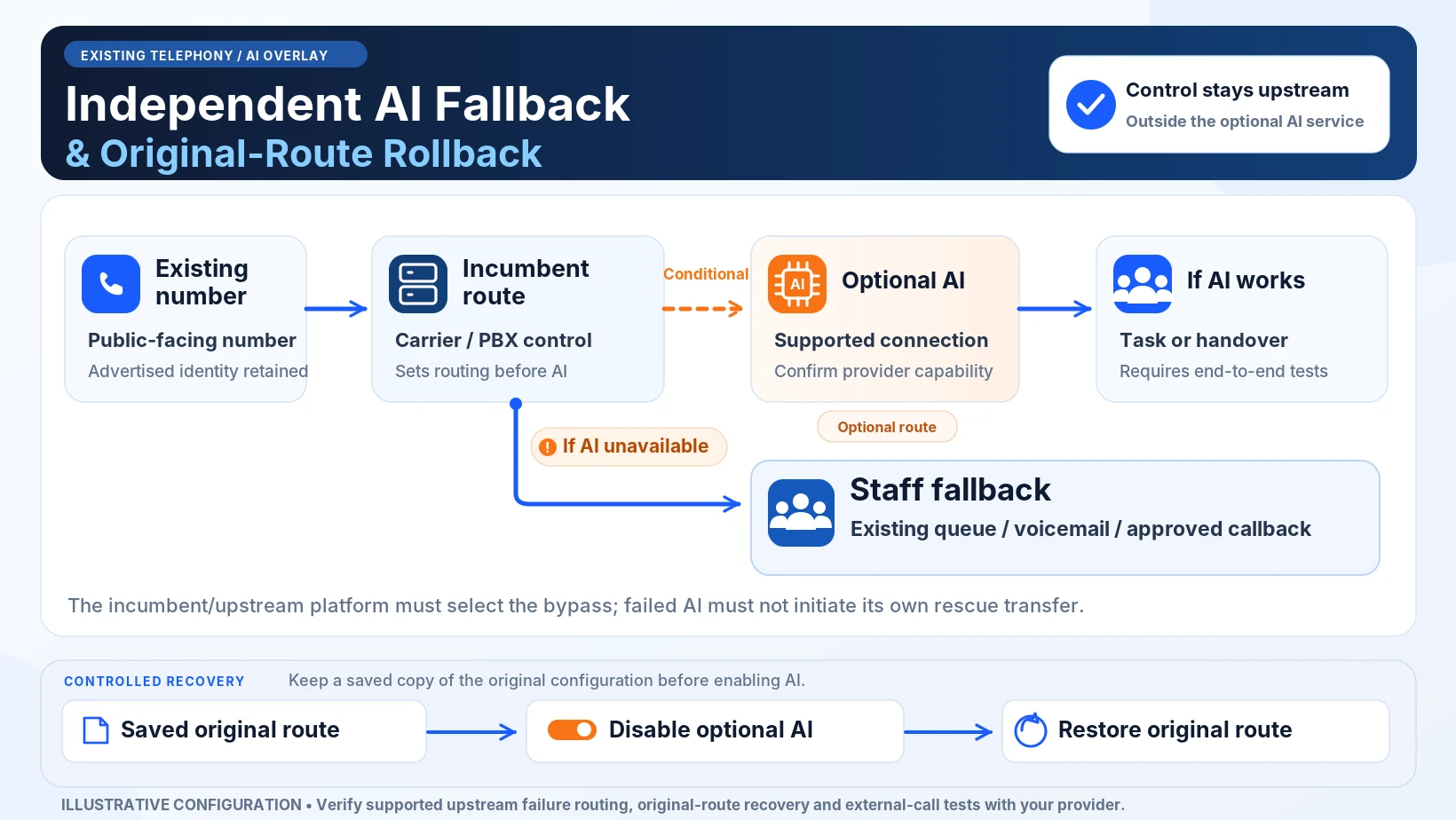
The original call route remains documented and restorable.
Short answer: Yes, many UK businesses can add AI call handling without changing the phone number customers dial or replacing their entire telephone system. The feasible route depends on your incumbent provider’s native features, approved call-forwarding options, SIP or API access. Before enabling it, confirm number ownership, charges for additional call legs, transfer behaviour, an independent human fallback and a tested way to undo the change.
Jump to a section
Can you add AI without replacing your current phone system?
In many cases, yes. A business can retain the public number its customers dial, continue using its current telephone provider and add AI to a selected part of the inbound journey. But these are separate things to verify. Your number might stay with the current carrier while selected calls are diverted elsewhere; alternatively, your current platform might support its own AI feature or an approved external extension.
Do not start by asking whether an AI supplier “supports VoIP”. Start by identifying who controls your inbound route, what your current contract permits and where a caller goes when the AI cannot answer.
Keeping your advertised number is not the same as keeping number hosting, preserving caller ID, retaining your handsets or guaranteeing transfers back to staff. Ask for each outcome to be demonstrated separately.
Quick compatibility answer selector
| Your current situation | Initial assessment | What to check next |
|---|---|---|
| Your PBX already offers a licensed, supported AI feature. | Potentially straightforward. | Confirm edition, routing rules, usage rights and unavailable-AI destination. |
| Your incumbent offers conditional forwarding to another UK number. | Possible without moving number hosting. | Confirm trigger type, concurrent diverted calls, extra legs and a route back to humans. |
| Your telephony platform supports approved SIP, BYOC or a programmable extension. | A technical overlay may be feasible. | Arrange a controlled compatibility design with your incumbent and integrator. |
| Your supplier restricts forwarding, extension/API access and external SIP. | The proposed overlay may not be available on your current agreement. | Request a written position before considering a separate migration. |
| You do not know your number holder, PBX edition or inbound route. | Decision pending. | Complete the six-point current-system fact finder in the next section. |
For the wider question of what AI can do across calls, summaries and workflows, the AI-powered VoIP adoption guide provides the broader background. This guide focuses on integrating the additional layer without unnecessarily changing the live calling environment.
Who controls your number, carrier, PBX and call route?
Before any trial, the business needs a simple map of who can authorise changes. The organisation named on the phone bill is not necessarily the company that controls the carrier routing, PBX, call-forwarding permissions and AI integration. These responsibilities can sit with different suppliers.
Six facts to obtain from your incumbent provider
- Main numbers and direct dials: confirm the exact active numbers and which legal customer account controls them.
- Serving telephone stack: record the number-hosting carrier, cloud phone service or private branch exchange (PBX), together with product edition and version.
- Current incoming route: document opening hours, menu or IVR, queues, staff extensions, overflow, voicemail and any linked branches.
- Permitted integration controls: establish who can modify forwarding, session initiation protocol (SIP) routes, API or programmable extensions and whether contract restrictions apply.
- Call-leg rules: request the charge and capacity for diverted calls, the caller identity presented at each hop, and which platform originates human callbacks.
- Fallback and rollback owner: document support contacts, the original routing rule and the process for restoring it; keep outbound 999/112 obligations under the responsible telephone provider.
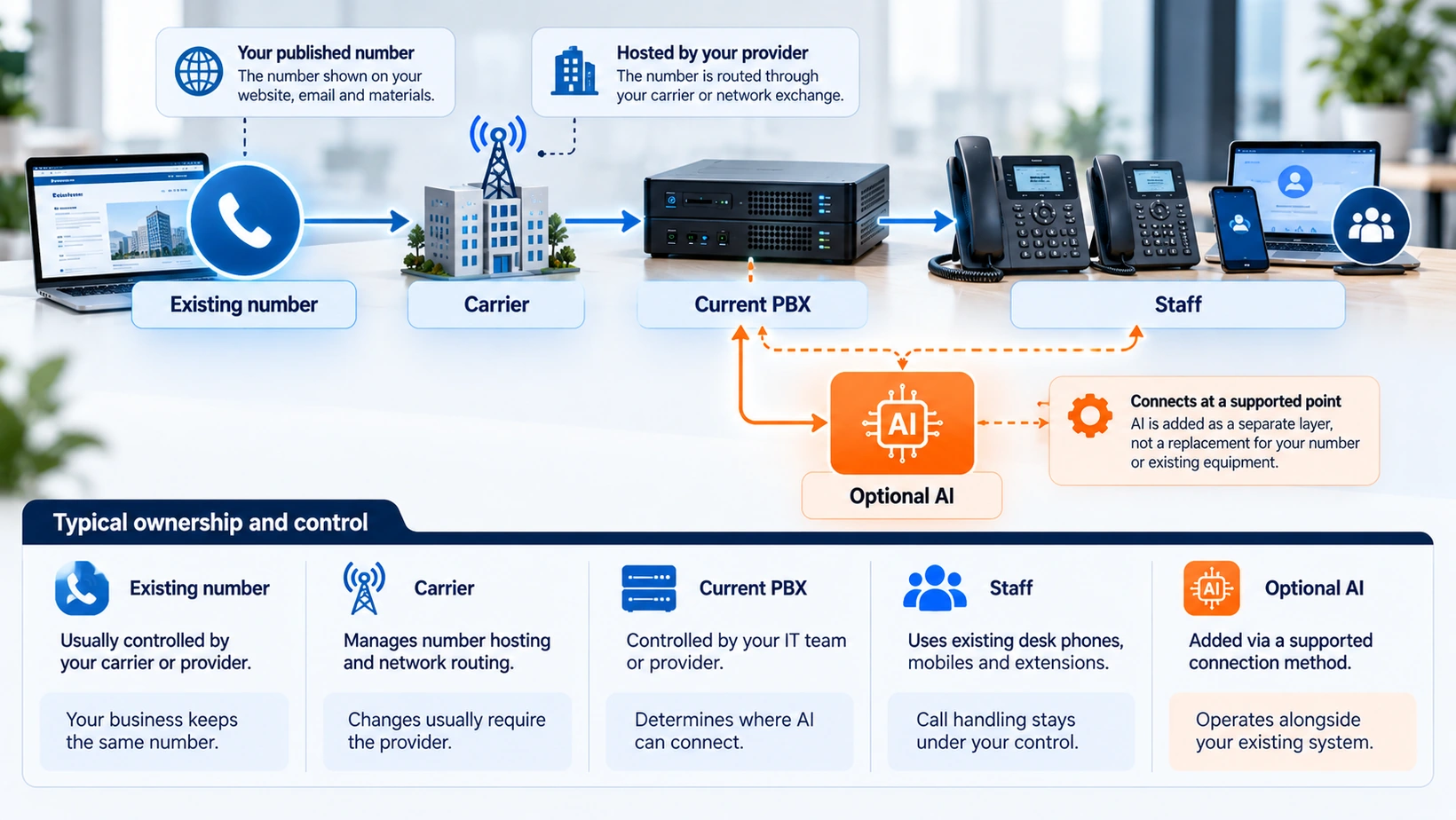
If the current call map is unclear, prepare it first using the business call-routing guide. Avoid applying new forwarding rules to a live main number while the present overflow behaviour is unknown.
Five ways to add AI to the existing telephone environment
There is no universal connection method for every UK phone provider. The options below progress from using an existing supported feature to a full change of platform. A migration is the last category to assess, not an automatic prerequisite for introducing AI.
Enable a native AI capability already offered by your current platform
Call path: existing number → existing PBX/provider → eligible AI role → existing queue or user.
Ask: Is it available on our actual edition and plan? Does the same supplier own the AI-unavailable destination and human handover?
Documented example: 3CX’s Customer Service Agent guide includes handoff, escalation topics and an option for an unreachable AI engine. That example does not establish equivalent capability in every PBX.
Divert selected calls to an external AI destination
Call path: existing number → incumbent rule (after hours, no-answer or selected route) → AI destination → agreed staff fallback.
Ask: Does our supplier support the precise diversion trigger? What happens with simultaneous calls, caller identity, diverted call charges, transfers back to the business and an unavailable AI number?
This can be useful for a limited trial because the original number and main PBX may remain in place. It is not automatically a zero-cost route or a guarantee of human transfer.
Use an approved SIP, BYOC or session border controller connection
Call path: existing carrier/PBX → authorised SIP gateway or trunk → compatible AI service → approved transfer or return route. BYOC means “bring your own carrier”; an SBC is a session border controller managing a telephony boundary.
Ask: Does the current carrier explicitly permit the architecture? Who manages authentication, security, codecs, DTMF, concurrent channels, timeouts, transfers and incident logs?
This requires supplier/integrator design and testing. Never expose a public SIP endpoint or modify production trunks from a generic tutorial.
Connect AI through a supported PBX API or programmable extension
Call path: number → existing PBX → approved programmable role → external AI application → PBX-controlled staff destination.
Ask: Is our edition/version licensed for the published API? Which extensions and actions can the application access? Who operates and monitors the bridge?
For a concrete example, 3CX documents Programmable Extensions that connect external voice applications while the PBX continues to provide telephony, routing and extensions. This is different from simply forwarding a call to a second number.
Consider migration only where the overlay is blocked or unsuitable
Call path: separately procured service → documented number migration, new routing and full acceptance testing.
Ask: Which non-migration options were ruled out, by whom and for what documented reason? What are the service, contract, number, device and support consequences?
A change of number hosting is a separate project. If it becomes necessary, follow a deliberate UK number-porting plan rather than treating porting as an automatic part of the AI purchase.
| Connection path | What commonly stays | Main dependency to prove |
|---|---|---|
| Native AI | Carrier and PBX can remain unchanged. | Correct feature entitlement and supported handover. |
| Conditional forwarding | Published number and current service may remain. | Forwarding trigger, charges and failure route. |
| SIP / BYOC / SBC | Existing number hosting and PBX can potentially remain. | Carrier approval, technical compatibility and ownership. |
| API / programmable extension | Existing PBX can keep its routes and users. | Published API access, edition and operated bridge. |
| Migration | Number may be retained subject to an accepted port. | New contract, cutover, downtime risk and rollback plan. |
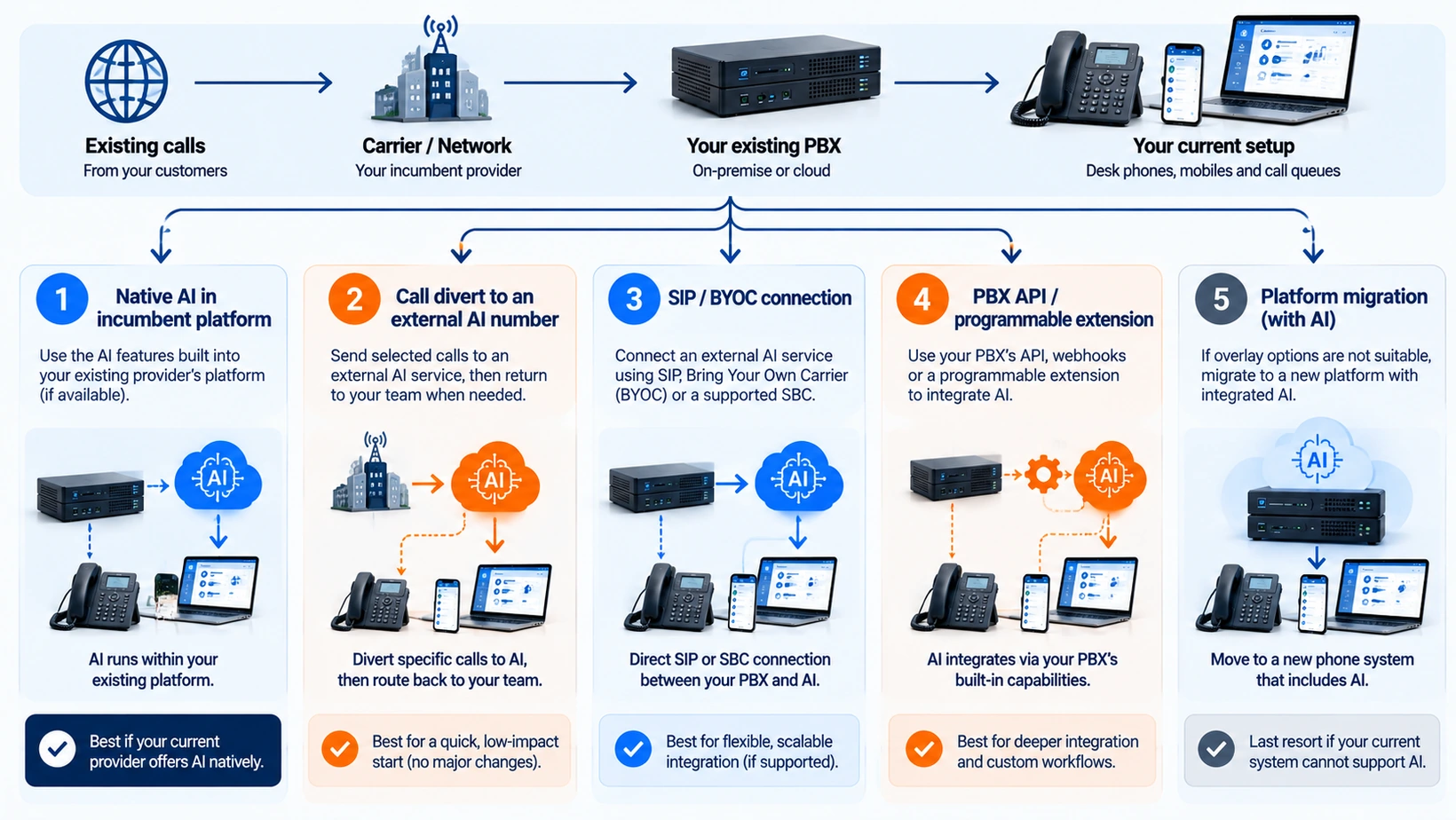
The appropriate path is the one both sides can support in writing and reproduce on a controlled test number—not the one with the shortest promotional setup video.
Can you keep the same UK number and caller identity?
Potentially, yes—but three different requirements are often bundled into the phrase “keep your number”. Write each requirement into the supplier brief and request an external-to-external test call.
| Requirement | What it actually means | Evidence to request |
|---|---|---|
| Keep the published 01/02/03/0800 number | Customers continue dialling the familiar number. | Dial it from a mobile outside your phone estate before and after the change. |
| Keep number hosting | The existing operator still holds/routes the number; an approved AI path is added. | Current carrier/account remains documented and authorised. |
| Port the number | Hosting moves to a different provider under a migration process. | Treat as a separate change requiring an agreed port/cutover plan. |
| Preserve incoming caller identity | Staff/AI see the correct CLI or a documented, acceptable alternative. | Confirm presentation across forwarding and a human return transfer. |
| Present the authorised outbound number | Callbacks show an approved business identity where permitted. | Confirm carrier/CLI authorisation and a real callback to an external phone. |
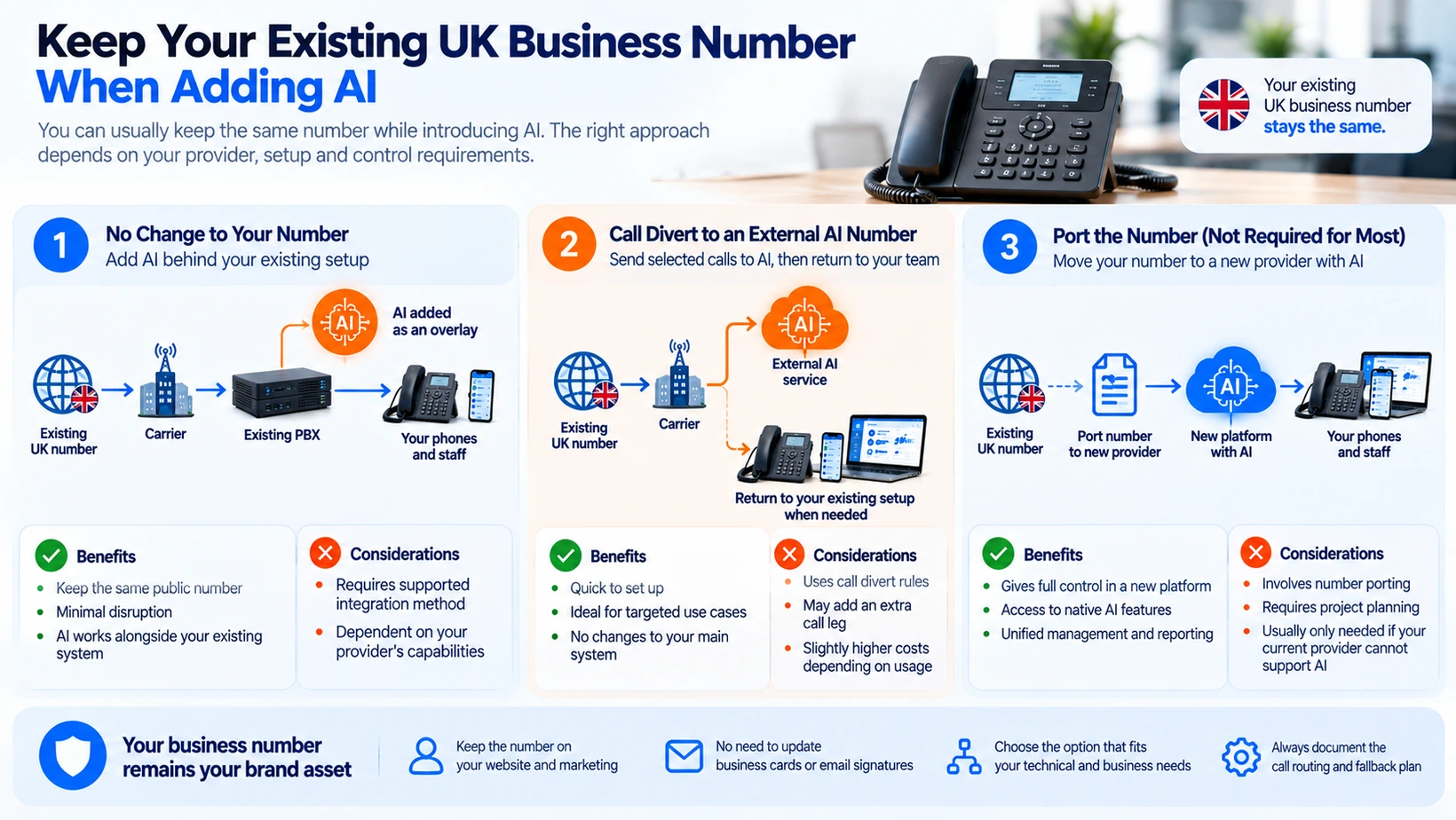
A caller can dial the same public number while the incumbent forwards a selected call to the AI. That alone says nothing about which supplier hosts the number, what outbound caller ID a transfer displays or whether the extra call leg is chargeable.
Ask how the AI handles multiple DDI numbers (direct dial-in numbers), geographic numbers, 03 or 0800 routes and return-to-staff transfers. The answer may differ by number class, provider and commercial agreement. If the current service includes a number that supports outgoing emergency calls, its emergency access and caller-location arrangements must remain correctly managed by the regulated telephony provider; an inbound AI overlay does not replace those duties.
Where should AI join the inbound call journey?
Do not make AI the first stop for every caller by default. Place it where the business has identified a specific failure or repetitive task—then draw the human route and the no-AI route alongside it. These three patterns are examples of requirements for your provider, not universal PBX configuration recipes.
Option A: Human-first, AI only for overflow
Option B: AI-first for a tightly defined task
Option C: AI after hours, normal routing by day
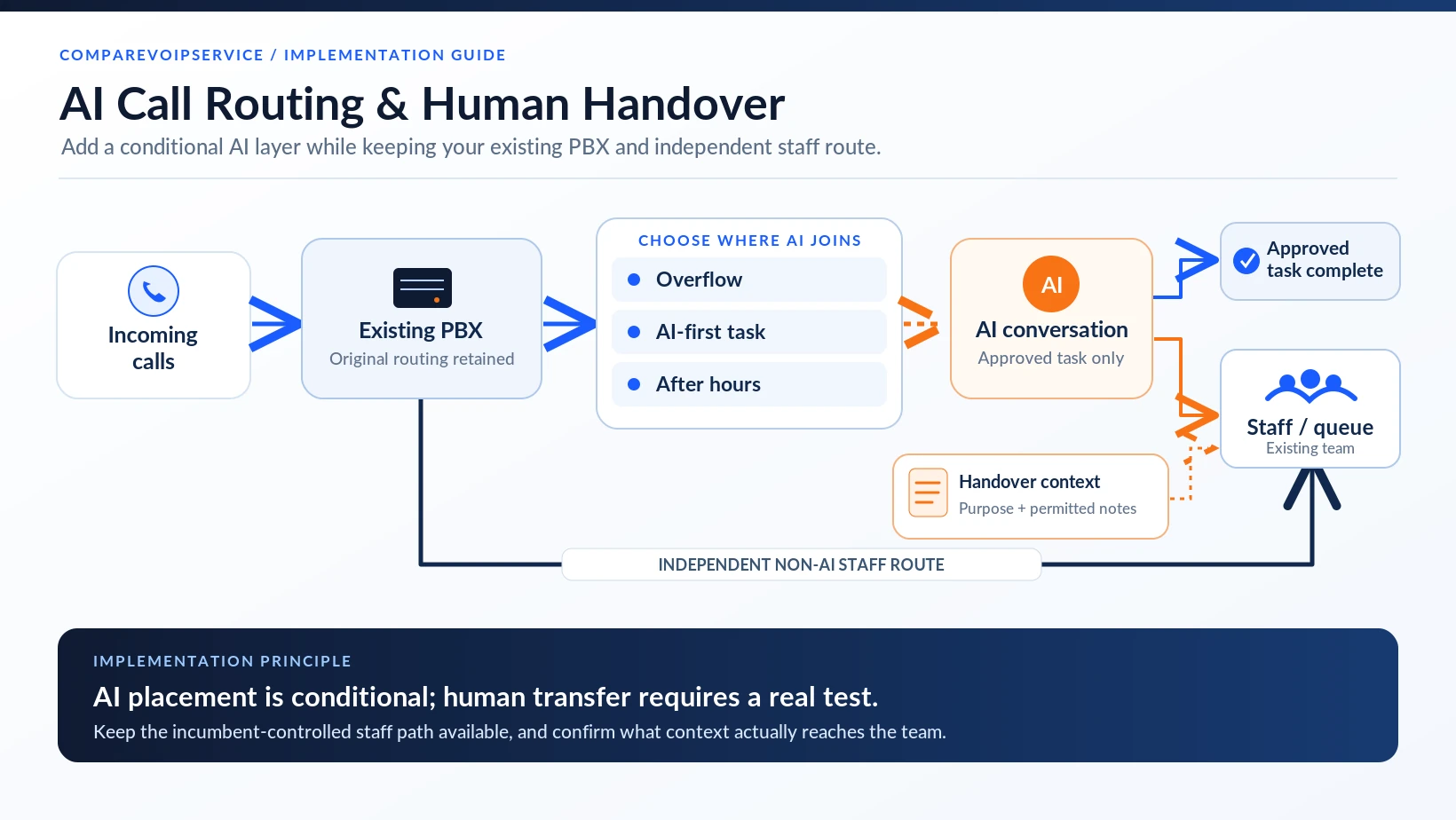
For each diagram, write down the party operating each decision point and how long a caller can remain in any queue. Keep the broader design of menus, ring groups and hunt groups in the call-routing reference; this guide only adds the extra AI hop and its consequences.
Will callers reach the right human with useful context?
“Human transfer supported” is not a complete acceptance criterion. An AI may simply dial another public number, request a PBX transfer, use an attended/bridged call or hand the user a callback promise. These have different reliability, caller-ID and cost implications.
| Demonstration | What you need to observe | Failure behaviour to require |
|---|---|---|
| Caller requests a person | Agent clearly acknowledges the request and attempts the agreed route. | No argument or repeated AI prompts when the caller wants a person. |
| Destination available | Caller arrives at the right group or named staff role. | Time limit for connection; no duplicate call loop. |
| Destination busy/unavailable | A real alternative destination or voicemail is offered. | Do not bounce indefinitely between AI and PBX. |
| Identity and context | Staff receives agreed caller number and suitable summary, if authorised. | No unsupported promise that full context will always transfer. |
| Return transfer | External transfer completes at the correct commercial rate/route. | Show who pays for overlapping voice legs or SIP transfer behaviour. |
| Sensitive/ambiguous request | AI recognises its limits and escalates according to policy. | Do not disclose protected data before identity and authorisation checks. |
A SIP REFER transfer, a PBX call-control action and a new outbound PSTN call can behave differently. For an example of supplier-specific transfer behaviour, see Twilio’s SIP REFER documentation. Your provider should demonstrate the actual configured route, costs and fallback.
A practical example: a customer asks for Accounts. The AI should identify the request, request transfer to the approved Accounts destination, notify the caller if it cannot connect and create a structured follow-up only if the caller has agreed and your data policy permits it. Successful recognition without a successful destination is not a completed handover.
What happens if the AI, network or an integration fails?
AI availability alone cannot establish business-call continuity. A carrier can be working while the AI application is unreachable; the AI can answer while the calendar API is down; the transfer can be initiated while the staff destination is unavailable. Treat these as separate failure domains.
| Failure to simulate | Caller-safe alternative | Who needs to show evidence |
|---|---|---|
| AI endpoint times out / no response | Existing PBX routes to a named non-AI queue or voicemail. | AI supplier and current phone provider together. |
| AI call connects but no audio | Detect the stalled conversation, terminate/route safely. | Integrator, AI operator and carrier. |
| PBX or carrier route unavailable | Use the incumbent continuity arrangement as contractually supported. | Serving telephone operator / PBX provider. |
| CRM or calendar rejects an action | Tell the caller that the action is not confirmed; offer human follow-up. | AI integration owner and business system administrator. |
| Transfer destination busy/unavailable | Alternative person, voicemail or caller-approved callback. | Incumbent PBX and AI supplier. |
| Wrong-hours or holiday rule | Restore correct schedule, log and retest external call. | Business phone administrator. |
| Data-processing or security incident | Restrict affected processing and follow the organisation’s incident procedure. | Business privacy/security owner and processors. |
Design a rollback you can demonstrate
- Save an accurate copy of the original routing rule and named destinations before any trial.
- Give one authorised person the right to disable the new AI leg without waiting for a supplier ticket during a live incident.
- Agree which external number, existing queue or voicemail takes calls if the AI cannot answer.
- Perform a controlled AI-unavailable test using a real external phone and record what the caller actually experiences.
- Reverse the AI route, dial the original business number again and confirm normal hours, queues, transfers and voicemail still work.
Staff outbound access to 999/112, any associated location information and power-cut provisions remain responsibilities to check with the regulated phone supplier. Ofcom publishes guidance on access to emergency organisations during power cuts. Do not assume an AI inbound-answering application is an emergency-calling solution.
Which UK privacy, recording and access controls need checking?
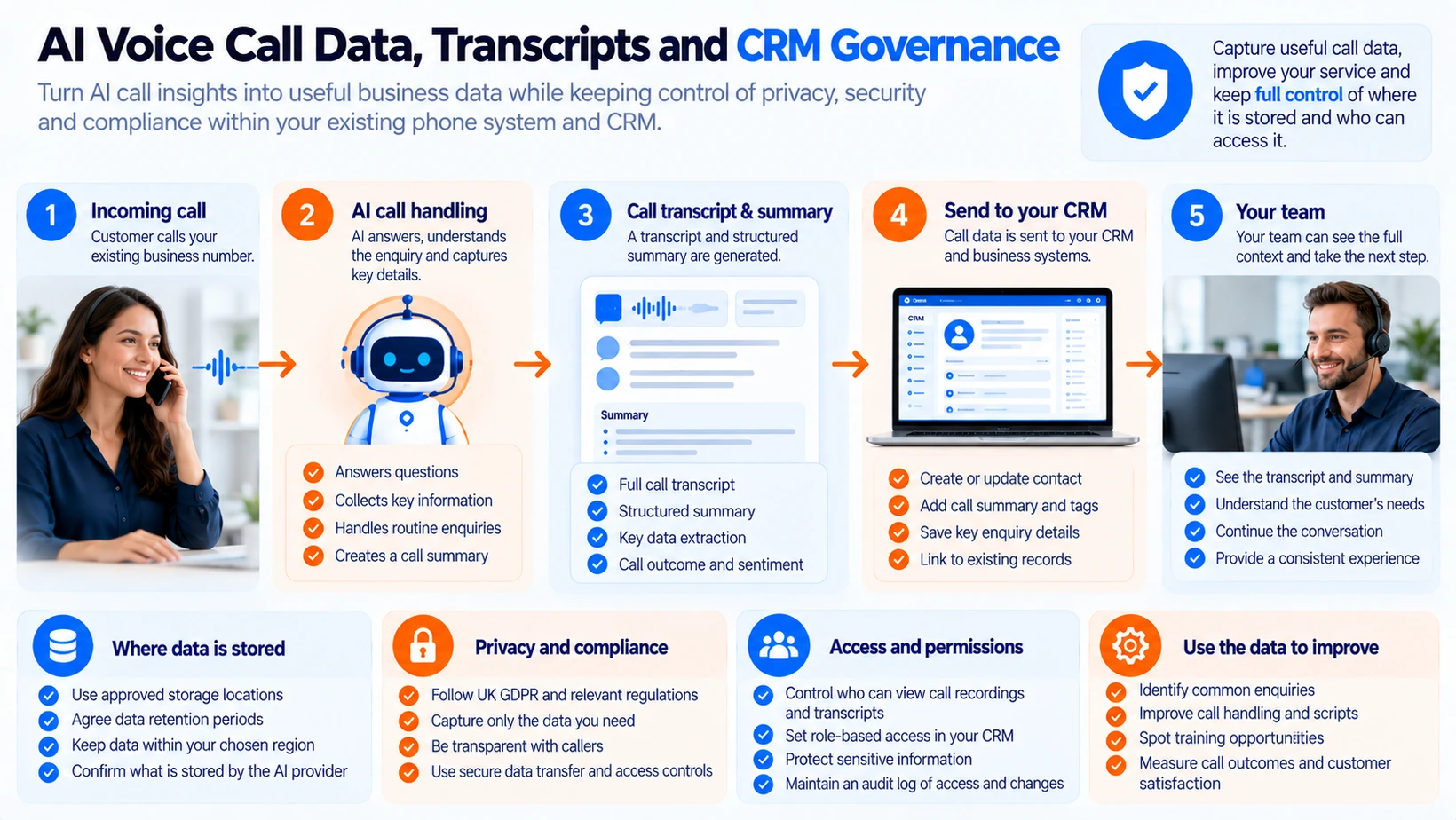
An AI overlay can introduce a new data-processing chain even when the public business number stays unchanged. Establish what audio is streamed, what is stored, whether transcripts or recordings are created, which subcontractors receive information and whether the AI can perform actions in other business systems.
Minimum questions for your privacy and IT owner
Why is AI processing needed? Is call content recording necessary or would a limited outcome record suffice? Identify the applicable lawful basis for each purpose.
Explain relevant AI involvement, call monitoring or recording as applicable and provide accessible privacy information. Include workers whose calls may be monitored.
Document contractual roles, subprocessors, international transfers where relevant, storage region, and who answers a data-subject request.
Apply the smallest required API permissions, retention limits, access logs, deletion routes and an incident escalation owner. Assess whether a DPIA is required by the risks.
The ICO’s worker call-monitoring guidance addresses the proportionality of monitoring and informing workers and callers. For the wider recording policy, access, retention and deletion workflow, use the site’s business call-recording guide.
For any AI action, require a verifiable business-system response. If a calendar write fails, the AI must not say the appointment is confirmed. If a transcript is shared, make sure the recipient has the right to see it.
What will the extra AI layer cost—and who supports each part?
An AI supplier’s per-minute figure is only one line in a combined telephone and automation service. Ask both your incumbent phone provider and the proposed AI supplier for a quote using the same assumed call pattern. A precise number cannot be produced honestly without their current contracts, usage rules and transfer architecture.
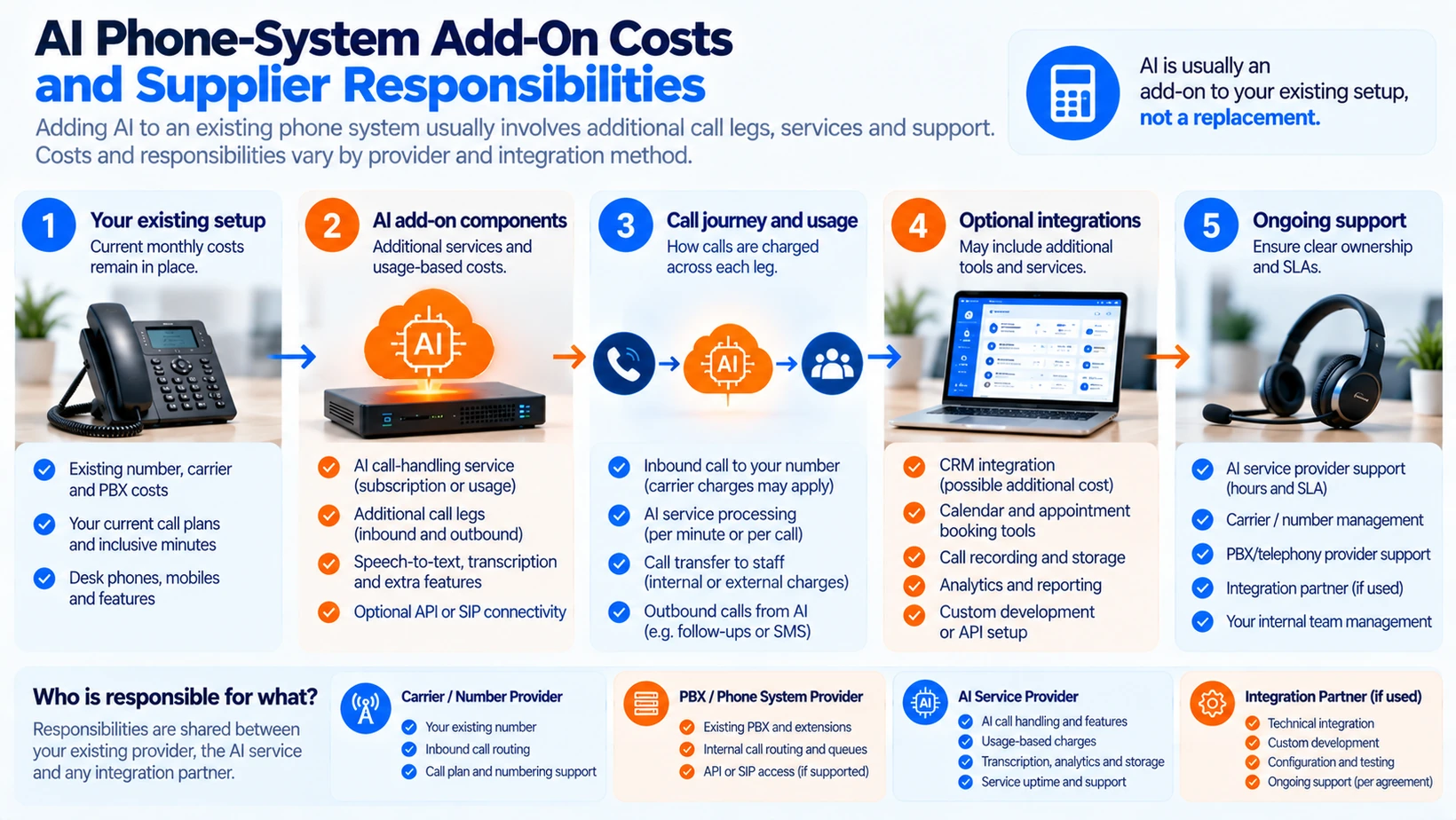
All-in quote items to obtain in writing
| Cost / contract item | Ask incumbent telephone provider | Ask AI provider / integrator |
|---|---|---|
| Existing subscription and number rental | Does the original plan stay in place? | Is your service standalone or bundled? |
| Call forwarding / additional inbound leg | Charge, trigger type, duration and concurrency limits? | Is receiving the forwarded call charged separately? |
| AI usage | Any upstream per-call or minute charge? | Is billed time conversation, telephony or both? Rounding/allowances? |
| Speech / model / voice component | Not usually bundled unless a native feature. | Included, metered separately or dependent on other providers? |
| Human transfers and outbound call legs | What does the return call or transfer cost? | Who originates and bills the second leg? |
| Setup, SIP/API work and testing | Administration, new capacity or consultancy charge? | Integration, training, monitoring and troubleshooting charge? |
| Support and contractual obligations | Who investigates call-routing/number faults? | Response times for AI/audio/action incidents? |
| VAT, contract length and exit | Which charges exclude VAT and survive cancellation? | Is number hosting independent? How is data exported/deleted? |
One named owner for each failure domain
| Layer | Expected point of responsibility to document |
|---|---|
| Number and divert rules | Incumbent carrier/number-holding supplier and authorised customer admin. |
| Queues, hours, handsets | Current PBX service administrator or managed support team. |
| SIP bridge or programmable extension | Named technical integrator plus the approved platform vendor. |
| AI inference and speech | AI operator and disclosed component providers. |
| CRM/calendar write | Business system owner and integration maintainer. |
| Call records, privacy and response | Business controller/privacy owner and documented processors. |
| Caller-facing incident and rollback | One reachable business decision-maker with joint-vendor escalation details. |
Do not let an AI vendor and telephone supplier refer a dropped call to each other indefinitely. Agree the shared diagnostic record in advance: timestamp, redacted caller/reference, number dialled, current route, event or call IDs and the contact who coordinates the investigation.
How should you pilot, sign off and reverse the change?
Use a controlled acceptance sequence rather than putting the entire main number through a new AI service on day one. Agree which person can stop the trial if customers cannot complete the journey. The twelve checks below are a practical sign-off list for a real deployment; ticking them does not constitute certification of any supplier.
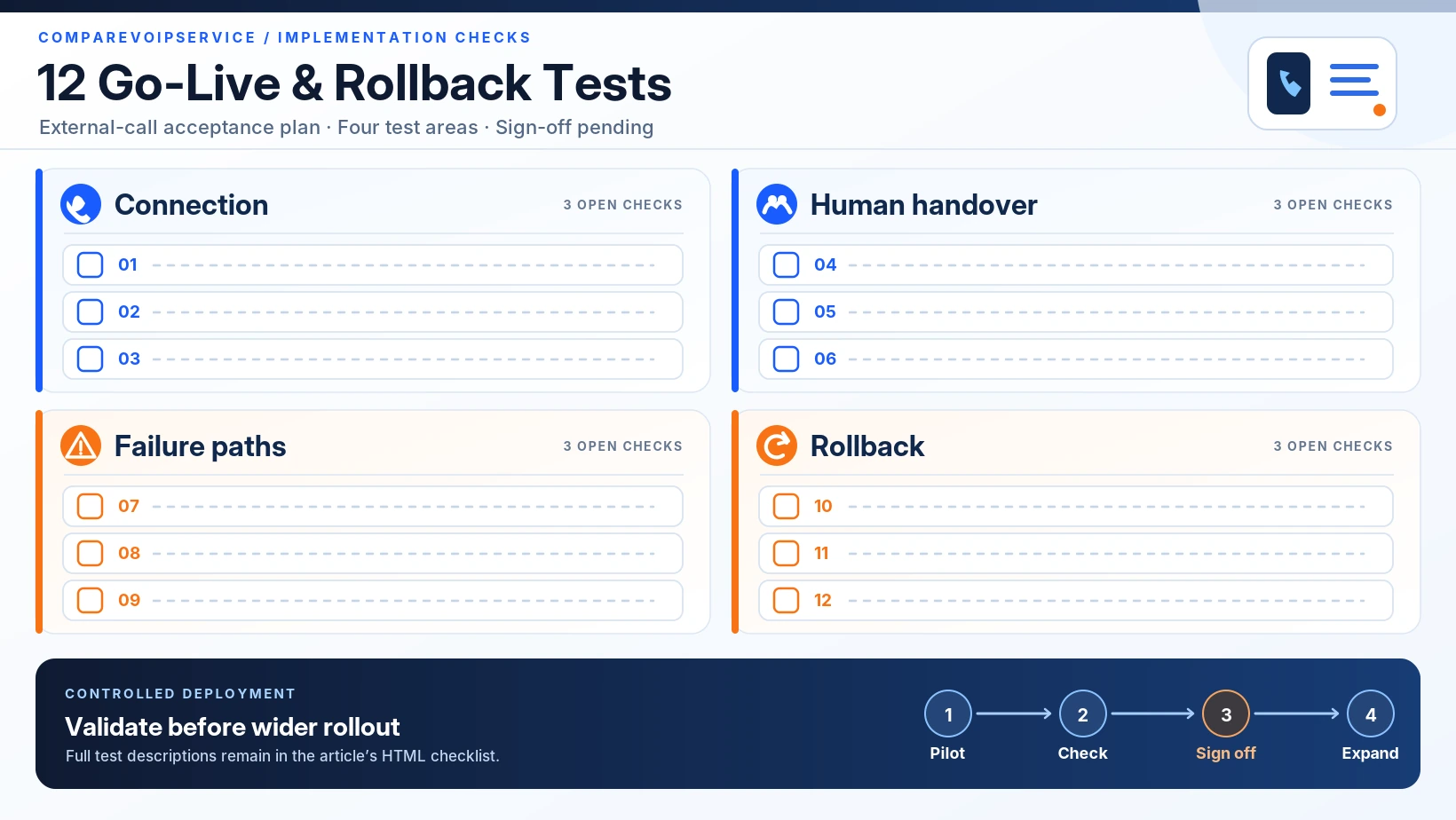
Four rollout stages
- Test number: prove inbound speech, intended workflow, internal transfer, rejected actions and the independent failure route with non-customer test calls.
- Selected call group: enable a limited use case and review actual outcomes and support ownership.
- Time-based pilot: test an agreed out-of-hours or low-risk segment, including exceptions for holidays and concurrent calls.
- Controlled primary-number change: only after all parties sign off the routing diagram, data processing, charges, transfer result and immediate rollback mechanism.
Twelve external-call acceptance tests
This is a local, tick-as-you-review checklist. It does not transmit results or store answers; record formal evidence and sign-off within your own change-management process.
AI Overlay Readiness & Rollback Pack
Use these points in one supplier meeting so the incumbent phone provider and the AI integrator agree the same configuration rather than working from separate assumptions.
- One documented current-state diagram: number holder, inbound routes, PBX/plan and existing staff destinations.
- One proposed route: five-path choice, allowed trigger, handover type and approved data flow.
- One commercial schedule: diverted calls, AI chargeable usage, return transfers, setup and support.
- One incident plan: named contacts, failed-AI destination, permissions to disable the route and original configuration record.
- One evidence pack: results of the twelve acceptance calls, with timestamp and the person authorising go-live.
- One reverse test: switching AI off must restore the original customer journey without changing the advertised number unless a separate migration was approved.
What to ask both suppliers before signing
Ask your current telephone provider and shortlisted AI supplier to answer this together: “Please show how the current business number reaches the AI, how calls return to our existing employees, what each call leg costs, which party can disable the AI route and what an external caller hears if the AI or connected calendar fails.”
Request a real demonstration on a controlled route. Written assurances are useful; the external-call evidence is what confirms that this specific configuration behaves as agreed.
Frequently asked questions
Can we add an AI receptionist without porting our current number?
Often, yes, if the incumbent supports an appropriate approved forwarding, native feature or integration route. Keeping the same advertised number does not itself mean the number has moved to the AI supplier. Confirm the carrier, route and rollback.
Will an existing 01, 02, 03 or 0800 number work?
Compatibility depends on number class, incumbent service, available divert targets and the AI provider’s telephony arrangement. Ask for an external call test on the actual number rather than accepting a generic “UK numbers supported” statement.
Can we keep our existing desk phones and mobile apps?
Potentially. When AI is an inbound overlay, existing users and devices can remain under the current PBX. Confirm where calls return and whether any new licences or queue changes are required.
Is call forwarding the same as a SIP integration?
No. Forwarding commonly sends a selected call towards another destination. An approved SIP/BYOC route connects voice infrastructure more directly and requires technical compatibility, authentication and operating responsibility. Their transfer, caller-ID and billing behaviour may differ.
Can 3CX or Teams work with an external voice agent?
Specific capabilities depend on current product, edition, licence, tenant and supported connectivity. 3CX publishes native agent and programmable-extension guidance; that does not confirm your installation. Ask your current Teams/phone administrator or provider for the supported route and a demonstration.
Can the AI transfer callers back to our existing staff?
Only where the chosen service and incumbent path support the required handover. Test an available colleague, busy queue, failed transfer, caller identity and whether the AI supplies an authorised summary.
Will adding AI make every call more expensive?
Not necessarily, but an external AI destination can add diverted, chargeable AI, speech and return-transfer legs. Request a joint quote using your own incoming-call and transfer pattern.
What happens if the AI goes down?
A properly planned setup uses an independent non-AI destination controlled by the incumbent/upstream system where supported. Prove it with a deliberately unavailable AI endpoint; do not rely solely on the AI saying it can fall back.
Do we need to tell callers their speech is processed or recorded?
Review the purposes, lawful basis, transparency, contracts and risk with your privacy owner. Recording and monitoring of staff/customer calls bring specific ICO expectations; not every AI conversation needs a persistent recording.
Can we remove the AI layer later without losing our number?
That is an explicit objective for an overlay, but the answer depends on who hosts the number and how routing was changed. Save the original configuration, keep the number-hosting agreement documented and complete a successful rollback call before go-live.
Sources and implementation basis
This guide combines UK public-authority guidance with published platform documentation. The diagrams are illustrative architecture patterns. Your current provider must confirm the availability and exact behaviour of any proposed installation.
- 3CX: AI Customer Service Agent — call-routing options, human handoff and unavailable-AI destination.
- 3CX: Programmable Extensions — a documented API-connected application pattern.
- Twilio: Voice failover practices — telephone application continuity considerations.
- Twilio: SIP REFER call transfer — technical and billing distinctions that depend on the route.
- ICO: monitoring telephone calls — proportionality and information for workers and callers.
- Ofcom: emergency calls and power cuts — continuity responsibilities for voice-service providers.

Bhav Giva
Founder & Lead Analyst at CompareVoIPService.co.ukBhav Giva publishes UK-focused business communications research and practical VoIP guidance. This guide concentrates on compatibility, continuity and the evidence businesses should request when introducing an AI call-handling layer into an established telephone environment.