

Build a business call-recording policy that explains why calls are captured, which calls are in scope, what callers and workers are told, who can listen, how long recordings are kept, how payment and sensitive data are handled, and how recordings can be found, exported and deleted when required.
Fast answer: Business call recording is the controlled capture and storage of telephone conversations for a defined purpose such as evidence, training, quality assurance or regulatory compliance. In the UK, the recording decision should be tied to a lawful basis, clear notice, restricted access, a justified retention period and a tested retrieval-and-deletion process.
Jump to a section
Recording is not one switch. A defensible business process connects the reason for recording to the technical scope, the notice given to people, the controls around the file and the point at which the recording is removed.
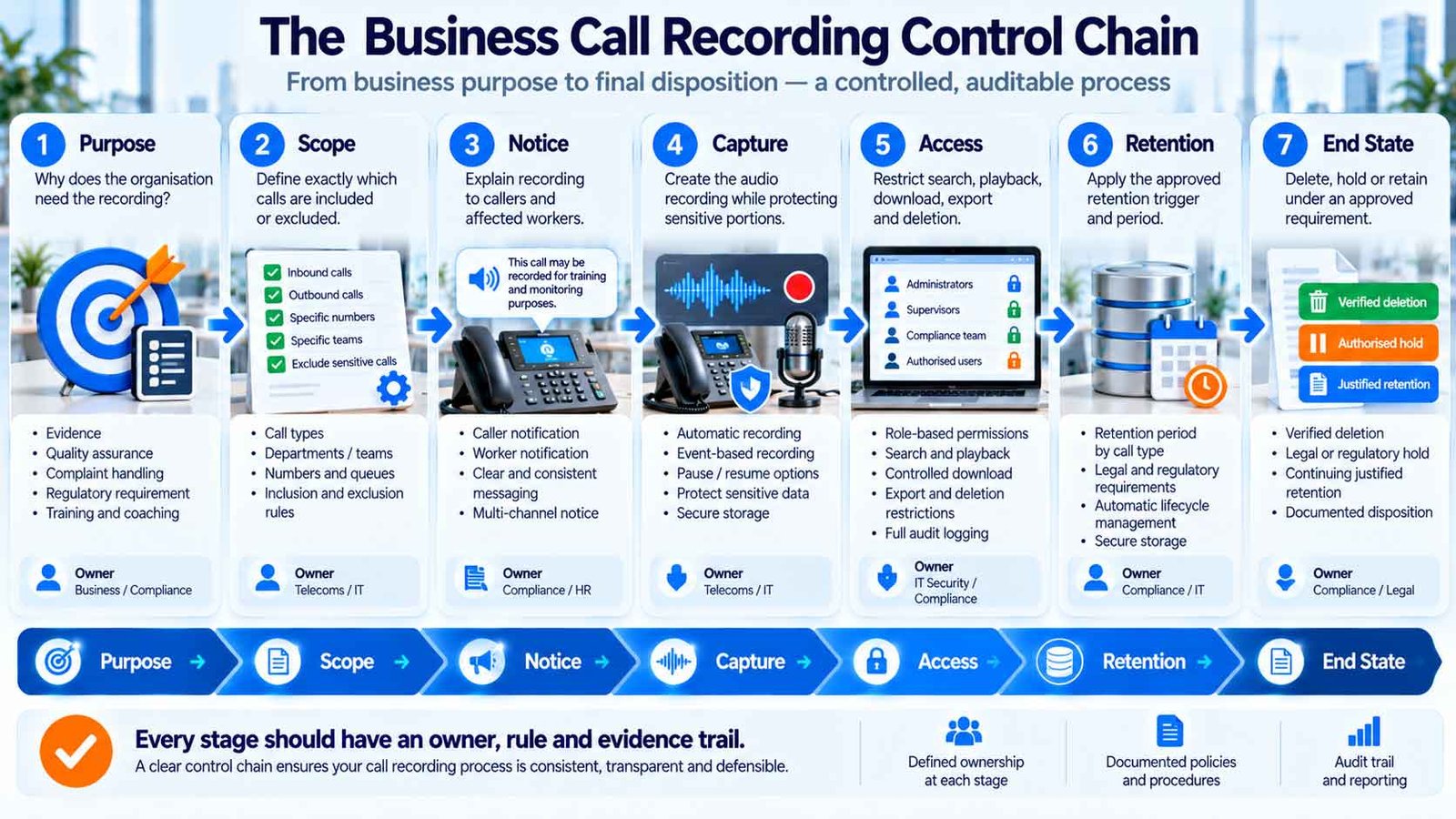
What Business Call Recording Actually Covers
Business call recording is the deliberate capture and storage of some or all of a telephone conversation so the organisation can use the recording for a defined operational, evidential or regulatory purpose. The recording may be created by a hosted phone platform, contact-centre service, mobile recording service, compliance archive or another approved communications system.
A recording is different from a call log. A call log usually records metadata such as the number, date, time, direction and duration. A recording contains the conversation itself and can therefore contain names, voices, addresses, account details, complaints, payment information, health information or other personal information spoken during the call.
Automatic, selective and on-demand recording
| Recording mode | How it works | Good governance question | Main control risk |
|---|---|---|---|
| Automatic Automatic recording | Calls matching a configured user, number, queue or direction are captured without the user pressing a record button. | Is every call in that scope genuinely necessary for the approved purpose? | Over-recording personal, sensitive or irrelevant conversations. |
| Selective Policy-based recording | The platform records only calls that meet defined rules, such as a regulated team, queue, number or business process. | Can the rule be proved and audited across all relevant channels? | Gaps where important calls bypass the rule. |
| On demand User-controlled recording | An authorised user starts and stops recording during a call. | When should a user record, and what notice must be triggered when recording starts? | Inconsistent capture and reliance on staff memory. |
| Compliance Mandatory compliance recording | Specified communications are captured because a regulatory or legal requirement applies to the activity. | Does the design prevent relevant calls moving to unrecorded devices or channels? | Incomplete evidence, tampering or uncontrolled exceptions. |
A phone platform may make automatic recording easy to enable across the whole organisation. That technical capability does not establish the business purpose, lawful basis, proportionality, retention period or access model for every call.
If call recording is one requirement within a wider platform decision, compare the broader operating models separately in the business phone systems comparison and cloud phone systems comparison.
Business Call Recording in the UK: Separate the Recording Authority from the Data-Protection Duties
UK business recording is governed by more than one layer of rules. The Telecommunications (Lawful Business Practice) framework permits certain business monitoring and record-keeping activities where its conditions are met. Separately, the UK GDPR and Data Protection Act 2018 govern how personal information in the recording is collected, used, stored, shared and deleted.
The practical buyer lesson is simple: “we are allowed to record this type of business communication” and “we are handling the resulting personal data correctly” are two different tests. Passing one does not automatically pass the other.
Identify a lawful basis for each recording purpose
Where a call recording contains personal information, the organisation needs an appropriate lawful basis for the processing purpose. Legitimate interests can be relevant where recording is necessary for a genuine business interest and the organisation has considered necessity and the impact on people. A legal obligation may be relevant where a specific rule requires recording. Other bases may apply in different circumstances.
Consent should not be treated as a default checkbox simply because the call is recorded. If consent is the chosen basis, the normal standards for valid consent still matter. The more reliable approach is to decide the real purpose first, identify the lawful basis that genuinely fits that purpose, document the decision and make the recording practice transparent.
Purpose limitation matters after the recording exists
A recording created for quality monitoring should not silently become a general-purpose source for unrelated profiling, staff surveillance or marketing analysis. If the organisation wants to reuse recordings for a new purpose, it should assess whether that use is compatible with the original purpose and whether a different lawful basis or further transparency is required.
Define the approved purposes before enabling recording. The phone-system setting should implement the policy; the setting should not create the policy.
Record the Minimum Call Population That Satisfies the Approved Purpose
The strongest recording design starts with a purpose statement and works outward. A vague purpose such as “for business purposes” is too broad to make useful decisions about capture, access or retention. Better purpose statements identify what the organisation needs the recording to prove or support.
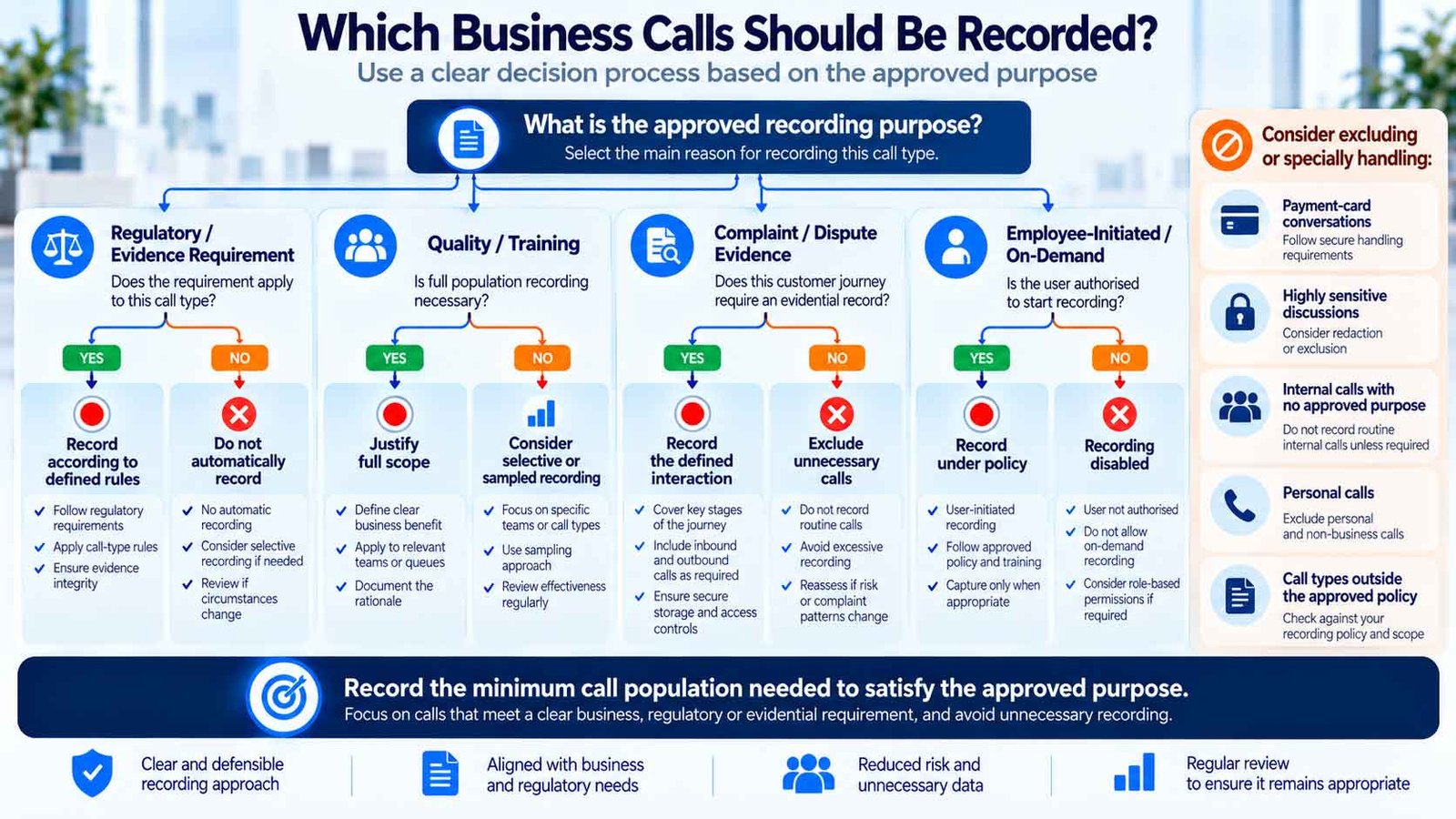
| Purpose | Questions to answer before recording | Likely scope decision | Evidence of control |
|---|---|---|---|
| Transaction evidence | Which calls create, vary or confirm a transaction, instruction or commitment? | Target the relevant team, number or workflow rather than unrelated calls. | Defined business process, searchable metadata and retrieval test. |
| Quality assurance | Does every call need to be retained, or would a controlled sample satisfy the purpose? | Automatic capture with shorter retention, or proportionate sampling where appropriate. | QA policy, reviewer roles, sampling rule and deletion schedule. |
| Training | Do staff need full historic call libraries, or curated examples? | Limit who can select recordings and consider reducing identifiable material used for training. | Training-use policy and controlled access. |
| Complaint or dispute evidence | Which customer journeys create a foreseeable need for a reliable conversation record? | Record the relevant service or sales path and preserve specific recordings when a dispute arises. | Complaint hold process and chain of access. |
| Regulatory compliance | Which communications are actually within the rule, and which devices and channels can carry them? | Policy-based mandatory recording with controlled exceptions. | Written recording policy, exception process and audit evidence. |
1. Is there a specific purpose that needs conversation content?
2. Must every call in the population be captured?
3. Are personal calls, sensitive conversations or payment steps mixed into the same channel?
4. Can relevant calls bypass the approved recording path?
If recording scope changes when calls enter queues, transfer between teams or overflow to another destination, document that journey separately in the business call routing guide.
Tell Callers and Workers What Is Being Recorded and Why
The ICO’s worker-monitoring guidance says people who make or receive recorded business calls must be told that recording is taking place and why. A recorded message is good practice; where that is not possible, workers can be instructed to inform callers and the organisation can provide the fuller privacy information by another route.
A useful call-opening notice should match reality. If recordings are used for quality assurance, transaction evidence, complaints and regulatory compliance, a notice that mentions only “training” gives an incomplete picture. The detailed privacy information should explain the purposes, lawful basis, retention approach, recipients or categories of recipients where relevant, individual rights and how to contact the organisation.
Worker monitoring needs its own transparency
Recording customers also records employees. Workers should understand the purpose and extent of call monitoring, how recordings may be reviewed, who can access them and whether recordings may be used for training, quality review, complaints, investigations or another defined employment purpose.
Routine recording of personal calls is particularly difficult to justify. Organisations that permit occasional personal use should create a workable way to exclude or minimise that content rather than assuming a policy statement removes the privacy impact.
A caller hearing the short announcement should understand that recording is happening and its immediate purpose. The fuller privacy information should then explain the rest of the processing in clear language.
Design for Payment Data, Special Category Data and Other Sensitive Conversations Before Go-Live
Call recordings can capture much more than the organisation intended. A customer may disclose health information, religious beliefs, union membership or another category of sensitive personal information during an otherwise routine service call. A voice may also become biometric data if it is subject to specific technical processing for unique identification.
Where the organisation intentionally processes special category data, it needs both an appropriate Article 6 lawful basis and a separate Article 9 condition. The recording policy should therefore identify which teams or call types are likely to receive sensitive information and apply additional controls where appropriate.
Payment card data needs an explicit recording boundary
PCI DSS treats card verification codes and similar sensitive authentication data differently from ordinary call content. These values must not remain stored after authorisation, including inside digital audio recordings. Where telephone payments are taken, the safer design is to prevent sensitive payment authentication data from entering the recording in the first place through pause-and-resume, suppression, secure payment capture or another approved method.
Pause / resume
The recording stops before the sensitive payment step and resumes afterwards. Test that the pause event covers the entire sensitive interval and cannot be bypassed casually.
DTMF suppression
Payment digits are captured through a controlled payment path rather than spoken into the recording. Confirm what data is removed from both audio and any transcript.
Secure payment hand-off
The caller moves to a separate compliant payment process while the agent remains outside the sensitive data path.
Exception handling
If prohibited data is captured unexpectedly, staff need a documented escalation and deletion process rather than waiting for the normal retention period.
Encryption does not make stored card verification codes acceptable after authorisation. Prevent the sensitive authentication data from being recorded or remove it in accordance with the applicable PCI DSS requirements.
A Recording Is Only as Controlled as the People Who Can Search, Play, Download and Share It
Recording security should be designed around the specific actions users can take. “Access to recordings” is not one permission. A supervisor may need playback for coaching but not bulk download. A compliance user may need export and legal-hold controls. A system administrator may need configuration rights without routine access to call content.
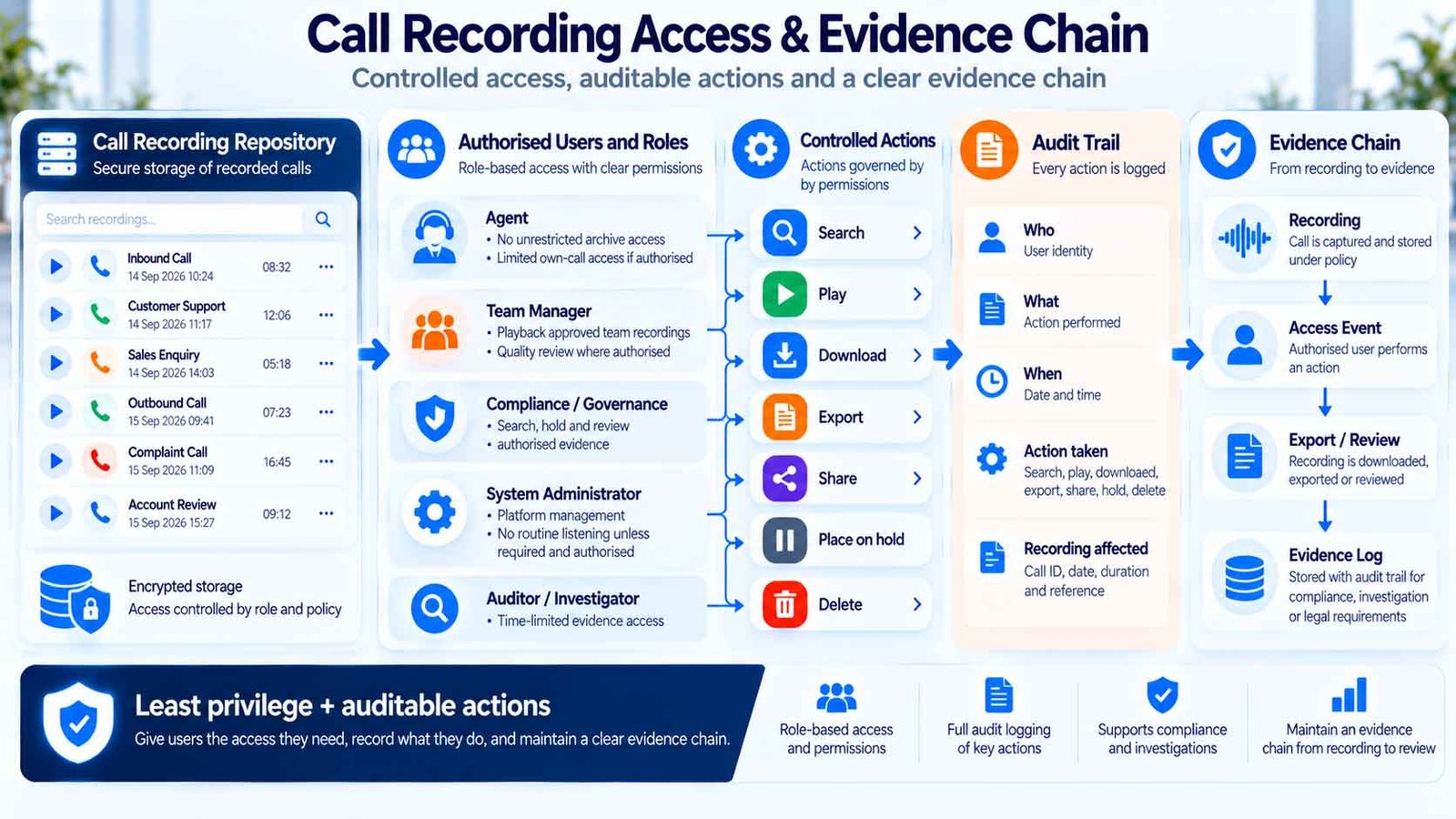
| Role | Typical need | Permission boundary | Evidence to expect |
|---|---|---|---|
| Team supervisor | Review a defined team’s calls for quality or coaching. | Playback within assigned team; limited download or sharing. | Role assignment and access audit trail. |
| Quality assurance | Search, sample and score recordings within an approved programme. | Access only to the populations covered by the QA purpose. | Reviewer identity, review history and controlled export. |
| Compliance / legal | Retrieve regulated calls, complaints, disputes or legal holds. | Broader search with strong authentication and auditable export. | Search history, export event, legal-hold state and integrity evidence. |
| Telephony administrator | Configure recording policy, users, queues and retention. | Configuration rights should not automatically create unrestricted listening rights. | Admin-change audit trail and separation of duties. |
| Ordinary user | May need access to their own approved recordings or none at all. | No organisation-wide browse, bulk export or deletion authority. | Least-privilege role and controlled exceptions. |
Controls worth testing
- strong authentication for privileged recording access;
- role-based access with least privilege;
- separation between recording configuration and content access where practical;
- encryption in transit and at rest appropriate to the risk;
- audit trails for playback, download, deletion, policy changes and exports where supported;
- restrictions on bulk download and uncontrolled local copies;
- clear supplier responsibilities for storage, subprocessors, backup copies and data return;
- an incident process that treats leaked recordings as personal-data incidents, not only telephony faults.
This guide covers controls specific to recorded conversations. Broader account security, device security, fraud controls and VoIP hardening belong in the dedicated VoIP security guide.
There Is No Single UK Retention Period for Every Business Call Recording
UK GDPR does not prescribe one universal number of days, months or years for call recordings. The organisation must be able to justify how long identifiable recordings are needed for the stated purpose and should delete or anonymise them when that purpose no longer applies, unless another legal or regulatory requirement justifies continued retention.
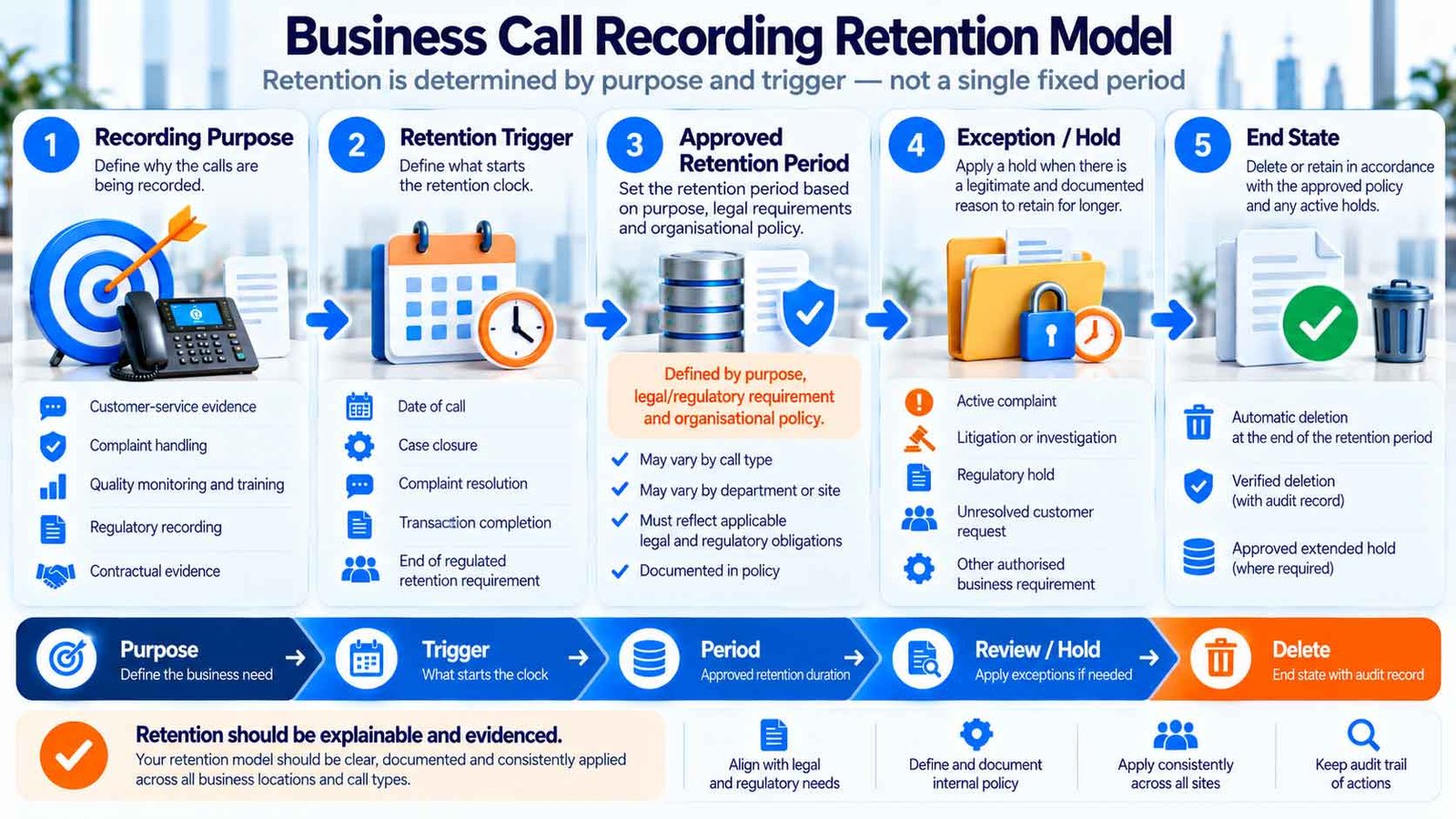
This makes “our phone provider stores recordings for twelve months” a technical fact, not a retention policy. The business should decide the period first and then verify that the platform can enforce it.
| Retention question | Why it matters | What to document |
|---|---|---|
| What starts the clock? | Different purposes may start retention from different events. | The exact trigger for each recording class. |
| Is there a regulatory minimum? | Some regulated communications have specific record-keeping periods. | The rule, scope and affected call population. |
| Can a specific recording be placed on hold? | A complaint, dispute or investigation may require preservation beyond normal deletion. | Who can apply the hold, why, review date and release process. |
| Does deletion cover derived copies? | Exports, backups, transcripts or downstream archives may outlive the source recording. | Every system that receives a copy and its deletion behaviour. |
| Can the period vary by purpose? | Training, regulatory and dispute recordings may have different justified periods. | A retention schedule by recording class rather than one blanket default. |
Do not choose a retention period because storage is available. Choose it because the approved purpose, applicable rule and documented risk justify it.
If You Cannot Find the Right Recording Reliably, You Do Not Have a Controlled Record
Search and retrieval are governance controls, not convenience features. A business may need to locate a recording for a complaint, a transaction query, a regulator, litigation, internal investigation or an individual exercising data-protection rights.
Call recordings can be personal information and may need to be considered when responding to a subject access request. The ICO states that a valid request does not need to use formal language and organisations normally have one month to respond once the relevant timing conditions are met.
Build a retrieval key before you need it
Call identity
Date, time, direction, calling number, called number and internal user or queue.
Business context
Customer reference, case, account, complaint or transaction identifier where an approved VoIP CRM integration legitimately supplies it.
Recording state
Normal retention, legal hold, restricted, exported, redacted or scheduled for deletion.
Evidence trail
Who accessed, exported, changed or deleted the recording and when, where the platform supports those events.
Third-party information and disclosure
A recording can contain information about several people. Responding to an access request may therefore require careful handling of third-party information rather than simply emailing the entire audio file. The organisation should have a repeatable process for locating the recording, confirming identity, assessing what information must be supplied and delivering it securely.
Give the responsible team a realistic request with only the information a customer would normally know. Measure whether they can identify the right recording, verify it, apply any necessary review and produce the information through the approved process.
The Deletion Proof Test: Confirm That Expired Recordings Actually Leave the Estate
A retention policy is incomplete until deletion has been tested. Cloud recording platforms can create copies in primary storage, archives, backups, exports, transcripts, CRM attachments or analytics systems. A recording disappearing from the normal playback screen does not necessarily prove that every controlled copy has reached its intended end state.
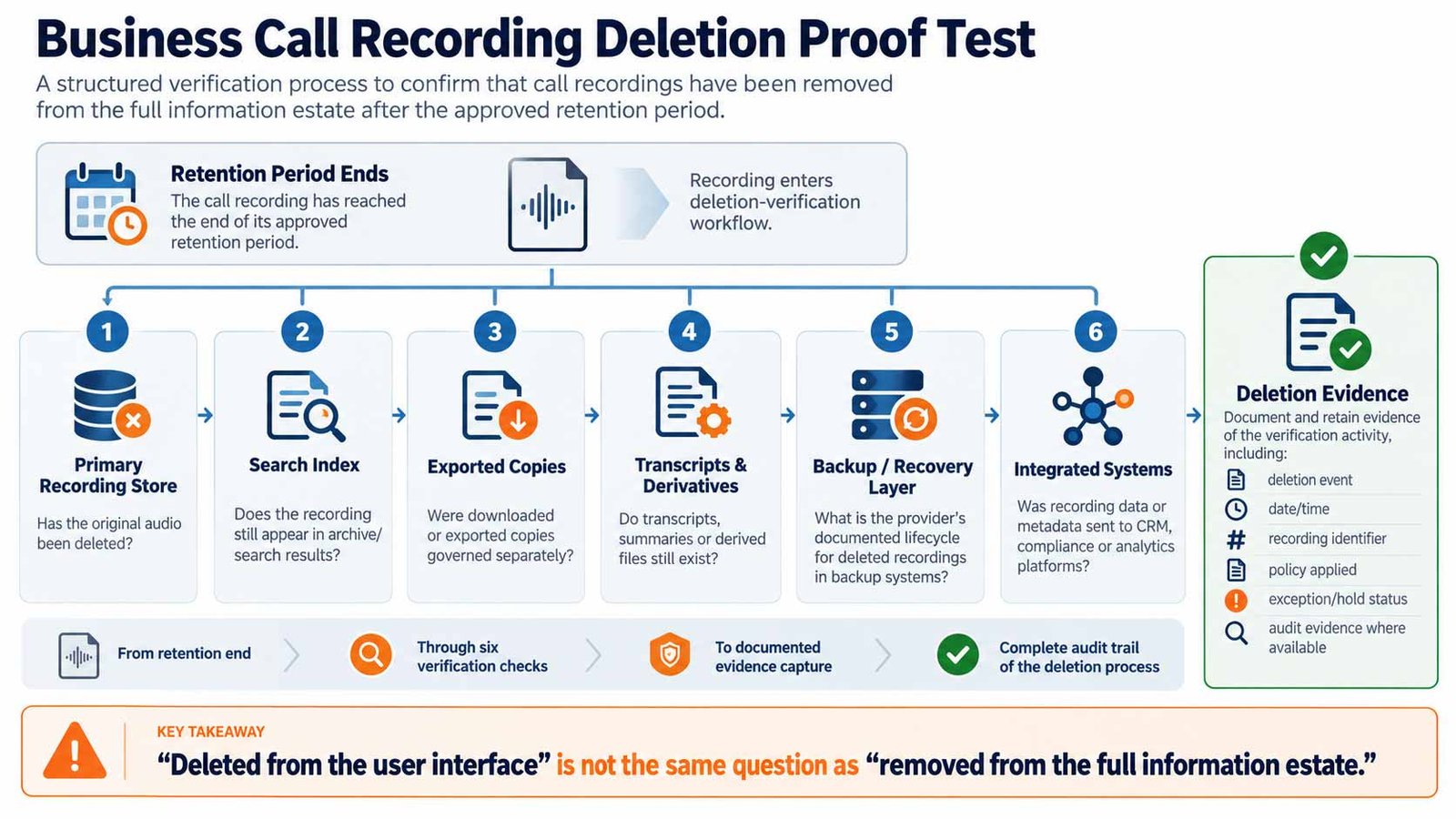
Ask the supplier to show what “deleted” means in the service: removed from the user interface, removed from active storage, queued for backup expiry, anonymised, or permanently destroyed according to the service design.
Regulated Call Recording Can Change the Scope, Retention and Evidence Standard
General business recording and regulated compliance recording should not be treated as the same operating model. Some FCA rules require specified telephone or electronic communications to be recorded and retained. For MiFID-related recording within FCA SYSC 10A, relevant records are generally kept for five years and, where requested by the FCA, for up to seven years. Other FCA regimes have different scopes and retention rules.
The important buyer task is not to apply a financial-services number to every business. It is to map the organisation’s actual regulated activities to the applicable rule and ensure the recording architecture covers the right communications, devices, users and exception paths.
| Environment | What changes | Buyer evidence to request |
|---|---|---|
| General UK business | Retention is purpose-led unless another legal, contractual or regulatory requirement applies. | Lawful-basis record, privacy information, retention schedule, role controls and deletion evidence. |
| MiFID-related FCA recording | Specified conversations and electronic communications may be subject to mandatory capture and record-keeping requirements. | Written recording policy, channel coverage, exception procedure, durable storage and retrieval. |
| Claims management | FCA claims-management rules include specific call-recording notification and retention requirements for relevant communications. | Start-of-call notification, complete relevant-channel capture and rule-specific retention logic. |
| Telephone card payments | PCI DSS controls apply where payment-card account data is stored, processed or transmitted; sensitive authentication data must not remain stored after authorisation. | Pause/suppression design, secure payment path, exception deletion and PCI scope evidence. |
| Sensitive service environments | Calls may routinely contain health or other special category information requiring additional processing conditions and safeguards. | Special-category assessment, access restriction, purpose limitation and privacy information. |
A regulated minimum is evidence for the regulated call population it applies to. It is not a generic justification for keeping every recording in the organisation for the same length of time.
Ask the Call-Recording Supplier to Demonstrate the Governance Workflow, Not Just Playback
A recording demo that stops at “here is the play button” is incomplete. Give shortlisted suppliers the same operational scenarios and ask them to demonstrate how policy is enforced from capture through deletion.
| Scenario | What the supplier should demonstrate |
|---|---|
| 1. Automatic recording scope | Enable recording for one defined team or number without turning it on for unrelated users. |
| 2. On-demand start and stop | Show the user action, the caller announcement behaviour and the resulting audit information. |
| 3. Inbound and outbound notice | Demonstrate how different call directions receive the correct recording notification. |
| 4. Payment suppression | Show how recording and any transcription behave during a payment-card step. |
| 5. Restricted supervisor access | Allow a manager to review only their own team’s recordings and prove they cannot browse another team. |
| 6. Search by known metadata | Locate a specific call using the same information a service or compliance team would realistically receive. |
| 7. Subject access workflow | Show how recordings can be located, reviewed and exported securely without granting excessive system access. |
| 8. Retention by recording class | Apply different retention rules to different approved call populations where the platform supports this. |
| 9. Legal or complaint hold | Preserve one recording beyond normal deletion without disabling retention for the whole organisation. |
| 10. Deletion evidence | Explain what happens to active storage, archive copies, backups and derived data after expiry. |
| 11. Audit trail | Show who played, downloaded, exported, deleted or changed the recording policy. |
| 12. Exit export | Demonstrate how the organisation retrieves required recordings and metadata when changing provider. |
“GDPR compliant call recording” is not a sufficient product description. Ask the supplier to demonstrate the controls your policy actually depends on and identify which responsibilities remain with your organisation.
The Business Call Recording Buyer Evidence Test
Use one evidence pack for every shortlisted platform so feature claims are converted into comparable operational controls.
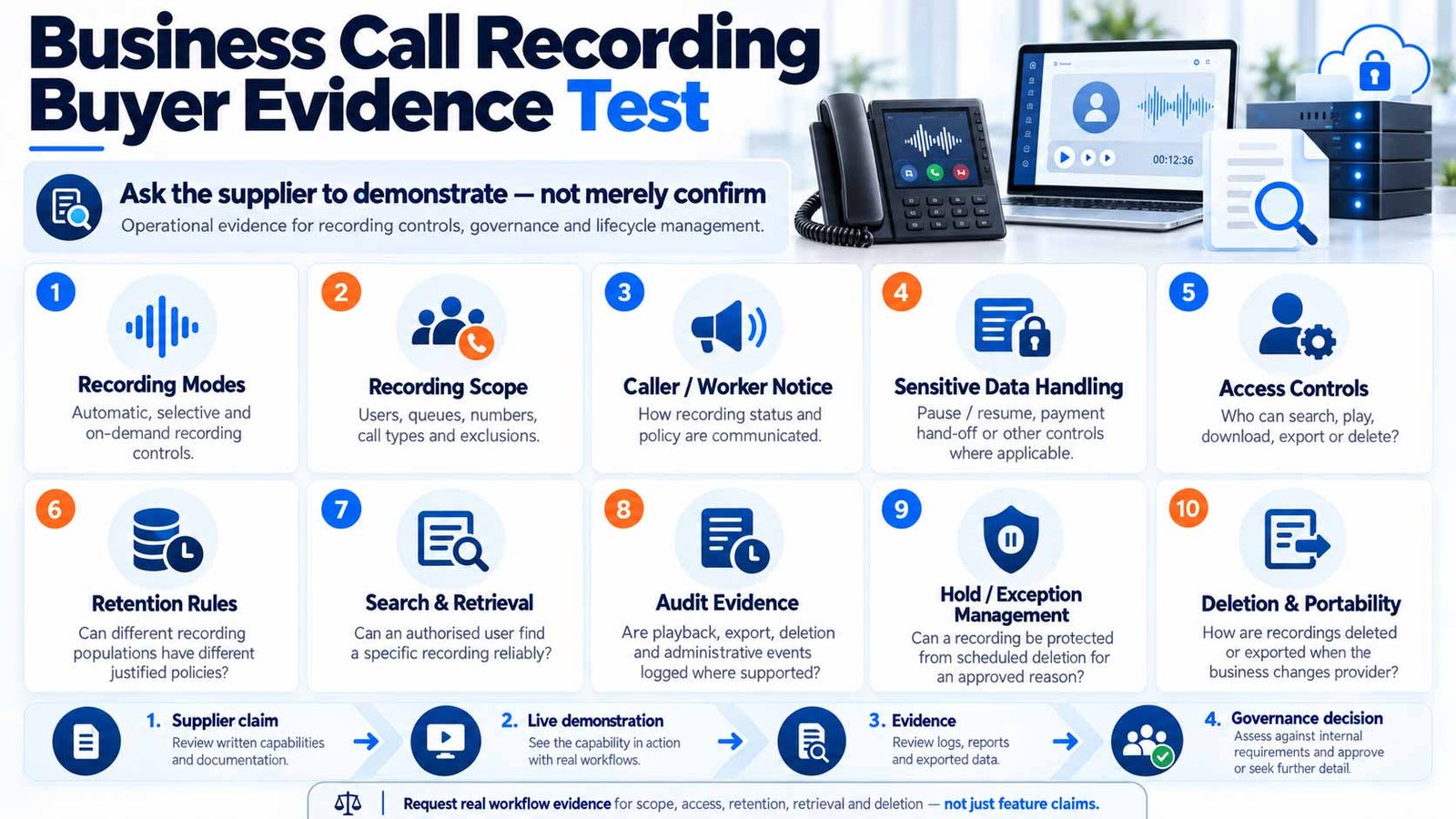
Once the recording evidence pack is complete, use the VoIP guides library to review wider telephone requirements. Give every shortlisted supplier the same recording specification so its controls can be tested consistently.
Business Call Recording Implementation Checklist
Before enabling recording in production, confirm the following:
- Each recording purpose is written down and has an identified lawful basis.
- The call population for each purpose is defined by user, number, queue, direction or activity.
- Automatic recording is not broader than the approved purpose requires.
- Inbound and outbound caller-notice behaviour has been tested.
- Workers understand which calls are recorded, why and how recordings may be used.
- Personal-call handling is documented and technically workable.
- Payment-card steps are excluded, suppressed or handled through an approved secure process.
- Teams likely to capture health or other special category data have additional safeguards where required.
- Playback, search, download, export, deletion and configuration rights follow least privilege.
- Privileged users use appropriate strong authentication.
- Recording access and administrative changes are auditable where the platform supports them.
- The retention period for each recording class is justified and documented.
- The event that starts each retention period is clearly defined.
- Regulatory minimums apply only to the communications actually within that regime.
- Complaint, investigation or legal-hold exceptions can preserve specific recordings without disabling normal deletion everywhere.
- The organisation can find a specific recording using realistic metadata.
- The process for subject access and secure disclosure has been tested.
- Exports and downstream copies have their own access and retention controls.
- The Deletion Proof Test has confirmed what happens when a recording expires.
- The supplier can explain storage, processing, backup, subprocessor and exit responsibilities.
- The recording policy is reviewed when the purpose, platform, regulation, AI processing or business workflow changes.
If the business cannot explain why a recording exists, who can access it, how long it will remain identifiable, how it would be found for a valid request and what proves its deletion, the recording operating model is not finished.
For deployment sequencing, endpoint provisioning and go-live testing around the approved recording policy, use the VoIP setup guide.
Business Call Recording FAQs
Is business call recording legal in the UK?
Business call recording can be lawful in the UK when the organisation has an appropriate reason and meets the applicable interception, data-protection and sector-specific requirements. The recording purpose, lawful basis, transparency, access, retention and security all need to be considered rather than relying on a blanket assumption that every business call may be recorded.
Do UK businesses have to tell callers that calls are recorded?
Businesses should make callers aware that recording is taking place and explain why. ICO worker-monitoring guidance describes a recorded message as good practice; where that is not possible, workers can be instructed to tell callers, with fuller privacy information provided separately.
Is consent always required to record a business call?
No. Consent is one possible lawful basis for processing personal information, but it is not automatically the correct basis for every business recording. Legitimate interests, legal obligation or another basis may be more appropriate depending on the purpose and circumstances. The organisation must identify and document the basis that actually applies.
How long should a business keep call recordings?
There is no single UK GDPR retention period for every business recording. Keep recordings only for as long as the approved purpose and any applicable legal or regulatory requirement justify. Document the retention trigger, period, exceptions and deletion process for each recording class.
Are call recordings personal data?
They often are. Recordings can identify people through their voice, number, name or the information spoken during the call. They may also contain information about other people, special category information or criminal-offence information, depending on the conversation.
Can call recordings contain payment card details?
Telephone-payment workflows need specific controls. PCI DSS prohibits storage of sensitive authentication data such as card verification values after authorisation, including in digital audio. Businesses should prevent that information from entering the recording through suppression, pause controls or a secure payment path.
Can employees listen to any recording in the business?
No general business need justifies unrestricted access. Playback, search, download, export and deletion permissions should follow job responsibilities and least privilege. Supervisors, QA, compliance and administrators can require different rights.
Can a customer request a copy of a recorded call?
A recorded call can contain the requester’s personal information and may fall within a subject access request. The organisation should be able to locate the relevant information, verify the requester where necessary, consider third-party information and provide the required information securely within the applicable response period.
What is the difference between call recording and call monitoring?
Recording creates a stored audio record for later use. Monitoring can include listening to a live or recorded call for quality, coaching, compliance or another defined purpose. Both can involve personal information and worker monitoring, so the purpose, transparency and proportionality of the activity matter.
Does AI transcription change the call-recording rules?
AI transcription does not remove the obligations attached to the original audio. A transcript is another processing output and may itself contain personal or special category information. If recordings are reused for transcription, summarisation, scoring or other AI analysis, the organisation should assess the purpose, lawful basis, transparency, supplier processing and retention of those derived outputs. The wider automation and conversation-intelligence layer is covered in the AI-powered VoIP guide.
Do all FCA-regulated firms have the same call-recording requirement?
No. FCA recording duties depend on the activity and the part of the Handbook that applies. Some MiFID-related communications are subject to specific recording and retention rules, while other regulated activities have different requirements. Map the actual activity to the applicable rule instead of assuming one retention period covers every FCA firm.
What should a business ask a call-recording supplier to prove?
Ask the supplier to demonstrate recording scope, caller notifications, role-based access, payment suppression, retention, legal holds, search and retrieval, audit trails, secure export, deletion behaviour, storage responsibilities and exit portability. Feature labels alone do not show how the control works in practice.
Sources & Methodology
The Call Recording Control Chain connects seven governance decisions: purpose, scope, notice, capture, access, retention and the final retrieval-or-deletion state. Apply the framework alongside the legal and sector-specific requirements relevant to your organisation; obtain qualified compliance advice where needed.
Primary reference materials informing this guide:
- ICO guidance on monitoring and recording telephone calls, including worker and caller transparency.
- ICO legitimate interests guidance for lawful-basis assessment where that basis is appropriate.
- ICO storage limitation guidance for purpose-led retention and deletion.
- ICO subject access guidance for response timing and retrieval context.
- Telecommunications (Lawful Business Practice) (Interception of Communications) Regulations 2000.
- FCA Handbook SYSC 10A recording and record-keeping requirements for relevant regulated communications.
- PCI Security Standards Council guidance on sensitive authentication data in audio recordings.
- Current business communications platform documentation confirming that automatic and on-demand recording are distinct technical modes whose availability does not determine the organisation’s lawful purpose or governance model.
Important: requirements vary by business activity, call purpose, information captured and regulatory scope. A provider feature described as “compliant” does not transfer accountability for the organisation’s own recording purposes, notices, access rules, retention decisions or rights-handling process.
Last reviewed: 30 September 2026.
Business Call Recording Governance Plan
Compare Recording Controls Beyond the “Call Recording Included” Claim
Use the same scope, notice, payment-data, access, retention, retrieval, audit and deletion requirements with every shortlisted platform. That turns a generic feature claim into a buyer specification you can actually test.

Bhav Giva
Founder & Lead Analyst at CompareVoIPService.co.ukBhav Giva is the founder of CompareVoIPService.co.uk, a UK-focused platform helping businesses choose the right VoIP provider with clear, unbiased guidance. With a background in telecom, AI automation, CRM engineering, and digital strategy, Bhav specialises in simplifying complex communication systems and making VoIP decisions transparent, cost-effective, and easy to understand for UK organisations. .