
VoIP ROI Calculator: Your Three-Year Business Case

See Whether a Phone-System Change Pays Back After All Costs

Compare your existing business phone costs with a written VoIP proposal, including implementation spending, transition, 36-month cash flow, payback and financial downside. No sign-up required.
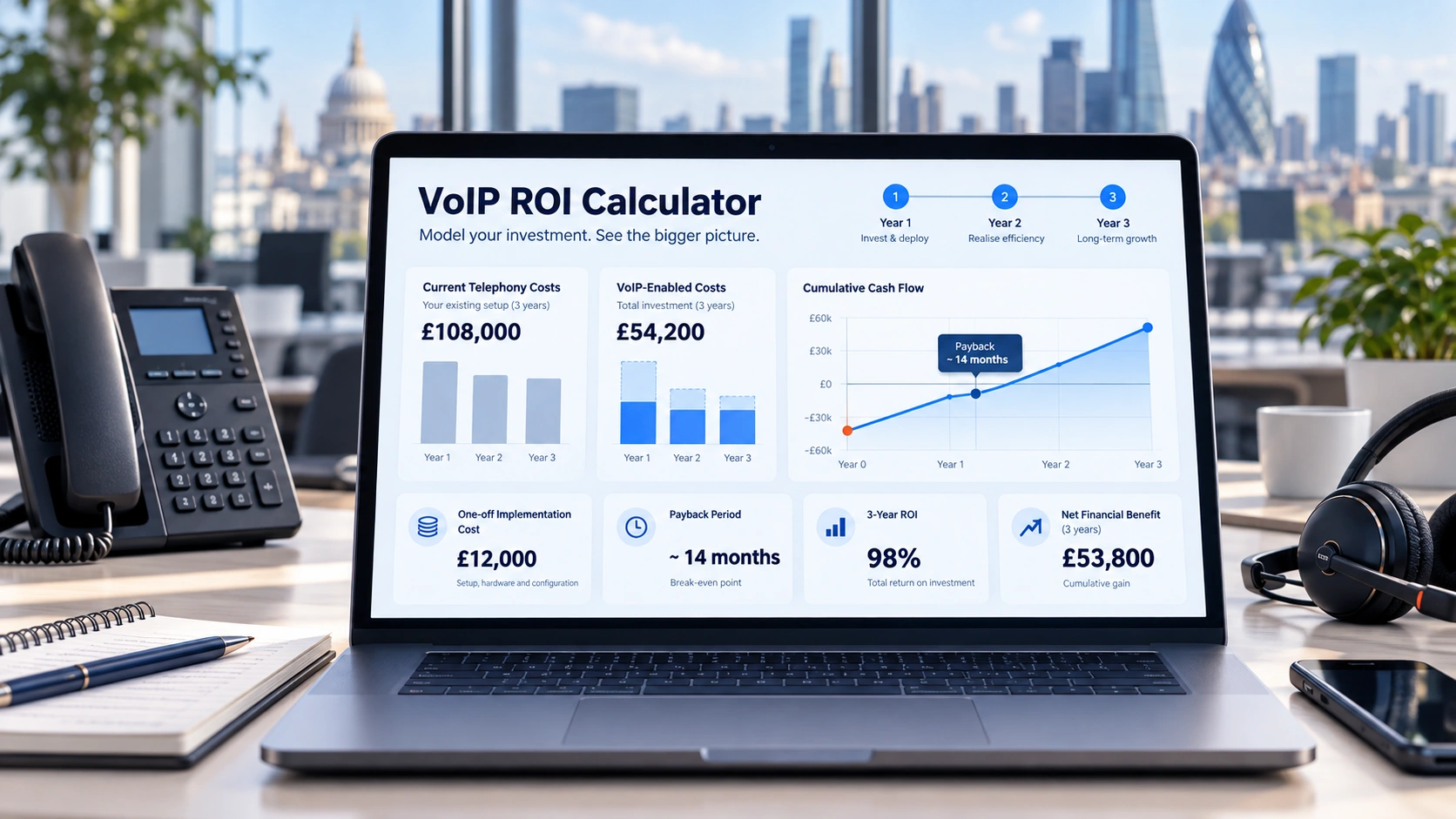
VoIP ROI calculator illustration comparing existing and proposed UK business phone system costs

Independent Three-Year VoIP Investment Calculator

A lower monthly quote does not guarantee a worthwhile investment. Include one-off migration spending, contract overlap and actual supplier terms before making a decision.

Calculate VoIP ROI

Enter comparable current and proposed costs in GBP. Include setup, equipment, training, contract exit and overlap, then review a 36-month cost ledger and payback rather than only monthly savings.

What Your Investment Result Explains

The assessment separates recurring cost differences from one-off spending, reports net benefit and ROI, and shows exactly when cumulative payback occurs — or that no payback is achieved. The result depends on the validity of the figures and assumptions entered.

Financial review: Verify the current invoice, new quotation, contract overlap, VAT treatment, billing commencement and financial assumptions before approval.

Compare Your Three-Year VoIP Investment

Enter current invoices, a proposed quotation and one-off implementation spending. The tool compares month-by-month cash costs and identifies whether and when the investment pays back.

Build Your Three-Year VoIP Business Case

Compare your current telephone arrangement with a specific proposal over 36 months. Enter real costs and evidence status; results show cash expenditure, net benefit, simple ROI and payback, including negative outcomes.

1. Comparison Basis
1 = change from month one; current service continues until this month.
Evidenced replacement or renewal expenditure on the current option.
2. Current Monthly Costs
3. Proposed Monthly Costs
4. Implementation and Transition Costs
Enter transition costs once, including extra legacy contract months paid after the new service begins. For a transparent baseline, all one-off costs are recognised at the start of the comparison, even when the new monthly service begins later. The model does not invent overlap charges.
5. Timing, Growth and Assumptions
Annual uplifts are user-specified scenarios, not market predictions. Current increases apply from months 13 and 25; proposed increases apply after each 12 months of service.
'; } $('cvroi-report').addEventListener('click',()=>{ if(!latest)return; download(reportMarkup(latest),'text/html;charset=utf-8','comparevoipservice-three-year-finance-review.html'); }); })();

Recurring and One-Off Costs

Assess current and proposed recurring commitments separately from migration fees, hardware, training, number-porting and contract overlap.

Net Benefit and Payback

Compare the full 36-month ledger and the first month cumulative benefit becomes non-negative; show no payback if recovery never occurs.

INVESTMENT INTERPRETATION

What a Positive ROI Does Not Prove

A modelled positive return does not guarantee supplier suitability. Test required features, call quality, security and continuity separately from the finance case.

Build Your VoIP Investment Case Using Your Own Figures

Start with the actual costs of the existing service and the written commercial terms of the proposed service. Keep recurring commitments separate from one-off expenditure. All monetary inputs should follow the same GBP and VAT treatment so that the comparison is consistent.

Cost categoryExisting arrangementProposed arrangementWhy it belongs in the model
Recurring service feesPhone lines, maintenance or current hosted licencesQuoted user licences, trunks or service bundleEstablishes the regular baseline and replacement commitment
Numbers and callingDDI rental, call charges and agreed add-onsProposed number charges, minutes and usage termsCaptures items not always included in headline licence pricing
Support and managementPaid service or support obligationsQuoted support and administration servicesIdentifies whether responsibilities or costs change
HardwareExisting leases or unavoidable replacement expenditurePurchased or leased phones, headsets and adaptersDistinguishes capital costs from recurring charges
Network changesCosts that will continue regardless of the changeRequired broadband uplift, network equipment or ongoing connectivityAvoids treating necessary technical changes as free
ImplementationCosts of maintaining the current arrangement where applicableInstallation, configuration, migration and trainingCaptures cash spent to make the proposal usable
TransitionExit fees or unavoidable legacy commitmentsContract overlap, parallel running and number-porting feesIncludes costs during the period when both arrangements may be paid
Other verified financial effectsDocumented operating costs under the current arrangementContractually defined credits or evidenced operating savingsPrevents unsubstantiated benefits from distorting the return

Calculate my three-year ROI

Keep Invoiced Charges And Assumptions Separate

For every input, distinguish confirmed invoice, written supplier quote, internal estimate or not yet known. Unknown charges should remain visible as unresolved risks. A three-year total built from guessed prices is a scenario, not a defensible purchasing decision.

Use dates as well as amounts when a charge does not begin on day one. Training, equipment purchases, early-termination penalties and overlap periods can change the payback month even where the ongoing service looks cheaper.

Understand the Financial Measures

The most useful result is a small set of measures that can be reconciled with the underlying ledger. They are not interchangeable.

Financial measureCalculation basisDecision it supports
36-month total cost of ownershipAll included cash costs over three years for each optionWhich option costs more across the selected period?
Recurring monthly differenceCurrent recurring cost minus proposed recurring cost, using comparable assumptionsHow does the ongoing cost change once both services are stable?
Incremental upfront investmentTransition and implementation cash outlay attributable to the change, net of any explicitly recognised one-off creditsHow much investment must the recurring benefit recover?
36-month net benefitAvoided current costs minus proposed costs and implementation/transition expenditureWhat is the overall cash benefit or cost across the period?
Payback monthFirst month when cumulative net benefit reaches zero or becomes positiveWhen is the extra investment recovered, if at all?
Simple investment ROINet benefit divided by positive incremental upfront investment, expressed as a percentageHow large is the net return relative to the extra upfront cash committed?

A negative result is a valid result. If the new service costs more, or the transition expense exceeds the benefit during the period, the page should show that plainly. If cumulative benefit never becomes non-negative within 36 months, the correct outcome is “No payback within the modelled period”, not an invented future date.

The ROI Percentage Needs A Clear Denominator

A percentage is useful only when its formula is explicit. For the simple investment return shown here:

Simple ROI (%) = 36-month net benefit ÷ positive incremental upfront investment × 100

If there is no positive incremental upfront investment, this particular ratio is not defined. The tool can still display total-cost difference and net benefit. It should not force a percentage by dividing by zero or by substituting an unrelated spending total without explanation.

Simple ROI is not the same as an accounting return, discounted cash-flow net present value or internal rate of return. Those measures require different definitions and, for discounted measures, a separately agreed discount rate.

A Transparent Three-Year Worked Example

This illustrative example uses invented inputs solely to demonstrate the arithmetic. It does not describe a real customer, supplier quotation, market benchmark or predicted saving for your business. All values below are treated as GBP excluding recoverable VAT, and recurring costs are assumed to remain constant across the example period.

Example inputCurrent optionProposed option
Monthly recurring telephone cost£420£350
Monthly difference—£70 lower than current
One-off migration and setup spending—£1,800
Temporary contract overlap—£300
Total incremental upfront or transition cost—£2,100

The hypothetical recurring difference is £70 per month. Across 36 months it would avoid £2,520 of the current recurring expense. Deducting £2,100 of transition spending produces a £420 net benefit. Under the stated simplified assumptions, that is a 20% simple investment ROI and reaches cumulative break-even at month 30.

PeriodRecurring difference during periodTransition cost recognisedCumulative net benefit
Start of change£0−£2,100−£2,100
End of year 1+£840£0−£1,260
End of year 2+£840£0−£420
End of year 3+£840£0+£420

Decision illustrated: this proposal is not profitable in cash terms during its first two years, even though the monthly subscription is cheaper. A business ending the contract early may therefore reach a different conclusion from a business remaining for the full 36 months. The model must use the user’s real dates, contractual amounts and change costs before any actual decision is made.

Why a Cheaper Monthly Subscription Can Still Be a Poor Investment

The headline seat price is only part of the commercial commitment. A quote may exclude required features, telephone numbers, supported integrations, handsets, extra calling allowances or network work. Equally, the existing arrangement may contain maintenance charges that disappear after migration. Include both sides transparently rather than deciding in advance that the newer service must be cheaper.

Implementation And Change Costs

Account for the activities needed to make the new phone system operational: configuration, data and number migration, training, procurement, technical testing and temporary support. Decide whether each item is truly incremental to the proposed change. Do not include a cost twice under separate labels.

Contract Overlap And Early Termination

A move may involve paying an existing contract while the new service is being installed or tested. Record the duration and contractual basis of the overlap. If an early-termination charge is uncertain, carry it as a separate scenario rather than assuming it is zero.

Productivity And Efficiency Benefits

Changes in call handling or administration may have real value, but that does not justify assigning arbitrary monetary savings. Keep unverified labour-efficiency claims outside the base financial result. Where a business has credible internal time records, an agreed hourly cost basis and a realistic adoption assumption, show the calculation separately from contract and invoice savings.

Benefit claimEvidence worth obtainingAppropriate financial treatment
Lower service chargesExisting invoices and a written replacement quoteInclude in the base cost model
Reduced maintenance costsCurrent agreement and evidence the cost will ceaseInclude when the cessation is confirmed
Fewer missed enquiriesReliable baseline, relevant call data and an agreed attribution methodPresent as an operational benefit unless the financial effect can be substantiated
Faster call administrationTime observations and an agreed workload modelKeep separately identified and test the assumptions
Avoided hardware replacementDocumented expected expenditure under the status-quo optionInclude only if the expenditure is credible and otherwise necessary
Assumed revenue upliftNo evidence suppliedDo not include in base ROI
Practical VoIP Investment Decisions

Six situations that can change a financial outcome. These are planning examples, not customer testimonials or claims of achieved savings.

Budget Approval

Scenario01

Move From a Cheap Quote to Full Cost

InvoiceCurrent baseline
QuoteNew commitment
DecisionVerify
StageProcurement
Business Decision Checks
  • Compare regular charges under the same VAT basis and usage assumptions.
  • Include all implementation and training costs.
  • Confirm the documented financial owner before approval.

Legacy Contract Overlap

Scenario02

Do Not Understate Transition Spending

Exit chargesCheck contract
Parallel billingCapture extra months
DecisionVerify
StageProcurement
Business Decision Checks
  • Confirm legacy cancellation and termination terms.
  • Record any months when both services are payable.
  • Recalculate payback if migration dates change.

Equipment Refresh

Scenario03

Include Necessary Devices and Network Work

HandsetsQuoted devices
ConnectivityOngoing uplift
DecisionVerify
StageProcurement
Business Decision Checks
  • Include any required headsets, adapters and network changes.
  • Compare with genuinely unavoidable hardware spending if staying.
  • Do not count the same expenditure twice.

Growth and Licence Changes

Scenario04

Test the Cost of More Users

Annual risesKnown terms
User countScope
DecisionVerify
StageProcurement
Business Decision Checks
  • Check licence flexibility and expected staff movements.
  • Test higher recurring charges as a sensitivity case.
  • Keep unverified growth benefits outside cash-only ROI.

Non-Financial Benefits

Scenario05

Keep Service Improvements Separate

Call qualityPilot tests
Feature fitSupplier proof
DecisionVerify
StageProcurement
Business Decision Checks
  • Ask the shortlisted supplier to demonstrate essential workflows.
  • Do not invent revenue or productivity gains.
  • Make a separate operational case for unavoidable service requirements.

Finance Handover

Scenario06

Create an Auditable Decision Record

36 monthsCash ledger
EvidenceSource of costs
DecisionVerify
StageProcurement
Business Decision Checks
  • Export the month-by-month costs and stated assumptions.
  • Record unresolved quotes, VAT basis and exception costs.
  • Reassess the business case before signing.

Validate the Financial Case Before Approval

A financial model is useful only where the figures are comparable. Use real invoices, written quotations, transparent transition costs and separately stated unverified assumptions.

Verify Current Invoices and Proposed Quotes

Record the relevant existing invoices and all replacement charges on a consistent VAT basis. Confirm numbers, support, network changes and annual price adjustments.

Unknown charges require written clarification. An estimated figure is a scenario, not a supplier promise.

Understand the Cost Comparison

Confirm Transition and Contract Liabilities

Include setup, number porting, headsets, network changes, training, termination fees and any overlapping supplier invoices.

Check when each service starts or ends, and do not remove costs from the calculation simply because they are inconvenient to estimate.

Investment Returns Need Verified Evidence

A positive financial return does not establish that the proposed supplier can deliver your required features, service resilience or secure customer handling. Assess those independently.

Examine the Downside Before Approval

A single central figure can hide the consequences of incorrect assumptions. Recalculate the financial outcome when key costs or timings change.

Scenario to testWhat changesWhat you learn
Supplier licences cost more than quotedIncrease the proposed recurring totalWhether the case still pays back after a higher service cost
Migration takes longerIncrease overlap and related project costsWhether delay removes the expected benefit
Staff training needs increaseAdd evidenced training expenditureWhether internal adoption costs were underestimated
The business adds usersAdjust both options according to their contract termsWhether growth changes the financial comparison
An expected saving cannot be provenRemove that benefit from the modelWhether the business case stands without optimistic assumptions
The project finishes earlyAssess a shorter horizonWhether the upfront investment is recovered in time

A Simple Financial Decision Path

If the 36-month net benefit is negative, investigate the cost drivers and whether non-financial requirements independently justify the change. Do not present the change as a financial saving.

If the net benefit is positive but payback is late, check the expected service life, contract term and risk of early replacement.

If the case relies on unverified productivity savings, separate those claims from the evidenced cash-only case.

If essential quote data is missing, seek written clarification before treating the analysis as procurement-ready.

If the financial case remains credible, take the result into the formal operational and procurement approval process, alongside non-financial service requirements.

What the Investment Report Should Contain

Decision recordWhy it matters
Options comparedMakes clear what “stay” and “change” actually include
Comparison periodPrevents twelve-month and three-year figures being mixed
VAT and currency basisKeeps costs comparable in GBP
Current invoices and proposed quoteIdentifies the commercial evidence for each input
One-off and recurring ledgerPrevents transition costs disappearing inside a headline number
Cumulative cash flowShows the timing of expenditure and possible payback
Downside scenariosTests whether modest changes overturn the conclusion
Exclusions and unresolved itemsMakes limitations visible before approval
Decision owner and next reviewCreates accountability for the business case

An investment report does not certify that a supplier will deliver technical or operational requirements. Those should be assessed separately through the VoIP Feature Checker and the agreed purchasing process.

Financial Review Before Signing

Confirm the base case using invoices and a written supplier quote. Compare the 12-, 24- and 36-month cumulative result and retain negative scenarios.

Set a named reviewer and keep exported evidence with your procurement record.

Operational and Supplier Suitability

Positive ROI does not certify emergency calling, resilience, required integrations, support or the reliability of a proposed service.

Use the independent feature-requirements assessment and your normal supplier due diligence before approval.

COMPARE WITH CONFIDENCE

Make a Finance-Ready VoIP Purchasing Decision

Compare the true 36-month cash positions, test downside assumptions and share a dated financial brief with the decision owner before signing a supplier contract.

FAQs

Answers about three-year ownership costs, negative ROI, month-by-month payback, VAT treatment and evidence needed before approving a VoIP change.

A savings calculator gives an early estimate of recurring telephone costs. This ROI calculator uses specific quotations, implementation investment, three-year cash flow and payback to assess a defined proposal.

Compare 36 months of the status quo against the proposed option, subtracting all relevant recurring and one-off cash costs. For simple investment ROI, divide net benefit by positive incremental upfront investment, then multiply by 100.

Yes. Higher running costs, migration fees, equipment or too little time to recover the expenditure can produce a negative result. The calculator displays this rather than assuming the new service saves money.

The result states that no payback occurs within the 36-month period. A separate continuity or operational requirement may still justify a change, but it must not be misrepresented as a financial saving.

A simple ROI percentage with upfront investment as its denominator is undefined when that investment is zero. Total cost, net benefit and cash flow remain valid comparisons.

Use a consistent basis in GBP. Compare excluding recoverable VAT where appropriate, or including non-recoverable VAT when it is a genuine cost. Ask your finance team to confirm the correct treatment.

Only where there is credible internal time evidence, an agreed value and a real cash effect. Unverified productivity and hypothetical revenue uplift should stay outside the base cash-only return.

No. Verify essential telephone features, call quality, security, emergency calling, supplier support and migration readiness independently of the financial model.

Make a Decision That Can Withstand Scrutiny

A worthwhile business case shows the costs that are known, the assumptions that can be challenged and the point—if any—at which the new service recovers its implementation investment. Compare the actual 36-month cash position, not just the two monthly subscription prices.

VoIP Savings Calculator · VoIP Comparison Builder

How the Financial Results Are Explained

CompareVoIPService distinguishes user-entered quotes and invoices from scenario assumptions. Worked numbers are illustrative and are not represented as provider prices or real customer results. The model is intended to support internal commercial review, not provide accounting, tax or regulated financial advice.

Financial methodology: Model 36 months of the present arrangement against the proposed service with the same GBP and VAT basis. Include evidenced changes, annual increase assumptions and one-off transition liabilities. Net benefit equals stay cost minus change cost; simple ROI uses positive incremental upfront investment as its denominator. A percentage is not shown when that investment is zero. This is not a discounted cash-flow analysis, a supplier price quote or financial advice.

Privacy: Your inputs and calculations stay in the browser unless you download the report or CSV. No email address or account is required.

Related reading: VoIP Savings Calculator and VoIP Comparison Builder.