

3CX vs Yeastar: compare the complete UK phone system, not just the PBX licence.
Put both systems through the same capacity, SIP, numbers, calling features, emergency access, support and 12/36-month cost tests—then choose the proposal that proves it can deliver.
View the original like-for-like buying model
Illustrative procurement comparison, not measured capacity or a supplier quotation.
Quick answer: For UK SMEs, 3CX and Yeastar P-Series can both support business telephony when correctly specified, deployed and supported. The meaningful differences are licence sizing, edition eligibility, hosting responsibility and the supplier’s complete UK service commitments. Choose on a documented same-workload comparison—not a universal brand winner.
Jump to comparison section
3CX vs Yeastar: which is better for your UK business?
Neither 3CX nor Yeastar P-Series is automatically the better UK business phone system. 3CX can suit an organisation that wants its chosen 3CX system edition, a supported SIP carrier and a clearly defined hosting or partner arrangement. Yeastar P-Series can suit a buyer who prefers its Appliance, Software or Cloud route with the required feature plan and an accountable local supplier. The right answer depends on capacity, integrations, operational ownership and the full service quote.
3CX may suit you when
- You want to size an annual PBX system licence by simultaneous calls and confirm its user/extension limit.
- Your IT team or provider can operate the selected hosting model and supported SIP trunk.
- The named edition demonstrably includes required queues, reporting, CRM or other workflows.
Yeastar may suit you when
- You want to tender a P-Series Appliance, Software or Cloud proposal with explicit scope.
- A supplier can demonstrate required extension, concurrent-call, Linkus and call-centre entitlements.
- One contract clearly identifies who provides PBX, carrier, resilience and support.
To learn how each platform works, see the separate 3CX phone-system guide and Yeastar P-Series phone-system guide. This page owns the like-for-like buying decision instead.
The UK business scenario: 40 staff, two locations and eight busy-hour calls
Forty named employees across two UK sites, with remote workers; a working main number and 12 direct-dial numbers; eight active conversations at the busiest point; reception, time-based routing, call queues, CRM logging, business-hours policy, 999/112 and tested outage fallback. The buyer wants a 12-month price and a 36-month total-cost comparison.
| Input | Requirement | Proof needed |
|---|---|---|
| People and devices | 40 named users, remote/mobile access and a stated handset mix | Demonstrate supported user/extension limit, endpoints and device policies. |
| Call capacity | 8 concurrent active conversations as an initial illustration | Use actual call records to validate peak calls, internal call counting and safety margin. |
| Routing and CRM | Main number, 12 DDIs, queue, IVR, opening-hours rules and CRM events | Provide feature entitlement and a scripted workflow demo. |
| UK telecoms | Existing number port, compatible SIP service, valid caller identity, 999/112 | Carrier quote, porting owner, emergency location procedure and fallback. |
| Operations | Recovery, change/patch owner, incident escalation, 12/36-month terms | Named RACI, contractual support SLA and test record. |
3CX vs Yeastar P-Series: the meaningful differences
| Decision dimension | 3CX — current documented approach | Yeastar P-Series — current documented approach |
|---|---|---|
| Product structure | SMB Free / 4SC Basic Free (small deployments); commercial Basic, PRO and AI system editions. | P-Series Appliance, Software and Cloud routes; plan and licence rules differ by route. |
| Licence sizing | Commercial annual system licence sized primarily by simultaneous calls; max user/extension limits also apply. | Edition-specific extension and concurrent-call allowances; licences, appliance model and subscription/add-ons affect capacity. |
| Hosting | 3CX-hosted, self-hosted supported cloud or on-premises, according to edition and terms. | On-premises appliance, customer/partner hosted software, or partner-delivered Cloud. |
| SIP and UK numbers | Supported SIP provider selected and paid separately; verify trunk/caller ID/porting. | SIP operator and numbering agreement depend on the proposal and deployment. |
| Queue/CRM/AI functions | Feature availability depends on Basic, PRO or AI and supported integrations. | Plan, edition, firmware and paid add-on services affect features. |
| Support and backup | Supplier/partner/host/customer duties depend on selected managed arrangement. | Appliance/software/cloud and UK reseller agreement determine operational duties. |
| Public UK prices | Current licences listed by vendor; hosting, carrier, UK support, VAT and add-ons change total cost. | Vendor/reseller bundle or contract is needed; avoid treating one UK package as a national price. |
| UK emergency calling | Requires correctly configured carrier route, accurate location data and tested continuity plan. | Same requirement; hardware/brand choice does not itself establish regulatory compliance. |
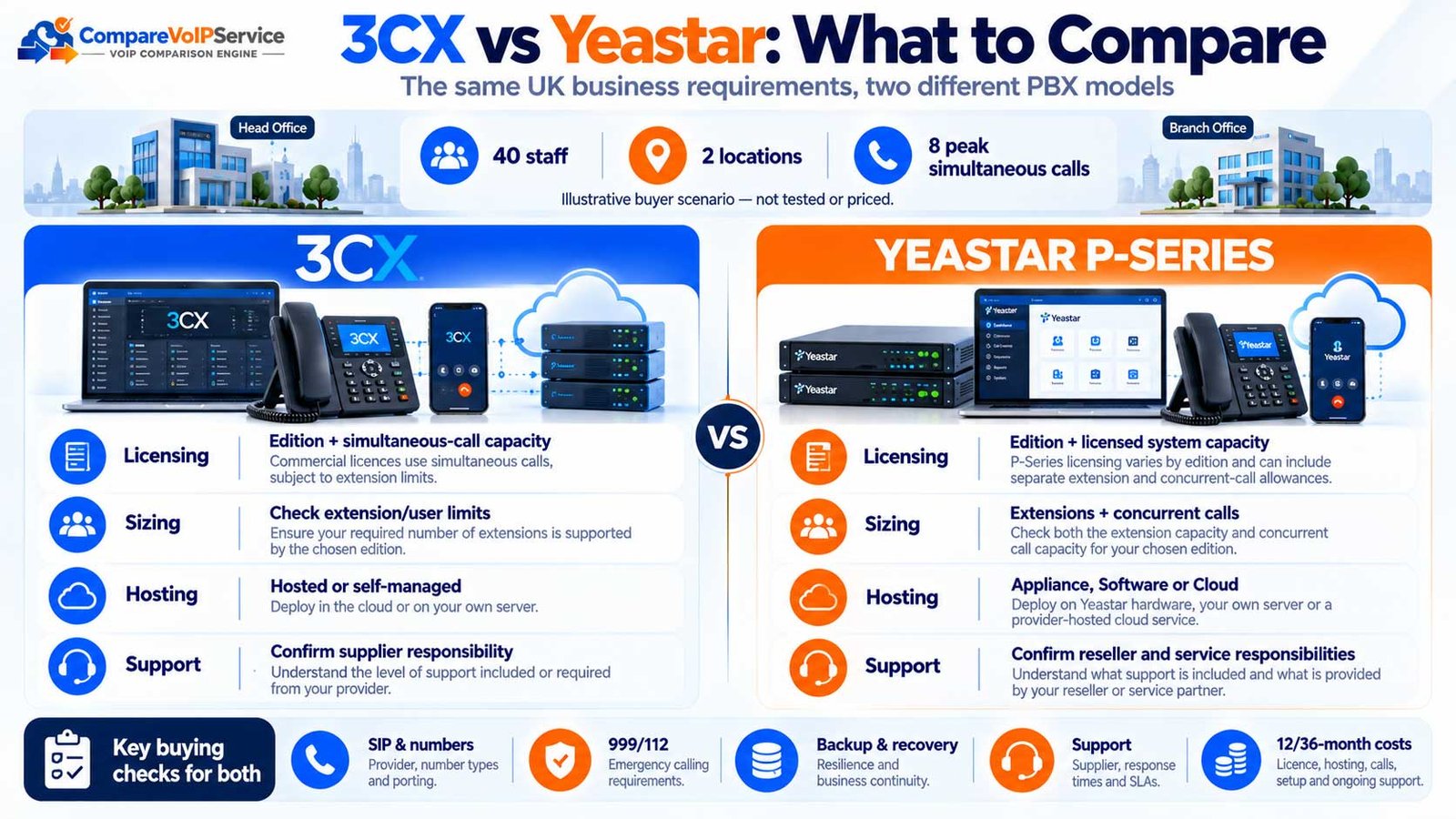
The primary licensing differences are documented by 3CX and Yeastar. Neither vendor should be treated as guaranteeing a complete UK calling service from its software licence alone.
How 3CX and Yeastar licensing compares — without false price equivalents
3CX states that commercial Basic, PRO and AI licensing is priced per system around simultaneous calls (SC), with recommended and maximum extension limits. Internal calls may count. The SMB Free offer and self-hosted 4SC Basic Free are not substitutes for a 40-person production procurement without checking their hard restrictions.
Yeastar documents different plans for P-Series Appliance (Basic included; higher tiers and optional services) and Software Edition (trial versus commercial Enterprise/Ultimate plans). Software Edition also documents extension and concurrent-call allowances. Cloud pricing and service operations depend on the provider agreement.
| 3CX proof | Yeastar proof | Why it matters |
|---|---|---|
| Exact Basic/PRO/AI edition and SC licence size | Exact P-Series edition, plan, model/SKU and extensions/concurrent calls | Product labels alone do not tell you what is included. |
| Maximum and recommended extension limits | Maximum concurrent calls and extensions, including expansion purchase | 40 people and 8 calls are two different sizing questions. |
| Queues, CRM, recordings, reporting and AI entitlement | Matching queues, CRM, reports, recording, Linkus and add-on entitlement | Avoid paying for features that are unavailable in the quoted tier. |
| Hosting and renewal, separately identified | Appliance purchase/service or software licence or cloud instance plus support | Do not compare licence-only price with a managed bundle. |
Cloud, self-hosting or appliance: who owns the actual phone service?
Neither vendor name tells you who fixes a failed telephone service. The supplier must separate PBX hosting, hardware, operating-system/security updates, SIP carrier access, customer-side internet, user devices, backups and restoration.
3CX operational questions
- If hosted by 3CX, what hosting, backup, region and additional support services are included in this specific order?
- If self-hosted, who controls the cloud subscription, server updates, certificates, authentication and recovery?
- If deployed on-site, who supports physical hardware, power supply, UPS and local network?
Yeastar operational questions
- For Appliance, who holds spare equipment, applies updates and replaces failed hardware?
- For Software, who maintains the virtual host, resource limits, operating system, certificates and backups?
- For Cloud, what is managed by the partner and what is still a customer responsibility?
Request a one-page operating-boundary diagram and name the escalation owner for ISP failure, PBX outage, SIP carrier failure, deskphone problems and licence expiry.
UK SIP trunks, number porting and 999/112 obligations
The PBX is not the regulated voice operator merely because it routes calls. Verify a suitable UK provider, number ownership, portability, caller-line identification, call records, emergency access and registered location handling for both fixed offices and nomadic staff.
| Area | Required acceptance evidence | Supplier owner |
|---|---|---|
| Number porting | LOA/number inventory, agreed port date, routing freeze and reversion contact | Current operator / gaining operator |
| Caller identification | Representative UK landline/mobile inbound/outbound CLI tests | SIP carrier / telephony supplier |
| 999 and 112 | Documented regulated provider arrangements, current caller locations and the provider-approved test procedure | Regulated communications provider + business location owner |
| Network/power failure | Alternate calling routes, UPS/backup access, site/mobile communication instructions | Internet/voice provider + business continuity owner |
| Remote work | How emergency location updates are recorded and surfaced | Carrier + service administrator + employee process |
Queues, recording, CRM and mobile apps: compare demonstrated tasks
A marketing checkmark is not a production acceptance test. Use matching scripted scenarios with the actual 3CX edition and selected Yeastar P-Series edition, and test on the intended business network and CRM.
| Business workflow | What to demonstrate | Important limitation |
|---|---|---|
| Reception and overflow | One main number → receptionist/IVR → queue → fallback with timed routing | Verify specific edition, contact-centre feature and flow configuration. |
| CRM event logging | Known and unknown callers, contact matching, answered/missed call, note and task | Confirm supported connector/version, permissions and event completeness. |
| Remote worker | Deskphone and mobile/desktop client sign-in, transfer, status and push alerts | Check endpoint, push notification and firewall requirements. |
| Recording/retention | Consented test call, rights, retention, export, deletion and access audit | Privacy, storage and licensing vary. |
| Reporting | Queue abandonment, missed calls, SLA measures, export and administrator permissions | Metrics can differ or require higher tiers. |
| AI services | Show one genuine approved transcription/reception workflow and exact billing unit | Never assume AI or transcription is included in a base plan. |
For the wider CRM data flow, see VoIP and CRM integration in the UK. A vendor-specific connector must still pass a user-authorised demonstration.
Security, backup and failover: request evidence, not reassurance
Security and operations
- Named patch owner and verified supported software/firmware schedule.
- Least-privilege access, MFA where available, role reviews and secure SIP/network controls.
- Fraud thresholds, outbound dial restrictions, audit logs and incident contacts.
Resilience tests
- Export and restore a configuration using test data in a controlled recovery exercise.
- Describe PBX/server, ISP, site power and SIP-carrier failure paths separately.
- Record recovery time objectives, backup location and the named person who declares service restoration.
Do not infer “zero downtime” from optional high-availability features or off-site hosting. Yeastar lists feature-specific redundancy options for particular P-Series editions; 3CX also has edition/hosting conditions. The evidence is a documented and demonstrated business recovery process, not a vendor comparison badge.
Compare 3CX and Yeastar costs over 12 and 36 months
A licence is only one component of total telephony spend. Ask the same UK provider profile and calling assumptions of both bidders. Record currency, VAT, discounts, invoice frequency, initial implementation, renewal and optional services.
For 36 months, separate one-off costs from recurring charges and apply only the contractually confirmed renewal prices or indexation provisions. Do not assume one-year promotional discounts continue.
| Cost line (GBP) | 3CX quote | Yeastar quote | Required documentation |
|---|---|---|---|
| Licence / plan / capacity | Supplier to quote | Supplier to quote | SKU, call/extension limits, renewal date. |
| PBX hosting or appliance | Supplier to quote | Supplier to quote | Region, hardware ownership, backups/restore. |
| SIP trunks and numbers | Supplier to quote | Supplier to quote | Channels, DDIs, CLI, port charges, tariffs. |
| Deskphones and accessories | Supplier to quote | Supplier to quote | Compatible units, replacement/spares, support. |
| Setup and migration | Supplier to quote | Supplier to quote | Port plan, training, acceptance and rollback. |
| Support and security | Supplier to quote | Supplier to quote | Hours, incident response, updates, certificates. |
| Add-ons and metered services | Supplier to quote | Supplier to quote | CRM, AI minutes, transcription, storage. |
| Year 2/3 and termination | Supplier to quote | Supplier to quote | Renewal, uplift, exit and port-out. |
| VAT treatment | Explicit ex/incl VAT | Explicit ex/incl VAT | VAT registration, invoicing and tax treatment. |
Supplier responsibility matrix: 3CX vs Yeastar operating boundaries
For either proposed solution, assign one accountable incident coordinator even when different organisations perform the work. “The reseller handles it” is not sufficient unless the written contract specifies what is handled.
| Operational area | 3CX supplier response required | Yeastar supplier response required |
|---|---|---|
| Licence and product updates | Who renews key, patches PBX and verifies interoperability? | Who renews plan, patches edition/firmware and checks compatibility? |
| PBX infrastructure | Who manages host/cloud hardware, TLS, monitoring and restore? | Who owns Appliance/Software/Cloud runtime and infrastructure? |
| UK SIP and numbers | Which regulated carrier owns trunks, numbers and CLI faults? | Which regulated carrier owns trunks, numbers and CLI faults? |
| 999/112 and location | Who updates calling locations and approves emergency-call test? | Who updates calling locations and approves emergency-call test? |
| Security incident | Who blocks fraud, reviews logs and coordinates response? | Who blocks fraud, reviews logs and coordinates response? |
| Outages and continuity | Who declares fallback, communicates to users and restores service? | Who declares fallback, communicates to users and restores service? |
| Exit and data portability | Who exports system data and releases DDIs on termination? | Who exports system data and releases DDIs on termination? |
A bidder should identify Responsible, Accountable, Consulted and Informed parties for the final design. This worksheet does not assert either manufacturer undertakes those duties in all purchases.
When should a business prefer 3CX, Yeastar or neither?
Prefer evaluating a 3CX proposal when
- The quoted SC size and extension limit comfortably handle verified demand and approved features.
- You want the specified 3CX deployment/hosting and can identify its maintenance, carrier and service owners.
- The configured workflow has passed the same acceptance tests with a competitive complete cost.
Prefer evaluating a Yeastar proposal when
- The Appliance, Software or Cloud operating model is a better fit for your internal support team.
- The exact P-Series edition, extension/call licence and paid services cover proven workflows.
- A UK reseller provides stronger written support, migration and resilience commitments under equivalent costs.
The standalone 3CX and Yeastar review URLs remain separate, planned content owners in the master register. They should be linked here only after their live publication and destination response are verified. This comparison owns the two-platform decision rather than either individual review.
Worked procurement example: how the decision changes with a requirement
If the buyer must maintain its own supported virtual infrastructure and documented recovery runbooks, compare a properly licensed 3CX self-hosted option with Yeastar P-Series Software Edition. Reject an attractive managed quote that cannot satisfy the hosting-control requirement, regardless of headline cost.
If no internal team can manage updates and recovery, ask for a vendor/partner-managed 3CX proposal and a Yeastar Cloud managed proposal that each include specific support hours, backup obligations, SIP ownership and exit rights. Here the SLA and division of responsibility may outweigh a licence difference.
If the buyer mandates on-site PBX hardware, compare a supported 3CX on-premises configuration with the relevant Yeastar P-Series Appliance hardware and plan. Confirm local power, servicing and spare-unit logistics. Do not present this as the same cost model as hosted cloud.
A realistic two-site cutover sequence
- Prepare one inventory of users, existing DDIs, device types, queues, SIP trunk, porting owner, emergency locations and dependency systems.
- Record call measurements across representative days and approve feature, extension and peak simultaneous-call sizing.
- Request separate 3CX and Yeastar quotes using the same implementation calendar and an accountable supplier lead.
- Build a pilot with synthetic CRM records and representative internal users; review security and permissions.
- Validate number port readiness, UK caller ID, emergency-calling location, queue overflow, mobile clients and branch-to-branch scenarios.
- Document a rollback plan, outage notice, forwarding fallback, old provider hold period and escalation contacts.
- Run the port and acceptance process with the authorised carrier team; capture tickets, results and sign-off.
- Review live support performance and usage-based charges after changeover; update continuity instructions and renewal diary.
For multi-branch programme ownership, use the existing multi-site migration planning guide rather than turning this product comparison into a second migration article.
12-point 3CX vs Yeastar supplier acceptance checklist
- Both quotes name the exact current product edition, deployment route, plan/SKU and support arrangement.
- Both can support measured peak active calls and 40 users within documented licence limits.
- The same inbound and outbound UK SIP route/number bundle has been itemised.
- Port-out authority, port date, rollback conditions and main/DDI inventories are signed off.
- 999/112 calling, registered caller location and outage instructions have carrier-approved evidence.
- Business-hours routing, main number, queues, voicemail and overflow work against a scripted test.
- CRM events, permissions and any paid integration functions are actually demonstrated.
- Recording/retention and administrator audit controls are configured to the business privacy policy.
- Remote users can sign in and transfer calls using the required supported devices and networks.
- A controlled backup and restore procedure has been demonstrated and recorded.
- Each support, incident, patch, carrier, renewal and recovery task has a named accountable party.
- First-year, 36-month, VAT, renewal uplift, termination and data/number portability terms are written and comparable.
3CX vs Yeastar FAQs for UK businesses
Is 3CX cheaper than Yeastar?
There is no evidence-backed universal answer. 3CX commercial licensing is mainly system/SC based, while Yeastar’s licensing varies by edition, plan and deployment. A total UK quote must also include hosting/hardware, SIP, numbers, support, installation, add-ons and VAT.
Does 3CX charge per user?
3CX says commercial licences are priced per system by edition and simultaneous-call size, with recommended and maximum user/extension limits. An idle extension does not consume a simultaneous call, but counts against extension limits.
Is Yeastar P-Series free?
P-Series Appliance Edition includes a Basic plan, but the appliance, SIP service and business support have separate costs. Software Edition trials are time-limited; commercial licences and optional services have their own terms.
Which supports more concurrent calls?
Both products have capacities dependent on the exact purchased licence or hardware/edition. Compare actual limits and business headroom, not headline user counts. The trial allowances for Yeastar Software are not commercial tier limits.
Can both connect UK SIP trunks and retain numbers?
Potentially, subject to supported trunking providers, number-porting eligibility, carrier contracts and configuration. Obtain written confirmation for the exact numbers and intended deployment.
Which is easier to maintain?
Neither product removes the need to maintain the chosen phone-service stack. A managed 3CX proposal or managed Yeastar Cloud proposal may reduce internal maintenance, but the actual SLA and supplier contract determine ownership.
Do both make 999 and 112 emergency calls?
The configured UK voice provider and the installation determine emergency calling, registered caller location and continuity. Never infer compliance from a PBX brand. Require carrier-approved commissioning and continuity evidence.
Which is best for CRM and call-centre teams?
Either may be shortlisted if the exact edition/licence supports required queues, recordings, reporting and CRM connector events. Require a controlled demonstration with the buyer’s real software versions and synthetic data.
Has CompareVoIPService tested these systems head-to-head?
No. This is an independent source-based UK buying comparison and procurement framework, not a firsthand lab benchmark. No test scores, measured performance winner or first-party customer case is claimed.
Official sources, methodology and editorial boundaries
This independent comparison uses public vendor licensing and product documents and Ofcom UK regulatory material accessed 23 October 2026. The tables identify documented product distinctions and proposed buyer checks. Actual UK supplier quotes, licence activation, installed emergency-calling arrangements, service performance and first-party hands-on testing were not obtained.
- 3CX licensing overview — SC system pricing, extension limits and hosting boundaries.
- 3CX pricing FAQ — free and commercial editions, SC definition and taxes.
- 3CX features matrix — edition-dependent feature entitlements.
- 3CX installation guide — deployment/hosting options and conditions.
- 3CX Basic/4SC introduction — small free route and restrictions; check current availability.
- Yeastar P-Series overview — Appliance, Software and Cloud product family and edition-conditional features.
- Yeastar Appliance Edition plan purchase — Basic and optional paid plans and services.
- Yeastar Software Edition licence purchase — trial/commercial, extension and concurrent call licensing.
- Yeastar Software Edition activation — expiry and operational activation considerations.
- Ofcom General Conditions — provider emergency access and caller-location framework.
- Ofcom emergency-calling compliance review — provider responsibilities and regulatory context updated in June 2026.
Our editorial methodology provides broader evaluation principles. This is not a manufacturer-endorsed comparison, not a field-test certificate, not a reseller quotation and not professional regulatory/legal assurance. Both platforms may be viable after written tender and acceptance results.
Put 3CX and Yeastar to the same test
- 40 users, proven busy-hour calls and licensed features
- Existing UK numbers, SIP carrier and 999/112 checks
- Hosting, updates, backup and recovery responsibility
- CRM, queues and reporting acceptance tests
- 12/36-month GBP, VAT, support and renewal terms
Make the decision using evidence, not a headline tariff
Give both UK suppliers the same requirements and request written, itemised quotes, a named incident owner and a testable cutover plan before awarding the contract.

Bhav Giva
Founder & Lead Analyst at CompareVoIPService.co.ukBhav Giva publishes UK-focused business communications research and practical VoIP guidance. This guide concentrates on compatibility, continuity and the evidence businesses should request when introducing an AI call-handling layer into an established telephone environment.