

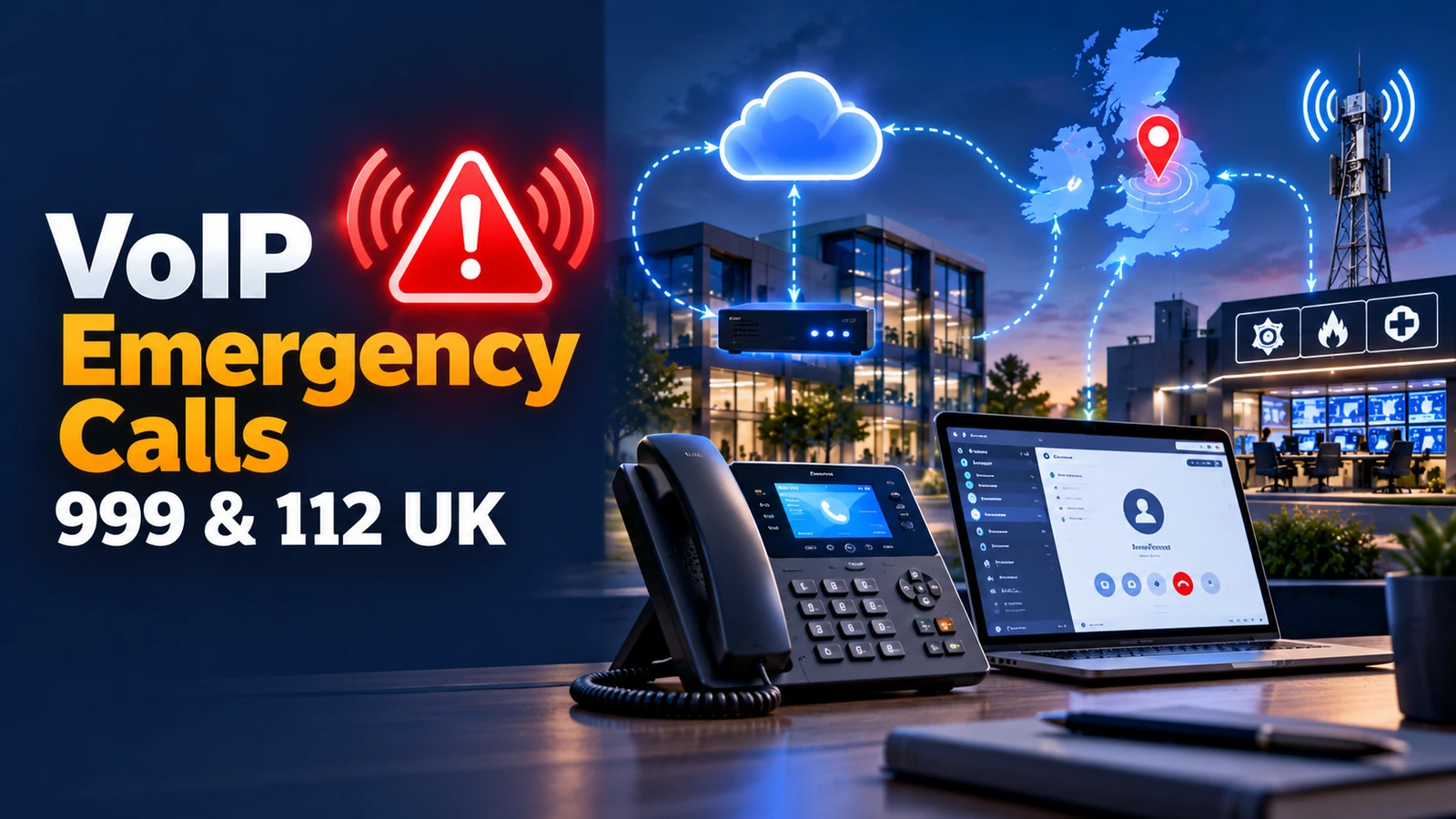
VoIP Emergency Calls in the UK: 999, 112 and Caller Location
Know which calling route works, what location information an operator receives, and what your business must do when power or broadband fails. Use this independent guide to obtain supplier evidence before relying on VoIP for emergency access.
The provider must explain the supported service; the business must keep site and user information accurate and plan for local dependencies.
Quick answer: UK business VoIP services connected to the ordinary telephone network can support 999 and 112, but correct emergency access depends on the actual subscription, carrier, configured user identity and current location information. Local electricity and broadband failures may interrupt VoIP, so obtain a documented provider response and a suitable alternate calling plan before go-live.
Jump to a Section
Can You Call 999 or 112 Using VoIP in the UK?
Yes, properly configured UK telephone services using VoIP can provide access to 999 and 112. Where the regulated voice service connects callers to the ordinary public telephone network, the relevant provider has emergency-calling obligations. But a functioning phone app, a dial tone or successful ordinary calls do not prove that your organisation has accurate location data, an appropriate emergency route or a working fallback when a dependency fails.
UK businesses should treat 999/112 calling as an end-to-end service: the employee’s device, local network and power, phone platform, carrier routing, emergency caller identity and location records must support the required outcome. A phone can be connected to a cloud PBX yet still fail to place a call during a local outage.
Never call 999 or 112 simply to test a new phone system. Arrange a provider-approved commissioning or verification method and obtain written confirmation from the relevant telecoms supplier.
How Does a VoIP Emergency Call Reach the Operator?
Unlike a traditional fixed line, an IP phone or softphone may be used in several places. The internet is only one part of the emergency-call journey. The supplier must also establish the connection to emergency organisations and handle caller identity and location information correctly.
The emergency call handler may ask the caller which service is needed and to confirm where the emergency is taking place. The caller should state the actual location even if their supplier has registered an address; do not rely on an operator already having a correct location.
A business with two offices, a remote workforce or staff travelling with laptops has a different location-management task from an organisation using only fixed handsets at one address.
What Does Ofcom Require for 999 and 112 Calls?
Ofcom’s General Conditions address the obligations on regulated communication providers, rather than creating a universal checklist of automatically compliant hardware. Conditions A3.2(b), A3.5 and A3.6 cover emergency access and the provision of accurate and reliable caller-location information, to the extent technically feasible and as relevant to the service provided.
| Requirement or Principle | Provider-Side Duty or Expectation | UK Business Action |
|---|---|---|
| Emergency access | Take the measures required to maintain access to emergency organisations for applicable voice services. | Ask which subscription, trunk and outbound route support 999 and 112; obtain written confirmation. |
| Caller location | Make accurate and reliable location information available to the emergency organisation, where technically feasible. | Supply and maintain correct user, number and site information; resolve unknown nomadic-user arrangements. |
| Power-cut provision | Ofcom guidance sets expectations for identifying customers’ needs, informing them and enabling emergency access during an outage. | Tell the provider about dependency, site-specific risks and any users without a reliable alternative. |
| Ongoing changes | Maintain arrangements reflecting the applicable customer and service circumstances. | Assign ownership for updates after office moves, new users, new DDI allocations and other site changes. |
The one-hour backup expectation in Ofcom guidance must not be presented as an automatic free battery or one-hour guarantee for every business PBX, broadband router, handset or multi-site deployment. The applicable provider obligations and proposed solution depend on the service and customer circumstances. Ask for the precise protection included in your contract, and assess whether your own equipment also needs continuity planning.
The source of these distinctions is Ofcom’s emergency-access compliance programme and its summary of provider rules. An individual contract may have additional operational terms.
Caller Location, Registered Addresses and Caller ID
A correctly presented business telephone number is not necessarily enough to establish where an emergency is happening. Some systems allow the same direct-dial number or user extension to move between offices, homes and mobile devices. Location records can become stale while ordinary business calling continues to work.
| Situation | What Could Go Wrong | What Must Be Confirmed |
|---|---|---|
| Fixed office desk phone | The provider’s stored address belongs to a previous location. | Street address, floor or unit where relevant, and the registered identity used on emergency calls. |
| Multiple branches | Several numbers or users inherit headquarters as their default location. | Correct mapping for each branch, number, trunk and shared phone group. |
| Remote or hybrid user | A softphone is used away from its expected address. | Whether the provider supports changing emergency locations and what users are told to do. |
| Shared reception or hot desk | A shared device presents a number linked to another site. | Actual outbound emergency CLI and location handling for the shared device. |
| Ported numbers or new carrier | Provider migration changes the source of caller or location data. | Who holds the current emergency-address record after porting and how accuracy is confirmed. |
BT Business specifically instructs users of its Digital Voice for Business service to keep 999 location information accurate in the Business Portal. Another provider may use a different method. An emergency caller should still tell the operator their actual location; do not treat address records as infallible.
For every site, assign an internal owner who knows how to request a location update and receives confirmation when it is completed. For mobile users, document how the service handles a different calling location before permitting it as the primary emergency route.
How Should Multi-Site and Remote Teams Handle Emergency Calls?
Location matters most when the same telephone identity is used in several physical places. The organisation should avoid a single “main office” record becoming the assumed location for all users. Instead, create a working-location register and ask each voice provider exactly what the emergency call records reflect.
Map phone numbers and emergency identity to the correct site. Include shared phones, communal areas, reception and the address of a large or multi-floor building where that detail is useful.
Explain how changing location affects emergency calling. Where the client cannot assure reliable location signalling, maintain a separately tested alternative emergency method.
Document whether the service permits location moves and how updates are submitted. A temporary construction, event or serviced-office location may need different assumptions.
Confirm whose caller identity appears, which location information is passed to the emergency service, and whether that device works on the intended network.
A worked example: a seven-person company has offices in Leicester and Birmingham, while two employees work remotely. The correct acceptance record does not simply state “999 available”. It lists the intended location treatment for each office, the remote-user policy, the responsible supplier and what each employee must do if the VoIP client is unavailable. This is an illustrative scenario, not a tested installation.
Will VoIP 999 Calls Work During a Power Cut or Broadband Failure?
They may not. Cloud-hosted phone software can remain healthy while a powerless router, fibre ONT, network switch or cordless telephone base leaves a particular site unable to place calls. An uninterruptible power supply (UPS) can support selected equipment temporarily, but powering a router alone does not guarantee emergency-call access if the upstream broadband service or the provider’s route is unavailable.
| Failure Scenario | Possible Impact | Evidence to Request |
|---|---|---|
| Mains electricity fails | Phone, router, network switch, access point or ONT loses power. | List every powered component, expected runtime and the separately working fallback route. |
| Broadband circuit fails | IP phones cannot reach the cloud or carrier. | Document a diverse connection, verified diversion or independently usable mobile calling route. |
| Hosted PBX or SIP carrier fails | Normal outbound emergency calling may be disrupted even if the local internet works. | Provider continuity scope and an emergency route that does not depend on the failed service. |
| Mobile network unavailable | Mobile fallback may not connect on that site. | Coverage and availability of another network; alternative arrangements where mobile coverage is unreliable. |
| Business telephone identity changes | A new number, account or site record may have incorrect emergency location. | Written provider confirmation of the new caller identity and address data. |
UK mobile emergency calls may connect through another available network, even when the subscriber’s home network has no service. That is a valuable safeguard, but no network available means no guaranteed connection. Keep devices charged and give staff a practical fallback appropriate to the premises and risks.
For general reliability testing, network metrics and WAN failover, use the VoIP Call Quality and Reliability guide. This page concentrates on the extra emergency-location and emergency-access outcomes.
Does Every UK Business Get a Free One-Hour Backup?
Not as a universal promise. Ofcom’s power-cut guidance expects providers to assess customers’ needs and have a solution that enables access to emergency organisations for at least one hour. It also states that providers should offer a free solution to customers who depend on their landline to call emergency services during a power cut.
The crucial procurement questions are who is covered, what equipment is included, how long the actual service path operates, and what happens if broadband—not just mains power—fails. A business may have multiple sites, switches, Wi-Fi access points or specialist devices outside the scope of a standard single-premises backup arrangement.
“For each of our premises and user groups, what emergency-call access is supported during a power failure, what is the backup method, what runtime has been specified, what is included at no additional charge where applicable, and who maintains the equipment?” Record the supplier’s answer in the acceptance register.
A 60-minute specification is not a reason to stop planning for longer outages. Assess your own operational need, especially where people may depend on the business’s phone system as their principal means of calling for urgent help.
Which Alternative Emergency Calling Routes Make Sense?
An alternative is only useful if it is available when the main service fails. Avoid a fallback that silently relies on the same power supply, router or carrier as the primary service. Choose an approach that suits the premises, mobile coverage, staffing and relevant supplier obligations.
| Possible Route | Where It Can Help | Important Limitation |
|---|---|---|
| Charged mobile phone | Independent way of calling 999/112 from many locations. | Coverage, battery life and availability must be considered; confirm network access at each site. |
| Second broadband circuit | May preserve VoIP when the first circuit fails. | Not helpful if common-site power or the PBX/carrier itself is the problem. |
| UPS and protected network equipment | Can keep local phones and connectivity equipment running during short power interruptions. | Must cover the complete local route and relevant power requirements; does not cure an ISP outage. |
| Provider-supported call diversion | May direct ordinary inbound calls elsewhere during an outage. | Inbound diversion does not automatically create a working outbound emergency route. |
| Alternative site or independent service | Can provide a different physical or provider path. | Users must know how to reach it; emergency location and calling capability need checking. |
Businesses should document which fallback a receptionist, a lone worker, a visitor and a remote employee can actually use. Do not assume staff will improvise an appropriate solution in an emergency.
Four Illustrative UK Emergency-Calling Scenarios
A receptionist uses a fixed IP handset. The buyer verifies the registered site address, the outbound identity, the local power path and who maintains a separate calling option during an outage.
The business has one central cloud PBX. A shared outbound number must not lead to an unchecked assumption that callers from both branches are at headquarters.
An employee uses a softphone at a temporary location. Their documented procedure explains how to report the actual location and which independent telephone to use if the VoIP route cannot be assured.
The PBX stays online but the local fibre termination loses power. The pre-agreed alternative must remain reachable without relying on the failed router or switch.
These examples explain decision boundaries; they are not evidence of operational testing by CompareVoIPService. Treat each scenario as a prompt for evidence from the supplier responsible for the deployed service.
The UK VoIP 999/112 Emergency-Calling Acceptance Record
Instead of accepting “999 works” as a single verbal assurance, ask the supplier to document the emergency-call configuration and its limits for each site and each relevant user group. This gives facilities, IT and procurement teams a common sign-off record.
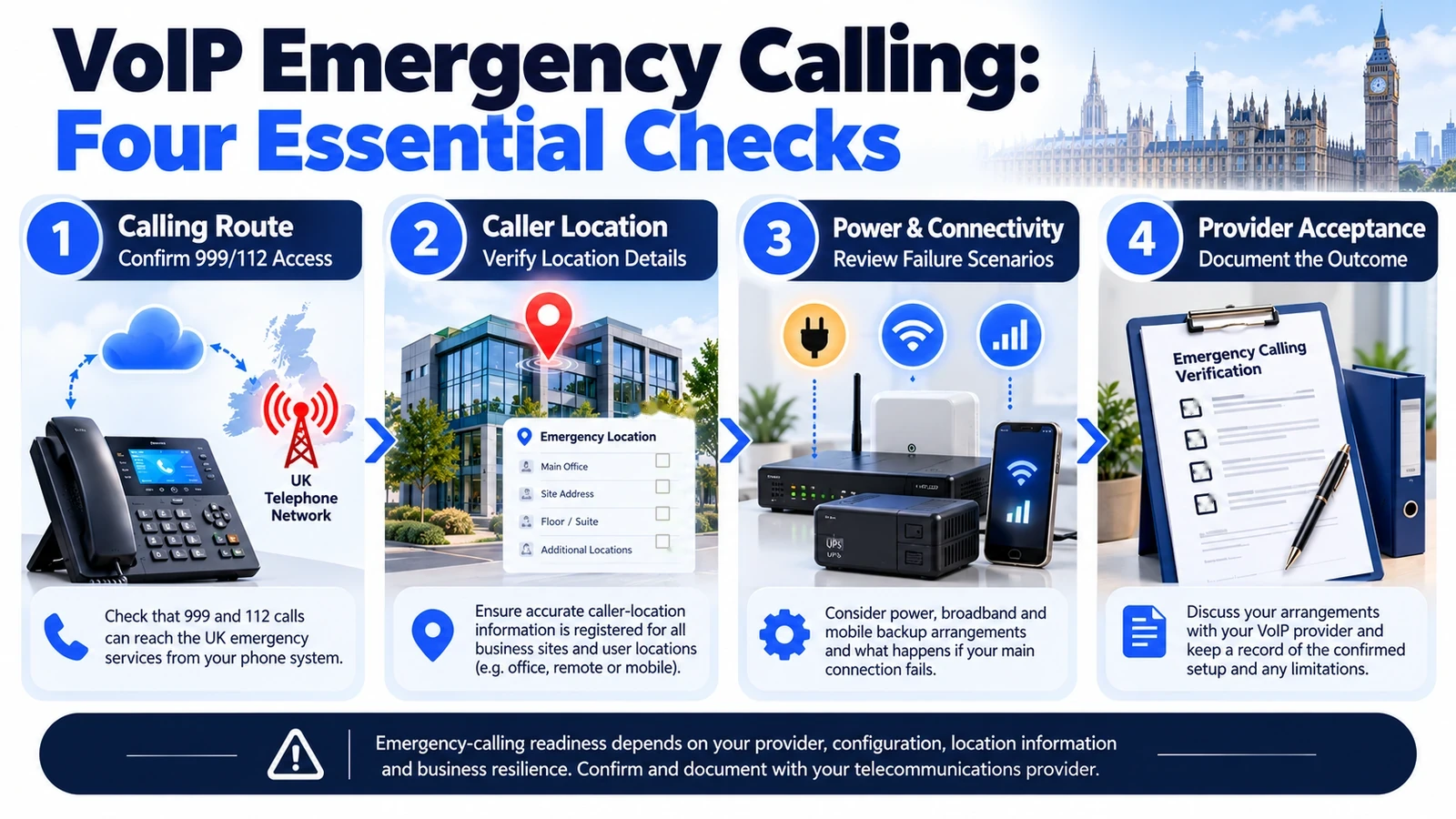
Five Evidence Groups to Sign Off
| Record Field | What to Enter | Acceptance Evidence |
|---|---|---|
| Site / User Group | Business premises, shared device or remote-user category. | Named scope and owner. |
| Caller Identity | Registered telephone number or emergency identity where relevant. | Provider-confirmed presented CLI or equivalent configuration. |
| Emergency Location | Address or supported location-management mechanism. | Date-stamped supplier confirmation and update procedure. |
| 999/112 Routing | Supplier and service handling the emergency call. | Written supported service/contract statement. |
| Power and Network Dependencies | Phone, ONT, router, switches, Wi-Fi and relevant provider path. | Dependency map and proposed protection. |
| Independent Fallback | Mobile, alternate service or approved continuity route. | Agreed process appropriate to the actual site. |
| Commissioning Method | Non-emergency, supplier-approved evidence procedure. | Completed service acceptance or supplier test evidence; never unnecessary live 999 calls. |
| Change Owner and Review | Owner, review trigger and escalation contact. | Written operational handover. |
Keep site-specific records inside the organisation’s secure operational documentation, not in a public form. Update them whenever users, numbers, locations, premises or telecoms suppliers change.
Questions to Ask Before Signing a VoIP Contract
- Does our contracted service support both 999 and 112, and are any user types or calling modes excluded?
- For each fixed site, how is the emergency address created, verified and updated?
- What happens to caller identity and emergency location after number porting or a trunk change?
- Can mobile or nomadic users change location and what warnings or controls are provided?
- Which provider owns emergency routing if the PBX platform and SIP carrier are separate companies?
- What will still work during local electricity failure, broadband failure or carrier outage?
- How will our business be assessed for power-cut protection and what is included for dependent users?
- What evidence can be provided without placing unnecessary live 999/112 calls?
- How should we report a defect in caller-location presentation or a failed emergency route?
- Who maintains the record and repeats verification after meaningful changes?
A supplier unable to explain the above should not be treated as automatically unsuitable; it may simply need to involve its carrier or specialist implementation team. But the unanswered question should remain open until the right party supplies an attributable answer.
For broader procurement criteria such as costs, integrations, support and migration, continue to our UK VoIP Buyer’s Guide. For general platform/security controls rather than emergency call routing, see VoIP Security.
Common Mistakes That Leave Emergency-Calling Risks Unresolved
- “Our usual calls work”: ordinary calling does not demonstrate the emergency route or the correctness of location information.
- “All phones use the headquarters number”: do not assume that is an accurate location for people at other sites.
- “We have a UPS”: check whether every needed piece of equipment and the upstream network remains available.
- “Mobiles always work”: network coverage, charged batteries and user access still matter.
- “Calls divert to an external number”: inbound diversion is different from an employee’s ability to dial 999.
- “Our provider guarantees one hour for everyone”: distinguish Ofcom’s expectations and the actual customer/service provision from an unsupported blanket promise.
- “We can test by ringing 999”: do not make unnecessary emergency calls; use the carrier’s authorised test or commissioning process.
The recurring issue is treating a complex emergency access path as a checkbox. The acceptance record makes the underlying responsibilities visible and gives the business a way to ask for evidence.
Frequently Asked Questions About VoIP Emergency Calls
Can UK Business VoIP Phones Call 999 and 112?
Yes, an appropriately provisioned UK voice service that connects to the public telephone network should support access to emergency organisations under the applicable regulatory requirements. Check that the particular service, device and external calling route are in scope. Ordinary app-to-app calling on its own does not establish emergency telephone access.
Will My VoIP Phone Work During a Power Cut?
Not necessarily. Desk phones, routers, ONTs, switches and Wi-Fi may need mains electricity. Ofcom guidance expects providers to address emergency access during power outages, but the actual business deployment and eligible protection must be assessed individually.
Does the Emergency Operator Automatically Know My Exact Address?
Do not assume so. Providers must make accurate, reliable location information available where technically feasible, but VoIP users can move. Always state the actual location and keep provider-held location details up to date.
What If Staff Work From Home or Travel?
Ask the provider how nomadic use and location changes are handled. Provide employees with a clear instruction to state their location and maintain an accessible alternate calling route if the VoIP client’s location or availability cannot be assured.
Are 999 and 112 the Same in the UK?
Both are UK emergency telephone numbers. The 999/112 service routes callers to emergency call handling, and the handler asks what service is required. Either number should be treated as an emergency-only service.
Can We Test 999 Calls During Phone-System Installation?
Do not place an unarranged live emergency call. Ask the voice provider or carrier for an approved verification process and keep its commissioning evidence. Test ordinary calling, failover and location-record administration separately using non-emergency procedures.
Is a Mobile Phone a Sufficient Emergency Backup?
A charged mobile can provide an important independent calling route, and UK emergency calls may use another available network. But poor coverage, no available network, flat batteries and accessibility requirements can make mobile-only assumptions unsuitable at some locations.
What Does the One-Hour Backup Requirement Mean for Businesses?
Ofcom’s published guidance expects providers to identify needs and provide arrangements enabling emergency access for at least an hour during a power cut, with free provision for customers dependent on their landline. Do not assume every business device or all services receive a universal one-hour guarantee; ask the supplier what applies.
What Should We Record When Moving a Business Number?
Keep the effective number, associated location record, carrier owner, change date, test evidence and named administrator. Number porting and changing a SIP provider can affect the emergency-service information path even where normal calling works.
Official Sources and How This Guide Was Prepared
This independent UK guide draws on Ofcom’s published regulatory framework, government emergency-access guidance and named provider documentation. It presents a reader-facing due-diligence framework, not a claim that CompareVoIPService has commissioned, technically tested or certified any specific PBX, telephone number, carrier or 999 routing configuration.
- Ofcom — Compliance Programme on Emergency Calls
- Ofcom — General Conditions and Power-Cut Guidance Summary
- Ofcom — Protecting Emergency Access During a Power Cut
- Ofcom — Enforcement Case Concerning Incorrect 999 Location Data
- UK Government — 999 and 112 Emergency Numbers
- UK Government — Telecoms Resilience and Emergency Access
- Comms Council UK — VoIP Emergency Services FAQ
- BT Business — Digital Voice for Business, 999 Location
Regulatory and source review: October 2026. Contract entitlements, provider capabilities and applicable rules should be checked again before deployment or procurement. The precise site and number details needed for 999/112 service must come from the responsible supplier.
999/112 Readiness Brief
Get Emergency Access Confirmed Before Go-Live
Ask the responsible voice supplier to document the available route, location records and outage arrangements for each work location. Use the same evidence checklist when choosing or migrating a business phone service.

Bhav Giva
Founder & Lead Analyst at CompareVoIPService.co.ukBhav Giva publishes independent UK business-communications guidance for CompareVoIPService.co.uk. This guide translates published Ofcom and emergency-calling requirements into practical buyer checks for VoIP services, caller location and continuity. It does not claim hands-on testing, regulatory certification or live emergency-call commissioning.