


SIP Trunking Explained for UK Businesses
Keep a compatible PBX, connect it to UK public calling and know exactly what you must test before approving the service. Understand channels, numbers, full costs and the people responsible when something fails.
Carrier connectivity and PBX operations are separate. Agree capacity, interoperability, emergency service and support ownership.
Quick answer: SIP trunking is an IP-based telephone service linking a compatible business PBX to external public calling. It can replace traditional ISDN/PSTN voice circuits while allowing an organisation to keep a suitable phone system. You still need a supported PBX, appropriate SIP channel capacity, a reliable network, UK numbers and defined supplier responsibilities.
Jump to a SectionReading: SIP Trunking Basics
What Is SIP Trunking and Who Needs It?
SIP trunking is a service that connects a compatible business phone system (PBX) to the public telephone network using IP-based communications. It replaces the external telephone circuits traditionally provided by ISDN or analogue business lines, while allowing a business to retain a suitable PBX, call-handling rules and supported phones.
Imagine an office with an established PBX, 28 users, a reception queue and a block of UK direct-dial numbers. The internal system may still be useful, but the older external lines are due to be retired. A compatible SIP trunk can provide the external calling connection without forcing the business to replace every extension. This is not automatic: hardware, software licences, security, numbering and technical support must be verified.
Session Initiation Protocol helps establish, manage and end communications sessions. A SIP trunk is a commercial service using SIP to connect a calling platform with a communications provider.
Extensions, queues, business hours and other call-control features live primarily in the PBX or phone platform. A SIP trunk does not automatically provide a replacement PBX, new handsets or a CRM integration.
For a new business without a PBX, a managed hosted phone system may be simpler. This guide focuses on deciding whether SIP trunking is suitable, understanding the components and checking an existing platform before service approval; it is not a ranking of SIP providers.
How Does a SIP Trunk Work?
On an inbound call, a customer dials a business number. The telephone network routes it to the selected carrier, whose SIP service delivers the call to the customer’s compatible PBX. The PBX then applies its extension, department or queue rules. Outbound calls usually follow the reverse direction, subject to dial plans and caller-ID authorisation.
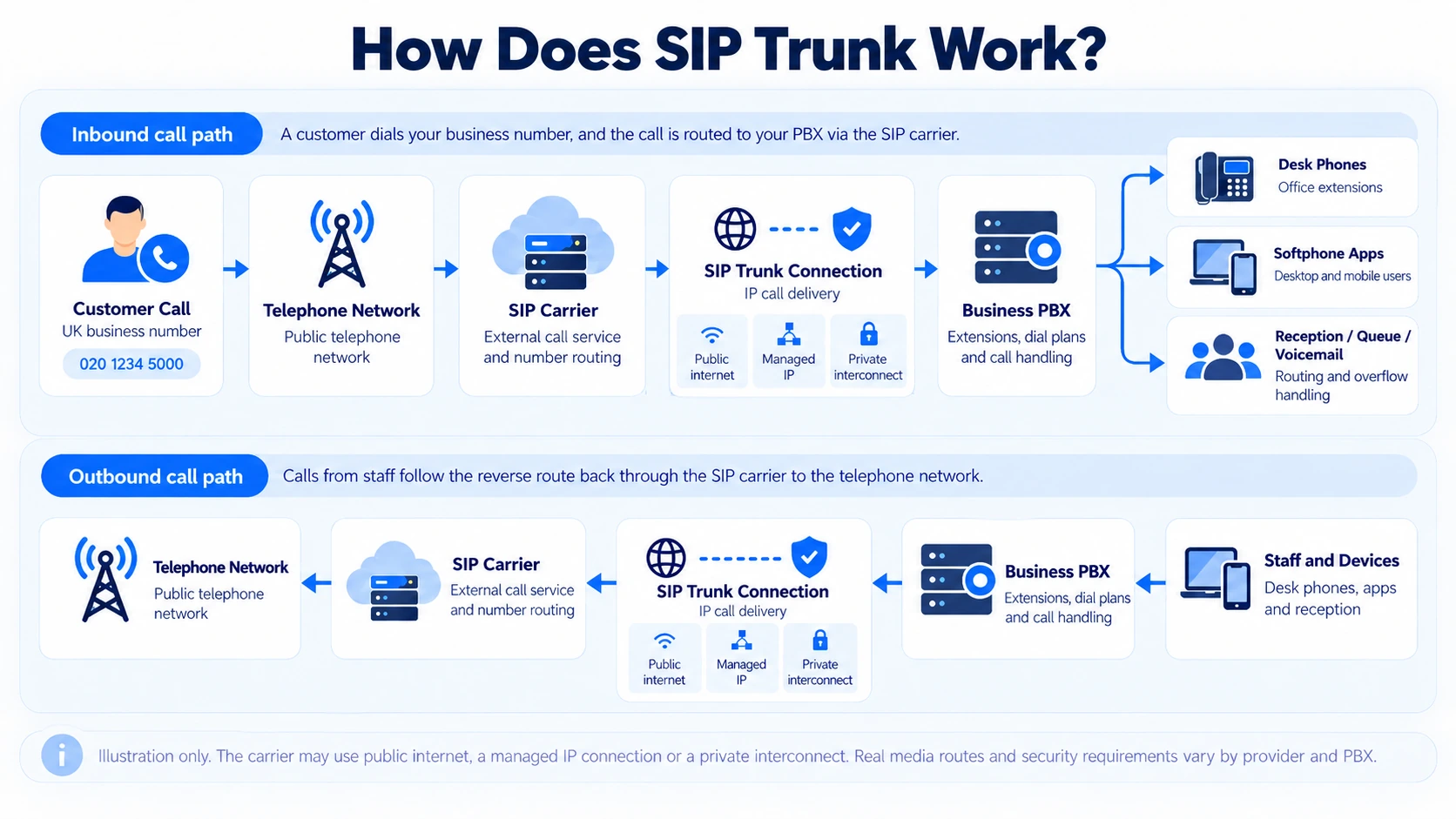
SIP signalling and voice media are related but distinct. SIP negotiates the call; audio usually travels using RTP or, where properly supported and configured, encrypted SRTP. A successful trunk registration does not guarantee that audio works in both directions. Firewall, NAT, codec and media-path compatibility still need testing.
| Service element | What to verify | Common ownership |
|---|---|---|
| Existing PBX | SIP support, software version, trunk licences, routing and resilience | Business or PBX support partner |
| SIP trunk/carrier | Authentication, channels, tariff, numbers, interconnect and incident support | SIP provider |
| Internet / private network | Bandwidth, reliability, firewalls, address changes, path diversity | Connectivity provider and business IT |
| Phones and extensions | Supported devices, user provisioning and local power | Business/PBX support partner |
| Business numbers | DDI inventory, porting authority, CLI presentation and location records | Number-owning provider and porting team |
The most common procurement mistake is to assume the supplier of the trunk also manages the PBX, broadband, firewall and desk phones. That can be true for a managed offer, but only if the contract says so.
Will SIP Trunking Work With Your Current PBX?
Not every existing PBX can accept a SIP trunk directly. Some support SIP natively. Others may need additional software licences, firmware changes or a properly designed session border controller (SBC) or gateway. A very old digital PBX might be technically adaptable but uneconomic to retain.
| PBX situation | Possible route | Before signing |
|---|---|---|
| Current IP-PBX with SIP support | Connect directly where the vendor/carrier combination is supported | Confirm supported software, licences, SIP method, TLS/SRTP expectations and carrier templates |
| PBX with limited SIP compatibility | Vendor-approved SBC or gateway may be required | Confirm device support, firmware lifecycle, interoperability testing and support owner |
| Legacy ISDN PBX with no supported IP trunk option | Explore vendor-approved gateway or planned PBX replacement | Compare gateway lifetime cost with replacement; do not assume plug-and-play |
| Cloud/hosted PBX already in use | Existing provider may already supply external trunking internally | Avoid paying twice; confirm who owns the external calling route |
| Microsoft Teams Phone | Uses its own PSTN connectivity models and eligibility rules | Do not assume generic SIP trunk credentials can be entered directly into Teams |
For 3CX specifically, its official SIP trunk requirements describe registration- and IP-based authentication, DTMF, carrier addresses and optional media encryption. Treat these as an example of vendor-level interoperability checks rather than universal rules for every PBX. For the wider PBX setup, see our 3CX phone systems guide, which separates 3CX licensing, hosting and SIP carrier connectivity.
Ask the PBX maintainer to state in writing: the exact PBX version, a supported SIP trunk method, any gateway/SBC required, who will configure it, who will support faults and what happens when software reaches end of support.
For a Yeastar deployment, our Yeastar P-Series phone system guide explains the differences between appliance, software and cloud editions, and why the SIP carrier, numbers and support arrangement must be checked separately.
How Many SIP Trunk Channels Do You Need?
A channel generally represents capacity for one simultaneous external call through a trunk, subject to the provider’s service definition. A company with 60 staff does not necessarily require 60 channels. Conversely, a small business running busy outbound calling, reception transfers and inbound queues could need more than its headcount suggests.
Worked Example: A 24-Person Business
Suppose 24 employees use a compatible PBX. During a hypothetical busy interval there are five external inbound conversations, four outbound conversations and two additional incoming calls waiting in an externally connected queue. If those eleven external call legs each consume one carrier channel under the chosen provider’s model, the estimate is 11 active channels. A transfer or conference can introduce additional legs; verify the actual billing and routing model. The appropriate purchased capacity also needs agreed headroom.
Obtain busy-hour reports for inbound, outbound, queued, transferred and conference calls, ideally across seasonal peaks.
The SIP carrier’s concurrent-channel limit and the PBX’s call/licence capacity can be different bottlenecks.
Choose capacity using observed peaks, growth plans, queuing behaviour and the cost of blocked calls—not an unsupported fixed percentage.
Document what happens when all channels are busy: engaged tone, alternative route, callback or network divert.
The number of external carrier channels is not automatically the same as the PBX licence’s simultaneous-call capacity. Some internal calls use PBX call capacity without requiring an external SIP trunk channel. Check both separately.
Can You Keep Your UK Business Numbers?
Many geographic and other eligible business numbers can be transferred to a new communications provider, but porting depends on the number type, network arrangements and correct paperwork. Make a complete inventory before deciding which trunk service to order.
- Main numbers and DDI blocks: record the full numbers, active owner/provider, ranges, call destinations and any reserved numbers.
- Call routing after porting: map each inbound number to the correct PBX destination, including out-of-hours paths and department queues.
- Outbound CLI: agree which valid, diallable telephone numbers users may present; the carrier must authorise the appropriate number presentation.
- Connected services: check whether existing numbers or legacy lines also serve fax, monitored alarms, payment terminals, lift phones or broadband dependencies.
- Timing and fallback: agree porting milestones, a test number, port-failure escalation and a date when the old service can be ceased.
Ofcom sets number portability and switching obligations under its number portability guidance. Porting rights do not remove the need to establish commercial, technical and operational eligibility for a particular order.
Use our dedicated UK business number-porting guide for the wider transfer process. This SIP guide is limited to how number arrangements affect a trunk deployment.
What Does SIP Trunking Cost in the UK?
SIP trunking costs depend on the provider’s charging basis, included calls, contract term, number rental and the equipment/services required around the trunk. An advertised low channel price is not a complete business telephone quotation.
| Cost item | Typical charging basis | What to ask |
|---|---|---|
| Trunk/channel rental | Monthly per channel, account or agreed capacity | Minimum number of channels, burst limits, standby capacity and annual increases |
| Outbound calls | Per minute, per call or bundle/fair-use tariff | UK mobile/landline rate bands, international/premium calls and overage |
| Numbers and porting | Number/DDI rental and any applicable service or professional charges | Blocks, 03/08 options, rejected port administration and porting responsibilities |
| PBX and SBC | Existing licences, upgraded support, SBC/gateway or hardware | Support lifecycle, configuration effort and security maintenance |
| Connectivity and resilience | Broadband/private circuit, backup access, power protection | Network diversity, mobile backup limits and cloud/network diverts |
| Service operations | Setup, monitoring, support SLA and incident cover | Response and restoration commitments, support hours and excluded items |
Annual channel/service rental + number rental + forecast call charges + PBX/SBC and network support + backup arrangements + any setup and migration costs + applicable VAT = a more useful first-year estimate. Compare quotes on the same user count, concurrent demand, call mix and support scope.
There is no single verified “average UK SIP price” suitable for every business. For transparency, public UK procurement listings show that products can be priced by channel, user or other units. For example, a published public-sector SIP listing uses a per-licence monthly price, but that figure is not an offer for your organisation or proof of market-wide pricing. Obtain current written supplier quotes and distinguish excluding/including VAT.
Where Does SIP Trunking Fit Into the PSTN Switch-Off?
Openreach identifies 31 January 2027 as the retirement milestone for the traditional PSTN. For businesses with an eligible PBX, replacing legacy voice circuits with an approved SIP connection can be one possible transition route. It does not necessarily mean replacing the internal phone system.
It also does not mean every old device attached to a telephone line will work on a trunk or an analogue adapter. Security alarms, lift emergency communications, fax, card terminals and other non-voice devices need separate compatibility review. Some organisations should replace the PBX rather than spend money keeping an obsolete platform connected.
Our PSTN-to-VoIP migration guide owns the full business-wide migration programme. Here, the narrower decision is the readiness of the PBX-to-carrier connection.
Individual suppliers may require earlier changeover, and product-specific arrangements vary. Confirm your existing service’s withdrawal and migration dates in writing with its provider. Read Openreach’s current switch-off information.
How Do You Make SIP Trunking Reliable?
A SIP trunk is not inherently resilient because it uses IP. If the PBX, office power, router, broadband connection or carrier service fails, calls may be interrupted. Resilience has to be designed across the entire chain, with responsibilities agreed before the number port.
| Fault scenario | What may happen | What to validate |
|---|---|---|
| Office broadband stops | On-site PBX or phones may lose access to the SIP carrier | Independent connectivity, network-based divert, restored route and test plan |
| Local power fails | Router, firewall, SBC, PBX and PoE phones may stop | Backup-power duration and an alternative working device/service |
| Carrier or trunk endpoint fails | Inbound/outbound public calling may be affected | Secondary carrier/endpoint, number-route behaviour, failover conditions |
| PBX or SBC fails | The carrier may be working but unable to reach the business | Supported restoration, standby environment or network divert |
| Channel capacity is exhausted | Some new external calls may be rejected or queued | Overflow behaviour, alerts and realistic concurrency capacity |
| Number port does not complete | Some inbound calls may still reach the previous arrangement | Carrier-led port escalation, bridging and phased validation |
A second broadband link is useful only if it genuinely avoids the relevant shared failure. An alternative SIP address does not help if both paths depend on the same single router, access circuit or unpowered PBX. Ask who can implement a network-level divert when the local PBX cannot be reached.
What About 999, 112 and Caller Location?
The SIP trunk and PBX together must support an appropriate emergency-call route. A normal outbound call succeeding is not evidence that 999/112 is correctly routed or that relevant caller-location information is accurate.
Ofcom’s General Conditions address uninterrupted access to emergency organisations and accurate, reliable location information where technically feasible. The obligations fall on regulated providers; businesses still need practical arrangements and verified information about locations, remote workers, CLI, power and alternative calling routes.
- Identify which carrier and configuration handle 999/112 for every calling site.
- Confirm the appropriate registered emergency location for the supplied numbers and how it is updated.
- Check remote or movable users, where a phone or app may be used away from the registered premises.
- Establish an alternative method for emergency calls during power or connectivity failures.
- Ask the responsible provider to explain its approved verification method; do not place unnecessary live emergency test calls.
For the detailed UK-specific requirements and a separate location-verification record, read our VoIP 999/112 emergency-calling guide. The Ofcom compliance guidance provides the relevant regulatory context.
What SIP Trunk Security Checks Matter?
SIP systems can be abused through stolen credentials, exposed services, malicious routing changes or unexpected international and premium-rate call activity. Security is shared across the PBX, network, carrier and administration process.
Use supported registration or IP-based controls as specified by the PBX/carrier. Keep credentials confidential, remove stale accounts and restrict administration rights.
Apply the vendor’s supported firewall, NAT and SBC guidance. Limit exposure to the carrier’s verified endpoints where technically appropriate.
Check whether SIP over TLS and SRTP are supported end-to-end in the intended configuration. Do not assume a checkbox guarantees interoperability or complete security.
Request destination restrictions, spending thresholds, call alerts and rapid out-of-hours carrier escalation. Review bills and unusual call spikes.
For the platform-specific distinction, 3CX documents support and limitations for TLS and SRTP trunking. Other PBXs and carriers may behave differently. Your approved configuration and incident response plan matter more than a general claim that SIP is secure.
SIP Trunk Compatibility and Acceptance Record
This is the practical output of the guide: a shared sign-off sheet for the business, PBX maintainer, carrier and connectivity team. Its purpose is to prevent a contract being accepted solely because one test call worked.
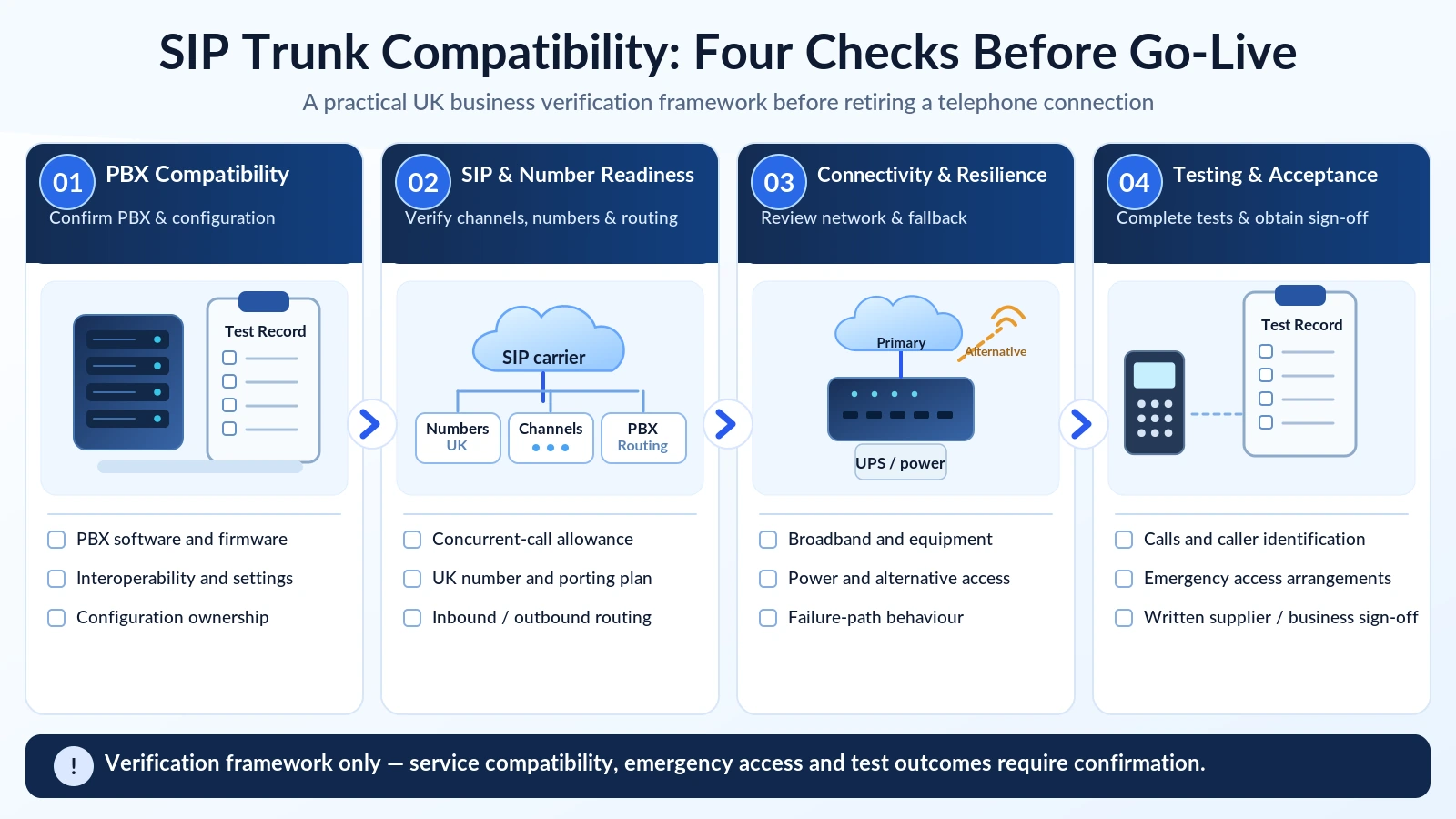
Stage 1 — Establish the Baseline
Record the PBX product and supported version, sites, existing trunks, main number/DDI list, current provider, required concurrent calls, normal opening hours and affected business processes. Assign an owner to every dependency.
Stage 2 — Confirm Compatibility in Writing
Record the chosen carrier and PBX interoperability method, required licences and SBC, authentication approach, dial plans, incoming DDI format, outbound CLI conditions, security expectations and support handoff.
Stage 3 — Test the Actual Call Paths
Have the designated suppliers check incoming and outgoing calls, transfers, queue capacity, dial plan, DTMF, audio in both directions, out-of-hours rules, approved emergency verification and nominated fallback route.
Stage 4 — Approve and Handover
Retain the test outcome, defects, remediation owner, carrier incident contacts, port confirmation, rollback/failover instructions and written business acceptance before terminating dependent legacy services.
| Acceptance item | Evidence to retain | Owner / decision |
|---|---|---|
| PBX and SIP compatibility | Supported configuration, versions, licence and interop reference | PBX maintainer + carrier — pass / hold |
| Inbound number and DDI routing | Recorded test for main number and representative extensions/queues | Carrier + business call-flow owner — pass / hold |
| Outbound routes and CLI | Normal and authorised CLIs tested against agreed destinations | Carrier + PBX admin — pass / hold |
| Capacity and voice quality | Busy-hour design, load evidence and bidirectional audio checks | PBX/carrier/network team — pass / hold |
| Emergency access and location | Provider’s approved verification and location-registration outcome | Responsible telecoms provider — pass / hold |
| Power, broadband and carrier failure | Observed or simulated agreed fallback process; limitations documented | Business continuity owner — pass / hold |
| Numbers, porting and legacy dependencies | Porting confirmation and approval to cease each old service | Number provider + service owner — pass / hold |
| Support, monitoring and handover | SLA, hours, fault triage, backup/restore and sign-off | Named commercial/service owner — accept / hold |
Decision rule: mark the deployment ACCEPT only when material controls have evidence and responsible owners agree. Otherwise record HOLD with the defect and remediation plan. This is an editorial decision framework, not a supplier certificate or a substitute for qualified engineering tests.
How to Move a Compatible PBX to SIP Trunking
- Audit the current phone estate. Inventory numbers, sites, users, PBX software, gateways, non-voice devices, active call patterns and maintenance terms.
- Confirm the PBX transition route. Ask the manufacturer or maintainer for a supported SIP/carrier combination and any required updates, licences or SBC.
- Choose a carrier and define ownership. Require clear technical and commercial terms, routing, porting support, emergency arrangements, incident response and exit options.
- Prepare network and security. Review connectivity, addressing, firewall/media routes, QoS where relevant, access controls, monitoring and power resilience.
- Build and pilot before porting. Test a temporary number or test trunk where available, including incoming/outgoing routing, hold, DTMF, queues, transfer and both-way audio.
- Agree cutover and rollback. Schedule number transfer, nominate decision-makers, notify users, prepare fallback instructions and identify any external dependencies.
- Test and document acceptance. Use the acceptance record above, confirm the approved emergency verification route, then sign off defects and training.
- Cease old services only when safe. Obtain confirmation that porting succeeded and that all dependent services have been migrated or independently resolved.
The business-wide migration sequence and dependency audit belong to our PSTN migration guide. This checklist concerns the narrower process for a specific SIP-to-PBX handover.
When Is SIP Trunking the Right Choice?
| Situation | SIP trunking may be suitable when… | Alternative or caution |
|---|---|---|
| Established business PBX | PBX has remaining support life, supported SIP capability and accountable administration | An end-of-life PBX may be costly to retain |
| Multiple sites or branches | Central call control and site routing are already designed and reliable | WAN, resilience and site-level emergency location may add complexity |
| 3CX or other IP-PBX deployment | A provider-supported trunk and PBX licence/call-capacity model can be verified | Check both PBX capacity and external trunk capacity |
| Small company with no phone system | A business has technical resources to run its own PBX | Fully hosted telephone service may reduce operating burden |
| Microsoft Teams-first organisation | An approved Teams PSTN route is explicitly designed for the tenant | Ordinary SIP trunk credentials are not a direct replacement for Teams Phone licensing/connection models |
| Business needing guaranteed single-party support | One provider contracts for PBX, trunk, network and incident support | Otherwise split responsibility may be unacceptable |
Do not treat SIP trunking, hosted PBX and unified communications as interchangeable labels. SIP trunking is the external telephony connection; hosted VoIP is often a managed complete phone-platform service. The broader solution-selection task is covered by the published VoIP Buyer’s Guide.
Frequently Asked Questions About SIP Trunking
Is SIP Trunking the Same as VoIP?
No. VoIP describes voice communications carried using IP networks. SIP trunking is a particular way to connect a compatible telephone system to a carrier using SIP signalling and an IP network.
Do I Need to Replace My Business PBX?
Not necessarily. A supported SIP-ready PBX may be retained, but an older platform can need licences, an SBC, a gateway or replacement. Confirm the exact vendor-supported option.
How Many SIP Channels Does a 20-Person Office Need?
There is no universal number. Size the carrier capacity from peak simultaneous external call legs, busy queues, transfers, growth and the supplier’s channel model—not simply from employee count.
Can I Keep My Existing UK Telephone Number?
Often, where the number and provider route are eligible. Record the existing provider, full DDI range and proposed port date; confirm the gaining carrier will manage the process before cancelling old service.
Does a SIP Trunk Include Broadband and a Phone System?
Usually not by default. The trunk typically supplies external calling, while broadband, PBX, devices, configuration and support may be separately supplied. Managed bundles can combine these elements.
Is SIP Trunking Secure?
It can be operated securely with supported authentication, restricted network exposure, updates, call-fraud controls and compatible signalling/media encryption where available. Security depends on configuration and governance.
Does SIP Trunking Support 999 and 112?
The responsible UK voice provider must address the applicable emergency-calling requirements. The buyer must verify the whole route, accurate location arrangements and power/network failure behaviour with its providers.
What Happens if the Internet Goes Down?
A location using SIP over that connection can lose calling. Agree and test backup connectivity, network diverts or alternative calling devices as appropriate; a second connection is not automatically independent.
Can a SIP Trunk Work With Microsoft Teams Phone?
Teams Phone has supported PSTN connection methods such as Direct Routing and Operator Connect with their own requirements. A generic SIP account is not by itself a complete Teams Phone configuration. Our Microsoft Teams Phone system guide explains the supported connection choices, licensing and UK calling requirements.
Is SIP Trunking Cheaper Than ISDN or Hosted VoIP?
It may be, particularly where a suitable PBX is already owned, but cost depends on trunk channels, call usage, numbers, PBX maintenance, network resilience, support and migration. Compare complete like-for-like quotes.
Official Sources and Editorial Method
This independent guide synthesises current UK network and regulatory guidance with published vendor requirements. The examples are expressly hypothetical. CompareVoIPService has not claimed hands-on SIP trunk tests or a measured sample of UK supplier prices. Technical acceptance must be performed by the appointed providers or competent installers.
- Openreach — UK PSTN retirement and digital migration
- Ofcom — Emergency calling access and caller location
- Ofcom — Number portability requirements
- Ofcom — Calling Line Identification guidance
- 3CX — Supported SIP Trunk Requirements
- 3CX — Configuring SIP Trunks and DDIs
- 3CX — SIP Trunk TLS/SRTP Compatibility and Limits
- Vodafone Business — UK SIP Service Characteristics
- Virgin Media Business — SIP Trunking Service Overview
Editorial source review: October 2026. Prices, service coverage, SIP requirements, number portability and support terms must be rechecked at the time of a real procurement. This guide is not a regulatory certificate or carrier test report.
UK SIP Trunk Readiness Brief
Compare the Complete SIP Trunk Service, Not Just Channel Rental
Confirm PBX compatibility, capacity, UK calling and resilience first. Then request like-for-like proposals with named support owners and a documented acceptance plan.

Bhav Giva
Founder & Lead Analyst at CompareVoIPService.co.ukBhav Giva publishes UK-focused business communications research and practical VoIP buying guidance. This guide explains SIP trunking as part of a complete UK telephone service, with emphasis on PBX compatibility, number retention, provider responsibilities, safe migration and evidence-led purchasing decisions.