

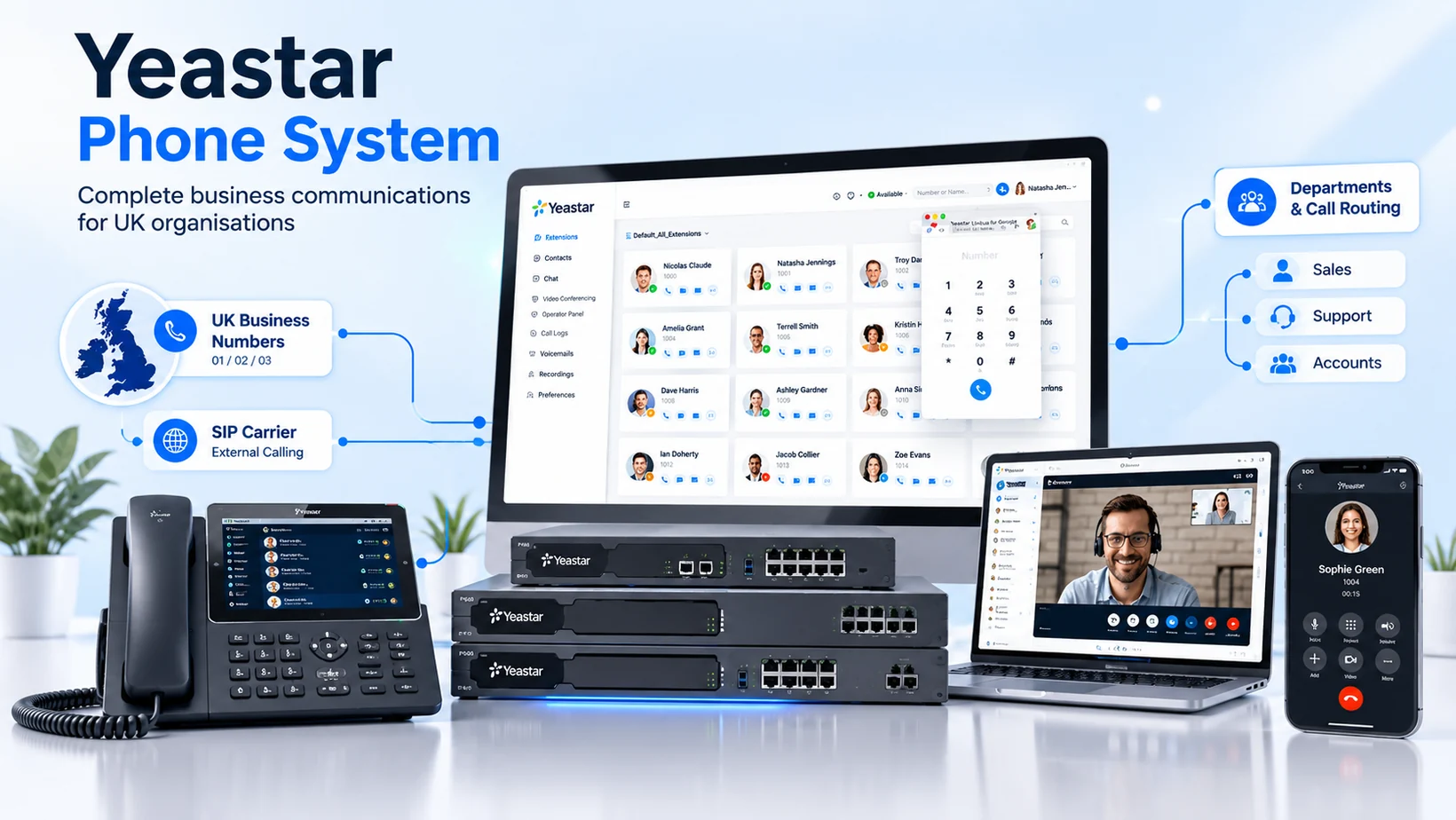
A Yeastar phone system is more than the PBX box or software.
Understand what P-Series controls, how calls reach UK numbers, where appliances, hosted services and Linkus apps fit, and what a business needs to verify before going live.
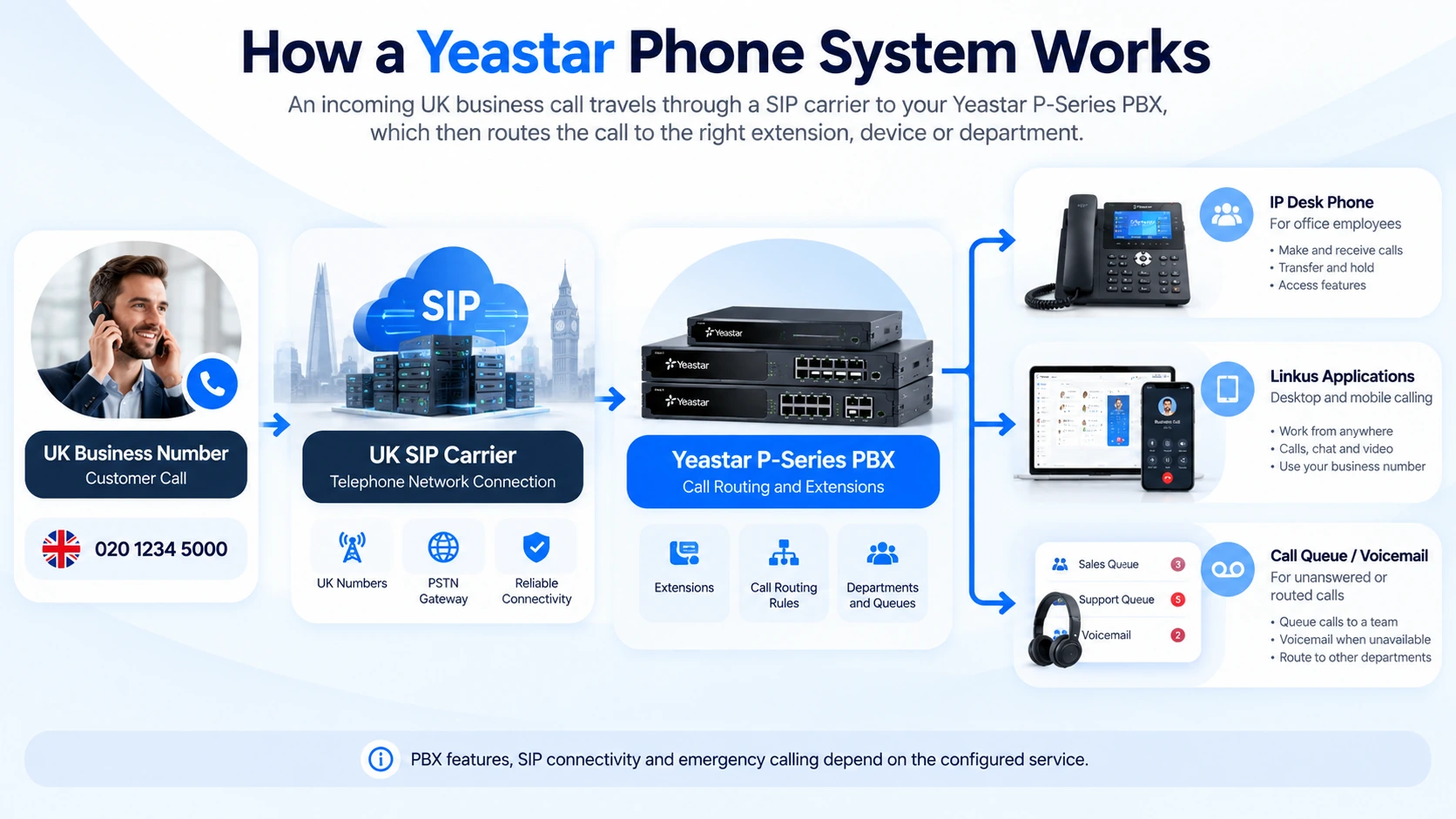
A Yeastar phone system is an IP PBX and unified communications platform that manages business extensions, incoming and outgoing call rules, and supported employee devices. The current P-Series family includes physical appliances, self-hosted software and cloud options. To make and receive normal UK public-network calls, a business must also arrange suitable telephone numbers, carrier connectivity, emergency-call provision and support responsibilities.
Jump to a section
What Makes Up a Complete Yeastar Phone System?
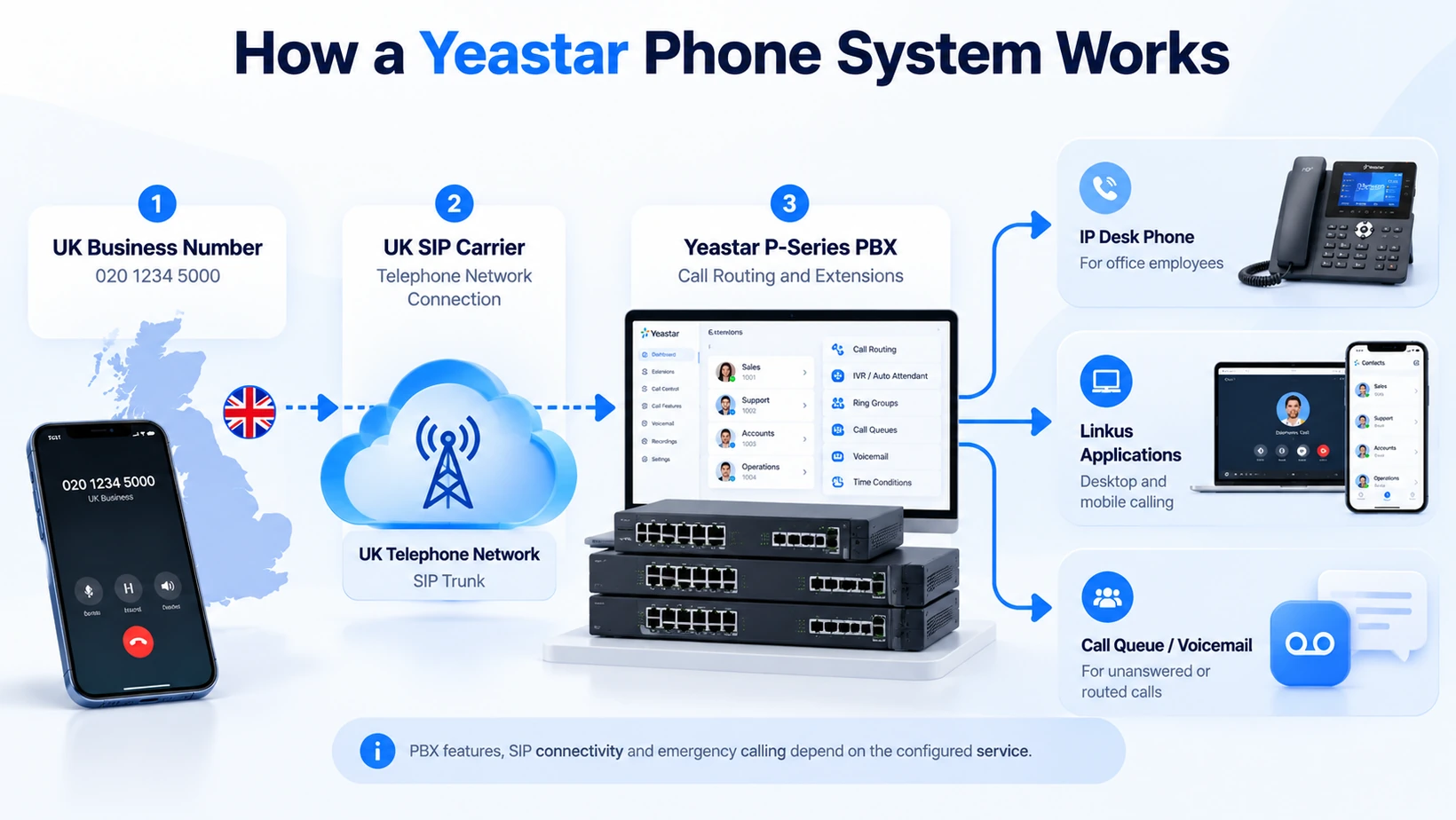
Yeastar P-Series is the part of a business telephone service that manages users and extensions and decides how calls are handled. Yeastar calls this an IP PBX. The organisation normally needs additional services to connect those extensions with people calling from ordinary UK landlines and mobiles.
The core relationship is PBX + endpoints + trunks. Yeastar’s own getting-started documentation uses those three components to explain a working phone service. A PBX sets the call rules; an endpoint is where somebody answers; a trunk carries outside calls through a telecommunications provider.
| System component | What it provides | UK implementation question |
|---|---|---|
| P-Series PBX | Extensions, call control, supported user services and administration. | Which edition, model and feature entitlements are licensed? |
| SIP trunk / carrier | Routing to and from the external public telephone network. | Does the chosen carrier support this deployment, numbers and 999/112? |
| Business numbers | Published company numbers, branches and direct dial-in (DDI) numbers. | Can existing numbers be ported and displayed as authorised caller ID? |
| Users and devices | Extensions for staff using Linkus or supported handsets. | What is the registered device policy and remote-working arrangement? |
| Hosting or appliance | Runs the PBX service in a cloud, software or physical form. | Who owns updates, backup, power, networking and recovery? |
| Support agreement | Help with configuration, incidents and ongoing change. | Who resolves a carrier issue versus a Yeastar or network issue? |
For instance, a small consultancy might keep one published main number, give individual staff extensions, and answer calls through Linkus at the office or while working remotely. The P-Series routes the calls; the carrier provides the external connection; the business or its partner maintains the account and availability. This is an illustrative use case, not a claim about an installed customer.
For the wider question of how to design menus, queues, ring groups and fallbacks across any provider, see our business call-routing guide. This Yeastar page stays focused on the specific system and its dependencies.
What Can Staff Do on a Yeastar P-Series System?
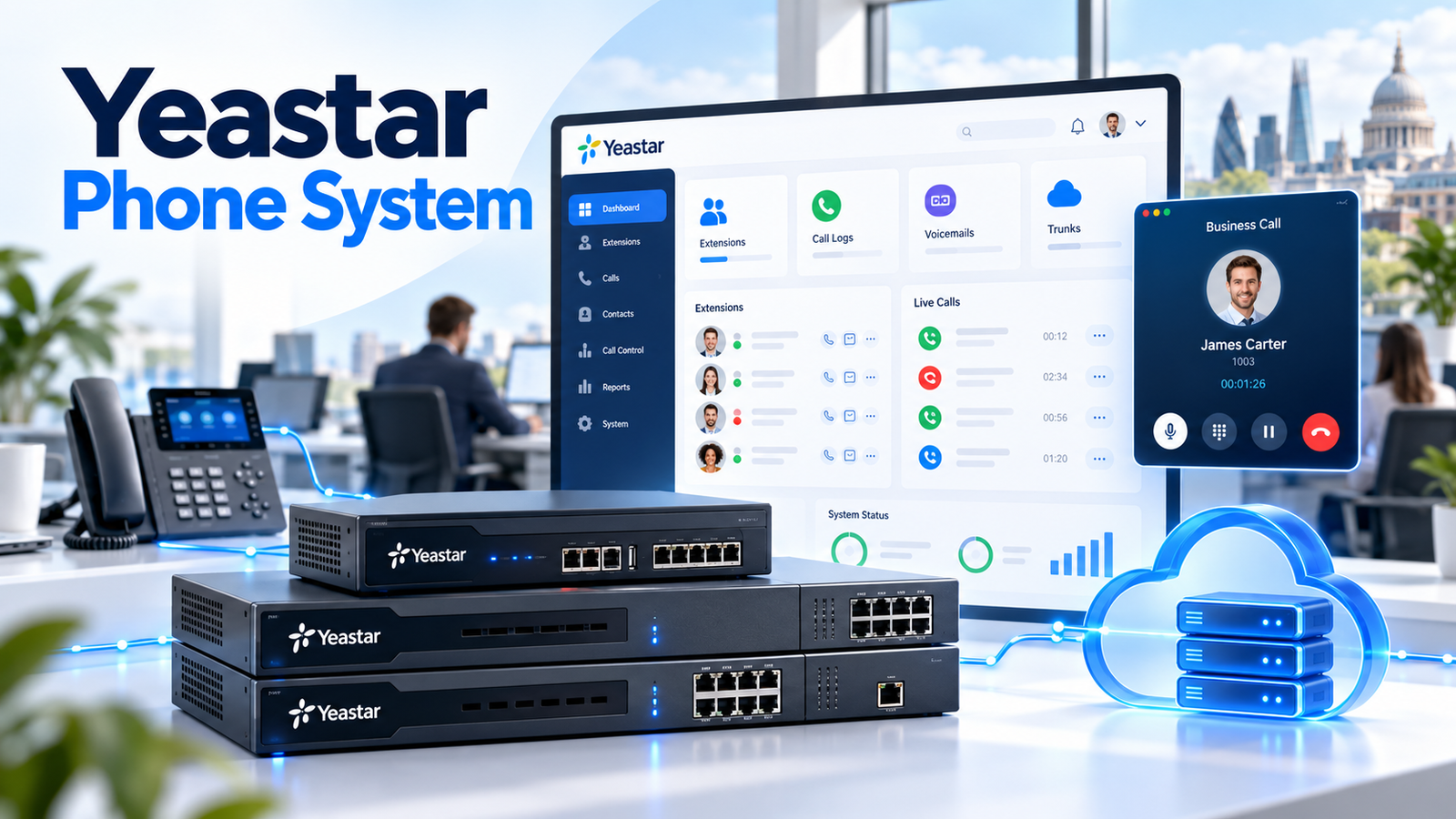
Yeastar positions P-Series as business calling with additional unified communications and customer-handling functions. Which features are usable depends on the edition, active plan, licences, available integrations and configuration. A feature shown on the product website should not be interpreted as included in every system.
Linkus is Yeastar’s user-facing application family for supported web, desktop and mobile environments, enabling staff to handle business extensions away from a dedicated desk phone.
Administrators can create extension-level rules and supported inbound call destinations. Exact queue, reporting and advanced call-control functions depend on entitlement.
Yeastar supports SIP handsets and device provisioning in qualifying deployments. Check manufacturer models, firmware and the particular provisioning method before reusing existing phones.
Administrators can manage users, routes and permissions. Some central or remote-management functions depend on a separately subscribed service or partner arrangement.
Yeastar publishes integrations with collaboration and CRM systems. Verify the specific edition, supported connector, third-party licensing and which call workflows are actually covered.
Higher plans and optional services may provide monitoring, transcription, AI tools and richer reporting. Check usage allowances, access controls and privacy obligations.
Do not assume an advertised integration connects two products without configuration work. For example, a CRM screen-pop or Microsoft Teams telephone workflow may involve separate subscriptions, supported user identities and integration conditions.
Yeastar P-Series Appliance, Software and Cloud Editions
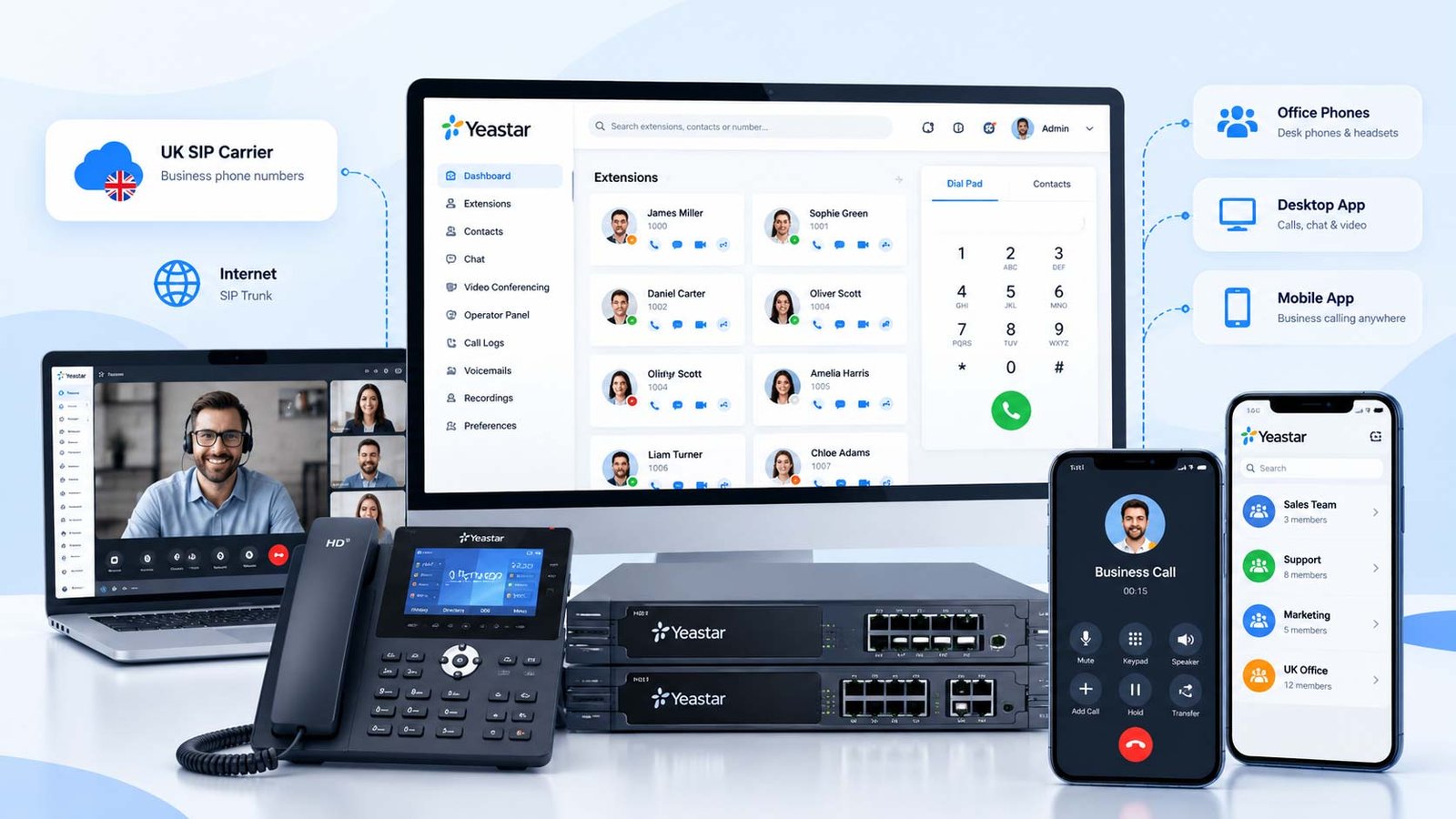
P-Series is a product family rather than one mandatory hosting arrangement. A UK business may encounter a dedicated appliance, a software PBX installed on infrastructure chosen by the organisation or partner, or a cloud service supplied through Yeastar’s channel ecosystem.
A Yeastar P-Series hardware PBX operates on supported local or data-centre infrastructure. The appliance model sets core capacity limits, and extra plans or services may be needed for advanced functions.
P-Series PBX software can run on supported physical, virtual or cloud environments. Hosting maintenance, resource sizing, backups and operating-system security need an identified owner.
Yeastar also markets hosted or cloud-managed arrangements, including partner-oriented instances and turnkey packages. Check who actually hosts, administers, supports and bills for your tenant.
Self-hosted software in a cloud VM and a partner-supplied P-Series cloud instance do not automatically carry the same managed-service responsibilities or prices.
The practical first question is whether you have a person or provider responsible for the underlying PBX. The more detailed decision between a cloud instance, a software deployment and an on-site appliance belongs to a separate deployment-choice guide; it is not a reason to duplicate the entire discussion here.
How Many Users and Calls Do Yeastar Appliances Support?
Do not size a telephone system by employee count alone. A user or extension represents someone or a configured line on the PBX; a concurrent call is a conversation or call leg that consumes active system capacity. Hardware specifications, enabled expansion services and carrier channel limits are separate checks.
| P-Series appliance | Base / expandable users | Base / expandable concurrent calls | What to confirm |
|---|---|---|---|
| P520 | 20 | 10 | Regional sales availability. |
| P550 | 50 | 25 | Available trunk channels and required features. |
| P560 | 100 / 200 | 30 / 60 | Whether paid expansion is included. |
| P570 | 300 / 500 | 60 / 120 | Expansion terms, endpoints and resilience. |
That organisation needs at least enough registered users and genuine peak call capacity for the scenario, with headroom and the correct licence and carrier provision. The P550’s published base user capacity of 50 would not suit 65 registered users without a different arrangement, even though its 25 concurrent-call specification is above this hypothetical peak. A larger appliance or another supported deployment might be considered, but a responsible sizing decision also examines actual call records, queues, licences, future growth and network capacity.
This is an example, not a recommendation to purchase a particular model. Calls at busy times, extension count, cloud/software licence terms and SIP trunk channels should all be checked independently.
How Does Yeastar Licensing Work, and What Will a UK System Cost?
A Yeastar quote is not necessarily a single monthly price per employee. The cost depends on the edition, hardware or hosting, subscription and service entitlements, expansion, carrier, UK numbers, equipment, installation and support.
Basic, Standard, Enterprise and Ultimate are not interchangeable
Yeastar’s current documentation describes a basic telephony offering included with P-Series appliances, alongside Standard, Enterprise and Ultimate appliance plans. It lists Enterprise and Ultimate for Software and Cloud Edition arrangements. Service add-ons and their eligibility vary between product lines. Some functions also require minimum PBX firmware versions; verify entitlement using the current Yeastar purchase overview.
Having a no-subscription basic telephony plan does not make handsets, the PBX appliance, SIP calls, number rental, network infrastructure or support free.
Find out whether hosted PBX resources, software licences, telephone numbers, outgoing call charges, administration and business-hours or 24/7 support are included.
Request the full first-year and ongoing cost
| Cost layer | Question for the supplier |
|---|---|
| P-Series edition / licence | Which plan and extensions/concurrent-call limits apply, and how do renewals work? |
| Hardware or hosting | Who purchases appliances or pays for cloud/VM resources and failover? |
| SIP and UK calls | What are the trunk/channel, number/DDI, call-bundle and excess charges? |
| Apps / integrations / AI | Which features, quota allowances and third-party licences are included? |
| Phones and equipment | Do handsets, PoE switching, headsets or site power backup need buying? |
| Implementation and support | What do porting, installation, training, monitoring and incident support cost? |
| UK invoicing | Are amounts in GBP, is VAT included, and how are increases or exchange rates applied? |
Use this comparison: first-year total = PBX/licence + hosting/hardware + carrier/number/call charges + implementation + support + applicable VAT. Calculate recurring years separately, removing genuinely one-off expenses and adding renewals. There is no reliable single UK Yeastar price that applies to every reseller, edition and configuration; this guide therefore does not invent one.
UK SIP Trunks, Phone Numbers and Porting with Yeastar
Most businesses will need a UK-capable telecoms provider to carry external calls. Yeastar documents connection to an internet telephony service provider (ITSP) and publishes compatibility guidance, but an integration listing does not prove that all UK numbers, tariffs and emergency-location obligations are covered by the quoted service.
- Number inventory: record the main number, every direct-dial number, branch numbers and any numbers used by legacy connected equipment.
- Porting: ask who takes responsibility for the port, eligibility checks, fallback and completion date. Do not cancel the existing number service prematurely.
- Outgoing identity: agree which verified UK caller number is presented to recipients and whether different locations or departments need different identity.
- SIP capacity: check the provider’s external channels and calling restrictions separately from PBX concurrent-call capacity.
- Compatibility: confirm the supported trunk registration model, encryption, DTMF, codecs and vendor-verified deployment steps with the integrator.
- Continuity: establish what happens to incoming numbers if your PBX or primary internet connection is unavailable.
For wider number selection, geographic versus non-geographic numbers and direct dialling, use our UK business phone numbers guide. For the transfer process itself, our number-porting guide owns that topic.
999/112 Calling and Power-Failure Planning on Yeastar
A configured Yeastar extension does not automatically demonstrate safe and reliable UK emergency calling. The end-to-end path includes the registered endpoint, available network and power, PBX emergency routes, active carrier service, the caller’s telephone number and the emergency location data supplied by the relevant communications provider.
Yeastar’s current emergency-calling documentation makes the role of an emergency outbound route explicit: a registered phone and at least one appropriate trunk are needed. It also highlights that emergency location for wireless devices and softphones may rely on the emergency caller-ID arrangement configured for that user. Read the Yeastar emergency-calling overview.
Ofcom’s General Condition A3 addresses access to 999 and 112, availability and reliable caller location where technically feasible for regulated providers. Your business must agree with its carrier and implementing partner how these obligations are met for office, home-working and mobile locations. A PBX setting or vendor feature label alone is not a compliance certificate.
| Disruption | Possible impact | What to verify before go-live |
|---|---|---|
| Office power failure | Phones, PoE switches, router or local PBX may stop working. | UPS runtime, an independent emergency contact route and staff instructions. |
| Internet outage | External SIP or remote endpoints may be unreachable. | Provider-supported alternate routing, independent mobile connectivity and its limitations. |
| PBX/hosting failure | Normal extension routing and automation may stop. | Backups, restore ownership, measured recovery procedures and supported redundancy services. |
| Carrier interruption | External incoming or outgoing calls may be affected. | Alternative route eligibility and the party responsible for activation. |
| Remote-location change | Emergency location information could be out of date. | Location-register update procedure and provider-confirmed emergency routing. |
Agree with the carrier how emergency-call validation will be conducted. Do not make unnecessary live calls to 999 or 112 as a routine test. Provide an alternative contact route for staff if the business calling service is unavailable.
Who Secures, Supports and Maintains Yeastar?
Although Yeastar supplies the PBX technology, administration and availability depend on the actual contract. In a self-managed Software Edition, the business or its IT partner needs to maintain the hosting environment. A reseller-managed appliance may shift some work to the partner without shifting every responsibility. A hosted cloud service still needs a named support contact and incident process.
Who schedules Yeastar updates, compatible handset firmware changes and regression checks? Which updates are covered by the support plan?
Restrict administrator access, use applicable MFA and permissions, review calling restrictions and watch for unusual international or premium-rate activity.
Who exports and protects backups, how often are restores tested, and what downtime can the organisation tolerate?
Confirm lawful purpose, retention, transparency, role-based access and any AI processing terms before enabling monitoring or recording functions.
For telephone-call monitoring and recordings, the UK’s Information Commissioner’s Office says that routine recording or monitoring of all calls is not usually proportionate. Staff and callers need appropriate information and the business should evaluate necessity and its data-protection duties. See ICO guidance on monitoring calls.
Yeastar Phone System Readiness Checklist
Use this to brief an IT partner or Yeastar supplier before commissioning a system. It is focused on P-Series components and ownership rather than duplicating a generic VoIP installation plan.
- Record the precise P-Series edition, appliance model or cloud product being quoted and the supplier responsible for it.
- Count registered staff/extensions, external numbers and actual peak concurrent calls; allow capacity for seasonal demand.
- List existing phones, compatible SIP endpoints, Linkus devices and any hardware that cannot be reused without adapters.
- Agree the UK SIP carrier, external channel capacity, supported trunk template and inbound/outbound route test.
- Build an inventory of main numbers, DDIs, porting eligibility, caller ID and any legacy numbers supporting other devices.
- Request the exact plan tier and add-on list, including licence renewal, expansion limits and any AI/recording allowances.
- Assign a named owner for 999/112 access, location data, remote-worker changes and an independent emergency fallback.
- Confirm who maintains firewall, firmware, administrator permissions, monitoring, backups and restore tests.
- Ask for one documented quote covering appliance or hosting, PBX licence, trunk, numbers, calls, devices, setup, support and VAT.
- Run representative acceptance tests for inbound and outbound calls, voicemail, app registration, transfers, office hours and user access.
- Schedule the number cutover only after the old/new provider handover, fallback procedure and escalation contacts are documented.
“Who fixes a failed SIP trunk?” “Who corrects an out-of-date 999 location?” “Who restores the P-Series after an outage?” “Who pays for extra concurrent-call or extension capacity?” If the answers are missing from the proposal, the offer is not yet complete enough for operational sign-off.
Once those system-specific questions are answered, use our VoIP setup guide for the general installation and testing sequence. For comparing the wider service specification and like-for-like supplier proposals, use the UK VoIP buyer’s guide.
Frequently Asked Questions About Yeastar Phone Systems
Is Yeastar a phone system or a VoIP provider?
Yeastar supplies PBX and unified-communications technology. A UK business normally also needs an appropriately configured carrier and phone numbers for external public-network calling. A reseller can bundle the components into a single managed service, but check exactly what is included.
Can a Yeastar P-Series system run in the cloud?
Yes. Yeastar offers Software Edition for self-hosted installations in supported environments and Cloud Edition and turnkey cloud arrangements through its partner ecosystem. These have different hosting and service responsibilities; they are not automatically the same product or contract.
Does Yeastar include UK phone numbers and unlimited calls?
Do not assume so. Numbering, SIP service and call allowances depend on the supplier contract. A PBX subscription or appliance purchase alone does not establish an unlimited UK calling plan.
Can I keep my current UK business telephone number?
Often, if the number is eligible to be transferred between the relevant providers. Confirm portability, required documentation and cutover timing before cancelling the old service. A transfer is not guaranteed merely because the PBX supports SIP.
What is the difference between P550, P560 and P570?
They are P-Series appliance models with different published user and simultaneous-call capacities. P550 starts at 50 users and 25 concurrent calls, P560 lists 100/200 users and 30/60 concurrent calls, and P570 lists 300/500 users and 60/120 concurrent calls. Maximum expandable figures may require an additional entitlement. Always check the current product matrix.
Does Yeastar work with existing IP phones?
Yeastar supports compatible SIP phones, but compatibility depends on the exact manufacturer model, firmware, PBX edition and provisioning method. Ask the implementer to test the handsets you already own rather than relying on a generic statement.
Can I use Yeastar Linkus on a mobile or laptop?
Supported Linkus clients are available for web, desktop and mobile environments. Your licensed edition, account configuration, application compatibility and network connection determine which capabilities are available to your users.
Will Yeastar make 999 calls during an internet outage?
That cannot be promised for an unverified installation. It depends on the configured endpoint, local power and network, PBX hosting, carrier route and any independent fallback. Check the emergency service with the responsible UK provider and establish an alternative emergency contact method.
Is Yeastar cheaper than 3CX or a hosted business phone service?
There is no universal answer. The products can involve different system, user, capacity, hardware, hosting and carrier charging models. Compare full UK first-year and recurring costs for an identical requirements brief; that is a separate purchase-evaluation task from this explanatory guide.
Official Sources and How This Guide Was Prepared
This independent guide uses published Yeastar product documentation and current UK regulatory guidance. We have not claimed hands-on testing of Yeastar devices, a commissioned provider installation, first-party customer interviews or exclusive UK tariff access. Vendor features, model capacities and entitlement conditions may change.
- Yeastar — P-Series product overview, deployment arrangements and advertised functionality.
- Yeastar — PBX, endpoints, trunks and external-calling setup.
- Yeastar — P520/P550/P560/P570 hardware specifications and capacities.
- Yeastar — edition plans, licensing and available add-on services.
- Yeastar — Software Edition supported deployment methods.
- Yeastar — emergency routes and location considerations.
- Ofcom — general conditions, including emergency access and caller-location obligations.
- Ofcom — emergency-services compliance programme, June 2026 update.
- ICO — monitoring and recording workers’ telephone calls.
Editorial product and regulatory source review: 21 October 2026. This is a product-system educational guide, not a platform review, purchased-service recommendation, UK compliance certification or quote.
Practical takeaway: treat Yeastar as the call-control layer of a working business communications service. Confirm its edition, capacity, SIP connectivity, end-user devices and named operational responsibilities before treating any quote as complete.
Yeastar System Readiness Brief
Compare the Complete Calling Service, Not Just the PBX
Use the checklist to confirm how Yeastar, the UK telecoms carrier, business numbers, devices and operational support fit together. Then assess your wider business phone requirements on a like-for-like basis.

Bhav Giva
Founder & Lead Analyst, CompareVoIPService.co.uk
This guide explains Yeastar P-Series as a working UK business phone system using published technical documentation and Ofcom/ICO guidance. It is independent educational research, not a hands-on product test or a reseller quotation.