

Is Yeastar the right PBX buying and support model for your business?
Compare Appliance, Software and Cloud purchasing routes, the real UK cost drivers, licence limits, support ownership and acceptance checks—without confusing product capability with a complete telephone service.
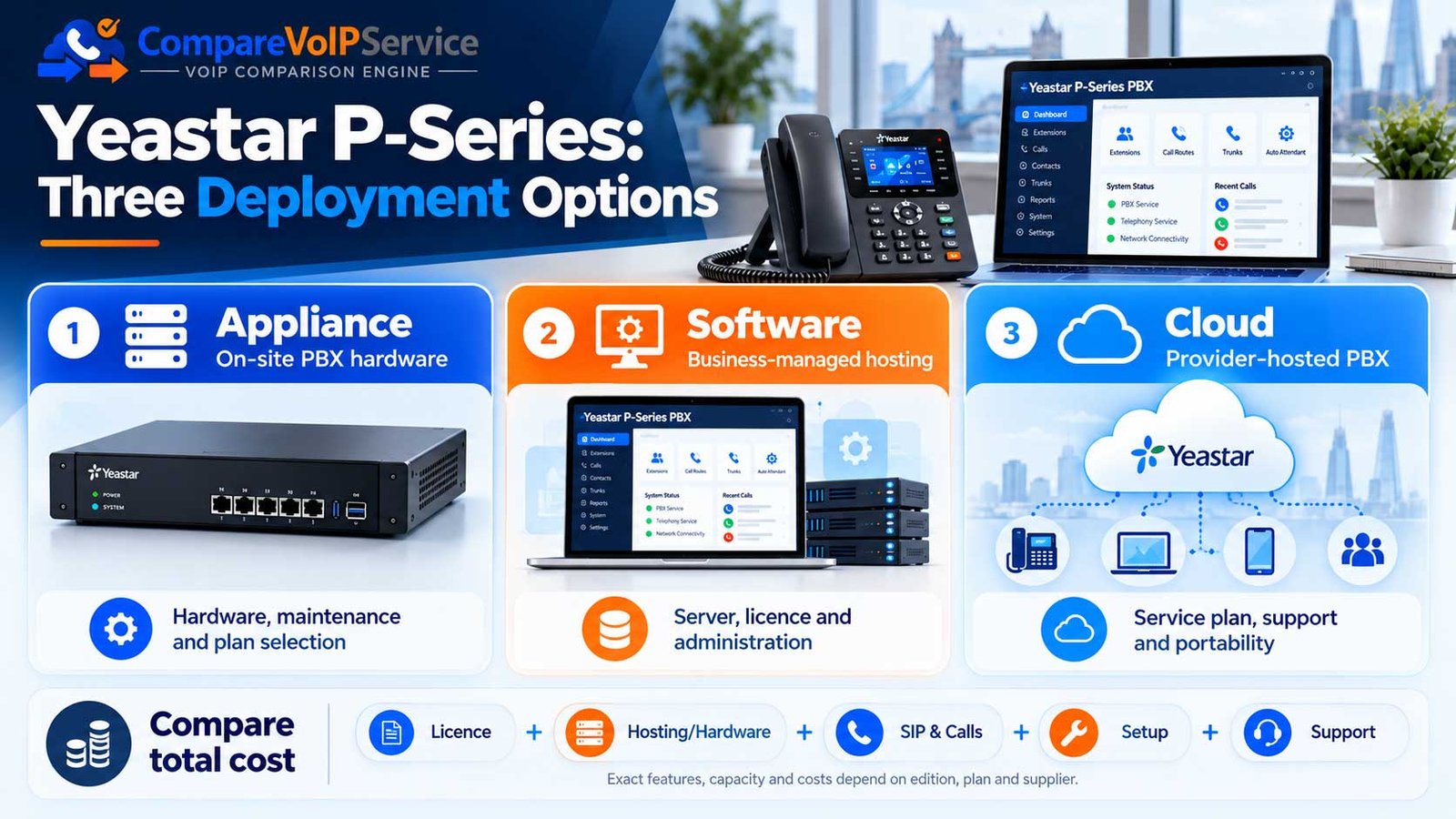
How the three Yeastar deployment models differ
Original conceptual buying diagram; not a system benchmark or a supplier-approved network design.
Quick verdict: Yeastar P-Series is a credible option where its chosen edition and plan cover the required calls, users and integrations, and one accountable supplier can deliver UK numbers, SIP, emergency calling, backup and support. Compare complete 12-month service quotes—not an appliance feature list or a nominal licence charge. Request practical demonstrations before signing.
Jump to a review section
Yeastar P-Series review: our UK buying verdict
Yeastar P-Series merits a shortlist when a UK business wants an identifiable PBX platform and can obtain a complete, supportable proposal for its chosen Appliance, Software or Cloud route. The platform offers business calling, Linkus clients, call handling and optional higher-tier workflows. The harder question is not whether the feature list is attractive: it is whether a named supplier will own the carrier, numbers, licensing, backup, support and recovery commitments.
Likely a good fit
- An SME wants structured queues, IVR, business-hours routing or multi-device users, with a partner that can demonstrate the required plan.
- An IT team wants a controlled appliance or supported self-hosted PBX and accepts the associated maintenance duties.
- A business wants to compare hosting and support offers on the same documented service specification.
Pause or compare alternatives
- You need one contractual owner but the quote fragments responsibilities across a reseller, carrier and hosting company.
- The advertised feature requires a different edition, an add-on or additional consumption allowance.
- The supplier cannot demonstrate UK number porting, emergency-location handling, backup recovery and a defined support response.
For an introduction to the PBX components and day-to-day features, read our Yeastar phone system guide. This review instead helps a buyer assess purchase fit, risks, financial scope and accountability.
Strengths and limitations that affect a real purchase
What may work well
- Flexible deployment models: appliance, self-hosted software or partner-delivered cloud, subject to the actual plan.
- Business telephony and unified communications functions such as Linkus apps, routing, reports and integrations are documented by Yeastar.
- A service can be tailored by a UK reseller, with clear scope for SIP providers, implementation and ongoing helpdesk provision.
What needs scrutiny
- A product feature list is not a guarantee that it is available in the quoted edition or current firmware.
- Self-managed software or appliances add patching, certificate, network, backup and physical or cloud-host responsibilities.
- “Cloud” does not identify by itself which organisation guarantees availability, emergency-call routing, recoverability or billing.
Yeastar publishes broad P-Series product capabilities, including call-centre, CRM and unified communications functions. Feature availability varies by edition, licence, add-on and configuration. A buyer should request a line-by-line entitlement schedule rather than accepting “P-Series supports it” as proof that their order includes it.
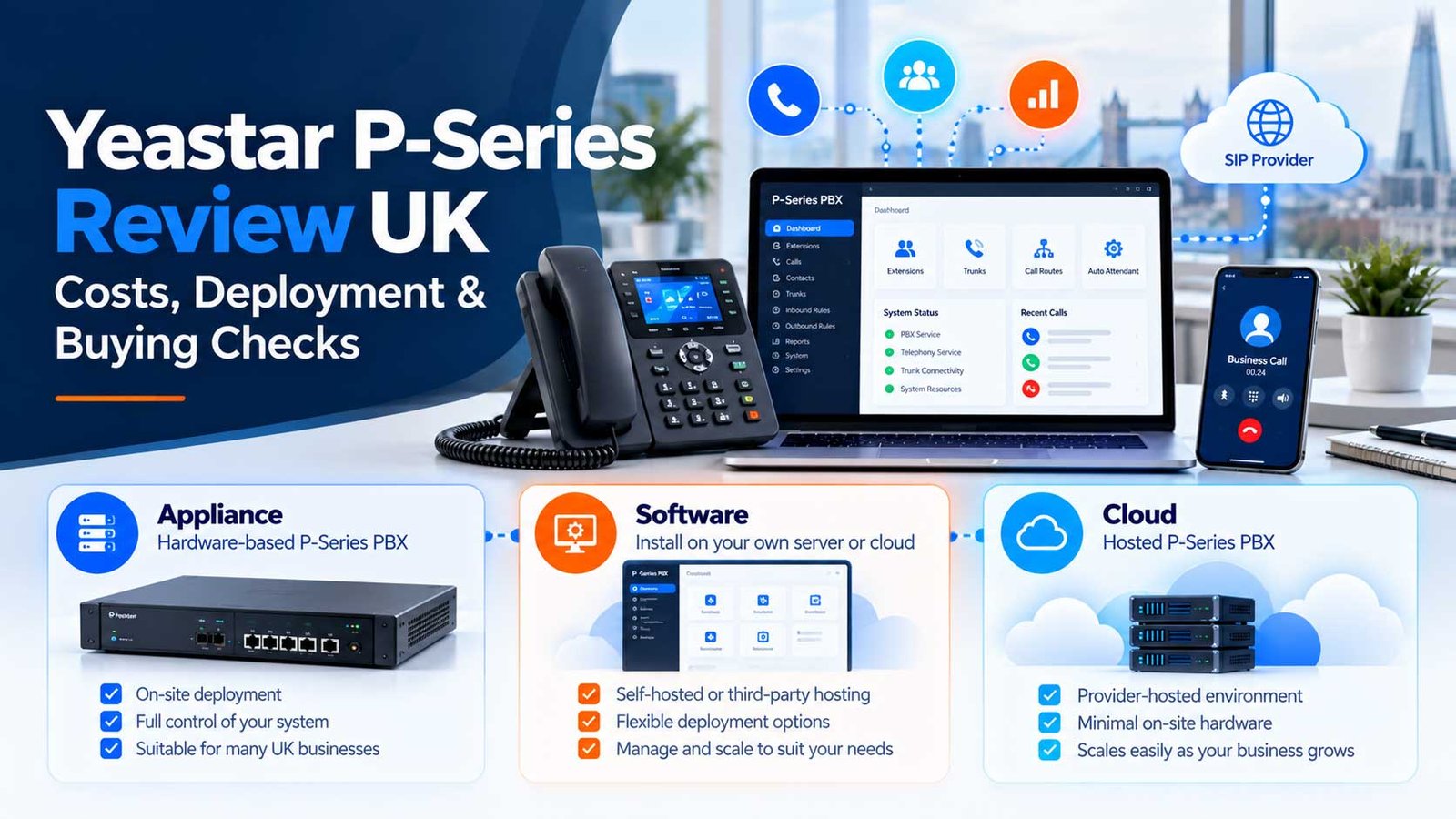
Appliance vs Software vs Cloud: what you are actually buying
The deployment route alters the risk, staffing and commercial package. The full architectural explanation belongs to our system guide; the practical review question is who runs the service once the installer leaves.
| Consideration | Appliance Edition | Software Edition | Cloud Edition |
|---|---|---|---|
| Platform footprint | Physical Yeastar PBX at a location. | Software installed on an eligible server/virtual or cloud environment. | Partner-provided cloud PBX service/instance. |
| Upfront cost model | PBX hardware, provisioning and optional subscriptions. | Licence plus infrastructure/hosting and implementation. | Recurring hosted service/instance and reseller package. |
| Who maintains the infrastructure? | Named customer IT or reseller; confirm hardware replacement and on-site support. | Named VM/cloud operator or managed provider; confirm OS, storage and renewal responsibilities. | Partner/cloud provider arrangement; confirm actual uptime/backup/service terms. |
| Resilience decision | Local power, ISP and appliance contingency; optional design-dependent redundancy. | Compute, networking and backup/restore design; recovery owner required. | Contracted region, service recovery, failover and export/exit arrangements. |
| Commercial pitfall | Assuming the included Basic features replace higher plan needs. | Mistaking a trial for an indefinite no-cost licence. | Assuming one supplier’s seat price includes all numbers, calling and support. |
P-Series plans, trial licences and add-ons: where costs change
Edition, plan and capacity are separate decisions. According to Yeastar’s Appliance Edition purchase guidance, Appliance Edition has a Basic plan and additional Standard, Enterprise and Ultimate plans plus value-added services. Basic does not automatically include higher-tier functionality.
| Deployment | What Yeastar documents | Buyer verification |
|---|---|---|
| Appliance | Basic included; Standard, Enterprise, Ultimate and some optional services can be purchased. | Serial/model compatibility, plan level, renewal, feature and remote-access entitlements. |
| Software | Trial and annual commercial licensing; Enterprise and Ultimate are documented for the Software Edition. | Trial-to-production conversion, licence renewal, extensions/concurrent calls and whether activation requires connectivity. |
| Cloud | Trial and commercial cloud instances supplied through the Yeastar partner model. | Who is the tenant/service owner, expansion/add-on costs, data export, contract term and service continuity. |
| AI and transcription | Selected Software/Cloud capabilities may use paid consumption packs or subscriptions. | Edition eligibility, minutes, fair-use/excess rules, recording/privacy handling, renewal and data-processing terms. |
The Software Edition trial guide distinguishes trial from commercial licensing and documents a time-limited trial. The Cloud Edition purchasing documentation describes partner-managed cloud instances. Those are not a universal offer of “free Yeastar calling”. SIP calls, UK numbering, hardware, hosting and support are separate economic and contractual components.
Users, extensions and concurrent calls: do not compare the wrong numbers
An extension is not necessarily a concurrently active external call. A 40-person company may need far fewer or nearly as many simultaneous external calls, depending on staffing, busy periods and inbound queues. Sellers can use different dimensions for licences, plan limits and carrier channels.
| Planning input | Example assumption | Supplier must confirm |
|---|---|---|
| Named employees | 40 users across two locations | Licensed extensions/users and included Linkus/mobile endpoints. |
| Peak external calls | 10 concurrent external calls in a measured busy interval | Supported PBX concurrent calls and SIP-trunk channel allowance. |
| Queue / transfers | 6 callers holding; internal transfers also occur | Whether queues, conference legs or recording alter capacity sizing. |
| Growth reserve | 25% capacity contingency assumed for planning | Pricing at the next eligible product/plan tier and upgrade path. |
What should Yeastar cost a UK business over 12 months?
There is no defensible single “Yeastar UK price” without specifying the edition, plan, capacity, hosting, carrier, support and contract. Some UK resellers sell a licence alongside managed hosting or other services. Those are seller-specific bundles, not manufacturer-wide list prices. An example UK retailer catalogue illustrates the diversity of configurations and VAT-inclusive package listings; ask for a dated quotation covering your intended deployment.
| Cost row | Appliance quote | Software quote | Cloud quote |
|---|---|---|---|
| Edition and plan | Model, capacity, Basic/paid tier | Licence, extensions, concurrent calls | Instance/seat/package and limits |
| Platform / infrastructure | Hardware, UPS, replacement cover | VM/cloud server, backups, administration | Included hosting region, resilience, restore SLA |
| Carrier and numbers | SIP lines, DDIs, calls, overages | Same list, independently priced | Included carrier? If not, price separately |
| Integration and extra features | Paid remote/recording/CRM options | AI minutes, integrations, failover | Plan features, add-ons and consumption |
| People and service | Install, testing, support, travel | Setup, patching, monitoring, support | Helpdesk, incidents, migrations, exit support |
| Commercial terms | Ex VAT / inc VAT, term, renewal | Same plus licence expiry | Same plus data export and provider move |
Record both an ex-VAT operating comparison and the actual payable cash total under the quote’s VAT terms. Compare a first-year figure separately from year two. For wider cost risks, use our UK VoIP hidden-costs guide.
Who fixes a failed call? Use this responsibility matrix
A PBX brand cannot resolve every outage. Calls traverse the internet, PBX, SIP carrier, numbers, endpoints and local power. Request a written responsibility owner for every step. “Included support” is not an actionable escalation route until it names the responder and coverage.
| Service outcome | Potential owner(s) | Required written evidence |
|---|---|---|
| Inbound DID / DDI delivery | UK SIP carrier, porting provider, reseller | Number list, routing owner, porting authority and cutover fallback. |
| 999/112 and caller location | Regulated voice provider and commissioning team | Emergency access policy, per-user/location records, contingency and escalation. |
| PBX licence renewal | Reseller or customer account administrator | Renewal date, licence owner, failure/expiry impact, payment approver. |
| Security updates and certificates | Reseller, customer IT or hosting provider | Patch cadence, access privileges, certificate renewal, incident notifications. |
| Backups and restore | PBX operator, cloud host or reseller | Backup scope, retention, access rights, restoration test and RTO/RPO objectives. |
| ISP outage / site power | Connectivity supplier / business continuity lead | UPS, alternative network or mobile contingency and tested recovery. |
| 24/7 call fault escalation | Supplier helpdesk plus accountable carrier/NOC | Support hours, severity, response, telephone escalation and third-party hand-off. |
UK numbers, porting and 999/112: what must be proved
Yeastar is a telephone-system platform, not by itself proof of UK regulated voice-service compliance. Ofcom General Condition A3 addresses emergency access and caller-location obligations for regulated communications providers. The organisation supplying outbound PSTN service, the reseller and the buyer must agree how correct caller details and contingency arrangements are maintained.
- Request written confirmation that 999 and 112 calls route correctly for each relevant UK calling location and roaming/remote-working scenario.
- Confirm the SIP carrier’s emergency-location registration and update process; include moves, hybrid workers and DDIs.
- Plan for loss of electricity, internet, PBX service and carrier; document an alternative way to reach emergency services.
- Verify UK number ownership, porting eligibility, lead time, authority forms, risk of partial porting and rollback routing.
- Have the regulated service provider supply an appropriate emergency-call validation method; do not casually dial 999/112 to test.
Ofcom’s emergency-services compliance summary and power-cut guidance reinforce that caller-location accuracy and continuity must be actively managed. A PBX product checkbox cannot substitute for commissioning evidence.
Security, backups and licence expiry: operational control
Yeastar documents security and management features including TLS/SRTP, permissions, authentication, audit logs and backup/restore. Whether a particular installation is secure depends on the selected edition and configuration, access controls, firmware, firewall rules, monitoring and updates. The P-Series overview is a feature source, not independent evidence of a specific installation’s security.
Admin and protection checklist
- Define tenant/system super-admin ownership and named secondary administrators.
- Enforce appropriate MFA, role separation, secure remote access and minimum privileges.
- Record patch, firmware, certificate and SIP anti-fraud change ownership.
- Secure backups, retention and recovery credentials outside a single person’s account.
Continuity and licence checks
- Document how calls are handled if a virtual host, appliance, SIP trunk or ISP fails.
- Check licence expiration and renewal effects before the business-critical period.
- Set recovery-time and recovery-point objectives; demand an actual restore demonstration.
- Obtain a configuration export and a written data/number exit plan.
Yeastar’s Software Edition activation documentation describes renewal and activation states. It notes service effects when an applicable licence expires; your supplier must explain which subscription applies and what the service will do at renewal or disconnection.
CRM, Linkus, recording and AI: validate the paid feature
The product lists CRM integrations, Linkus apps, call queues, recordings and AI-related functionality. These should be tested against the exact plan and workload rather than counted as universally included. For example, Yeastar’s custom CRM integration guidance identifies plan and firmware prerequisites for that integration route.
| Requirement | Evidence to request | Possible limitation |
|---|---|---|
| CRM caller match and logging | Demo with a test contact, inbound/outbound calls and consent rules | CRM permissions, plan requirements and contact-matching variations. |
| Mobile / desktop client | Linkus demo on the business’s actual endpoints | Device permissions, networks, push notification and remote access. |
| Queue and agent reporting | Scenario with queue overflow and after-hours treatment | Plan/feature entitlement, supervisor licences, data retention. |
| Recording and storage | Retention, download controls, access log and deletion tests | Privacy basis, storage, archives and off-platform backups. |
| AI Receptionist / transcription | Edition, minute quota, transcription languages and privacy/DPA terms | Not every edition supports it; purchased minutes/add-ons may apply. |
For general cross-platform CRM integration concepts, consult VoIP + CRM integration for UK businesses. A Yeastar CRM connector claim needs supplier-led testing for the intended CRM and licence.
Three UK buying scenarios: where Yeastar deserves a trial
Scenario A — 12-person advisory practice
A small team wants one main number, a simple reception menu, remote Linkus users and predictable support. A managed Cloud or well-supported Appliance proposal may be simpler than a self-managed virtual PBX. The deciding evidence is support responsiveness, number porting, failover and total price—not which edition sounds most sophisticated.
Scenario B — 55-person service team
Call queues, supervisor roles and CRM events matter. Shortlist on demonstrated concurrent-call sizing, the exact plan for reporting/recording, contact matching, data retention and resilience. A low entry licence is irrelevant if the mandatory features sit in a higher tier.
Scenario C — Multi-site organisation with IT governance
An IT-led buyer can consider Software Edition where it genuinely wants server and change control. The tender should explicitly allocate host updates, patching, SIP circuits, redundancy, backups and incident lead, with measurable recovery acceptance. If nobody can own them, seek a managed offer.
Use the same cost and ownership worksheet for three suppliers
A useful Yeastar evaluation compares the same 12-month service requirements across an Appliance proposal, Software managed-host proposal and Cloud partner proposal. The templates below can be copied into your tender; empty cells must be filled with written quotes, not guessed from generic internet prices.
| Buyer question | Supplier answer to record | Evidence / proof |
|---|---|---|
| What exactly is included? | Edition, plan, SKU, extensions, simultaneous-call capacity, quota and add-ons | Quote schedule + Yeastar entitlement screenshot. |
| How much do we pay? | One-off GBP ex/incl VAT; monthly/annual recurring; metered calls; renewal dates | Dated price and contract terms. |
| Who owns the UK calling service? | Carrier name, number holder, 999 location management and fault routing | Carrier order + emergency access procedure. |
| What happens on failure? | ISP/power/PBX/host/carrier outage plan, support and recovery timings | Documented runbook and acceptance evidence. |
| Can we leave? | Port-out, recordings/contacts/voicemail export, termination, return of hardware | Exit clause and export sample. |
Use an identical assumption sheet for each supplier: number of sites, users, busy-hour calls, DDIs, devices, required integrations, support hours, call profile and mobile requirements. Score only what can be demonstrated or contractually committed.
12 checks to complete before a UK Yeastar go-live
- Confirm the bought edition, plan, SKU, licence expiry and add-ons in the admin portal or entitlement statement.
- Provision every test user and check extension/concurrent-call capacity during an authorised load scenario.
- Make and receive legitimate test calls to representative UK landline/mobile numbers.
- Verify main number, selected DDIs and caller-line identity against the agreed numbering schedule.
- Test reception, IVR, group ring, queue overflow and after-hours routing.
- Check Linkus/deskphone user sign-in and transfer behaviour on the business’s actual networks.
- Confirm porting responsibilities, planned change freeze, forwarding fallback and rollback contacts.
- Validate 999/112 arrangements, caller-location records and outage procedures through the regulated provider’s approved method.
- Test CRM or recording flows using synthetic records with appropriate permissions, consent and retention.
- Review administrator roles, remote access security, audit logging, fraud controls and patch owner.
- Restore a configuration or approved test dataset using the written recovery procedure.
- Obtain a signed handover with support/SLA contacts, full billing, licence renewals and exit/port-out plan.
Conditions that should stop a purchase
- Your organisation wants a turnkey phone service but cannot identify a single incident and contract coordinator.
- A critical promised CRM, AI, recording or call-centre feature is absent from the exact quoted edition or plan.
- UK emergency location, port-out authority or fallback arrangements cannot be provided in writing.
- The project assumes the Appliance Basic plan makes SIP, internet, support, installation and maintenance free.
- The provider cannot state who patches, backs up and restores the PBX or what happens when a licence lapses.
- Your stakeholders require independent uptime measurements or first-hand deployment benchmarks that have not been supplied.
None of these means the Yeastar product is inherently unsuitable. Each means the proposed package and operating arrangements lack sufficient evidence to recommend a contract.
Yeastar P-Series review: common UK buying questions
Is the Yeastar P-Series completely free?
No. Appliance Edition includes a Basic plan, but the physical PBX, connectivity and other required services have their own costs; optional higher-tier plans and add-ons also exist. Software trials are time-limited and commercial licensing applies for continued production use.
Can I buy Yeastar P-Series Cloud directly at one standard UK price?
Do not assume so. Cloud PBX is commonly delivered through the Yeastar partner service model. Compare the actual UK reseller’s hosting, licences, extensions, SIP, support, call bundles, VAT and contract term.
Which Yeastar edition is best for a UK small business?
It depends on whether your business wants local appliance responsibility, a supported self-hosted software PBX, or a managed cloud service. Request equivalent complete service proposals before deciding.
Does Yeastar support 999 and 112 calling in the UK?
Emergency calling depends on the regulated UK voice provider, SIP route, correct caller-location data and continuity setup. No PBX brand name on its own establishes compliance; obtain commissioning evidence from the provider.
Can Yeastar connect to HubSpot, Salesforce or another CRM?
Yeastar documents CRM connections and custom integration options, but exact connectors, firmware, plans and supported events differ. Ask for a demonstration using your CRM and selected PBX edition.
Can I use Yeastar without managing my own servers?
Yes, a partner-delivered Cloud service or managed Appliance/Software offer may remove some internal duties. Confirm the written division of administration, incident handling, backup and licence renewal.
Does this article provide a hands-on Yeastar score?
No. This is a documented UK buying review using public sources and explicit procurement criteria. No first-party testing or arbitrary star rating is claimed.
Sources, editorial method and limits of this review
This review was prepared from published product and regulatory materials, plus contextual UK buying information checked on 23 October 2026. The evidence is not an independent lab test, a guaranteed price quote, a compliance certificate, a sponsored endorsement or a customer-experience survey.
- Yeastar — P-Series product overview — advertised product functionality and edition-specific caveats.
- Yeastar — Appliance Edition plan purchase — Basic and paid appliance plan structure.
- Yeastar — Software Edition licensing — trial, commercial licensing and subscription categories.
- Yeastar — Software Edition trial guide — trial allowances and activation conditions.
- Yeastar — Cloud Edition purchasing — partner cloud-instance commercial model.
- Yeastar — Software Edition installation process — software-hosted responsibilities and installation prerequisites.
- Yeastar — Software Edition activation — renewal, activation and expiry considerations.
- Yeastar — Custom CRM integration — plan and firmware conditions and integration behaviour.
- Ofcom — General Conditions of Entitlement — UK regulated emergency-access and caller-location obligations.
- Ofcom — Emergency services compliance programme — regulatory context and June 2026 update.
- Ofcom — Power-cut guidance — emergency-service continuity guidance.
- UK seller — named Yeastar packages — examples of seller-specific bundles; not a manufacturer national list price.
Our broader published review methodology explains the site’s evaluation principles. This page uses a transparent, evidence-based UK procurement assessment and deliberately omits a star rating because no repeatable first-party testing record is available. The Yeastar system architecture guide explains the technical platform in depth. Product plans, limits and availability may change; confirm the current date and SKU before ordering.
Your P-Series purchasing brief
- Edition, capacity and licence/add-on entitlements
- Number porting, SIP service and 999/112 evidence
- Hosting, backups, security and incident ownership
- Linkus, CRM and call-flow pilot acceptance
- First-year, renewal, VAT and exit terms
Buy the complete calling service, not just the PBX
Get each Yeastar supplier to quote the same capacity, carrier, support, recovery and commercial assumptions. Confirm who will actually resolve failures before you sign.

Bhav Giva
Founder & Lead Analyst at CompareVoIPService.co.ukBhav Giva publishes UK-focused business communications research and practical VoIP guidance. This guide concentrates on compatibility, continuity and the evidence businesses should request when introducing an AI call-handling layer into an established telephone environment.