

Teams Operator Connect vs Direct Routing: Choose the Right PSTN Route
Compare the carrier relationship, SBC ownership, number porting, UK emergency calls, support and whole-life cost before connecting Teams to the public phone network.
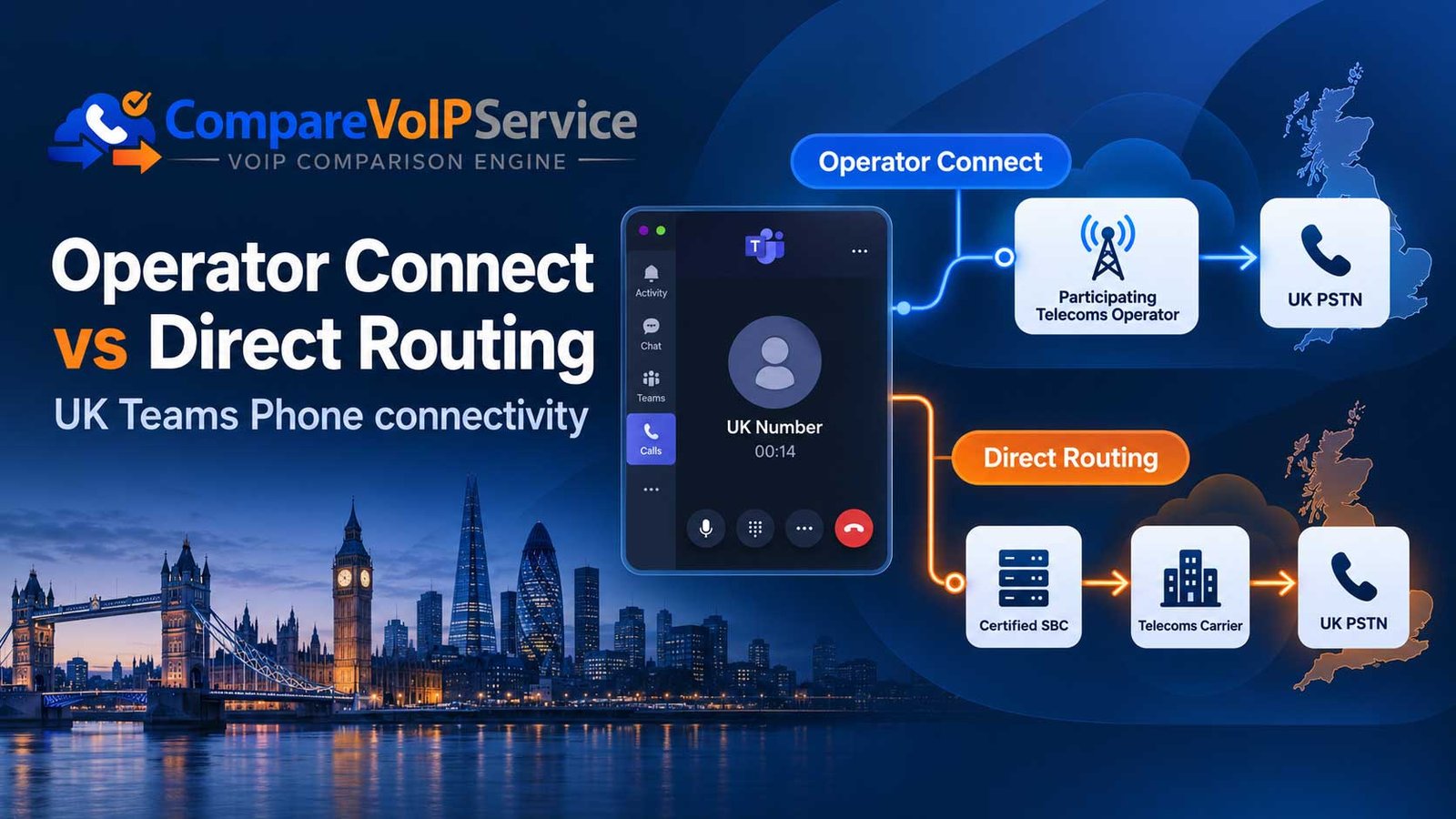
Illustrative connectivity model—not a certified technical network design.
Quick answer: Operator Connect usually reduces SBC administration by using a participating carrier integrated with Teams. Direct Routing usually provides greater control for compatible SIP carriers, existing PBXs and custom voice routes, but a certified SBC must be run and supported. Neither makes UK telephone numbers, emergency calling, licensing or network continuity automatic.
Jump to a Section Fast comparison
Operator Connect vs Direct Routing: Which Fits Your UK Business?
Operator Connect is usually the more straightforward choice when a participating operator can supply your UK phone numbers, handle its Teams PSTN infrastructure and provide a supported service without your organisation managing a Session Border Controller (SBC). Direct Routing is more appropriate when you need a compatible existing SIP carrier, connections to another PBX, specialist routing or greater control over the telephony design.
Both connect external telephone calls to Microsoft Teams Phone. Neither changes the need to licence users correctly, contract an eligible PSTN service, confirm number arrangements and prove UK emergency-calling behaviour before go-live.
Your telephony can be provided through a participating operator, and you prefer an operator-managed Teams PSTN connection with simpler provisioning.
You have supported SBC skills or a managed SBC provider, need PBX coexistence or want a particular carrier and custom routing.
The provider covers the required locations and phone numbers, and you can compare full costs, helpdesk ownership and resilience evidence.
This page compares PSTN connection responsibilities, not general Teams collaboration features or a complete provider ranking.
How the Two Teams Calling Routes Work
Microsoft Teams Phone provides cloud calling control; a PSTN integration is required for normal calls to and from UK landlines and mobiles. The practical distinction is which organisation provides and operates the PSTN connection. Operator Connect integrates a participating carrier with the Teams administration experience. Direct Routing connects your Teams tenant to a carrier or existing telephony environment through a certified SBC.
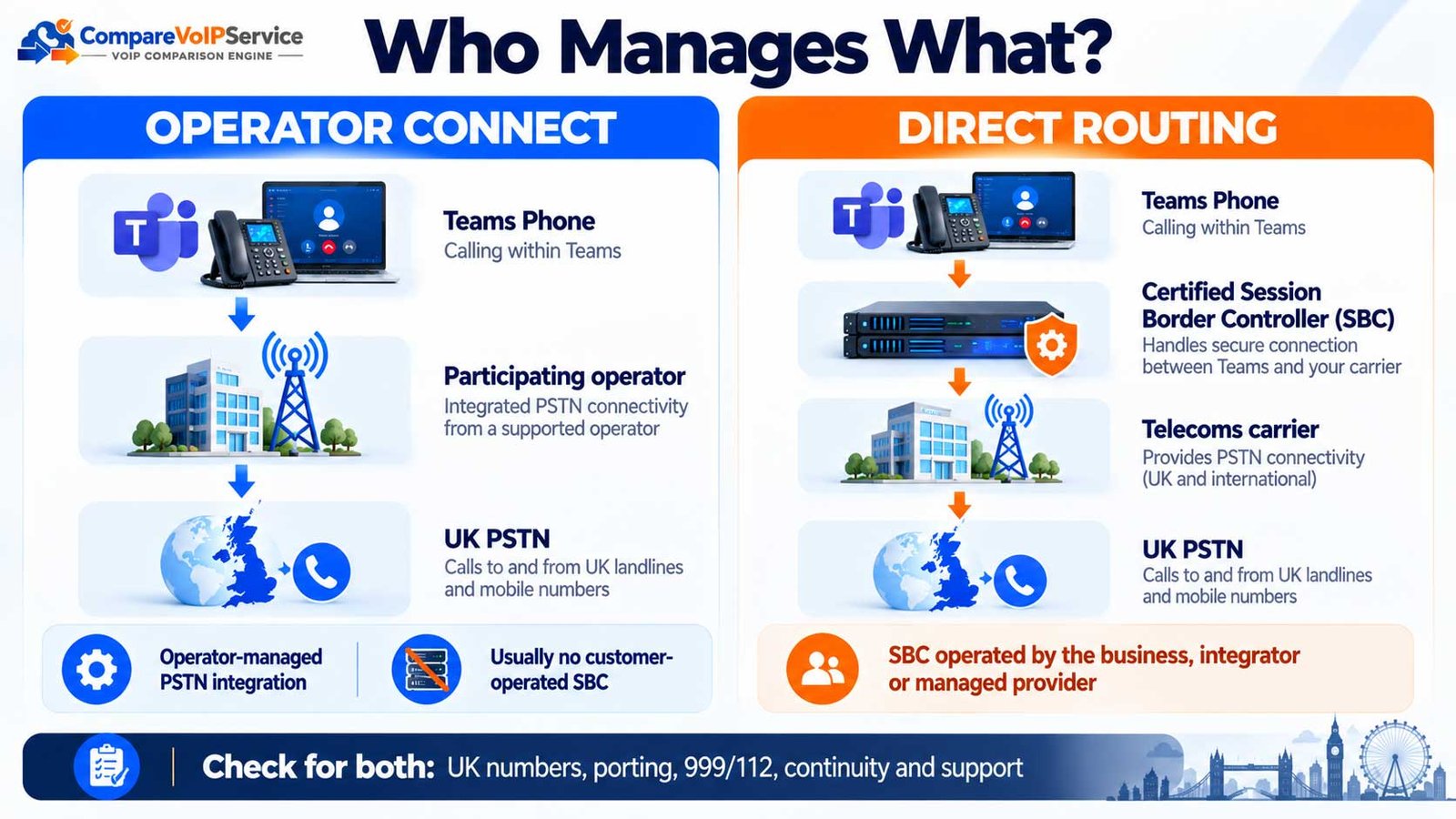
Read both connection paths as text
Operator Connect: Teams Phone users → participating Operator Connect carrier → UK PSTN callers and numbers.
Direct Routing: Teams Phone users → certified SBC operated by the organisation or a provider → compatible SIP carrier, legacy PBX or another supported telephony connection.
This is a simplified conceptual explanation, not a certified network design or proof of emergency-call readiness. Direct Routing can be supplied as a managed service; contract ownership is separate from the physical location of the SBC.
The two options can also coexist in one Microsoft 365 tenant. That makes the choice a user-group or site-specific design decision rather than an automatic all-or-nothing migration.
Operator Connect vs Direct Routing: The Core Differences
| Decision factor | Operator Connect | Direct Routing |
|---|---|---|
| Who manages the SBC? | The participating operator manages its interconnection infrastructure. | Your organisation, integrator or managed Direct Routing service operates a Microsoft-certified SBC. |
| Carrier options | Operators participating in the programme and supporting the required region. | Broader carrier choice, subject to SIP/SBC interoperability and contract eligibility. |
| Number provisioning | Operator supplies/ports numbers and uploads them for assignment in Teams administration. | Provisioning involves carrier, Teams number assignments, and the routing configuration. |
| Routing control | Managed operator connectivity with standard Teams administration. | More scope for dial plans, voice routes, third-party PBXs and specialist integration. |
| Legacy devices | Assess operator’s services and approved alternative paths; not a generic PBX bridge. | Often better suited to PBX coexistence, analogue gateways and complex calling paths. |
| Support ownership | Microsoft for Teams; participating operator for carrier/PSTN elements. | Microsoft, SBC vendor, SIP operator and your integrator each have a defined boundary. |
| Ongoing work | Operator relationship, user/number management and policy administration. | SBC monitoring, certificate life-cycle, routing rules, carrier and failover verification. |
| Primary risk | Limits of operator country/service coverage and contract-specific functionality. | Misconfiguration, unclear multi-supplier ownership and excess engineering burden. |
Scroll sideways to read every column.
These are operating-model differences. It would be misleading to claim that one method always has superior call quality, lower cost or guaranteed availability without evidence from the actual carrier and deployment.
Licensing and Eligibility: What Is Actually Required?
Both routes require the appropriate Teams Phone entitlement for the affected users, their Microsoft Teams environment to be configured for telephony, and a separate PSTN service relationship. A Teams Phone licence does not itself provide a UK public telephone number or carrier contract.
| Requirement | Operator Connect | Direct Routing |
|---|---|---|
| Teams Phone | Eligible Teams Phone licence or included entitlement. | Eligible Teams Phone licence or included entitlement. |
| Calling Plan add-on | Not automatically required when using a third-party PSTN route. | Not automatically required when using a third-party PSTN route. |
| Tenant and user mode | Teams-only arrangements and supported account/number configuration. | Supported cloud-homed users, Teams settings, voice routes and policies. |
| Connectivity contract | Participating operator must cover required UK services/number ranges. | SIP/PSTN carrier and a supported SBC solution must be arranged. |
| Infrastructure | Operator-side PSTN interconnection is managed by the operator. | Certified SBC, DNS/FQDN, TLS certificates, networking and monitoring. |
| Emergency calls | Operator’s emergency-routing/address process must be verified. | Carrier/SBC/Teams route and location responsibility must be confirmed. |
Scroll sideways to read every column.
The exact SKU, bundled entitlements and VAT-inclusive charge depend on your Microsoft agreement and carrier quote. For licence selection, use the separate Microsoft Teams Phone licensing UK guide; this page keeps its focus on the PSTN route.
When Operator Connect Is the Better Choice
Choose Operator Connect for conventional Teams external calling when a participating provider supports your geography, number types, porting requirements and service expectations. Microsoft describes onboarding through the Teams admin centre: select the operator, agree the service, arrange numbers, and assign them to eligible Teams users. Behind that interface the operator runs the supported PSTN integration.
Fewer separately maintained SBC components and a clearer carrier escalation point.
Straightforward user numbers, published service coverage and a clear porting plan.
Users and assignments remain visible within the supported Microsoft Teams administration experience.
Useful if your present carrier participates and confirms that your current ranges and business services can move.
When Direct Routing Makes More Sense
Direct Routing is designed for organisations that need a compatible carrier or third-party telephony system connected to Teams through a Microsoft-certified SBC. The SBC can be on premises, in a hosted environment or provided as a managed service. What matters is certification, operational ownership and correct end-to-end integration.
Maintain a defined transition path between Teams users and a compatible existing phone estate.
Work with a selected PSTN operator where supported by the SBC configuration and agreement.
Implement required voice routes, number translation, gateways or contact-centre integration with an accountable partner.
Use a competent provider for SBC maintenance, monitoring and support if internal expertise is limited.
UK Numbers, Porting and Call Identity
Both models can use UK business telephone numbers where the responsible provider supports the requested type and the transfer is permitted. The difference is who supplies the numbers and how they enter the Teams tenant. For Operator Connect, the operator provisions or ports the numbers and makes them available for assignment. In Direct Routing, the carrier and SBC design must be coordinated with the tenant’s configured number and routing policies.
Before agreeing a port, record the complete number inventory: geographic and non-geographic numbers, DDIs, main switchboard numbers, service numbers, fax or other legacy dependencies, current carrier and any call-routing services attached to them.
| Check | Evidence to request | Why it matters |
|---|---|---|
| Number eligibility | Carrier-confirmed transferable ranges and restrictions. | Not every existing number or service can be moved in the same way. |
| Cutover owner | Named operator/integrator and dated order reference. | Avoid conflicting instructions between old and new suppliers. |
| Service numbers | Auto attendant, queues and conferencing number use. | Some services require number types separate from ordinary user numbers. |
| Caller ID | Allowed presented identity and outbound policies. | Wrong CLI can affect trust and emergency handling. |
| Rollback route | Fallback and escalation contacts for port failure. | A delayed transfer should not leave critical lines unmanaged. |
Scroll sideways to read every column.
For the wider UK number transfer process, see the existing business number porting guide.
SBC, Certificates, Network and Support Responsibilities
A Direct Routing design needs more than an available SIP trunk. The certified SBC must be configured and monitored, its FQDN and certificate must remain valid, and the provider must maintain the supported Microsoft connection points and necessary firewall rules. Voice routes, dial plans and any number translations must match the users and carrier service.
| Component | Typical owner | Acceptance evidence |
|---|---|---|
| Teams user licensing and policies | Microsoft 365/Teams administrator | User entitlement and voice-policy assignment review. |
| Certified SBC firmware and configuration | SBC vendor, integrator or managed provider | Supported model/firmware, config backup, monitoring and patch plan. |
| DNS and certificates | Named infrastructure owner | FQDN, renewal calendar and approved TLS certificate. |
| PSTN trunks and numbers | Contracted carrier | Port order, service status, CLI and emergency-route description. |
| Incident coordination | Named lead provider / internal service owner | Escalation matrix, support hours and test record. |
| Failover and disaster recovery | Architecture owner and carrier | Agreed scenario test, observed routing and recovery evidence. |
Scroll sideways to read every column.
Microsoft support for Direct Routing is tied to supported certified devices; the SBC vendor is an important first support contact when the fault appears in that part of the architecture.
999/112 Emergency Calling and Caller Location in the UK
Neither route should be treated as ready for service solely because ordinary inbound and outbound calls succeed. The business needs the contracted carrier’s emergency-calling statement, accurate relevant caller-location information, a process for remote or movable users and a usable alternative if local power or broadband fails.
Operator Connect emergency-address assignments differ by operator: the operator may supply the address, permit the customer to amend it in Teams administration, or require a carrier request. Direct Routing has a different path involving the carrier, SBC, routing and configured policies. In both cases, obtain supplier evidence rather than assuming responsibility sits automatically with Microsoft.
For detailed UK obligations, emergency location and resilience checks, use the VoIP emergency calls 999/112 UK guide. Ofcom’s published General Conditions address emergency access and caller-location information for regulated services.
Failover, Outages and Operational Resilience
An operator-managed connection is not a guarantee against a broadband, power or Microsoft Teams client failure. Equally, operating your own SBC does not prove resilience merely because two SIP trunks are configured. Examine the entire calling chain, including identity, site network, SBC or operator service, carrier and destination call handling.
| Scenario | Operator Connect | Direct Routing |
|---|---|---|
| Office broadband failure | How can staff place/receive calls by a separate route? | Can the client still reach Teams and, if needed, the remote SBC route? |
| Provider PSTN issue | What are the operator SLA, diversion and restoration processes? | Which alternate trunk, SBC or provider route is actually available? |
| SBC/certificate fault | What service resilience is built into the operator’s contract? | Who receives alerts and fixes configuration/certificate failures? |
| Number port fails | Which operator owns coordination and escalation? | How do carrier and SBC/tenant administrators coordinate rollback? |
| Emergency route impairment | What verified alternate method does the site have? | What independently functioning emergency route has been agreed? |
Scroll sideways to read every column.
Require evidence for the expected recovery time, call diversion, change process and test conditions. This article makes no claims that an individual supplier has achieved a particular SLA.
How to Compare the Full UK Cost of Each Route
The cheapest quoted rate may not be the lowest operating cost. A fair comparison holds user numbers, usage, service numbers, geographic coverage, support hours and migration tasks constant. Request written, dated, VAT-labelled UK quotations and consider contract commitments, per-user fees, number rental and engineering work.
| Cost line | Operator Connect quotation | Direct Routing quotation |
|---|---|---|
| Teams Phone licences | Microsoft licence cost and included entitlements. | Microsoft licence cost and included entitlements. |
| PSTN service | Operator tariff, numbers and bundles. | Carrier SIP service, numbers, channels and call charges. |
| Integration/SBC | Usually operator-managed PSTN infrastructure; verify setup fees. | SBC license/hosting/support or managed Direct Routing service fee. |
| Implementation | Number porting, user assignment, policy and testing. | SBC provisioning, Teams policies, number translation and testing. |
| Resilience | Contracted provider continuity options and branch fallback. | Additional SBC/carrier paths, monitoring and failover tests. |
| Support and exit | Operator support hours, number release and exit terms. | Multiple support contracts, transfer assistance and termination terms. |
Scroll sideways to read every column.
Three Example UK Deployment Scenarios
These are illustrative decision patterns, not case studies or live test results. Their value is in showing which responsibility drives the choice.
No legacy PBX, straightforward UK geographic numbers and limited telephony engineering capacity: Operator Connect is the first route to check, provided a participating carrier meets the requirements.
Existing SIP trunks, warehouse analogue devices and site-specific routing: evaluate Direct Routing with a certified SBC and a named managed-service owner.
Teams knowledge workers can use Operator Connect while a specialist telephony application uses Direct Routing, if the architecture and support model permit coexistence.
Compare whether the existing number portfolio can move into Operator Connect or whether a managed Direct Routing design better preserves critical carrier and PBX dependencies.
A Practical Route-Selection Scorecard
Evaluate each candidate against the same evidence criteria. Give extra weight to hard requirements such as existing PBX coexistence, regulated calling, critical number portability and unavailable operator geography.
| Buyer question | Favour Operator Connect if… | Favour Direct Routing if… |
|---|---|---|
| Can an eligible provider cover all required numbers/sites? | A participating operator confirms it can. | A supported carrier/SBC design covers an unmet requirement. |
| Do you need another PBX or analogue gateways? | No significant third-party telephony integration is required. | Coexistence is essential and technically supported. |
| Who can run the technical integration? | You prefer a carrier-operated PSTN connection. | A certified SBC provider can own lifecycle, certificates and routing. |
| Are custom voice routes material? | Native Teams/operator functionality meets the call-flow need. | Specialist routing and interoperability have documented value. |
| Who owns incidents? | A clear carrier/Teams escalation agreement is sufficient. | A multi-party support matrix is acceptable and well defined. |
| What does the validated cost say? | Like-for-like all-in cost is favourable. | Like-for-like all-in cost or capability is favourable. |
Scroll sideways to read every column.
The best answer may be different by location or user group. Microsoft permits multiple PSTN connectivity models within one tenant, so a mixed implementation is possible where the design and administration are carefully controlled.
Migration and Acceptance Testing Before Cutover
Moving numbers or users between connection methods requires coordinated supplier and tenant changes. For example, Microsoft documents a specific process for moving Direct Routing numbers to Operator Connect, including removal of previous assignments and voice-routing policies. Do not improvise that sequence on a live business number or assume it is instantaneous.
- Record the inventory. Document users, numbers, service accounts, call queues, carriers, existing policies and dependencies.
- Confirm prerequisites. Validate the target operator or certified SBC design and the Teams Phone licence mix.
- Map responsibilities. Name the operator, Teams administrator, integrator, emergency-record owner and change approver.
- Pilot representative calls. Exercise inbound/outbound, reception/queue, voicemail, transfers, CLI and any legacy flows.
- Verify 999/112 without misuse. Obtain approved provider evidence for emergency routes, location and a workable outage alternative.
- Plan rollback and cutover. Coordinate ports and timing; prepare a provider-approved restoration route before switching critical numbers.
- Document acceptance. Record unresolved issues, support ownership and who may authorise production handover.
If migrations cover several premises, the site-by-site change plan and acceptance framework should be handled separately from this connectivity-choice page.
Operator Connect vs Direct Routing: Supplier Checklist
Copy the checklist into your procurement record and ask both suppliers to answer against the same scenario. Do not accept an unqualified “fully supported” reply in place of identifiable evidence.
Participating Operator Connect carrier or named Microsoft-certified SBC and responsible operator.
All locations, number ranges, DDIs, service numbers, port orders and presented CLI.
Correct user and resource-account entitlements, voice policies and deployment prerequisites.
Contracted 999/112 route, caller-location process, remote-user instructions and approved evidence method.
Reception, auto attendant, queue, recording or legacy-device requirements and their integration owner.
Actual service capacity, failure modes, rerouting options and observable recovery tests.
Dated UK quote: licences, carrier, SBC/service, setup, support, taxes and exit terms.
Named technical support owners, monitoring, certificate changes, escalation and acceptance sign-off.
FAQs: Teams Operator Connect vs Direct Routing
Is Operator Connect the same as Teams Calling Plans?
No. Calling Plans use Microsoft as the PSTN operator; Operator Connect uses a participating third-party operator integrated with Teams. Both are separate from the Teams Phone feature entitlement.
Does Direct Routing require an on-site SBC?
Not always. The certified SBC can be operated in a hosted environment or provided as a managed service. What remains essential is a supported SBC design and accountable operation.
Does Operator Connect require my own SBC?
Typically not. The participating operator manages the relevant PSTN interconnection infrastructure. You still need to manage the tenant, numbers and policies assigned to your organisation.
Can I keep an existing UK business number?
Often, provided the relevant operator supports the number and the transfer is permitted. Confirm number types, order details, service numbers and effective cutover before cancelling the old service.
Are Teams Phone licences included with Operator Connect?
Do not assume so. Teams Phone licensing and the carrier contract are different commercial items; your Microsoft plan may include some entitlements. Check the precise SKU and provider quote.
Can a business use both Operator Connect and Direct Routing?
Yes. Microsoft supports mixing PSTN connectivity methods within a tenant. Coordinate user assignment, number ownership, routing and support carefully.
Which option is better for an existing PBX?
Direct Routing is often a better starting point when a supported SBC must bridge Teams with another PBX or analogue equipment. The actual design must be checked for compatibility and support.
Which model costs less in the UK?
Neither is universally cheaper. Compare Microsoft licensing, number rental, SIP/PSTN charges, SBC hosting or managed service, implementation, support, resilience and exit costs using dated VAT-labelled quotes.
Does Operator Connect automatically handle 999/112?
Do not make that assumption. Obtain the provider’s emergency-calling arrangements and confirm address and remote-user procedures. Microsoft documents different operator-controlled emergency address workflows.
Does Direct Routing automatically improve call quality?
No. Quality depends on client networks, carrier performance, SBC configuration, media path and operational monitoring. Test real call paths and agreed failure cases.
Can I use any SIP provider for Direct Routing?
Direct Routing gives broader carrier choice, but the SIP service still has to work with the certified SBC, supported Teams configuration and the UK numbering and emergency requirements.
What evidence should we request before deciding?
A complete number inventory, licensing statement, technical ownership map, emergency route, support/continuity design, verified features, comparable UK quote and cutover acceptance plan.
Official Sources and Editorial Boundaries
Prepared from Microsoft Learn and Ofcom primary materials, with a UK buyer decision framework. This is not a technical test of a named operator, an SBC interoperability certification, a legal opinion or a claim about a specific carrier’s pricing. Verify current licence packaging, the Microsoft-certified SBC list, country/operator availability, number portability and UK emergency routing before using this guide for procurement.
- Microsoft Learn — PSTN connectivity options
- Microsoft Learn — Plan for Operator Connect
- Microsoft Learn — Configure Operator Connect
- Microsoft Learn — Plan Direct Routing
- Microsoft Learn — Configure Direct Routing
- Microsoft Learn — Teams licensing
- Microsoft Learn — Manage Teams phone numbers
- Microsoft Learn — Certified SBC support and firmware
- Microsoft Learn — Operator Connect emergency location considerations
- Ofcom — Emergency-call obligations
Research checked: 23 October 2026. Vendor documentation, Microsoft terms and UK telecoms rules can change; reconfirm before contracting or deploying.
Teams PSTN Route Readiness Brief
Compare the Whole Teams Calling Connection, Not Just the Tariff
Agree who operates the PSTN route, how your numbers and critical call paths will move, and what evidence proves emergency access and resilience before signing a provider contract.

Bhav Giva
Founder & Lead Analyst at CompareVoIPService.co.ukBhav Giva publishes independent UK business-communications research and practical VoIP buying guidance. This guide compares Microsoft Teams PSTN connection responsibilities using vendor documentation and buyer-checklist examples; it does not claim live carrier integration tests, SBC certification, provider pricing or emergency-call commissioning.