

Understand the full AI phone-system stack — from call summaries and AI receptionists to voice agents, CRM actions, human handoff, governance and measurable implementation — before you compare suppliers.
AI Phone System Control Stack
Use this guide to define what the AI may understand, say, read, write, trigger and escalate before deciding which product fits.
Transcription, summaries, prompts and context.
Reception, triage, FAQs, booking and routing.
CRM, calendar, helpdesk or API actions.
Permissions, handoff, audit and failure paths.
On this page
1. What Is an AI Phone System?
An AI phone system is a business calling platform that combines ordinary telephony with artificial-intelligence capabilities around the conversation. Depending on the product, AI may assist staff, answer callers, understand intent, route enquiries, summarise conversations, trigger approved actions or analyse call patterns. The useful question is not whether a system has AI, but what responsibility the AI actually owns.
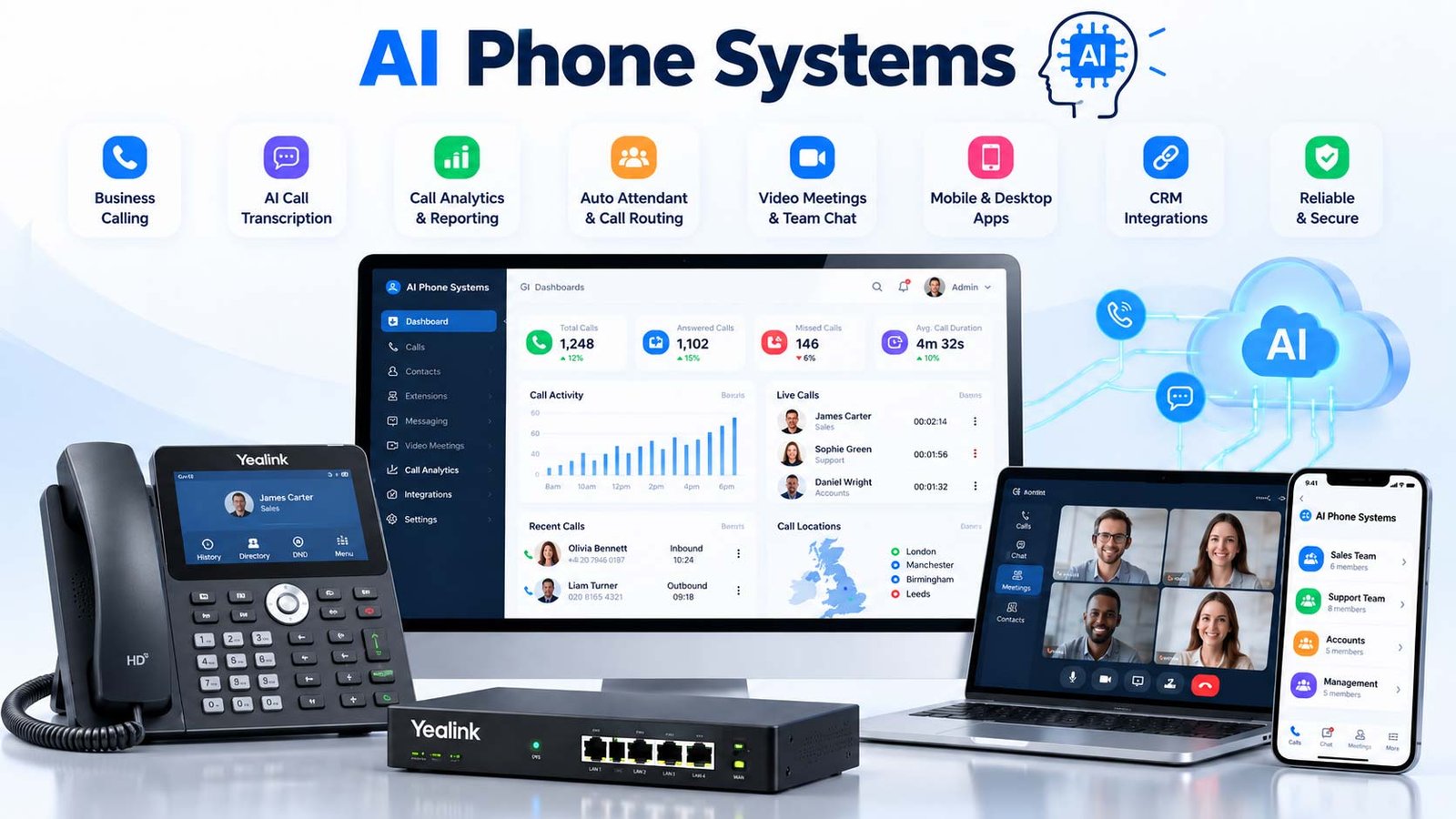
A business phone system becomes meaningfully AI-enabled when intelligence changes how calls are understood, handled, documented or acted on — not simply because the supplier uses “AI” as a product label.
That distinction matters because the market now groups very different capabilities under the same phrase. One product may add automatic call summaries to a conventional cloud phone system. Another may provide an AI receptionist that answers routine inbound enquiries. A third may run autonomous voice workflows that read and write data in a CRM or booking platform.
This hub explains those layers as one operating model. It does not rank AI providers and it does not replace the future specialist pages for AI receptionist or AI voice agent intent.
2. The AI Phone System Control Stack
The easiest way to compare AI phone systems is to separate the underlying phone service from the intelligence placed around it. A robust design starts with reliable telephony, adds assistive AI for staff, introduces conversational AI only where it improves the caller journey, and permits workflow actions only where permissions, validation, logging and recovery are clear.
Numbers, inbound and outbound calling, users, devices, routing, queues, voicemail and resilience.
Transcription, summaries, action items, voicemail extraction, agent assist and conversation intelligence.
AI receptionist, natural-language answering, intent capture, qualification, triage and guided self-service.
Bookings, CRM updates, case creation, notifications or other bounded actions with defined controls.
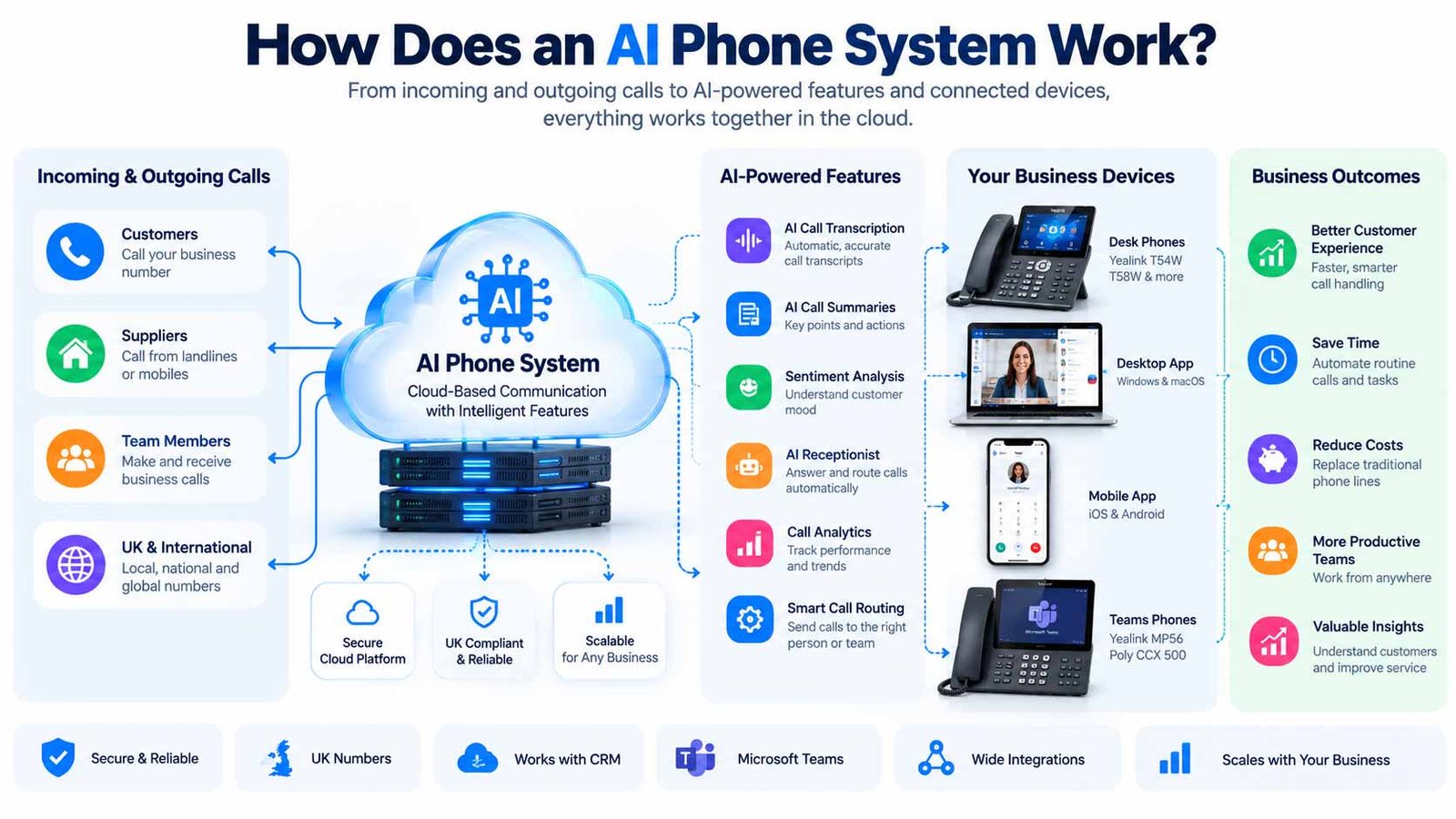
Modern platforms increasingly span several layers. RingCentral, Dialpad, Zoom and Microsoft all publish AI capabilities around calling, summaries or call assistance, while some platforms also expose AI receptionists or autonomous agents. The capability mix varies significantly, so buyers should compare behaviours rather than assume every “AI phone system” provides the same operating model.
3. AI Phone System vs AI Receptionist vs AI Voice Agent vs IVR
These terms overlap, but they should not be treated as synonyms. An AI phone system is the broad category. An AI receptionist is mainly a front-door inbound role. An AI voice agent is a wider conversational automation component for inbound or outbound workflows. IVR remains rule-based routing, while conversation intelligence primarily assists people rather than replacing them.
| Term | Main job | Typical direction | How much autonomy? | Best content owner |
|---|---|---|---|---|
| AI phone system | Broad platform combining calling with AI capabilities | Inbound + outbound | Varies from assistive to autonomous | This hub |
| AI receptionist | Front-desk answering, triage, booking, routing and message capture | Primarily inbound | Moderate, bounded by front-desk rules | Future AI Receptionist guide |
| AI voice agent | Conversational workflow execution using voice | Inbound + outbound | Potentially high when connected to business systems | Future AI Voice Agent guide |
| IVR / auto attendant | Deterministic menu and routing logic | Inbound | Low; follows configured rules | Business Call Routing |
| Conversation intelligence | Transcription, summaries, coaching and insight | Inbound + outbound | Assistive | This hub |
The architecture deliberately keeps detailed receptionist, broader voice-agent and future provider-ranking intent separate. That prevents one page from trying to own every AI-telephony query at once.
4. Assistive AI: Transcription, Summaries and Agent Support
Assistive AI works alongside a person rather than taking control of the conversation. It can transcribe calls, create summaries, identify action items, prioritise voicemail, surface knowledge or preserve transfer context. This is often the lowest-risk starting point because the human remains responsible for the call while AI reduces memory, documentation and follow-up workload.
Current business-phone platforms increasingly place these capabilities directly inside the calling experience. Dialpad publishes real-time transcription and AI recaps; Zoom Phone describes summaries, action items and voicemail task extraction; Microsoft Teams Phone can generate transfer summaries and in-call assistance when transcription or recording is available.
Live transcription, suggested knowledge, coaching prompts and context capture.
A concise summary can give the next person context so the caller does not need to repeat the entire story.
Summaries, action items, searchable transcripts and structured follow-up can reduce manual note-taking.
Assistive AI is still an information-processing system. Businesses should decide whether transcripts, summaries and recordings are necessary, who can access them, how long they are retained and what happens if the AI summary is wrong.
5. Where an AI Receptionist Fits
An AI receptionist is a specialised inbound use of conversational AI. Its job is usually to answer the front door, establish why the caller is contacting the business, provide approved information, capture details, book or request appointments, route the call and transfer to a person when the conversation exceeds the scope that has been defined for automation.
The most important design decision is not the voice. It is the responsibility boundary. A receptionist that can answer opening-hours questions and route calls is materially different from one that can change a customer record, reschedule an appointment or make a judgement about urgency.
The future `/guides/ai-receptionist-uk/` page should own deep front-desk intent. This hub keeps the receptionist in context as one component of a wider AI phone system.
6. Where AI Voice Agents Fit
AI voice agents extend beyond front-desk answering into defined conversational workflows. They may collect structured information, qualify an enquiry, perform an account lookup, create a case, confirm an appointment, trigger a follow-up or run an outbound reminder. The broader the action set becomes, the more important permissions, validation, exception handling and human intervention become.
An AI voice agent should therefore be evaluated as a business-process component, not merely a natural-sounding voice. Ask what systems it can read, what systems it can write to, what fields it can change, what limits exist, and what evidence is retained when an action succeeds or fails.
Natural conversation does not justify unlimited authority. The agent should have only the permissions required for the exact workflow it is meant to complete.
The future AI Voice Agent guide will own deeper inbound/outbound automation, APIs, CRM actions and workflow-execution intent.
7. Inbound and Outbound AI Calling Need Different Controls
Inbound AI usually reacts to a caller who has deliberately contacted the organisation, while outbound AI initiates contact and can create additional permission, identity and customer-experience risks. The same voice technology may power both, but the operating rules should differ. Businesses should define lawful purpose, contact policy, caller identity, escalation and stop conditions before automating outbound calls.
| Area | Inbound AI | Outbound AI |
|---|---|---|
| Trigger | Customer calls the business | Business or workflow initiates the call |
| Typical job | Answer, triage, route, book, support | Reminder, confirmation, permitted follow-up or defined notification |
| Main risk | Wrong answer, poor routing, failed handoff | Unwanted contact, identity confusion, repeated attempts, inappropriate automation |
| Control priority | Knowledge boundary and escalation | Contact permission, identity, frequency and opt-out handling |
Where outbound activity intersects with direct marketing, organisations should assess the applicable PECR and data-protection requirements rather than assuming that an AI-generated call can be treated exactly like an ordinary service notification.
8. AI Should Sit Inside the Call Flow, Not Replace It
AI works best as one stage in a larger call journey. The phone system still needs routing, queues, groups, business hours, overflow, voicemail, fallback and resilience. AI should enter where it adds value and exit cleanly when confidence is low, risk is high, the caller asks for a person or a downstream system is unavailable.
A strong handoff carries context. If the AI has already captured a caller’s name, reason for calling and account reference, the human recipient should receive that information where technically and lawfully appropriate. Microsoft publishes call-transfer summaries as one example of AI being used to preserve context across a transfer.
For the deterministic call-flow layer, use the Business Call Routing guide.
9. CRM, Calendar, Helpdesk and API Actions
The value of conversational AI increases when a call can move a real business process forward, but integration also increases risk. Reading a calendar differs from creating an appointment; finding a CRM record differs from changing it. Each connected action should therefore have a defined permission, validation rule, confirmation state and audit trail.
Opening hours, availability, account status or knowledge required for the conversation.
Appointment, CRM note, ticket, lead record or approved field update.
Send confirmation, create a task, notify a team or invoke a permitted automation.
Transfer to a person when the request, risk or confidence level requires human handling.
For the broader phone-to-CRM operating model, use the VoIP CRM integration guide.
10. What Should the AI Be Allowed to Know?
An AI phone experience is only as reliable as the information it is permitted to use. Businesses should define approved knowledge sources, ownership, freshness, conflict handling and prohibited topics before launch. A system that can answer from verified business information is easier to govern than one that improvises beyond the organisation’s published policies, products or operating rules.
A practical knowledge design separates:
- Stable facts: opening hours, locations, services and published policies.
- Live operational data: appointment availability, case status or account information retrieved from connected systems.
- Restricted information: data that should only be exposed after identity or permission checks.
- Human-only judgement: sensitive, exceptional or high-impact decisions that should not be delegated to the AI.
When information conflicts, the safest design is not to let the model guess. It should either use a defined source of truth or hand the question to a person.
11. AI Phone Systems, Personal Data and Transparency
AI phone systems can process caller names, numbers, voice content, transcripts, summaries, account information and inferred intent. UK data-protection obligations therefore belong in the design, not as a final legal checkbox. The ICO emphasises transparency, accountability, context and impact when AI is used with personal data, and its detailed AI guidance remains under active review after legislative changes.
Define why personal data is needed for the call and each downstream action.
Give callers meaningful information about relevant processing rather than hiding AI use behind vague wording.
Restrict recordings, transcripts, summaries and connected records to appropriate roles.
Set retention around an identified purpose instead of storing every conversation indefinitely.
If AI is used to make a significant decision about a person, additional automated-decision safeguards and human-intervention requirements may apply. The Data (Use and Access) Act has changed parts of the UK framework, so implementation should be checked against current ICO guidance rather than relying on older summaries.
12. Recording, Transcription and AI Summaries
Recording and transcription are related but not identical controls. A phone platform may store audio, create a transcript, generate a summary or retain all three. Each representation can expose personal, commercial or sensitive information. Buyers should know exactly what is captured, where it is stored, who can retrieve it, how long it remains available and whether deletion is enforceable.
| Record | Value | Governance question |
|---|---|---|
| Audio recording | Original conversation evidence | Is recording necessary, controlled and retained appropriately? |
| Transcript | Searchable text and machine-readable context | How accurate is it and who can search or export it? |
| AI summary | Faster review and follow-up | How are errors corrected before the summary drives action? |
| Extracted actions | Tasks, commitments and next steps | Who validates high-impact actions before execution? |
Microsoft, Zoom and Dialpad all publish examples of AI-generated summaries or transcription around business calls. Feature availability, retention and admin controls still need to be checked at the specific product and licence level.
13. When Human Oversight Becomes Essential
A human fallback is not only a customer-experience feature. It is a control mechanism. The higher the potential impact of an AI decision or action, the stronger the case for review, confirmation or intervention. This is especially important when the call affects eligibility, complaints, vulnerable callers, financial consequences, legal positions, healthcare matters or other sensitive outcomes.
Summarise a call or retrieve approved information.
Create a booking or case within clear constraints.
Require human review for exceptions, disputes or significant decisions.
The ICO’s current material on automated decision-making highlights the need for safeguards such as information, representations and human intervention where significant decisions are made using automated processing. The exact legal analysis depends on the use case, so this page treats human oversight as an operational design principle rather than a substitute for legal advice.
14. Security Risks Are Wider Than the Phone Login
An AI phone system expands the security boundary because it may combine telephony, voice models, knowledge sources, APIs, CRM data, recordings and automation credentials. Security review should therefore cover identity, permissions, secrets, connected applications, administrator roles, audit logs and abuse controls. A convincing voice experience is not safe if the integration layer has excessive authority.
Key controls to evaluate include:
- least-privilege access for the AI and its integrations;
- separate credentials for production connectors;
- authentication before exposing protected customer information;
- limits on sensitive actions and retry behaviour;
- administrator MFA and role separation;
- auditability of calls, prompts, actions and changes;
- protection against callers manipulating the system into disclosing or changing information outside its instructions.
Caller speech should be treated as untrusted input. The system must not convert a persuasive conversation into unrestricted backend access.
15. What Happens When the AI Is Wrong or Unavailable?
A production AI phone system needs a failure path for the AI itself, not only for broadband or carrier outages. Speech recognition can fail, knowledge can be stale, a downstream API can time out, an action can be rejected and a model can misunderstand the caller. Reliable design makes those conditions visible and routes around them safely.
Ask a clarifying question or transfer instead of guessing.
Use a defined source of truth or escalate.
Do not tell the caller an action completed unless the downstream system confirmed it.
Fall back to ordinary routing, queue, voicemail or another approved path.
The operational test is simple: the caller should still have a usable route when the AI layer is partially or completely unavailable.
16. Which Businesses Benefit From AI Phone Systems?
AI phone systems are most useful where call volume, missed calls, repetitive questions or post-call administration create measurable friction. The strongest use case is usually not “replace the receptionist” or “automate customer service.” It is a narrower problem that can be defined, measured and improved without making the caller journey harder or removing necessary human judgement.
Overflow answering, lead capture, appointment requests and after-hours handling.
Structured intake, routing, message capture and appointment coordination with clear escalation.
Call summaries, CRM updates, follow-up tasks and selected qualification workflows.
Initial triage, case creation, knowledge retrieval and context-rich transfer to a person.
Consistent first-line handling across locations with central policy and local routing.
Agent assist, QA, conversation intelligence and carefully bounded autonomous interactions.
High-volume, sensitive or regulated environments usually require more governance, testing and human supervision than a simple after-hours enquiry flow.
17. How to Compare AI Phone Systems
Compare AI phone systems against the workflow they must support, not against the longest feature list. Start with the call types, responsibilities and risks, then test whether the platform provides the telephony foundation, AI capability, integrations, control points and support model required. The same AI feature can be valuable in one workflow and unnecessary in another.
Which inbound and outbound journeys are actually in scope?
Assist, answer, qualify, route, act, analyse — which verbs are allowed?
When must a caller reach a person, and what context follows the transfer?
What may the AI read, write or trigger?
How are transparency, retention, access, audit and exception handling controlled?
What happens if the AI, network or connected system fails?
How will accuracy, containment, transfer quality and business outcome be measured?
Once those requirements are documented, place them inside the wider VoIP Buyer’s Guide so AI is evaluated alongside numbers, routing, devices, resilience, support, security and commercial terms.
18. Pilot One Workflow Before Scaling AI Calling
A bounded pilot is safer and easier to evaluate than switching a whole phone operation to AI in one step. Choose one repeatable call journey, define the baseline, set explicit success and failure criteria, test normal and edge cases, launch to a controlled audience, review real conversations and expand only after the evidence supports the next level of responsibility.
One clear problem: missed calls, intake, booking, summaries or another bounded workflow.
Knowledge, actions, permissions, handoff, failure path and caller messaging.
Happy path, ambiguity, noise, interruptions, unusual requests, system failure and escalation.
Review outcomes, not demos: completion, transfer quality, errors, customer friction and admin saved.
Add responsibility only where the first workflow is stable, governed and valuable.
19. What Should You Measure After Launch?
AI performance should be measured against the business job it was introduced to improve. A high percentage of automated calls is not automatically a success if callers repeat themselves, bookings fail or staff spend more time correcting records. Use a balanced scorecard that combines caller outcome, automation quality, operational effort, risk and commercial impact.
| Measure | What it tells you | Watch-out |
|---|---|---|
| Answered / contained calls | How much demand the AI handles without human intervention | Containment can hide poor experiences if callers abandon |
| Successful actions | Bookings, cases or updates confirmed by the destination system | Do not count attempted actions as completed actions |
| Transfer quality | Whether the right calls reach the right human with useful context | High transfer volume may reveal weak scope or poor knowledge |
| Error / correction rate | How often summaries, data or actions require repair | Track severity, not only quantity |
| Caller effort | Repetition, time to outcome and avoidable steps | A natural voice does not guarantee an efficient journey |
| Admin time saved | Whether automation is reducing real manual work | Include exception handling and review time |
20. Common AI Phone System Mistakes
Most AI phone failures are design failures rather than failures of voice generation alone. Businesses create problems when they automate an unclear process, give the AI too much authority, use stale knowledge, hide the human route or measure only how many calls avoided an agent. A better implementation keeps responsibility narrow and makes exceptions easy to detect.
- Buying an “AI phone system” before defining the caller journey.
- Using one generic prompt for every department and call type.
- Allowing actions without validating the destination-system response.
- Making callers fight the AI to reach a person.
- Assuming a transcript or summary is automatically an accurate business record.
- Retaining recordings and transcripts without a clear purpose or access model.
- Deploying outbound automation without separate contact and identity controls.
- Treating the AI as a replacement for ordinary routing and resilience.
21. AI Phone Systems FAQs
These questions cover the distinctions buyers most often need to resolve before comparing products: what counts as an AI phone system, how receptionist and voice-agent roles differ, where ordinary routing still matters, how CRM actions should be controlled, what UK data-protection issues need attention and how to pilot automation without handing over too much responsibility too early.
What is an AI phone system?
An AI phone system combines business telephony with artificial-intelligence capabilities such as transcription, summaries, natural-language answering, intent detection, routing, workflow actions or conversation analytics. The exact capability varies by platform, so buyers should identify what the AI is allowed to do rather than rely on the product label.
Is an AI phone system the same as an AI receptionist?
No. An AI receptionist is one use of an AI phone system, mainly focused on inbound front-desk tasks such as answering, qualifying, booking, message capture and routing. The broader phone system can also include staff-assist features, outbound voice agents, analytics, integrations and ordinary telephony controls.
What is the difference between an AI receptionist and an AI voice agent?
An AI receptionist is usually a narrower inbound role designed around front-desk handling. An AI voice agent is a broader conversational automation component that can run inbound or outbound workflows and may interact with CRM, calendar, helpdesk or APIs. The more actions it can take, the stronger the governance requirement.
Can AI phone systems transfer calls to a person?
They can when the underlying platform and workflow support transfer or escalation. The important buyer question is what triggers handoff, whether the recipient receives useful context, and what happens if the transfer destination is unavailable. Human handoff should be tested as part of the normal call journey, not treated as an exception.
Do AI phone systems replace IVR and call queues?
Not necessarily. IVR, queues, ring groups, business-hours rules and fallback paths still provide deterministic call control. AI can sit before, inside or alongside those components, for example by understanding caller intent before routing. A resilient design keeps ordinary routing available when the AI layer is unsuitable or unavailable.
Can an AI phone system update a CRM?
Potentially, if the platform or connected automation has permission to do so. Reading a CRM record, adding a note and changing a high-impact field are different levels of authority. Each action should have defined permissions, validation, logging and an exception path. Test the exact connector behaviour rather than assuming “CRM integration” means full workflow automation.
Are AI call summaries always accurate?
No. Summaries can save time, but they are generated interpretations of a conversation and can omit or misstate details. Businesses should decide when a summary is sufficient, when the transcript or recording must be checked, and which actions require human confirmation before the AI-generated output becomes part of an operational record.
What should UK businesses consider about AI and personal data?
They should consider purpose, lawful processing, transparency, access, retention, security, data sharing and individual rights. Where AI contributes to significant automated decisions, additional safeguards may be relevant. ICO guidance is being updated following legislative changes, so deployment decisions should be checked against current guidance rather than relying on old summaries.
Is AI phone automation suitable for every call?
No. Routine, repeatable and well-bounded conversations are generally easier to automate safely than complex, emotional, disputed or high-impact interactions. A useful design explicitly identifies which calls the AI should handle, which it should assist with, and which should move quickly to a trained person.
How should a business pilot an AI phone system?
Start with one measurable workflow, such as after-hours lead capture or call summaries. Define approved knowledge, permissions, handoff, failure behaviour and success metrics before launch. Test normal and abnormal conversations, deploy to a controlled audience, review real evidence, then expand only after the workflow is stable.
What is the best AI phone system for a UK business?
There is no single best system for every organisation. Fit depends on the existing phone platform, call types, number and routing requirements, integrations, AI responsibility, governance, support model and total cost. This hub explains the category; provider-ranking intent should remain on a separate comparison page.
What should I ask a supplier about AI voice features?
Ask what the AI does during and after a call, what data it stores, which systems it can access, what actions it can take, how handoff works, what happens when confidence is low, how failures are logged, what admin controls exist, and which capabilities require separate licences or usage charges.
22. Turn the AI Requirement Into a Provider-Ready Specification
Once you know which AI responsibilities are appropriate, put them into the wider phone-system requirement rather than shopping for AI in isolation. Define numbers, routing, users, devices, integrations, resilience, security, support and commercial terms alongside the AI layer. That makes supplier demonstrations comparable and prevents an impressive demo from bypassing the operational requirements that still determine whether the system works.
23. Sources and Research Notes
This guide uses official UK regulatory material for governance and current provider documentation to illustrate how AI is appearing inside business calling products. Provider pages are evidence of published capability, not neutral rankings. Because AI products and UK guidance are changing quickly, implementation decisions should be checked again at procurement and deployment.
- ICO — Artificial intelligence and data protection guidance
- ICO — Principles for explaining AI-assisted decisions
- ICO — Data (Use and Access) Act 2025 data-protection changes
- RingCentral UK — AI business phone system capabilities
- Dialpad UK — AI communications capabilities
- Zoom — AI built into Zoom Phone
- Microsoft — Copilot for Teams Phone
Provider pages are used as examples of currently published product capabilities, not as independent evidence that one supplier is better than another. AI features, licence packaging, data handling and availability can change; verify the current product documentation and contract before procurement.
Define the AI responsibility before choosing the platform
Turn the call journey, human handoff, permitted actions, integrations, governance and failure path into one provider-ready requirement.

CompareVoIPService.co.uk
UK-focused VoIP guidance