

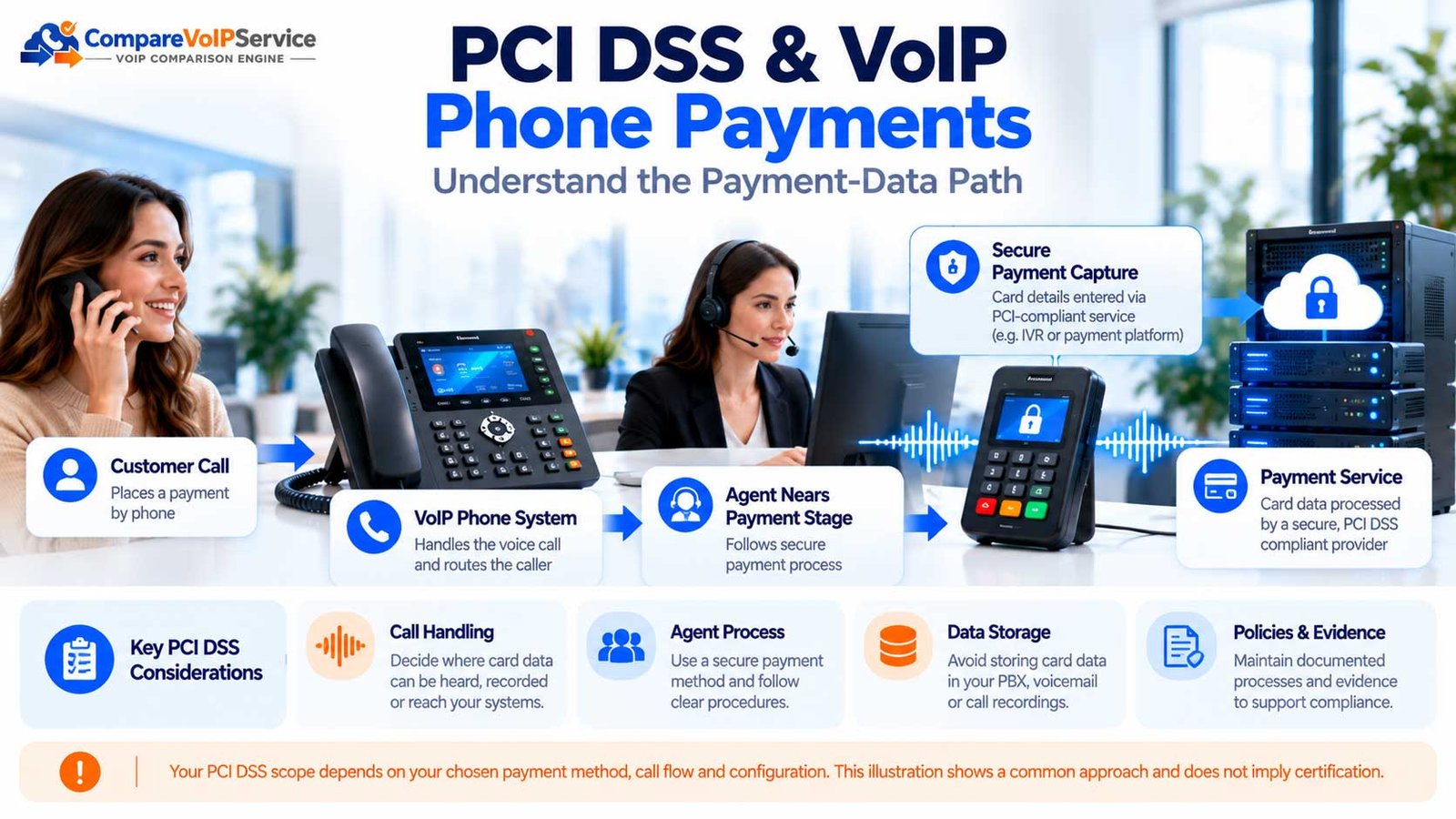
PCI DSS for VoIP Phone Payments in the UK
Follow payment-card data through your phone system, recording tools, agent desktops and providers—then check what your supplier must prove.
Reviewed October 2026 · Guidance only, not PCI certification or a supplier testA provider’s generic “PCI-ready” claim does not by itself determine your merchant obligations.
Quick answer: Taking card payments through a VoIP phone system can bring the systems handling account data into PCI DSS scope. Recording pauses may reduce stored-audio exposure but do not automatically exclude the agent environment. Compare capture designs using verified payment-data flow, supplier responsibilities and an acquirer/assessor-approved validation approach.
Jump to a Section PCI in phone calls
What Does PCI DSS Mean for VoIP Phone Payments?
PCI DSS can apply to a business telephone environment when payment-card account data is stored, processed or transmitted through it. That includes VoIP audio and supporting systems where card numbers or other account data pass through infrastructure the business controls. The relevant scope follows the actual data path, not a provider’s label of “cloud”, “secure” or “PCI-ready”.
For a UK organisation taking payment by phone, the useful first step is to identify who can hear, see, record, transmit, store or retrieve card information during each payment. Then identify controls that stop it reaching unnecessary systems and ask the acquiring bank or appropriate PCI assessor to confirm the applicable validation approach. PCI SSC FAQ 1153 explains how PCI DSS applies to VoIP.
Trace the caller, carrier, PBX, agent, recorder, desktop, payment service and any downstream copies.
Examine DTMF masking, secure payment IVR and other designs that may keep account data away from the agent environment.
Request data-flow diagrams, service-provider evidence and scoped validation from the appropriate parties.
Check recordings, transcription, transfers, failures and accessibility alternatives before live acceptance.
Map Every System a Telephone Payment Touches
Most scoping mistakes begin with a diagram that stops at the PBX. A real telephone payment can pass through a carrier, hosted calling service, agent headset, browser softphone, recorder, speech analytics, CRM notes and payment gateway. Whether each component is in scope depends on what it actually handles, can access or can affect.
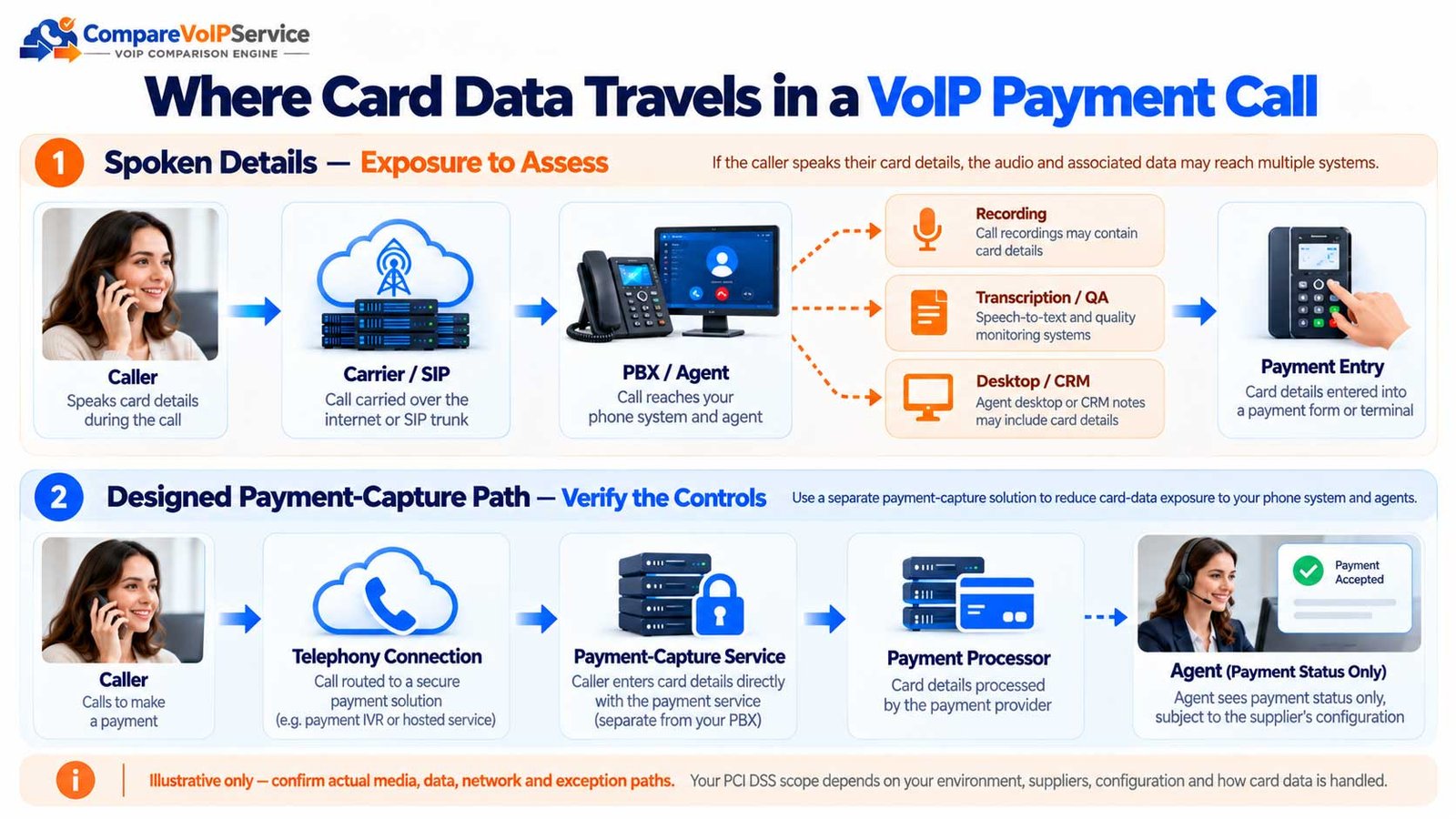
View the original text-based payment-flow diagram
Draw a second diagram for the proposed protected route and show where account data bypasses the business or becomes inaccessible. A diagram is only evidence when supported by configurations, contracts and acceptance tests.
| Component or channel | Exposure question | Evidence owner |
|---|---|---|
| Carrier and SIP service | Does the business control any part of the voice traffic containing payment data? Which party carries and processes it? | Telephony provider and network owner |
| Hosted PBX / IVR | Can this system route, hear, log, buffer or record card details? | PBX and application vendor |
| Agent phone or softphone | Can an agent hear PAN or CVV, replay tones, or see payment information? | Telephony owner and operations |
| Call / screen recording | Can account data be stored in audio, screens, backups or exports? | Recording service owner |
| Transcription and AI tools | Are payment segments transcribed, summarised, retained or sent to third parties? | Analytics, AI and privacy owners |
| Payment processor | Where are details captured, tokenised, authorised and logged? | Payment service provider |
| CRM, support and diagnostics | Could account data appear in notes, logs, tickets, attachments or support sessions? | Application owners |
Swipe inside the table to see all columns.
Where Does VoIP Enter PCI DSS Scope?
PCI SSC explains that voice traffic containing payment account data is considered for PCI DSS wherever it is stored, processed or transmitted within the organisation’s controlled environment. The external segment of an incoming call that the merchant cannot control is treated differently from its own internal network. This is a control-boundary distinction, not an exemption for hosted calling.
| Scenario | Likely consideration | What must be verified |
|---|---|---|
| Caller dials from a personal telephone | The merchant does not control the caller’s external network before the call reaches the merchant-controlled boundary. | Where the merchant or its service provider takes control of the payment data. |
| Card data travels across the business LAN | Relevant switches, networks, voice systems and other affected components may be subject to applicable PCI controls. | Actual data path, segregation, administrative access, protection and logging. |
| Employee takes payment using a browser softphone | The computer and applications may interact with in-scope traffic or provide access to card data. | Audio, browser, desktop, headset, recording, screen capture and support access. |
| Specialist provider captures payment outside agent path | A properly implemented design may reduce account-data exposure and scope for particular merchant components. | Verified data bypass, remaining connected systems, contracts, AOC and acquirer/assessor position. |
| Cloud recording or outsourced PBX handles payment audio | Outsourcing does not automatically mean the merchant has no responsibilities. | Shared-responsibility terms and current service-specific compliance evidence. |
Swipe inside the table to see all columns.
PAN, Cardholder Data and CVV: What Must Never Be Confused
Different data elements carry different rules. A primary account number (PAN) is cardholder data. Sensitive authentication data (SAD) includes card verification codes and values such as CVV2/CVC2/CID. PCI DSS Requirement 3.3.1 prohibits storage of SAD after authorisation even if encrypted. A stored audio file can violate this requirement just as a database can.
| Data element | Example of exposure | Compliance significance |
|---|---|---|
| Primary account number (PAN) | Customer speaks full card number and it is captured in audio or a transcript. | Treat according to applicable PCI DSS account-data requirements; avoid unnecessary capture or storage. |
| Cardholder name / expiry | Entered into agent desktop or copied to CRM notes. | Assess when associated with PAN; do not assume all fields have identical treatment. |
| Card verification code/value (CVV/CVC/CID) | Read aloud or typed in DTMF that becomes a stored recording. | Sensitive authentication data: must not be retained after authorisation under Requirement 3.3.1. |
| Payment token or non-sensitive result | Successful/failed status returned to the agent without card details. | Verify that values cannot recover account data and that logs/screens are restricted appropriately. |
Swipe inside the table to see all columns.
Compare Telephone Payment-Capture Options by Data Exposure
The right question is not “Which technology is PCI certified?” but “Which systems can obtain the card data, under the deployed configuration and failure conditions?” The following is a planning comparison, not an assessment outcome. Actual PCI scope and validation depend on implementation, evidence and acquirer/assessor confirmation.
| Method | Typical operational pattern | What it can change | Essential verification |
|---|---|---|---|
| Spoken details to an agent | Customer reads card details; agent types into a virtual terminal. | May expose agent, desktop, calls and recordings to account data. | What can hear, access or save PAN/SAD? Is there a safer alternative? |
| Pause / resume recording | Recording pauses while details are supplied to the agent. | May reduce recording-storage exposure when it works correctly. | Agent and connected systems may remain in scope; failure handling and gap tests essential. |
| DTMF masking / suppression | Customer uses keypad; masked tones or tokenised results reach the agent. | Properly designed routing may keep card data away from more merchant components. | At what point are tones masked? What do recording, agent and network actually receive? |
| Secure payment IVR | Caller enters data to a dedicated automated payment system. | Properly designed bypass may separate payment capture from the agent environment. | Does account data bypass agent infrastructure throughout the complete flow? |
| Agent-guided payment link | Customer follows a secure digital payment page while agent assists verbally. | Can avoid spoken/DTMF card data on the call if staff never take details. | Correct link domain, trusted payment page, failure recovery, accessibility and any other website PCI requirements. |
Swipe inside the table to see all columns.
An agent stays involved, but direct access to card details may differ by product and route.
The caller enters details through a separate system; prove the actual bypass and fallback.
A payment link can separate card entry from a voice call, but it needs its own security and accessibility checks.
Plan what happens when the masked path is unavailable or the caller cannot use keypad entry.
What DTMF Masking and Secure Payment IVR Actually Need to Prove
DTMF (dual-tone multi-frequency) is the keypad signalling used when a caller presses digits. A masked-payment service can intercept or suppress usable keypad data before it reaches an agent or recording platform. An IVR can instead direct the caller to a payment-processing function. The products are not interchangeable, and simply muting a headset may not protect the media stream or stored recording.
| Control boundary | Supplier demonstration to request | Failure-mode question |
|---|---|---|
| Media and tone handling | Show where original tones stop being accessible and what each downstream system receives. | What happens during a transfer or codec change? |
| Agent view and controls | Show that only non-sensitive payment progress and final status are displayed. | Can a privileged admin or support user reveal original values? |
| Recording and analytics | Prove audio, screen capture and transcripts do not contain PAN/SAD during payment. | What if pause/masking fails or recording restarts too soon? |
| Provider and processor boundary | Show who transports, captures, authorises and logs account data. | Which party handles failed authorisations, retries and handback? |
| Accessibility / alternate method | Offer a controlled solution when customers cannot use keypad or a payment link. | Can staff revert to unsafe verbal collection without approval? |
Swipe inside the table to see all columns.
Why Pausing Call Recording Is Not Full PCI De-scoping
Pause-and-resume aims to stop payment information being captured in stored audio. PCI SSC’s telephone-payment information supplement explains that a properly implemented pause feature may reduce requirements applicable to the recording and storage system, but does not by itself remove the agent, desktop or other telephone systems from scope.
When evaluating a recording platform, test manual and automated pause triggers, timing, live transfers, call queues, resuming after authorisation, recordings exported to quality systems, and retention of old data in backups. Include screen recordings and speech-to-text, not just the audio file.
Does the recording pause early enough before the first digit or spoken card detail?
Can any system still hear, copy, transcribe or screen-capture the details?
Does the restart avoid card-data leakage while retaining operational call evidence?
Does the call route into a safe fallback rather than simply recording everything?
For the separate UK privacy, retention, employee monitoring and caller-information questions, see our business call-recording guidance. This guide covers PCI card-data scope, not general UK GDPR recording policy.
Hosted PBX, Softphones, AI Transcription and Outsourced Support
Telephony outsourcing changes who operates a system; it does not automatically remove the merchant’s contractual or PCI responsibilities. Ask whether account data can traverse the business LAN, browser, desktop capture, headset software, screen recording, CRM integration, analytics or AI voice services. Review data flow under normal calls and exceptional routes.
| Component | Risk to investigate | Evidence to retain |
|---|---|---|
| Hosted PBX / SIP provider | Provider-held recordings, media routing, support impersonation, raw call diagnostics. | Shared-responsibility map, service scope and security evidence. |
| Agent softphone / laptop | Card audio on general-purpose workstation, local capture utilities or remote support tools. | Device build, access and application inventory, tested payment handoff. |
| Speech-to-text / AI summaries | Payment digits captured in transcript, prompts, logs or retained model processing. | Redaction/bypass behaviour, processor contract and deletion workflow. |
| Contact centre platform | Queue recording, monitoring, barging and supervisory replay. | Role privileges, masking boundary and exception test evidence. |
| CRM and ticketing | Card numbers copied into notes, forms, exports or support tickets. | Field controls, training, incident response and inspection results. |
| Backups / disaster recovery | Old recordings or debug artefacts with account data remain recoverable. | Retention scope, sanitisation, restoration tests and provider responsibilities. |
Swipe inside the table to see all columns.
For broader call-environment hardening and user access considerations, see UK VoIP security controls and, where a PBX feeds the payment route, how SIP trunking connects business calling.
What to Request from a Telephone-Payment Supplier
Do not accept a brochure as complete PCI evidence. Request the provider’s specific service name, payment path, responsibility allocation, current attestation or other applicable validation evidence, and limitations. Check whether the supplied evidence covers the particular component and deployment you are purchasing—not merely the parent company’s data centre.
| Ask the supplier for | Why it matters | Who validates or owns it |
|---|---|---|
| Current account-data flow diagram | Shows every system that could receive PAN/SAD, including failure paths. | Merchant technical lead + PSP |
| PCI service-provider validation evidence, as appropriate | Avoids reliance on broad “PCI-compliant” labels unsupported by scope. | Merchant compliance owner; acquirer/QSA as required |
| Responsibilities and services in scope | Clarifies which party controls PBX, IVR, recordings, network, processor and incidents. | Vendor contract owner + PCI lead |
| Call recording / transcription exclusion tests | Shows data does not enter retained audio, screens and AI transcripts as claimed. | Operations + recording/AI owners |
| Alternate payment channel procedure | Protects customers who cannot use DTMF and handles failed transactions. | Operations, accessibility and compliance owners |
| Change, incident and breach escalation rules | Controls updates, provider substitution, masking failure and data discovery. | Information security + supplier management |
| Attestation/SAQ/ROC route agreed with acquirer | Ensures the business uses the validation method actually applicable to it. | Merchant and acquiring bank / payment brands / QSA |
Swipe inside the table to see all columns.
Telephone Payment Acceptance Tests Before Go-Live
Use test or non-sensitive demonstration data under an authorised supplier-led test plan; never place genuine card numbers or CVV values into website forms, recordings, chat, screenshots or this checklist. Agree how the assessor wants redaction and exclusion demonstrated without creating sensitive test artefacts.
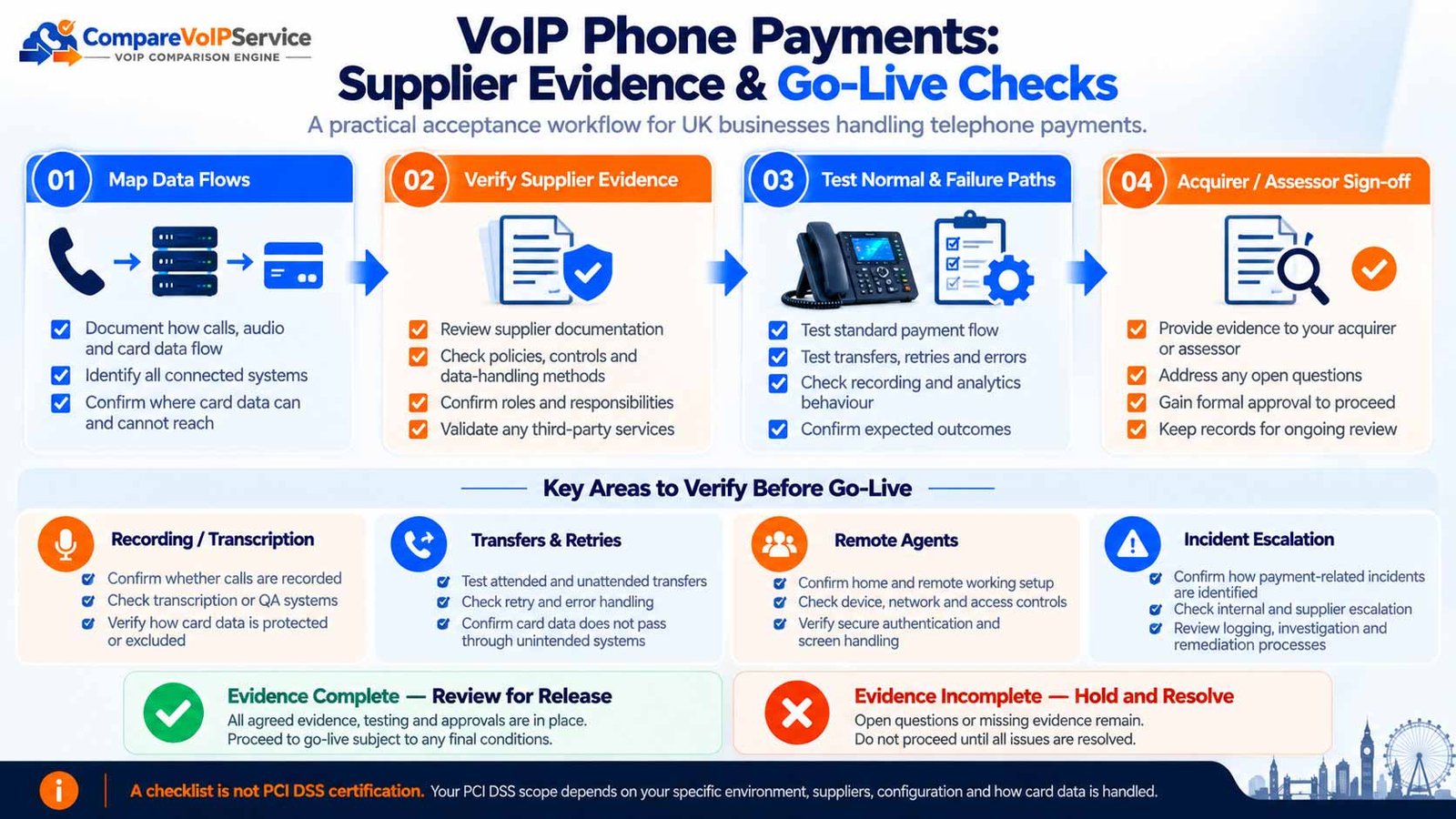
| Test scenario | Expected observation | Record and owner |
|---|---|---|
| Normal keypad payment | Agent, recorder, transcript and CRM do not expose original account data when the design claims bypass. | Dated vendor demonstration and approved test evidence; PCI lead |
| Failed transaction and retry | The caller returns safely to a permitted capture route without disclosure to agent. | Payment provider and operations |
| Transfer / hold / conference | No unmasked media or recording resumes unexpectedly. | Telephony and contact-centre owners |
| Manual recording pause late or omitted | Unsafe path is blocked or escalated; incident route is documented. | Recording owner + security |
| Softphone, remote worker or supervisor | Role permissions and alternative media paths do not bypass controls. | IT endpoint and compliance owners |
| Transcription, QA, screen recording and exports | No PAN/SAD present in retained outputs after payment test. | Analytics and privacy owners |
| Network disruption / failover | Fail-safe action prevents uncontrolled spoken-data capture. | Network and payment-service owner |
| Accessibility exception | Customer receives a usable approved method without insecure verbal fallback. | Customer service and accessibility lead |
Swipe inside the table to see all columns.
What If Card Details Enter a Recording, Transcript or CRM?
If card details enter an unapproved system, treat that as a potential security/compliance incident rather than quietly deleting a visible item and assuming the exposure has ended. Stop the unsafe capture route, preserve approved incident evidence without spreading account data, and engage the security owner and payment stakeholders.
| Step | Required action | Avoid |
|---|---|---|
| 1. Contain | Suspend the affected capture or recording path and route customers to a previously approved alternative. | Continuing to collect card data while waiting for a fix. |
| 2. Escalate | Notify the incident lead, service provider and relevant payment/compliance contacts under agreed contracts. | Circulating the raw recording or card number in ordinary tickets. |
| 3. Assess | Identify whether PAN or SAD was retained, where copies exist and who had access. | Assuming a single deleted file resolves backups/transcripts. |
| 4. Remediate and document | Follow the current PCI SSC, acquiring-bank and breach processes; verify secure disposal and residual risk with competent personnel. | Claiming compliance based on an unreviewed compensating control. |
| 5. Re-test before resume | Prove the defect, recording paths, failover and permissions are corrected. | Treating a provider statement as a substitute for evidence. |
Swipe inside the table to see all columns.
Who Decides the SAQ, ROC and Remaining PCI Responsibilities?
Merchants often hear that a hosted payment service “qualifies you for SAQ A” or “fully de-scopes the contact centre”. Those claims need context. Which assessment or attestation applies depends on the merchant, card brands, acquiring bank, validation criteria and the deployed card-data environment—not solely on whether payment capture is outsourced.
Before signing a supplier contract, give the acquirer or appointed PCI specialist the complete diagrams, product and service identifiers, data handling evidence and exception paths. Ask them to state the applicable assessment approach in writing. If the architecture changes, revalidate the impact.
Confirm payment acceptance and validation obligations for this merchant and channel.
Evaluate scope, control applicability, evidence and validation route.
Document the controlled voice path, system components and service responsibilities.
Demonstrate where PAN/SAD goes, which services are assessed and how incidents are handled.
PCI DSS and UK GDPR Are Different Obligations
PCI DSS governs payment-card data security. UK GDPR and associated UK law address personal-data processing, lawful bases, transparency, retention and individuals’ rights. A design may reduce payment-data exposure but still require privacy notices, access controls and appropriate retention practices for the rest of the recorded conversation.
Keep a separate privacy assessment for call monitoring, workforce recordings, transcriptions and any personal information beyond card details. PCI scope reviews should feed into—not replace—those governance processes. For that wider topic, refer to the existing call recording guide.
Example: A UK Service Desk Moves from Spoken Cards to Secure IVR
Fictional scenario: A three-team UK customer service operation uses a hosted PBX, browser softphones, call recording and a shared CRM. Customers currently read card details aloud. The business wants to use a separate secure payment IVR while keeping the agent on the call for order assistance.
| Decision point | Before: spoken payments | Proposed: secure-IVR path |
|---|---|---|
| Card capture | Agent hears PAN/CVV and enters details. | Customer enters account data into the dedicated payment system. |
| Agent display | Potential direct card-entry access on workstation. | Agent sees only payment progress/status; must verify no PAN/SAD access. |
| Call and screen recording | Risk of stored card details if recording not reliably suppressed. | Test actual IVR handoff and all media/recording/transcription paths. |
| Support, supervision and exceptions | Manual workarounds may expose card data. | Document approved exception, accessibility, incident and failover paths. |
| Compliance decision | Environment assessed against actual spoken-data path. | Acquirer/QSA verifies remaining obligations after evidence-based scope review. |
Swipe inside the table to see all columns.
Telephone-Payment Scope & Supplier Evidence Checklist
Use this before approving a VoIP or secure-payment provider. Capture evidence identifiers, owners and sign-off dates outside the public website; the checklist itself must never become a repository for payment-card details.
| Gate | Required evidence | Owner / decision |
|---|---|---|
| Design approval | Dated diagrams; all data/storage access paths; chosen exception route | IT + payment compliance; GO only with scope review |
| Vendor assurance | Current applicable service validation and responsibilities; documented caveats | Supplier owner + acquiring bank / assessor as needed |
| Control testing | Recorded non-sensitive test cases, including recording/transcription/IVR fallback | Technical owner + operations |
| Live operating readiness | Accessible approved alternative, incident contacts, change management and re-test plan | Merchant owner signs accepted residual obligations |
Swipe inside the table to see all columns.
Compare general business telephony features separately using the VoIP recommendation quiz. It is a general selection tool, not a PCI audit, approval or validation service.
Frequently Asked Questions
Does using VoIP automatically make a business PCI DSS compliant?
No. The organisation must understand where payment-card account data travels and which systems, suppliers and processes are affected. A VoIP or hosted PBX label cannot establish compliance.
Does PCI DSS apply if we take card numbers over the phone?
Potentially yes. PCI DSS applies to payment-card account data that is stored, processed or transmitted; PCI SSC FAQ 1153 specifically discusses VoIP environments.
Is pause-and-resume call recording sufficient to remove PCI scope?
No. It may reduce the exposure of correctly paused recording and storage systems, but it does not by itself exclude an agent, desktop or other telephony systems where card details remain accessible.
Can a business record CVV/CVC and keep it encrypted?
PCI DSS Requirement 3.3.1 prohibits storing sensitive authentication data after authorisation even if encrypted. PCI SSC FAQ 1210 outlines prevention and stringent exceptional handling where recordings unexpectedly contain SAD.
Does DTMF masking fully de-scope the merchant?
Not automatically. Proper implementation may prevent card data reaching some systems, but the actual deployed boundaries, remaining responsibilities, evidence and validation route must be verified.
What is the difference between secure payment IVR and a call-recording pause?
A correctly designed secure IVR may route account data away from the agent environment. Pause/resume attempts to prevent storage in recordings while the agent may still handle the data.
Are browser softphones and AI call transcripts relevant to PCI scope?
Yes, investigate them if they can receive, process, store, transmit or access account data, or affect the security of components that do. Do not assume transcription ignores payment segments.
Which PCI DSS SAQ should a UK merchant complete?
There is no universal answer from the phone-system type alone. Confirm eligibility and validation obligations with your acquiring bank, payment brand or relevant qualified assessor.
What if a customer cannot enter card details by keypad?
Provide a documented, accessible and approved alternative. Test that fallback before launch rather than allowing staff to improvise insecure verbal collection.
Does PCI DSS replace UK GDPR rules for recording?
No. PCI DSS payment-data security and UK GDPR personal-data obligations are different and can both apply to a telephone operation.
How often must a telephone-payment system be reviewed?
Review controls according to the applicable PCI requirements and after material changes to call routes, service providers, recordings, AI tools or exception handling. Agree responsibilities with the PCI owner.
Can CompareVoIPService certify our telephone payments as PCI compliant?
No. This independent guide provides a decision and evidence framework, not a PCI certification, scope assessment or substitute for an acquiring bank or qualified assessor.
Primary Standards and Further Reading
Reviewed on 22 October 2026. The 2018 PCI SSC telephone-payment supplement is supporting guidance, not a replacement for current PCI DSS requirements. Re-check the active standard and programme-specific rules at release.
- PCI SSC — FAQ 1153, How PCI DSS applies to VoIP
- PCI SSC — FAQ 1210, Sensitive authentication data in recordings (June 2025)
- PCI SSC — Protecting Telephone-Based Payment Card Data, Information Supplement v3.0 (November 2018)
- PCI SSC — PCI DSS v4.0.1 information and release
- PCI SSC — PCI DSS v4.0.1 request for comments (June 2026)
Editorial note: No supplier product has been technically tested or PCI assessed for this article. Illustrations, tables and scenarios are original advisory frameworks, not certification evidence.
Telephone Payment Scope Brief
Compare the Whole Payment-Data Path, Not Just the PBX
Agree the data boundary, supplier responsibilities, exception controls and PCI validation owner before taking payments on a new telephone setup. Use the checklist above and then assess wider business telephony separately.

Bhav Giva
Founder & Lead Analyst at CompareVoIPService.co.ukBhav Giva publishes UK-focused business communications research and practical VoIP guidance. This guide maps the potential PCI DSS impact of VoIP card payments, including telephone data flows, call recordings, masked DTMF, supplier responsibilities and evidence-led buyer decisions. It does not represent a PCI assessment or certification.