

15 written-evidence checks before you sign, renew or change a business phone agreement. Review the real clauses, document uncertainty and keep control of your numbers, support and exit obligations.
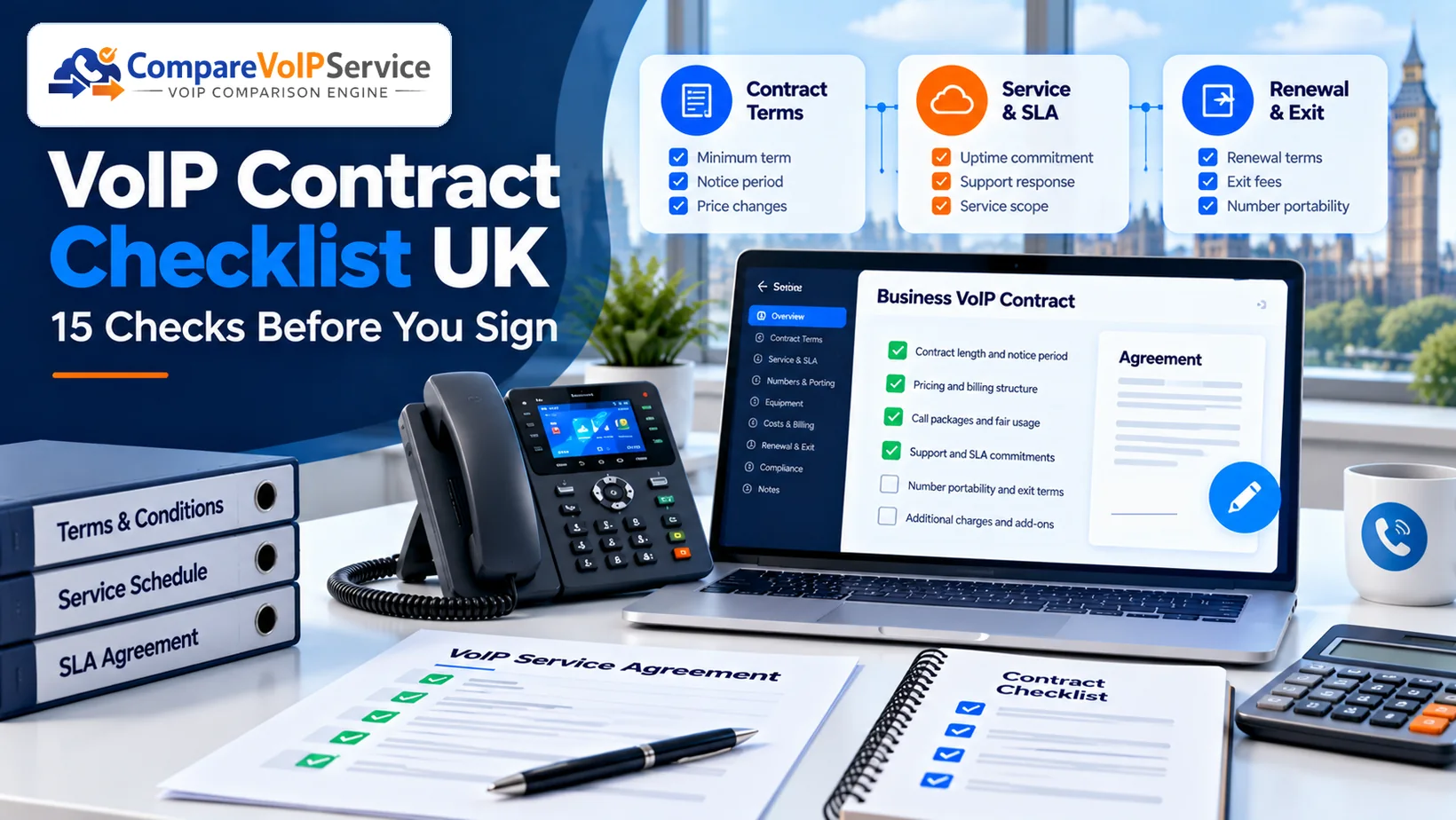
View the four contract evidence checks
A record of evidence is not an automated compliance verdict.
Quick answer: A safe procurement decision starts with a complete contract pack, a named responsibility owner and no material unanswered clauses. The embedded checklist lets you export supplier questions without sending them to a website.
Start here · contractual readiness
Before signing a UK business VoIP contract, collect the order form, full terms, service schedule, tariff, SLA, number inventory and exit wording. Check who provides each service, when fees start, how prices change, how to report faults, and what happens if the business moves supplier. If a clause is unclear, request a written answer and keep it with the signed agreement.
Use this page for
Pre-signature scrutiny of telephone service agreements, renewals and contractual evidence. The embedded 15-point register lets your team track missing answers.
Do not use it as
A legal determination, a vendor ranking, or proof that any particular supplier’s contract complies with every regulation. Contract scope and your specific facts matter.
Which UK business contract rights apply?
The relevant rights depend on the customer type, number of employees, communications service and contract structure. Start with the actual employing business and obtain written confirmation of the terms that apply to its services.
| Buyer category | What to investigate | Useful evidence |
|---|---|---|
| All business customers | Ofcom rules covering eligible communications services include contract-information, transparency, billing and switching duties. | Product and contract service definitions; Ofcom General Conditions. |
| SMEs: fewer than 250 employees | Ofcom summarises publication and durable-format access to standard SME terms, including SLA/SLG details for relevant services. | Standard contract, service specification and SLA copy. |
| Small businesses: ten employees or fewer | Additional protections may apply to relevant landline, broadband and other covered communications services, including pre-contract information, summaries, minimum-term and renewal protections. | Employee threshold, service type, one-page contract summary (or up to three for bundles), dated offer. |
| Larger businesses / mixed bundles | Do not assume rules that apply to consumers or eligible small-business services automatically cover a separately negotiated PBX, equipment lease or every service in a bundle. | Signed schedules identifying each legal supplier and service. |
Ofcom’s January 2025 pounds-and-pence price-rise rules are often discussed for consumer contracts. Do not assume that the same prohibition automatically determines the terms of every B2B VoIP, managed PBX or equipment agreement. Check the actual scope and published Ofcom conditions.
See Ofcom’s business protections summary and Ofcom’s contracts guidance. These are regulatory reference points, not an automated determination of entitlement.
Documents to request before signing
Ask for the complete agreement before accepting an order, direct debit or digital signature. A sales proposal is not always the controlling document. Record the exact version, date, relevant web terms and any subsequent changes.
Core contractual record
- Signed order form and product/feature schedule
- Terms and conditions, including incorporated hyperlinks
- Tariff, price changes, call allowances and VAT basis
- Support hours, SLA/SLG and escalation arrangements
Operational and exit record
- Number list and porting authority
- Emergency calling and resilience responsibilities
- Separate carrier, connectivity or lease contracts
- Recording/data export, retention and deletion terms
Interactive 15-point contract evidence register
Use this interactive evidence register as a procurement working document. Each of the 15 checks needs a recorded outcome; a claim of “evidence confirmed” must include a reference to the written evidence, and “not applicable” requires an explanation. This tool never determines whether a contract is legally compliant.
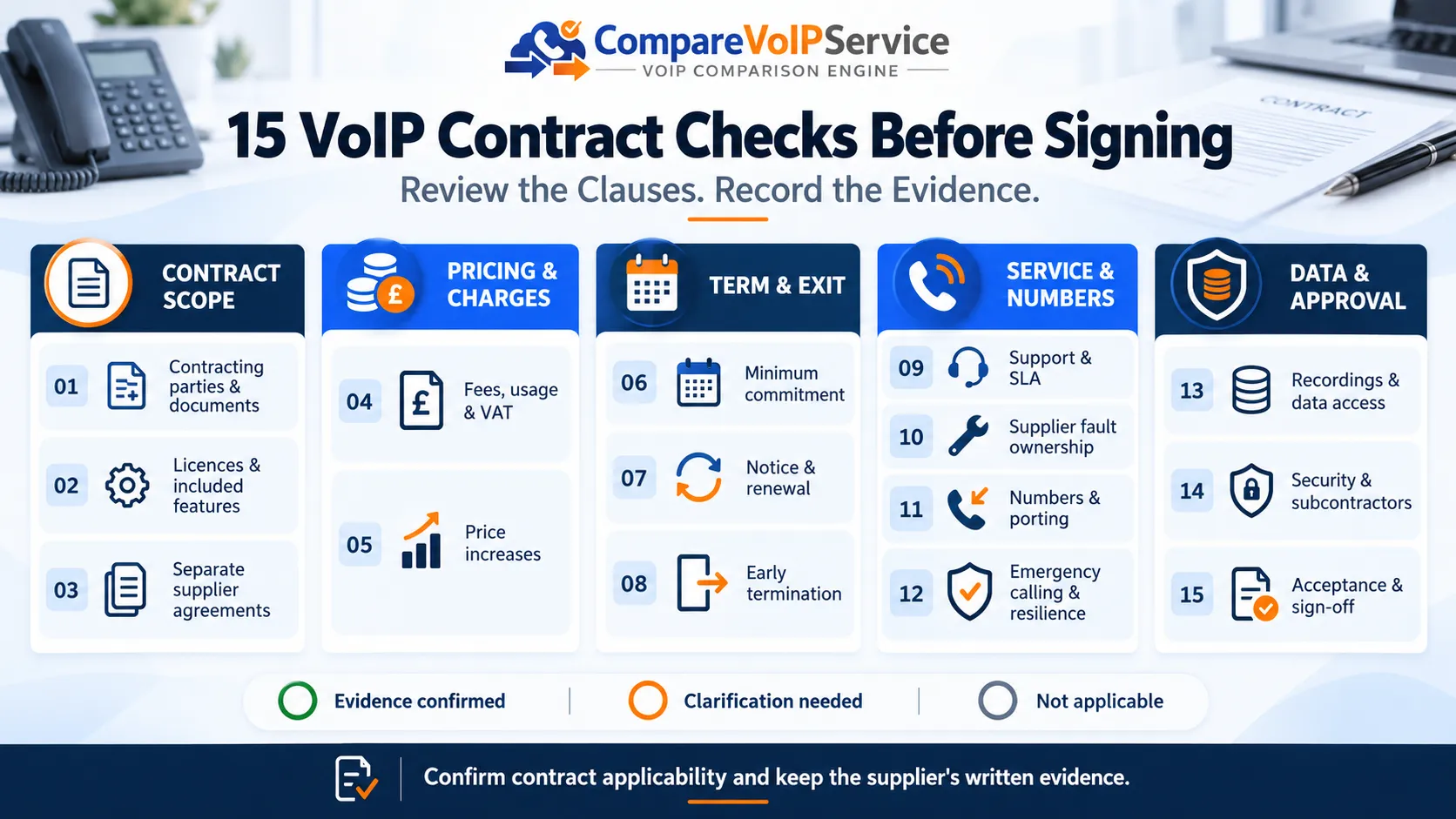
01 · Contracting entity and complete documentsScope
Examine: Name the legal provider, any agent/reseller, quote version, order form, schedules and incorporated web terms.
Request: Ask which entities are legally responsible for each service.
02 · Licences, users and feature entitlementsScope
Examine: Confirm numbers of users, extensions, concurrent calls, recording, integrations and service exclusions.
Request: Request the edition/tier and a signed feature schedule.
03 · Separate broadband, SIP and hardware agreementsScope
Examine: Identify separate contracting parties and whether equipment is financed or leased.
Request: Ask for every independent agreement, term and termination date.
04 · Monthly fees, usage, VAT and added chargesCommercial
Examine: Identify recurring licence, carrier, minute overage, setup, admin, equipment and support fees.
Request: Request a dated schedule stating ex-VAT / inc-VAT and billed units.
05 · Annual increases and price-change noticesCommercial
Examine: Find fixed increases, review dates, discretionary changes and rights following contractual changes.
Request: Ask for the precise written increase mechanism and applicability.
06 · Minimum commitment and start dateCommercial
Examine: Check term length, commencement trigger, staged deployment and add-seat impact on term.
Request: Request confirmed start/end dates and any term-extension rule.
07 · Cancellation, notice and automatic renewalCommercial
Examine: Confirm notice method, recipient, deadline, rolling term and any renewal into a further minimum.
Request: Ask for sample cancellation instructions and renewal wording.
08 · Early termination and related settlementsCommercial
Examine: Locate cancellation formula, remaining licence fees, equipment finance and any other termination charges.
Request: Request an illustrative clause calculation, without assuming legal enforceability.
09 · Support windows, SLA and service creditsOperations
Examine: Confirm supported hours, severity levels, response and restoration targets, exclusions and remedies.
Request: Ask for an actual service-level agreement and escalation matrix.
10 · Fault boundaries and third-party dependenciesOperations
Examine: Identify who owns ISP, router, LAN, SIP carrier, PBX, handset and Microsoft/CRM integration faults.
Request: Request an incident RACI and named single-contact escalation path.
11 · Numbers, DDI inventory and switching/portingOperations
Examine: List all phone numbers, contractual owners, porting authorisations, lead times and temporary diversion.
Request: Request a number schedule and the written port-out/handover procedure.
12 · 999/112, caller location and outage fallbacksOperations
Examine: Verify carrier emergency-calling arrangements, registered addresses and power/broadband failure plan.
Request: Request implementation acceptance criteria and carrier responsibilities.
13 · Recording, personal data and access on exitGovernance
Examine: Confirm recording storage, lawful access, retention, admin rights, export formats and deletion.
Request: Ask for contract schedule, privacy/security documentation and export procedure.
14 · Security, incident reporting and subcontractorsGovernance
Examine: Confirm account security, privileged access, breach escalation, subprocessors and backup scope.
Request: Request security controls, incident SLA and support ownership.
15 · Go-live acceptance, change control and sign-offGovernance
Examine: Document porting completion, test calls, routing, evidence sign-off, defects, remedies and when charges start.
Request: Request a written user acceptance test plan and rollback owner.
CSV is an editable evidence record for spreadsheet software; it is not a certified contract review. Save it somewhere appropriate for your organisation’s confidentiality requirements. On-page answers are not automatically saved across reloads. Files export directly from your browser.
Pricing, licence changes and annual increases
Compare the charges specified in your agreement, including usage and additions after go-live. Identify whether the contract price changes with seats, concurrent calls, integrations, recording or carrier usage. A headline “per user” figure rarely captures every obligation.
| Clause to locate | Question worth asking | Record in evidence register |
|---|---|---|
| Payment schedule | What is recurring, one-off, optional or excluded? Are invoices ex-VAT or inc-VAT? | Document, price schedule and date. |
| Price review | Are adjustments fixed, indexed, discretionary or tied to a date? | Exact wording and who may change it. |
| Seat adjustment | Can seats decrease mid-term, or only increase? Is there a minimum? | Minimum billable commitment and licence change rule. |
| Usage | Which UK calls, destinations and roaming services are included? | Allowances, fair-use threshold and rate table. |
For explanations of fee categories, see the existing UK VoIP pricing and hidden costs guide; this page focuses on contractual proof, not general price comparison.
Minimum terms, notice and renewal
Write down the exact minimum term, commencement trigger, renewal date and notice deadline. An agreement may start billing on signature, service activation, first number port, equipment delivery or some other contractual event. These may not be equivalent.
| Scenario | What to verify | Why it matters |
|---|---|---|
| Initial term | Start trigger, end date and any early termination basis. | Stops accidental exposure to an extra commitment. |
| Extra licences | Whether a new seat/order extends the original contract. | Protects against hidden contract resets. |
| Renewal | Whether the service rolls month to month or enters a new commitment and what consent is needed. | Changes your ability to leave or re-quote. |
| Notice | Deadline, recipient and method for giving valid notice. | A late or wrongly addressed notice may create a dispute. |
Ofcom advises that qualifying businesses with ten employees or fewer benefit from additional limits and protections for covered landline/broadband contracts, including a maximum minimum term of 24 months and restrictions on renewed minimum terms without consent. Check the exact covered service and customer classification; do not apply this automatically to independent equipment finance or all managed PBX elements.
Service levels, support and remedies
Ask for the service-level agreement itself. “24/7 support” might mean a helpdesk can log an incident at any hour; it does not automatically mean an engineer, replacement equipment or a contracted restoration time is available around the clock.
Written support schedule
- Included coverage and holidays
- Severity categories and escalation contacts
- Initial response, next update and restoration targets
- Excluded equipment, networks and third-party services
Remedies and service credits
- Definition of qualifying downtime
- Evidence and deadline to claim credits
- Maximum credit and any limitations
- Backup calling and customer communication owner
For businesses with fewer than 250 employees, Ofcom summarises specific duties to publish and provide standard SME contract information including relevant SLAs/SLGs for covered services. Compare the written scope to your operating hours rather than accepting a marketing promise.
Number ownership, portability and handover
Make an inventory of each main number, DDI and critical inbound destination. Obtain written agreement on how the supplier will support the porting process and continuity at contract end. Keep the list independent of the supplier’s portal.
| Issue | Evidence to request |
|---|---|
| Control of numbers | Full E.164 number inventory, losing/gaining provider details and authority to port. |
| Porting and switching | Required authorisations, planned outage window, temporary diversion and exception handling. |
| End of service | Who initiates and completes the port, who signs off, and when the prior service is terminated. |
Ofcom General Condition C7 addresses number portability for covered services. It includes obligations relating to porting on reasonable terms and no direct switching-customer charge for number portability. This does not mean that every separate consultancy, site visit or system-migration service must be free. For the process itself, read the published UK number porting guide.
Emergency calls, security and continuity
A compliant service promise is not proved by a feature badge. Request testable statements about 999/112 access, the caller location conveyed by the chosen carrier, non-fixed calling locations, power failures, broadband outages and alternative access arrangements. Assign the business and supplier responsibilities clearly.
- Emergency access: who confirms service availability for each type of phone/softphone and site?
- Location records: who maintains accurate addresses when users or devices move?
- Power and internet: what happens during an outage, and what alternative has been tested?
- Security: who manages administrators, account recovery, fraud controls and backups?
Emergency-call tests must follow an approved supplier procedure; never use 999/112 for an informal demonstration.
Reseller, carrier and equipment finance responsibilities
A quote from a reseller may include multiple separate contracts: a hosted PBX licence, a SIP carrier, broadband, handset lease and managed support. A single monthly payment does not necessarily mean a single contracting entity or aligned cancellation date.
| Service layer | Who must be named | Typical dispute risk |
|---|---|---|
| PBX platform | Licensor / managing service provider | Admin access, licensing and system backup. |
| Call carrier / SIP trunk | Network provider or wholesale partner | Number porting, calling rates, 999/112 and voice routing. |
| Internet / firewall | Broadband provider or IT team | Outage ownership and network readiness. |
| Handsets / finance | Owner, lessor or lender | Return, settlement and equipment recovery. |
Have each party confirm in writing where its responsibility begins and ends. If sales wording conflicts with signed schedules, request a corrected order pack before acceptance.
How to close gaps before signing
Set a single review owner and circulate an evidence register before acceptance. Mark a clause “confirmed” only when you have the applicable document and can identify the relevant page or clause. Use “clarification needed” for missing, conditional or contradictory answers.
- Collect signed-ready terms and schedules for every contracting party.
- Identify business size, service type and applicable Ofcom protections.
- Complete the 15 clauses in the evidence register above.
- Send the outstanding items as numbered supplier questions with a response deadline.
- Reconcile the supplier reply to the controlling contract wording.
- Escalate important unresolved terms to procurement, legal or operational owners.
- Keep the dated final contract pack with the accepted system test and number inventory.
Do not treat “15/15 recorded” as permission to sign. A complete evidence record can still contain unresolved supplier answers. Your organisation decides acceptable risk with appropriate professional review.
Worked example: an incomplete supplier contract
Illustrative example only (not a real customer case or supplier test). A business with eight employees receives a proposed hosted phone service but the document pack omits a contract summary, does not state whether the support hotline is staffed overnight, and links to an undated equipment lease.
Before clarification
The buyer knows the monthly licence rate but cannot confirm the minimum contractual commitment, leasing counterparty, support restoration terms or what happens if the business moves its numbers.
Required evidence
Request the relevant communications contract summary, complete leasing agreement, dated SLA, written renewal/notice terms and number porting schedule. Do not assume all small-business protections extend to the separately financed handset contract.
The useful outcome is a corrected contract pack, not a speculative legal score. Only afterwards should the business compare alternative supplier proposals.
Contract checklist FAQs
What should a VoIP contract checklist include?
Identify the contracting parties, service and feature schedules, price adjustments, minimum term, renewal and notice rules, support remedies, porting, emergency-call responsibilities, personal-data handling and termination requirements. Use the 15-point evidence register to record supporting clauses.
Can a UK business sign a 36-month VoIP contract?
Do not assume a 36-month commitment suits or is permitted for every customer. Ofcom summarises additional maximum minimum-term protections for qualifying businesses with ten employees or fewer on relevant covered services. Independently assess each service or financing agreement.
Can a VoIP supplier renew a contract automatically?
The answer depends on the customer and covered service. Ofcom says qualifying small businesses with ten employees or fewer have protections against automatic renewal into a new minimum term on relevant landline and broadband services without consent. Check your exact terms.
Does a 24/7 support promise mean a four-hour repair?
No. Read the written SLA and separate initial response, escalation and restoration commitments, exclusions and service credits.
Must I pay to port my telephone number?
Ofcom C7 sets rules for number portability of covered communications services, including no direct charge to the switching customer for providing number portability. Other distinct IT, installation or migration services may have separate charges.
Do consumer rules about inflation-linked price increases apply to every business PBX contract?
No blanket assumption is safe. Consumer guidance and small-business contractual protections may differ, as may the underlying service and equipment agreements. Ask for the exact pricing schedule and verify relevant Ofcom conditions.
Is the checklist itself legal advice?
No. It records evidence and questions for a business procurement decision. Ask a qualified adviser to review material legal uncertainty or any disputed term.
Does exporting the form send my contract information to CompareVoIPService?
No. The supplied browser tool generates a CSV on your device and does not send its entries to a server. Export is optional; treat the resulting file as business-confidential material.
Sources, limitations and review method
This guide is an educational contract review framework updated against publicly accessible UK primary guidance on 24 October 2026. It does not contain purchased supplier contracts, hands-on testing, guaranteed outcomes or legal advice.
- Ofcom — General Conditions that protect business customers. General customer categories, C1/C2/C7 scope and small-business protections.
- Ofcom — Contracts. Written terms, minimum commitments, changes, notice and automatic renewals.
- Ofcom — Checklist for new phone or broadband contracts. Advice updated in June 2026.
- Ofcom — Telecoms price rises: what are your rights?. Consumer-contract context and pricing terminology.
- Ofcom — C7 switching and number portability within the General Conditions. Confirm current official conditions for the specific service.
Get the terms clear before you commit.
Export the completed evidence register, send your unanswered questions to the supplier and compare options only when the written obligations are clear.
- Signed schedule and pricing version
- Support and emergency-call obligations
- Number/porting and data-exit terms
- Written clarification of open clauses

Bhav Giva
Founder & Lead Analyst at CompareVoIPService.co.ukBhav Giva publishes UK-focused business communications research and practical VoIP guidance. This guide concentrates on compatibility, continuity and the evidence businesses should request when introducing an AI call-handling layer into an established telephone environment.