

Compare business VoIP quotes on a truly like-for-like basis.
Normalise seats, calls, handsets, setup, VAT, contract terms and support. Use a three-supplier cost worksheet that flags missing evidence instead of hiding it.
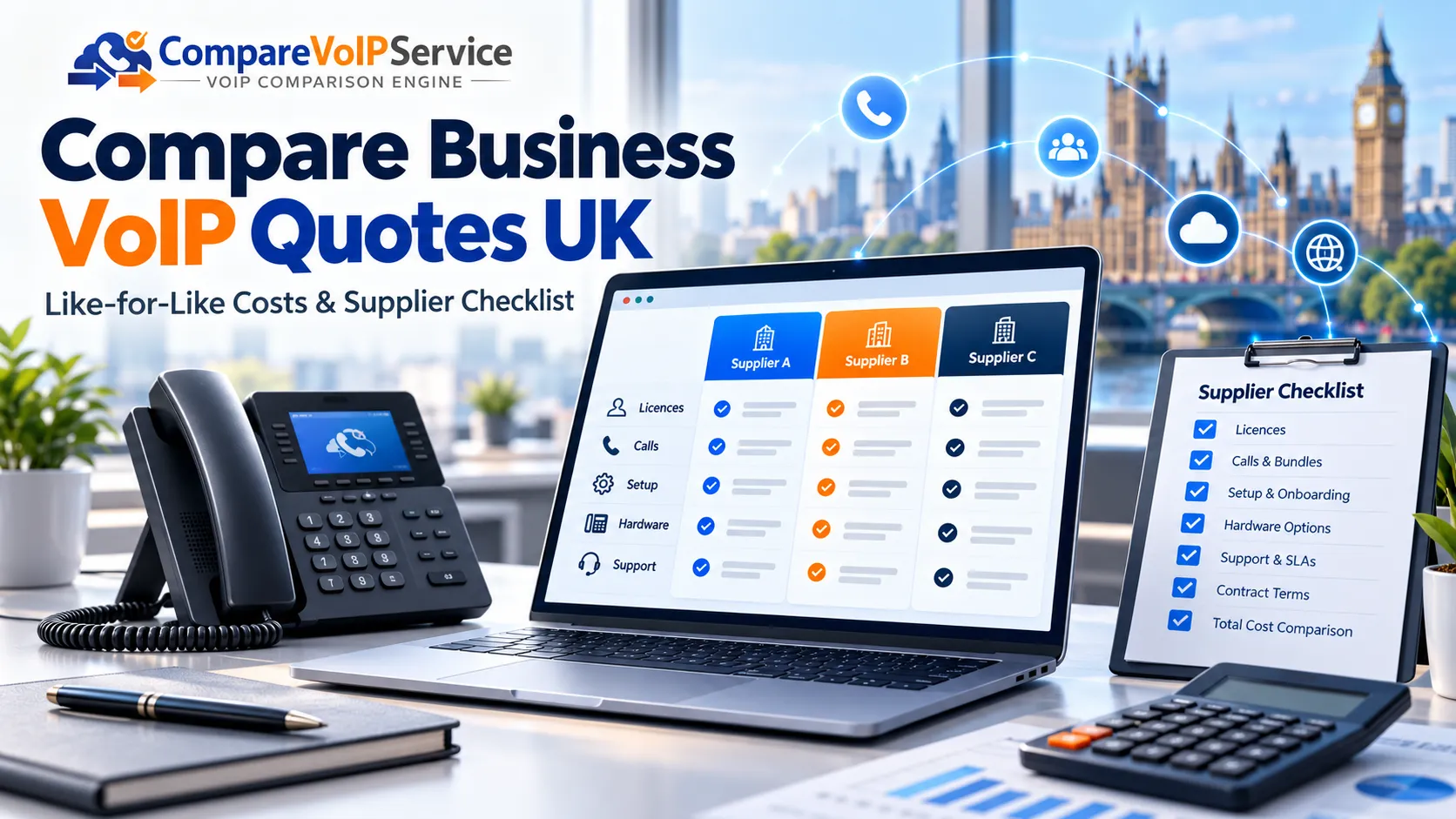
See the four checks behind the comparison
Cheaper per user does not prove cheaper total cost.
Quick answer: To compare UK business VoIP quotes fairly, send the same requirements to every supplier, mark each cost as included, quoted, estimated, not applicable or unknown, and calculate full 12-month and correctly qualified longer-term costs. Check contract rights, number porting, 999/112 access and service support before choosing.
On this page · jump to section
What does a like-for-like VoIP quote comparison mean?
It means comparing supplier prices for the same agreed business telephone requirements. A quote is not comparable just because it quotes the same number of users. One proposal may include UK mobile calls, porting, support and handsets; another may exclude them or charge separately.
Build one requirements schedule first: required seats and roles, sites, peak concurrent calls, inbound numbers, UK/international destinations, call features, connectivity, security, resilience and support. Send that same schedule to every supplier and ask them to mark each cost quoted, included, not applicable, estimated or unknown.
One number of users, call profile and service model.
Reconcile included and excluded items, not headline seat prices.
Check acceptance tests, support ownership and contract terms.
Define the same requirements before requesting prices
Use the following illustrative scenario only to understand the method. It is not a tested customer account and contains no supplier prices.
| Requirement | Illustrative buyer brief | Evidence to request |
|---|---|---|
| Users and sites | 20 staff across two UK sites | Named users, shared phones, remote workers and licences |
| Call handling | Main number, 2 queues, voicemail and business-hours routing | Which licence tier supports each function? |
| Capacity | Expected peak simultaneous calls stated by buyer | How does the supplier size SIP channels and concurrent calls? |
| UK calling | Define expected UK landline/mobile minutes | Destinations, fair-use wording, pooled vs per-user minutes |
| Numbers | Retain a main number and named DDIs | Porting provider, lead times, rollback and fees |
| Continuity | Power/ISP fallback and support escalation | 999/112 address handling and outage response |
If a supplier changes the requirements to make a quote appear cheaper, document the deviation. The benchmark is the buyer’s requirement, not the cheapest configuration.
The quote inclusion matrix: what must be itemised?
Each category needs either a genuine included entitlement, a priced amount, an evidence-backed estimate or a request for clarification. Ask for each answer against the exact plan/SKU.
| Cost category | Questions that prevent hidden extras | Treatment in comparison |
|---|---|---|
| Core licences | Per named user, concurrent call or system? Minimum seats? | Monthly recurring; multiply per-user rate only when truly per-user |
| Calling plans | Which destinations and fair-use thresholds? UK mobiles? | Recurring allowance plus estimated overages |
| Phone numbers / SIP | DDIs, SIP channels, transfer and monthly rental? | Recurring and one-off separately |
| Equipment | Buy, rent, reuse or supported softphones? | Upfront purchase or recurring rental |
| Onboarding | Porting, training, IVR, migration, site visits? | Upfront cost, record ownership |
| Add-ons | CRM, recording, analytics, storage and contact-centre licences? | Recurring charge or verified included scope |
| Support | 24/7 live support or ticket intake only? SLA remedies? | Chargeable coverage and responsibility |
| Network | Internet, PoE, firewall, dual WAN, backup power? | Necessary network costs; scope in or out |
| Contract / exit | Uplift, notice, equipment return, legacy exit? | Separate contractual risk and likely charges |
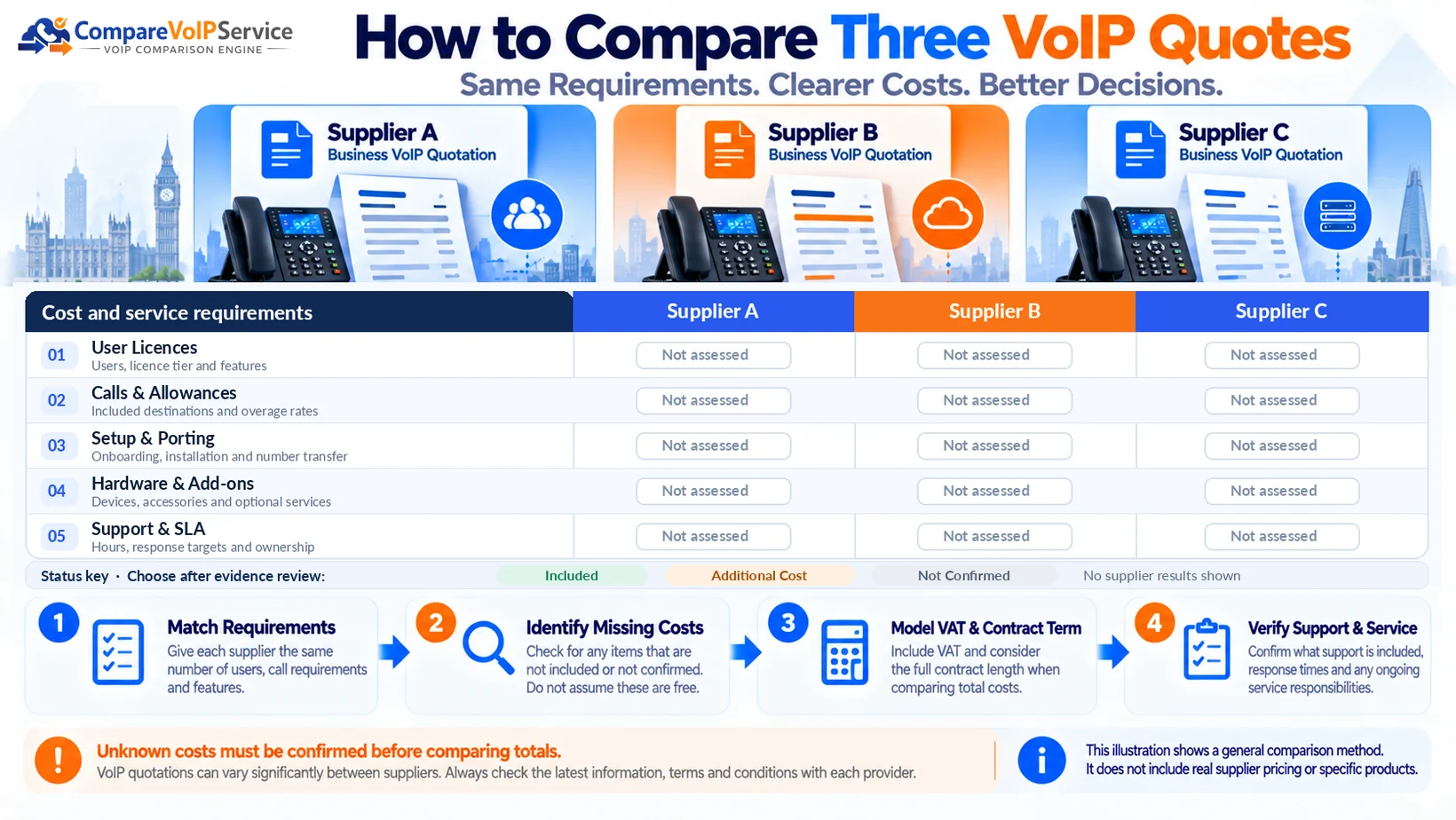
The published VoIP hidden-costs guide explains why these categories arise. This page focuses on converting them into a consistent procurement comparison.
Try the three-supplier quote normalisation calculator
This on-page estimate compares the same staff count using a shortened set of major charge groups. It uses your inputs only: there are no provider rates, invented tariffs or saved customer details. It is not a substitute for the fuller Excel evidence worksheet supplied with this release.
Use the downloadable three-supplier comparison workbook
The accompanying three-supplier Excel worksheet includes thirteen cost lines, per-line evidence statuses, supplier quotation notes and 12-, 24- and conditional 36-month projections. Its totals remain incomplete if even one line has an unresolved or unpriced status.
| Worksheet field | Why it matters |
|---|---|
| Quoted | Supplier has confirmed the line and supplied the amount |
| Included / N/A | Explicit zero additional cost, not an assumed absence |
| Estimate | Buyer assumption; must never be presented as a supplier quote |
| Unknown | Blocks complete cost projection until resolved |
| Evidence URL | Links the cost/entitlement to a dated supplier offer |
For a quick savings estimate, the existing VoIP Savings Calculator serves a different purpose: current-versus-future spend. Use the quote worksheet when you are already comparing multiple suppliers.
Compare year-one costs, renewals and valid contract horizons
For supplier s, let Ms be its verified monthly recurring costs and Os its verified one-off costs. Then the first-year ex-VAT estimate is 12 × Ms + Os. Apply a disclosed annual uplift or scheduled price change to each later year; if that uplift is unknown, do not show a precise multi-year total.
| Horizon | Comparison calculation | Important qualification |
|---|---|---|
| 12 months | 12 × monthly total + one-off charges | Model both rolling service and contract commitments |
| 24 months | First 12 months + adjusted next 12 months + one-off | Need verified year-two price and eligibility |
| 36 months (projection) | Add a third priced year where a relevant scenario is lawful | An analysis horizon is not an endorsement of a 36-month minimum contract |
Ofcom says residential and qualifying small-business phone/broadband contracts (businesses with ten employees or fewer) should not exceed a 24-month minimum commitment. These customers have additional pre-contract summary rights. Larger-business terms may differ; confirm the applicable rules and product. This is a commercial evaluation guide, not legal advice. Source: Ofcom — Contracts.
Request a written evidence schedule from each supplier
When quoting, suppliers may say “included”, “supported” or “unlimited” without defining the plan, limitations or responsible party. Ask for versioned evidence, not oral assurances.
| Field to request | Minimum acceptable evidence |
|---|---|
| Quote identity | Supplier legal entity, dated document, validity period, plan/SKU |
| Price basis | Ex/inclusive VAT, user count, minimum service spend, billing interval |
| Call allowance | Destinations, shared/per-user pool, fair-use or rate card |
| Number portability | Inventory, losing/gaining providers, port charges and rollback plan |
| Emergency calling | Written 999/112 access, caller location and power/internet interruption process |
| Service ownership | Named incident owner for platform, SIP trunk, internet and devices |
| Contract changes | Uplift formula, notices, renewal, term and early-exit mechanism |
| Quote exceptions | Explicit exclusions and alternate-cost assumptions |
A supplier refusing to itemise an exclusion should not be treated as having quoted a cheaper equivalent service. Ask for a revised version of the quotation.
Service responsibility matrix: price is only one buying dimension
Price is necessary but not sufficient. Ask who is accountable when an otherwise inexpensive service fails after a carrier outage or misconfigured number port.
| Service dependency | Supplier must identify owner for | What to verify |
|---|---|---|
| Telephony platform | Configuration, licences, app access | Changes, restore and admin permissions |
| UK SIP / PSTN | Carrier routing, numbers, capacity | Porting, call barring and failover |
| Internet / LAN | WAN, firewall, PoE, voice VLAN | Call quality, dependency and fault routing |
| Emergency access | 999/112 route and location records | Locations, moves, outages and power continuity |
| Helpdesk | Out-of-hours response and escalation | Live response, response clock and credits/remedies |
| Data / recordings | Storage, access and retrieval | Retention, portability and deletion at exit |
For UK emergency calling, Ofcom’s General Conditions require regulated service providers to meet specific emergency access and location obligations. Your acceptance procedure must establish responsibilities for your chosen deployment; the act of having a VoIP subscription does not prove continuity under power or connectivity loss. Ofcom emergency calling guidance.
Twelve acceptance checks before signing a supplier contract
- Each supplier has quoted the identical seat count and user roles, including shared and remote users.
- The named service tiers cover essential IVR, queues, voicemail, recordings and CRM if required.
- Concurrent call and SIP-channel requirements match the same peak-call assumption.
- UK landline, mobile and other destinations have a written allowance, excess rate and fair-use definition.
- Every retained main number and DDI has a documented port plan, price and cutover owner.
- Devices, softphones, licensing and support responsibilities are unambiguous.
- Network readiness, bandwidth, firewall settings, voice VLAN, power and contingency are assessed.
- 999/112 location handling and continuity dependencies have named owners and evidence.
- Helpdesk hours, response targets, escalation contacts, exclusions and remedies are documented.
- Recurring charges, one-off costs, licence minimums and add-ons are itemised ex/in VAT.
- Annual price changes, minimum term, renewal notice, exit charges and hardware ownership are clear.
- Trial or acceptance sign-off checks are agreed, with rollback and data access provisions.
Worked example: why the lower headline can cost more
The example below uses hypothetical numbers only to illustrate the comparison method. These are not live UK offers or supplier pricing claims.
| Hypothetical 20-user quote | Supplier A (illustrative) | Supplier B (illustrative) |
|---|---|---|
| User licences | £10/user/month | £13/user/month |
| Platform + SIP + calls + support | £190/month | £60/month |
| Setup, handsets, porting | £900 one-off | £350 one-off |
| Monthly recurring | £390 | £320 |
| 12-month ex-VAT total | £5,580 | £4,190 |
Supplier A looks cheaper per user (£10 vs £13), but the bundled scope produces higher monthly and first-year costs in this artificial illustration. The numbers say nothing about reliability, feature entitlements or value; they demonstrate why the same workload and cost categories matter.
Seven common quote-comparison mistakes
- Comparing per-seat pricing to system-based or concurrent-call pricing without normalising capacity.
- Mistaking an “unlimited UK calls” headline for an unrestricted, destination-neutral fair-use commitment.
- Treating a blank field as included at no additional cost.
- Ignoring telecoms services outside the hosted platform, such as SIP channels and WAN upgrades.
- Comparing one-off handset purchase with another provider’s monthly device rental without the total term.
- Using 36-month minimum-term examples for businesses entitled to stricter contract limits.
- Making a buying choice before written 999/112, porting, support and recovery responsibility is established.
A short procurement review may expose more practical risk than a lengthy unsourced provider feature ranking.
How to make the final supplier decision without a fabricated ranking
First apply a minimum acceptance gate: a supplier that cannot confirm required emergency access, number porting, contract terms or service dependencies should not win merely because its headline is lower. Only after eligibility and evidence are complete should you compare cost, operating fit and contractual risk.
| Decision factor | Suggested assessment method |
|---|---|
| Service fit | Met / not met for each non-negotiable requirement |
| Total cost | 12-month and matched-term fully evidenced ex/in VAT |
| Support quality | Documented ownership, support hours, SLA and remedy |
| Migration risk | Porting, transition plan, rollback, carrier responsibilities |
| Contract risk | Price rises, term, renewal notices and transfer/export terms |
The best supplier depends on your actual requirements and written offers. Where assumptions remain, ask for a revised quote. No automatic winner is assigned on this page.
Frequently asked questions about comparing VoIP quotations
How many supplier quotes should a UK business compare?
Two or three sufficiently detailed quotes often expose meaningful differences; more quotes are useful only if the same requirements are shared and the evidence remains manageable.
Is the cheapest VoIP user licence usually the cheapest full system?
No. Calling, SIP, handsets, installation, add-ons, network requirements and support can change the total. Do not compare per-user headlines alone.
Should I compare prices including or excluding VAT?
Record both where relevant. Use the correct rate for each line, and confirm each provider has quoted on the same tax basis. UK standard VAT is currently 20% for most services.
What should I do when a supplier leaves an item blank?
Mark it unknown, request a written clarification and withhold a final like-for-like total. A missing value must not silently become zero.
Can I use a 36-month comparison?
A 36-month cost projection can illustrate longer-run spending, but it must not be mistaken for advice to sign a 36-month minimum contract. Ofcom rules provide extra protections for qualifying small businesses with ten or fewer employees.
Should I use a VoIP savings calculator or a quote comparison sheet?
A savings calculator compares existing spend with a projected alternative. A quote comparison worksheet normalises actual, different supplier offers against one requirements schedule.
Can I assume 999 calls work because the VoIP provider says “UK coverage”?
No. Request deployment-specific emergency access, accurate caller location and continuity arrangements from the responsible service provider.
Does the comparison workbook decide which supplier is best?
No. It validates cost completeness and projects spend using entered information. Service fit, evidence, contract rights and support quality require human review.
Sources, methodology and editorial verification boundaries
This editorial decision guide uses the CompareVoIPService approved URL architecture and primary UK source guidance. It does not claim tests of a supplier, obtain unpublished tariffs or award scores. Source documents and applicable rules should be checked again at contract signature.
- Ofcom — Contracts — contract term, renewal and small-business protections
- Ofcom — New contract checklist — pre-contract buyer checks; updated June 2026
- Ofcom — Emergency services compliance — 999/112 access and caller location obligations
- GOV.UK — VAT rates — current UK VAT treatment overview
- CompareVoIPService — Buyer’s Guide — requirements definition, not quote normalisation
- CompareVoIPService — Hidden VoIP Costs — fee discovery and contract charge categories
Compare costs, then check which provider can actually deliver.
Use the quote-normalisation inputs and supplier acceptance checklist before choosing. For broader provider discovery, complete the separate recommendation quiz.
- Same features, seats and call allowance
- All recurring and one-off charges
- UK number porting and 999/112 owner
- Contract, SLA and renewal evidence

Bhav Giva
Founder & Lead Analyst at CompareVoIPService.co.ukBhav Giva publishes UK-focused business communications research and practical VoIP guidance. This guide concentrates on compatibility, continuity and the evidence businesses should request when introducing an AI call-handling layer into an established telephone environment.