

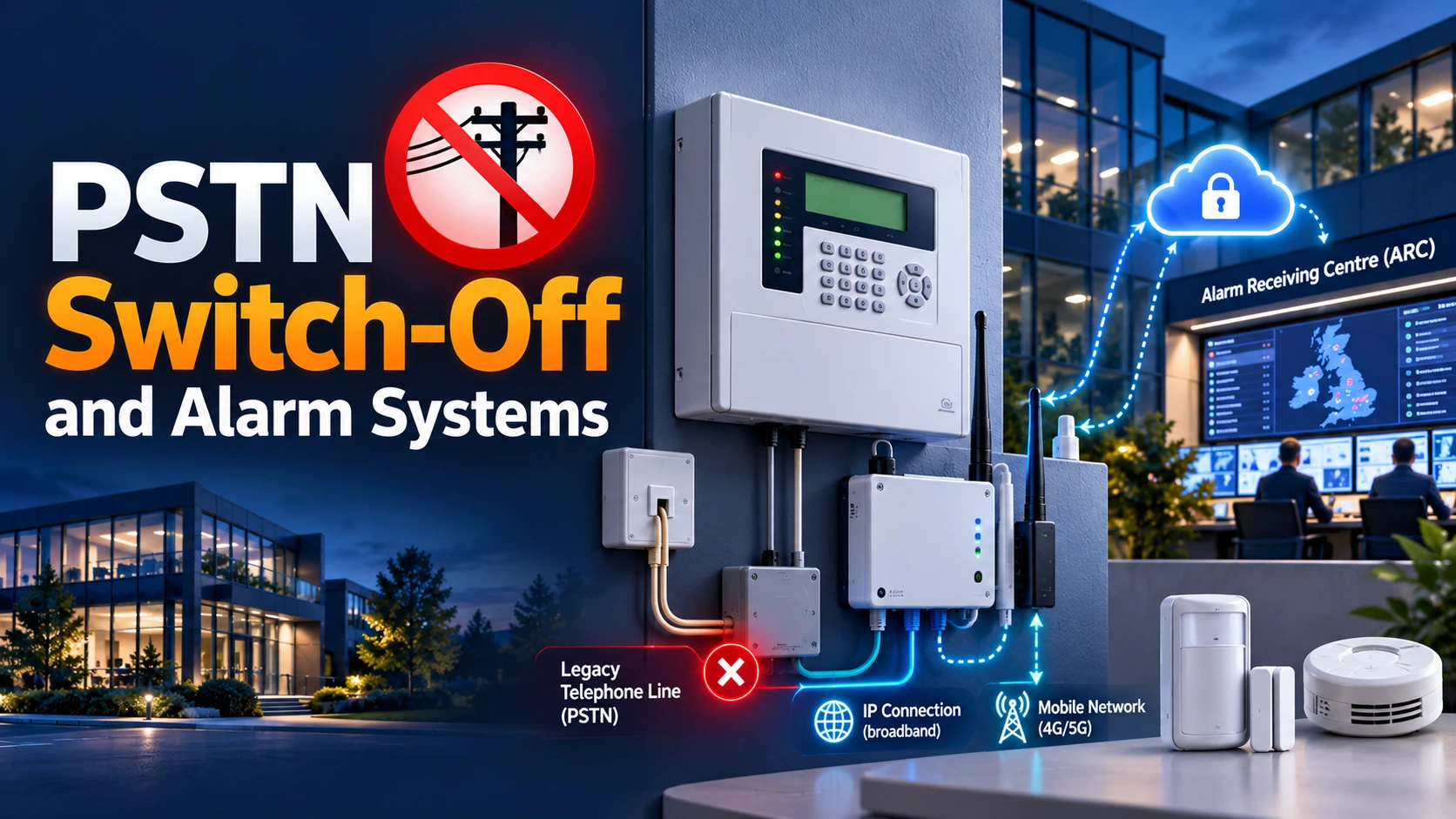
PSTN Switch-Off and Alarm Systems: Know What Must Be Verified
An alarm can sound at your premises while its monitoring link no longer works. Learn how to identify line-dependent signalling, coordinate your installer and monitoring centre, and obtain evidence before an old telephone circuit is disconnected.
Never use this illustration as permission to disconnect a fire, intruder or other safety-critical signalling service.
Quick Answer: The UK is retiring its traditional telephone network by 31 January 2027. If your business alarm still communicates with an Alarm Receiving Centre through an affected analogue line, its remote monitoring may fail after migration. Confirm the actual signalling path, agree an installer-approved replacement, obtain monitored event confirmation, and only then consider releasing the old line.
Jump to a Section
Will Your Alarm Work After the PSTN Switch-Off?
An alarm that relies on an analogue telephone line to contact an Alarm Receiving Centre (ARC) may lose its remote signalling when that line is migrated or withdrawn. The panel, sensors and sounder might continue to operate locally. That does not prove a monitoring centre will receive an activation, fault or tamper message.
Openreach identifies 31 January 2027 as the national PSTN retirement milestone. A particular communications provider may migrate your connection earlier. The date should therefore trigger urgent checks, not be treated as a guarantee that an existing alarm connection will continue operating until that day.
“The alarm went off” and “the monitoring centre received the right signal and can respond” are different outcomes. Ask your installer and ARC to confirm the second outcome through their approved test procedure before any existing line is ceased.
May not depend on a telephone network for the local sounder, but a hidden dialler, engineer-access feature or remote notification path may still need checking.
Needs its alarm transmission system assessed: signalling medium, ARC compatibility, path supervision, power provision and agreed response arrangements.
This guide is about monitored fire and intruder alarm signalling. For an inventory of every business telephone line and other connected devices, use the existing business PSTN readiness checklist.
How Does an Alarm Send a Signal to a Monitoring Centre?
A traditional monitored installation may have a communicator that dials an ARC over the public telephone network and transmits coded tones. When the telephone service changes, the communicator may no longer complete its signalling exchange reliably, even if an ordinary telephone can still make calls.
Do not infer the signalling route from the broadband package, the age of the building or the existence of a smartphone app. It is possible for a newer-looking alarm to retain a legacy communicator, or for a telephone line to be reserved for equipment that office staff rarely see.
Which Fire and Intruder Alarm Systems Could Be Affected?
| Alarm Arrangement | Potential Dependency | Who Must Confirm |
|---|---|---|
| Bells-only intruder alarm | Local sounder may continue, but check for a separate telephone dialler, engineer access or remote messages. | Alarm maintenance provider. |
| ARC-monitored intruder alarm | Analogue dialler, legacy alarm signalling service or other dependency may stop transmitting to the ARC. | Installer and ARC; insurer if conditions apply. |
| ARC-monitored fire alarm | Fire and fault transmission can be affected even if the local panel remains active. | Competent fire-alarm specialist, responsible person and ARC. |
| IP- or app-connected alarm | May not depend on PSTN, but check for a legacy backup route and any power/broadband dependency. | Installer or monitoring provider. |
| Mobile or dual-path communicator | Not necessarily dependent on the analogue network; cellular coverage, service life and path independence still require confirmation. | Installer, communications service and ARC. |
Buildings may also contain sprinkler, plant-room, environmental or other monitored equipment. Include it in the wider property audit, but do not assume that this fire-and-intruder guide supplies the acceptance criteria for every type of device.
Where fire alarm transmission forms part of a premises’ fire safety arrangements, the responsible person should involve the competent fire-alarm contractor and confirm any relevant standards, risk assessment and maintenance records. For an intruder alarm, ask the installer whether insurer or police-response arrangements affect the specified signalling service.
How to Find Out Whether Your Alarm Still Uses a Phone Line
Start with records and qualified suppliers, not by opening an alarm panel or unplugging cables. The objective is to establish what the installed alarm actually uses, which company supports it and what happens when its signalling path is unavailable.
- Identify the installation. Record the premises, alarm system type, panel and communicator model where known, and the relevant maintenance contract. Avoid storing sensitive access codes in general project notes.
- Ask your monitoring provider. Confirm whether the site is monitored by an ARC, the installed signalling technology and whether legacy PSTN services are recorded against the account.
- Ask the installer. Request the current signalling grade or specification, monitored event types, fault-supervision behaviour and supported replacement arrangements.
- Map the communications account. Ask the line supplier which number or circuit feeds the equipment and whether it is scheduled for migration, regrade or cessation.
- Check contractual constraints. Ask the insurer or broker whether the permitted signalling method, response grading or changes to monitoring require written approval.
Do not cancel an unexplained line, remove an old communicator, disconnect the alarm or assume the ARC will continue receiving signals. Treat unknown critical dependencies as unresolved until a competent provider confirms the position.
What Can Replace PSTN Alarm Signalling?
The right replacement may be a new communicator integrated with the existing panel, a supported alarm transmission upgrade or, where necessary, a wider system replacement. It is not automatically necessary to replace every sensor and control panel, but the existing hardware must be compatible with the proposed solution.
| Approach | What to Evaluate | Important Limitation |
|---|---|---|
| IP-based alarm signalling | Compatible communicator, protected data route, approved ARC service, path supervision, power resilience and service support. | Broadband/router or local network failure may interrupt the path unless suitable resilience is designed. |
| Mobile-network signalling | Coverage survey, supported network/SIM, antenna position, service life, approved ARC connection and fault monitoring. | Coverage at the actual communicator location, mobile network changes and power still matter. |
| Two independently managed paths | Installer-approved signalling grade, genuinely separate failure modes, path-loss reporting and ARC response. | Two labels do not establish true independence; verify the design and test evidence. |
| Panel/communicator replacement | Manufacturer compatibility, sensor reuse, compliance scope, commissioning, maintenance and training. | Only a site-specific quotation can establish whether the whole panel needs replacing. |
Guidance from the British Insurance Brokers’ Association explains why the alarm transmission system (ATS) and its fault reporting can be central to the effectiveness of monitored protection. Check the risk-specific signalling requirement with the installer and insurer rather than assuming one technical grade suits every site.
A modern business phone system or VoIP subscription does not by itself constitute a certified or approved alarm transmission system.
Will an Analogue Adapter or Digital Phone Socket Keep the Alarm Working?
Do not assume so. A router telephone socket or analogue telephone adapter may support ordinary voice calling while failing to preserve the timing, tones, supervision, power resilience or service characteristics required by an older alarm communicator.
BSIA guidance specifically flags analogue signalling compatibility during the move to IP voice. For safety-critical signalling, the alarm specialist must approve any proposed arrangement, and the monitoring provider must verify its performance. A successful voice call—or even an isolated apparent test—is not proof of durable compliant alarm reporting.
Openreach describes an emergency voice continuity arrangement for some unmigrated telephone customers after the retirement milestone. It is not evidence that legacy alarm data transmissions will function, nor permission to defer alarm migration. Obtain a replacement and the required monitoring confirmation independently.
Who Is Responsible for Alarm Compatibility, Monitoring and Approval?
| Party | Questions They Should Answer | Evidence to Retain |
|---|---|---|
| Business / Premises Owner | Which sites and alarms are in scope? Who authorises line changes and approves commercial work? | Dependency register, contacts, approved change window and decision record. |
| Alarm Installer / Maintainer | What signalling system exists? What replacement meets the site specification? What has been commissioned? | Equipment/specification confirmation, commissioning report, supervised test results. |
| Alarm Receiving Centre | Are alarm and fault signals reaching the correct account, with appropriate responses and supervision? | Dated event receipt and monitoring acceptance confirmation. |
| Telecoms / Connectivity Provider | Which circuit is changing? When? How is continuity coordinated and who authorises its cessation? | Line identification, migration date, change notice and cease confirmation. |
| Insurer / Broker | Are signalling method, grade and continuity conditions satisfied where applicable? | Policy-specific approval or documented advice. |
| Fire Safety Responsible Person | Does the revised monitoring arrangement satisfy the premises’ fire safety requirements? | Relevant fire records and specialist approval where applicable. |
Multiple suppliers may participate, but that does not make responsibilities interchangeable. A telephone provider can identify and change the line; an alarm specialist must assess whether the signalling design is acceptable. Do not substitute a sales quotation for a commissioning and monitoring acceptance record.
What Happens During a Power Cut, Broadband Outage or Mobile Failure?
Legacy analogue connections and modern IP/mobile systems have different dependencies. A replacement scheme should address both the expected day-to-day route and realistic failures—not just whether it transmits while every service is healthy.
Confirm the autonomy and maintenance of the panel, communicator, router, switches and any supporting network devices as designed by the specialist.
Confirm how the path is supervised, what fault reaches the ARC and whether an independent supported path remains.
Confirm coverage at the installation position, network/SIM arrangements, fault detection and replacement provisions.
Ask how faults are detected, escalated and communicated to keyholders, and where the documented response plan is held.
Do not run power-cut, path-isolation or monitored fire-alarm tests yourself. The installer and ARC must agree safe testing conditions and any notifications necessary to avoid false dispatches or interruptions to protection.
How to Migrate an Alarm Without Losing Monitoring
Find the panel, transmitter, monitoring route and affected line.
Agree the specialist design and any insurer/fire-safety conditions.
Install and verify monitored events using the approved procedure.
Receive written acceptance before authorising the old-line cease.
- Agree a single accountable coordinator. Include the site representative, alarm installer, ARC and telecoms supplier in the change plan.
- Obtain an approved replacement design. Specify communications route, monitoring, required signalling grade, fault reporting and supporting power arrangements.
- Prepare the cutover. Schedule installation and any brief supervised change window so there is no unapproved period without the required protection.
- Commission and test. The competent parties should verify receipt and correct identification of agreed alarm, fault and communications events, including permitted resilience testing.
- Obtain the handover. Retain a dated installer report, ARC acceptance, relevant approvals, support contacts and remediation of outstanding issues.
- Authorise line cessation separately. Only after every required dependency has a documented release decision should the telecoms provider be instructed to cease the legacy circuit.
The full telephone-migration project has additional steps for numbering, SIP, users and voice cutover. Those belong in the existing PSTN-to-VoIP migration guide; the alarm process above addresses only the specialist signalling dependency.
Alarm Signalling Migration Acceptance Record
Use this illustrative handover framework when requesting evidence from your alarm professionals. It is deliberately not a self-certification form or a substitute for a fire-safety record, formal commissioning certificate, monitoring agreement or professional sign-off.
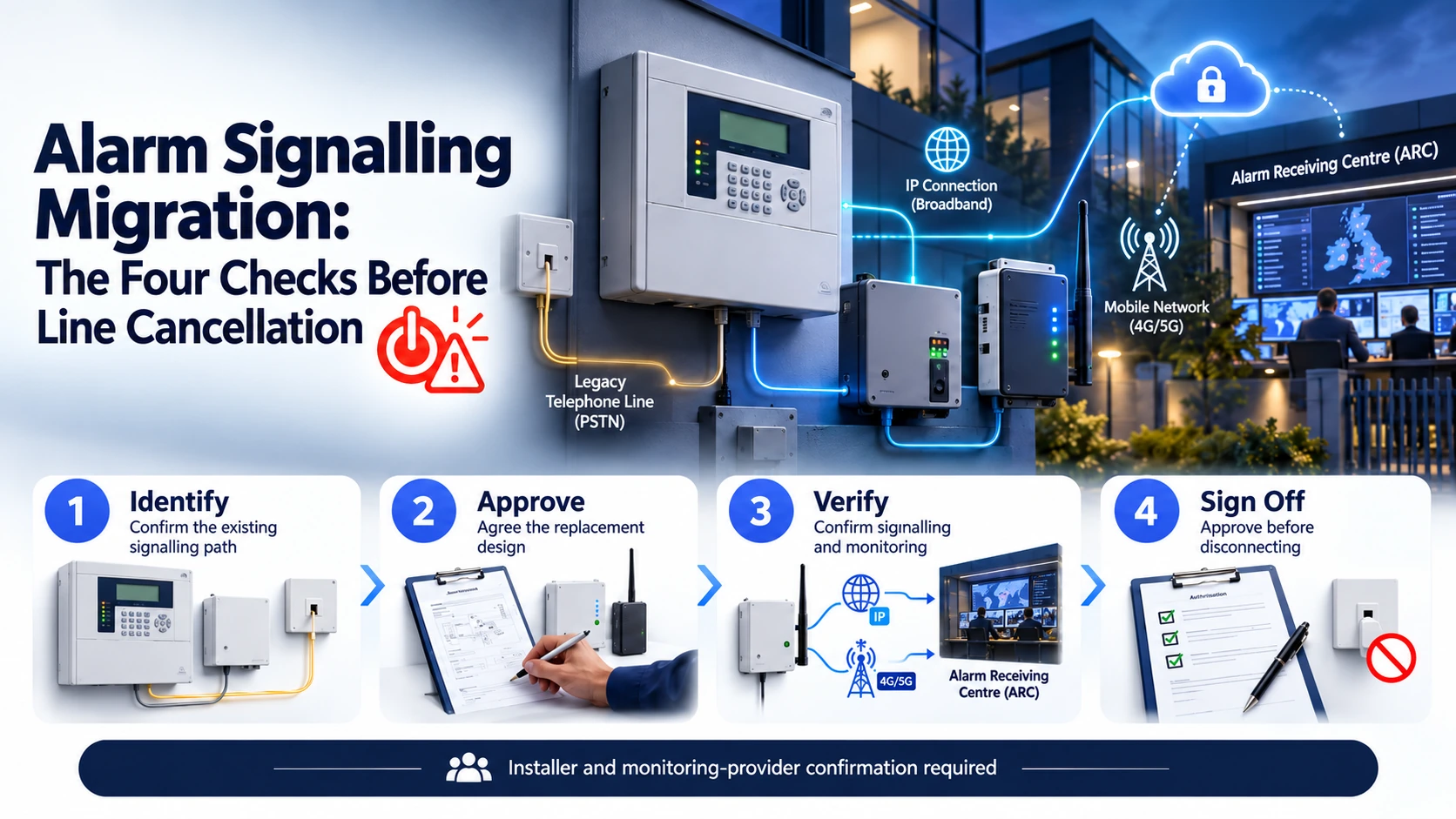
Document the evidence. If a critical item is missing or unresolved, mark the line HOLD and escalate to the responsible specialist.
| Release Evidence | Responsible Party | What to Retain | Initial Status |
|---|---|---|---|
| Current PSTN line and signalling path identified | Installer + telecoms provider | Confirmed circuit and equipment reference | Not Assessed |
| Replacement meets site monitoring specification | Competent installer | Approved design, applicable standards and equipment details | Not Assessed |
| Insurer / responsible person requirements addressed | Business + specialist advisers | Required written authorisations and fire records | Not Assessed |
| Alarm, fault and path-event monitoring verified | Installer + ARC | Commissioning results and dated ARC event confirmation | Not Assessed |
| Power and path-loss resilience considered | Installer + connectivity supplier | Approved test/inspection results and outstanding actions | Not Assessed |
| Maintenance and emergency support ownership confirmed | Business + service providers | Contacts, fault escalation and ongoing service arrangements | Not Assessed |
| Explicit authorisation to cease the old line | Authorised business representative | Dated decision supported by all necessary acceptance evidence | Not Assessed |
Statuses start as “Not Assessed” because no real site has been tested. Copy the headings into your secure change-control documentation; the table does not store entries or issue approval.
Any required signalling, ARC confirmation, insurer approval, fire-safety sign-off or resilience evidence is outstanding; monitoring status is uncertain; or the authorised site owner has not approved the release.
All requirements applicable to that site have been verified, the authorised professionals have confirmed the replacement works, and the person responsible for the site has documented the decision. This guide does not itself authorise a line disconnection.
For a wider business dependency register and handover process, see the published VoIP Migration Planner. Keep alarm access credentials and security-sensitive commissioning records within approved business systems.
What Does an Alarm Signalling Upgrade Cost?
There is no reliable single UK price for every fire or intruder alarm migration. The commercial scope depends on the existing panel and communicator, the monitoring agreement, signalling grade, site connectivity, mobile reception, power resilience and required installation/testing work.
| Cost Element | Quote Question |
|---|---|
| Panel and communicator compatibility | Can the existing panel remain, and exactly which module is being supplied or upgraded? |
| Approved signalling service | Which recurring IP/mobile/dual-path and ARC fees apply, and for what contract term? |
| Network, power and coverage work | Are a coverage survey, router resilience, UPS, cabling or antenna work included? |
| Commissioning and acceptance | Are installer attendance, ARC tests, documentation and stakeholder approvals included? |
| Maintenance and future changes | Who owns faults, out-of-hours support, replacement SIMs, equipment updates and renewal? |
| VAT and exit costs | Does the quote state VAT treatment and any overlapping or early termination charges? |
Request an itemised first-year estimate and separately identify ongoing annual costs. Do not rely on a generic “plug-in digital converter” price without the required professional acceptance.
Frequently Asked Questions About Alarm Systems and the PSTN Switch-Off
Will My Burglar Alarm Stop Working in January 2027?
The local sounder may still work, but a burglar alarm that signals over an analogue telephone connection risks losing remote notification when that connection changes or retires. Your installer and monitoring provider should identify and verify the actual path.
Does Every Alarm System Need Replacing?
No. Some systems need only a compatible communicator or service change, while others may require more extensive work. The installer must assess the existing panel, monitoring contract and site requirements before making that decision.
Can I Plug My Alarm Into My Broadband Router?
Do not assume an analogue router socket is suitable. Voice compatibility does not establish correct alarm signalling, supervision or resilience. Obtain explicit specialist approval and ARC confirmation.
Do Fire Alarms Need Different Checks From Intruder Alarms?
Often, yes. Where fire alarm signals are monitored, the responsible person should involve the competent fire-alarm service and verify applicable fire-safety arrangements and monitoring obligations, not simply accept a general telecoms upgrade.
Is a 4G Alarm Communicator Always Sufficient?
No single technology automatically meets every site’s requirements. Suitability depends on coverage, monitoring service compatibility, fault reporting, power, contractual and insurance conditions, and the approved system design.
Do I Need Dual-Path Alarm Signalling?
The required signalling grade and paths depend on the risk, installation and applicable insurer or monitoring requirements. Dual-path arrangements may provide resilience, but must be correctly specified and independently assessed.
Can I Cancel the Old Telephone Line After One Successful Test?
Not on that fact alone. Obtain all required installer commissioning, ARC acceptance, resilience and stakeholder approvals, plus the authorised business owner’s explicit release decision.
Who Should I Contact First?
Contact the alarm maintenance company or monitoring provider first to identify the signalling arrangement. Then coordinate with the telecoms provider and, where relevant, your insurer and fire-safety responsible person.
Will Openreach’s Temporary Emergency Voice Service Keep Alarm Signalling Working?
Do not plan on it. Openreach describes a limited temporary voice facility for certain connections; it is not confirmation that an alarm communicator or supervised monitoring path will operate correctly.
Sources, Evidence and Editorial Method
This guide combines current UK public-network migration information with primary industry guidance on monitored alarm signalling. It offers an independent planning and evidence-request framework, not a claim of having inspected or tested any premises, nor an installer certification.
- Openreach — PSTN Retirement and Temporary Continuity Information.
- UK Government — Moving Landlines to Digital Technologies.
- British Security Industry Association — Digital Voice and Alarm Migration.
- British Insurance Brokers’ Association — Intruder Alarm and Transmission Guidance.
- Hereford and Worcester Fire and Rescue Service — Business Fire Safety and PSTN.
- Fire Industry Association — PSTN Transition and Alarm Receiving Centres.
- Fire Industry Association — Guide to Changes in BS 5839-1:2025.
Use the latest vendor instructions, contract conditions and competent specialist assessment for any actual site. The published target and licensing details of telecommunications and alarm services may change.
Alarm Line Release Brief
Protect the Alarm Before You Move the Phone Line
Document the signalling dependencies first, ask the qualified alarm provider to confirm a replacement, and coordinate line changes only after monitoring acceptance. Use the migration planner to keep the broader business cutover organised.

Bhav Giva
Founder & Lead Analyst at CompareVoIPService.co.ukBhav Giva publishes independent UK-focused business communications guidance. This article translates the PSTN alarm-signalling transition into practical coordination, evidence and change-control questions. It does not claim alarm installation, live commissioning, monitoring-centre testing or professional fire-safety certification.